67% Of Ethereum Stablecoin Transfers Are P2P, Yet Institutions Dominate Volume

bitcoinistPublished on 2025-12-24Last updated on 2025-12-24

Abstract

A new analysis of Ethereum stablecoin transactions reveals that while peer-to-peer (P2P) transfers dominate in frequency, institutional activity accounts for the vast majority of transaction volume. According to data shared by an Ethereum Foundation member, 67% of USDT and USDC transfers on the Ethereum network from August 2024 to 2025 were P2P, typically associated with retail users. However, these transfers represented only 24% of the total volume. In contrast, business-related transactions—including business-to-business (B2B), internal business moves, and person-to-business (P2B) transfers—made up just 33% of transaction count but a dominant 76% of the volume. The data, sourced from Artemis, focused exclusively on USDT and USDC transfer transactions, excluding mints, burns, or cross-chain transfers. Ethereum remains the leading network for stablecoins, hosting over 50% of the global supply. Meanwhile, ETH’s price briefly recovered above $3,000 before pulling back to around $2,950.

Data shows 67% of Ethereum transactions involving the stablecoins USDT and USDC are P2P in nature, but the majority of volume lies elsewhere.

Business-Related Ethereum Stablecoin Transactions Dominate Volume

In a new post on X, Ethereum Foundation head of ecosystem James has shared some numbers related to stablecoin transactions on the ETH blockchain. Stablecoins refer to cryptocurrencies that have their value pegged to a fiat currency.

As these assets are relatively “stable” by nature, they have quickly established themselves as the preferred mode of payments, with their volume surpassing combined that of the top five non-stablecoin cryptocurrencies.

But what does the nature of these transactions look like? Below is the data posted by James, showcasing how the transfers related to the Ethereum versions of USDT and USDC break down between retail and business payments.
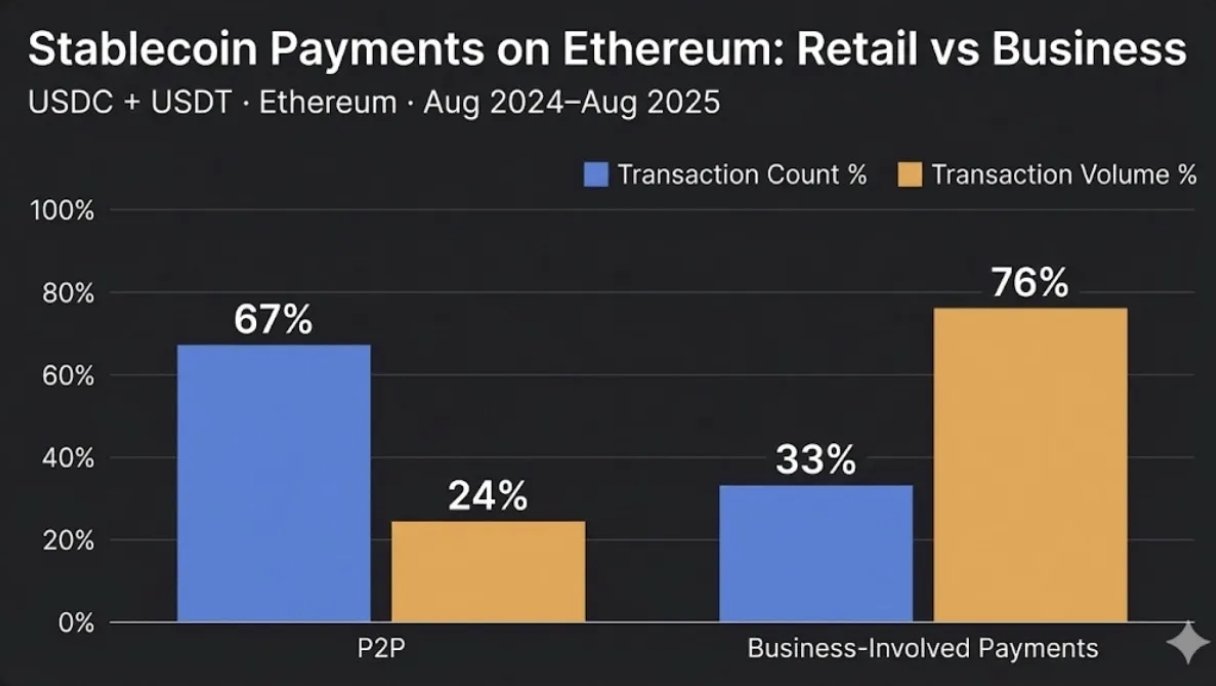
Businesses seem to be dominating in terms of the volume | Source: @Snapcrackle on X

As is visible in the chart, 67% of USDT and USDC transactions on the Ethereum network that occurred between August 2024 and 2025 were of the peer-to-peer (P2P) type. Such transactions are usually a sign of activity from retail users.

The small size of the users being involved could be why the transaction volume share of P2P transfers was just 24%. In contrast, business-involved payments made up for 76% of the volume, despite occupying a transactions share of just 33%.

The Ethereum Foundation member sourced the data from Artemis’ report on Ethereum stablecoin payment usage. While stablecoins pegged to various currencies exist, Artemis focused on the USD-tied USDC and USDT as they are by far the most popular options, occupying 88% of the sector’s market cap.

These coins circulate on several blockchains, but Ethereum is currently the most dominant network, hosting more than 50% of the global stablecoin supply. “We also only focus on transfer transactions and exclude any mint, burn, or bridge transactions from our analysis,” noted the report.

Artemis has broken down how it classifies transactions. Transfers are considered P2P if they occur between the externally owned accounts (EOAs) of two separate users.

Determining whether a transaction is P2P can be tricky, however, given that it’s not always possible to determine whether two accounts are owned by different entities. Problems also arise for wallets owned by exchanges and other centralized entities. “In our dataset we are able to label many institutional and firm EOA wallets; however, the labeling is not perfect and some EOA wallets that are owned by firms and are not documented in our dataset can be mislabeled as individual wallets,” explained the report.

The second category is business-to-business (B2B), naturally consisting of the moves taking place between two institutional EOAs. Transactions between the same institutional entity fall inside the “Internal B” label.

Finally, there is the person-to-business (P2B) category, accounting for the transfers happening between individuals and businesses. James’ chart clubs all the business categories into one.
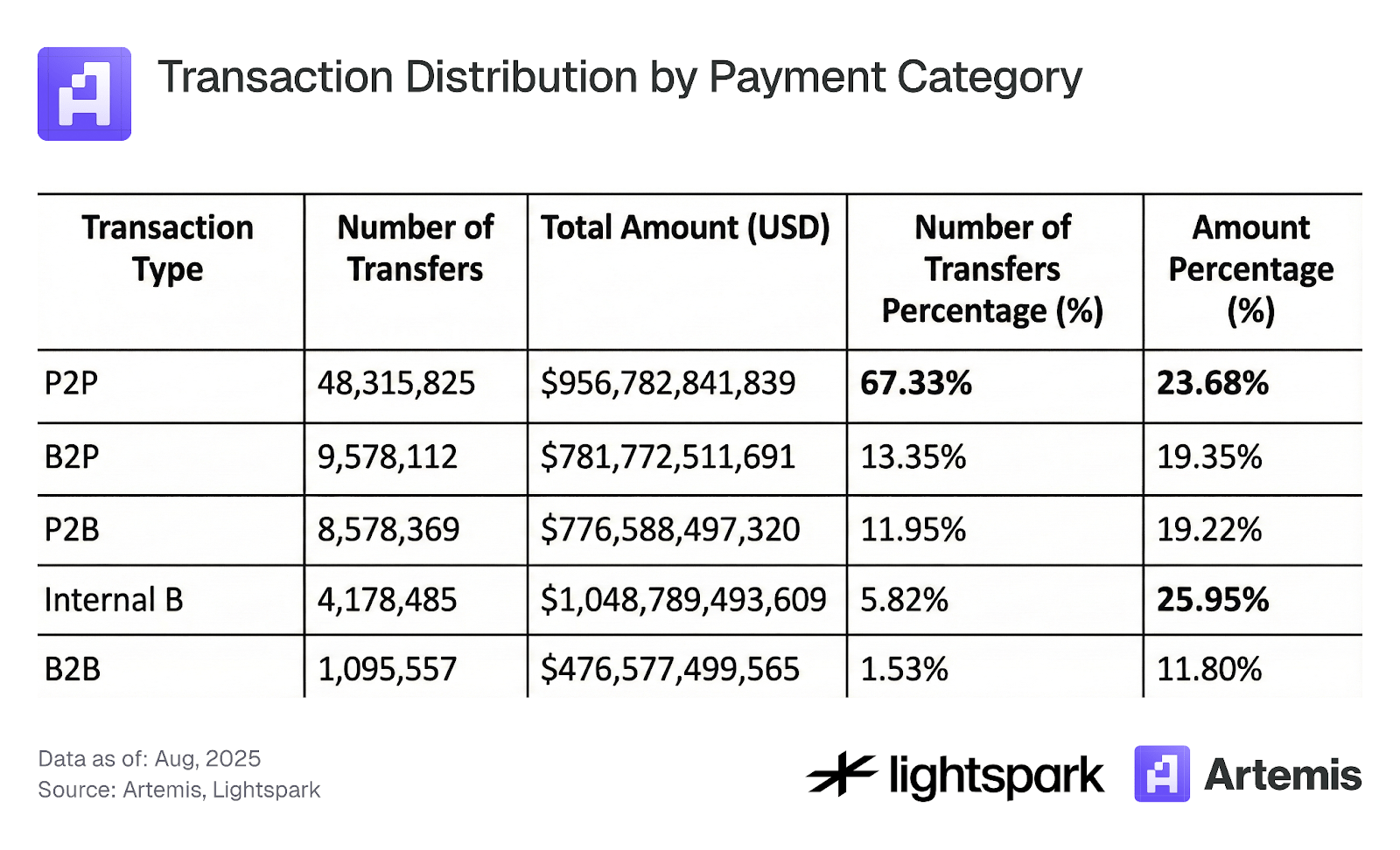
The numbers related to the stablecoin transactions on the Ethereum network | Source: Artemis

ETH Price

Ethereum made recovery above $3,000 earlier, but it seems the coin has once again faced a pullback as its price is now back at $2,950.

The trend in the ETH price over the last five days | Source: ETHUSDT on TradingView


Trending Cryptos

Related Questions

QWhat percentage of Ethereum stablecoin transfers are P2P, and what is their share of the total volume?

A67% of Ethereum stablecoin transfers are P2P, but they account for only 24% of the total volume.

QWhich stablecoins were the focus of the data analysis, and why were they chosen?

AThe analysis focused on USDT and USDC because they are the most popular stablecoins, occupying 88% of the sector's market cap.

QWhat is the main reason P2P transactions have a low volume share despite their high transaction count?

AThe small size of the users involved in P2P transactions is why their volume share is low, as these are typically retail users making smaller transfers.

QHow does the Ethereum network classify a transaction as P2P?

AA transfer is classified as P2P if it occurs between the externally owned accounts (EOAs) of two separate individual users.

QWhat was the price of Ethereum mentioned in the article after it faced a pullback?

AAfter facing a pullback, Ethereum's price was back at $2,950.

Related Reads

The Clarity Act's Journey Through Congress: The Thorny Path of Bipartisan Compromise in the U.S.

The U.S. Congress is struggling to advance the crypto market structure bill known as the Clarity Act, with bipartisan compromise proving difficult. Key hurdles include unresolved disputes over "yield" products and, more critically, the inclusion of strong ethics provisions for elected officials—a non-negotiable demand for many Democrats. While a compromise on yield was reached in May, securing only limited Democratic support in committee, the separate Senate Agriculture Committee version later passed with no Democratic votes due to the ethics impasse. As Republicans push for a full Senate vote in July, demands for ethics rules have expanded, and other contentious issues like developer protections and concerns from law enforcement and large banks further complicate negotiations. Despite consensus on the need for legislation, the path forward is unclear. Recent discussions between senators and White House officials aim to find acceptable ethics language. Some lawmakers question whether a compromise text can garner enough bipartisan support, with one Democrat stating the current proposal lacks the strong ethics provisions required for their vote. Potential short-term goals for the crypto community include symbolic Senate action before the August recess, a longer-term aim for passage by 2026, or establishing a detailed framework that addresses ethics and other compromises. The process remains arduous, relying on the traditional, vote-by-vote effort to build bipartisan support.

marsbit13m ago

The Clarity Act's Journey Through Congress: The Thorny Path of Bipartisan Compromise in the U.S.

marsbit13m ago

Are Kalshi and Polymarket Founders at Odds? This Business Rivalry Is More Brutal Than You Think

"The Rivalry Between Kalshi and Polymarket Founders Turns Bitter and Litigious" The intense feud between Tarek Mansour, CEO of Kalshi, and Shayne Coplan, founder of Polymarket, has escalated far beyond typical business competition into personal animosity and regulatory battles. Both lead billion-dollar prediction market platforms, but their approaches differ sharply. Kalshi positions itself as the compliant operator, securing U.S. regulatory approval before launching. In contrast, Polymarket initially operated offshore, allowing U.S. users to access its platform via VPN, which drew regulatory scrutiny. The conflict reached a peak in November 2024 when FBI agents raided Coplan's New York apartment. While Coplan publicly blamed political motives, his team privately suspected Kalshi was involved. According to sources, Kalshi's lawyers had previously reported Polymarket's operations to federal prosecutors, highlighting its accessibility to U.S. users despite a ban. This incident fueled mutual accusations and underhanded tactics, including social media smear campaigns and attempts to sabotage each other's major business deals. Their rivalry also played out in Washington, influencing regulatory debates. Kalshi actively lobbied against Polymarket's practices, framing them as illegal and unethical. Polymarket, after facing a CFTC fine and investigation, later acquired a licensed U.S. firm to launch a domestic app, regaining a foothold. Despite the hostility, both companies have seen massive growth, with combined trading volumes soaring. However, increased regulatory scrutiny, particularly around insider trading on Polymarket's platform, continues to pose challenges. The founders' deep-seated mutual disdain ensures their battle for market dominance remains as much a personal vendetta as a commercial one.

marsbit22m ago

Are Kalshi and Polymarket Founders at Odds? This Business Rivalry Is More Brutal Than You Think

marsbit22m ago

Trading

Spot

Hot Articles

Discussions

Welcome to the HTX Community. Here, you can stay informed about the latest platform developments and gain access to professional market insights. Users' opinions on the price of ETH (ETH) are presented below.

活动图片