Jamaican central bank to airdrop Jam-Dex CBDC to early adopters

CointelegraphPublished on 2022-03-11Last updated on 2022-03-11

Abstract

The first 100,000 Jamaican citizens to use the country’s new central bank digital currency (CBDC) known as Jam-Dex, will be given a free $16 payment in the hopes of promoting widespread adoption. 

The first 100,000 Jamaican citizens to use the country’s new central bank digital currency (CBDC) known as Jam-Dex, will be given a free $16 payment in the hopes of promoting widespread adoption. 
Jamaican prime minister Andrew Holness first announced the news in a Facebook post on Thursday. The post received a mixed response as some Facebook users praised Holness for “embracing a digital future”, while others expressed concern about the motivations of the Jamaican government, accusing Holness of trying to “bribe” citizens into the federal banking system.
According to the Jamaica Observer, approximately 17% of the Jamaican population is currently unbanked. While social media users postulate about government motives, the Observer points out that remaining unbanked is both costly and time-consuming for poorer Jamaicans. It is hoped that this new payment incentive, among others, will encourage low and middle-income citizens to join the national banking system.
The announcement comes as the Bank of Jamaica (BoJ) officially completed its 8-month long pilot program for Jam-Dex on Dec. 31 last year, and is expected to complete a national rollout as soon as next month. The BoJ further outlined that all Jamaicans with pre-existing bank accounts will be automatically eligible for Jam-Dex digital wallets.
Jamaican Finance Minister Nigel Clarke said in a speech to the country’s House of Representatives on March 9 that Jam-Dex must achieve widespread adoption by citizens and their businesses in order to be successful.
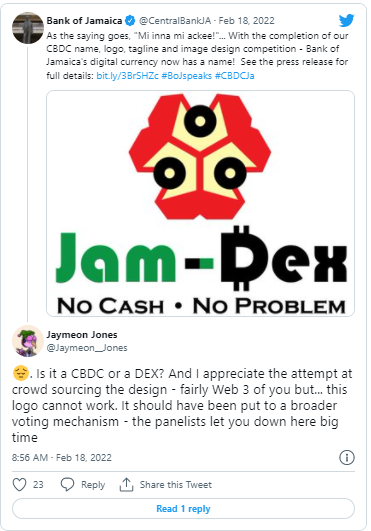
According to the report provided by the BoJ on Feb. 17, the new digital currency will be called Jamaica Digital Exchange or Jam-Dex for short, and comes with its own logo and the following tagline, “no cash, no problem”. The BoJ expects the currency to be launched as soon as next month.
The name “Jam-Dex”, was met with a great deal of criticism for both technical and aesthetic reasons. While the Jam-Dex is potentially making reference to the fact that currencies are “exchanged”, and that it is both “digital” and “Jamaican”, the terminology has created a good deal of confusion for many.
Users on Twitter were quick to point out the obvious misnomer in the currency’s namesake, as Jam-Dex is simply a digital currency whereas “DEX” in crypto parlance refers to a decentralized exchange, a place where cryptocurrencies are bought and sold.
Despite China being one of the first countries to announce the development of its CBDC, the “digital yuan”, countries in the Caribbean have quickly become leaders in the adoption and proliferation of CBDCs — with Eastern Caribbean Central Bank (ECCB) having now rolled out its own CBDC, DCash to eight different member countries.
The adoption of DCash however has been mired after a crash on Jan. 14 saw the central bank-backed digital currency go offline for nearly 2 months. It wasn’t until Mar. 9 that the ECCB announced that DCash was once again fully functional, stating the reason for the crash was an “expiring certificate” on the Hyperledger Fabric that hosts the DCash ledger.
Numerous other countries around the world are beginning to experiment with the implementation of CBDCs, with the Philippines announcing plans to launch Project CBDCPh as recently as Mar. 8. Iran, Kenya, and the European Union are also among the most recent countries to begin looking at introducing some form of CBDC.


Related Reads

A Nation Blocks Chips, a Giant Buys a Nuclear Power Plant: Why It's Time to Seriously Consider DeAI

**Title: Great Powers Blockade Chips, Giants Buy Nuclear Plants: Why It's Time to Seriously Consider DeAI** In May 2026, the US closed loopholes for Chinese firms to acquire advanced NVIDIA chips via overseas subsidiaries. That same month, Kenya halted a $1B geothermal data center project involving Microsoft, fearing its immense energy consumption. Meanwhile, Huawei announced mass production of its Ascend AI chip. These disparate events underscore a new reality: the competition for computing power ("compute") has escalated beyond the tech industry, becoming a geopolitical and infrastructural battleground. A new era of oligopoly is forming, with control over the AI stack—from GPU chips (NVIDIA) and cloud platforms (AWS, Azure, Google Cloud) to foundational models (OpenAI, Anthropic)—concentrating in a few Western "AI Octopus" corporations. This centralization creates systemic risks: pricing power and platform lock-in for users, infrastructure fragility, and a widening "compute divide" that threatens to marginalize nations without independent AI capacity. An "AI Iron Curtain" is deepening through export controls. In response, some nations like Saudi Arabia and the UAE are investing heavily to buy compute power, aiming to transition from oil to AI economies. The EU seeks to triple its compute capacity by 2030 to reduce dependency. However, the spending gap is vast, with four US tech giants alone planning ~$750B in AI capex for 2026. The race is increasingly constrained by energy, with AI tasks consuming up to 1000x more power than web searches, pushing firms to even acquire nuclear plants. This landscape is fueling interest in Decentralized AI (DeAI). It proposes a third way: using open protocols to coordinate a global network of idle GPUs, independent developers, and data centers, creating an AI infrastructure without a single controlling entity. Leveraging blockchain and cryptographic verification, DeAI aims to break market concentration, disperse energy demands, reduce geopolitical dependencies, and enhance transparency. While still nascent in performance and stability, DeAI's core promise is not immediate superiority but providing a crucial alternative architecture to resist monopoly, censorship, and centralized power. As specialized AI hardware costs fall and open-source models flourish, the window to build this foundation is open. The very existence of such competition serves as a vital check against the inevitable abuse of concentrated power.

marsbit53m ago

A Nation Blocks Chips, a Giant Buys a Nuclear Power Plant: Why It's Time to Seriously Consider DeAI

marsbit53m ago

Outpoll Review: A Prediction Market Platform Built for Active Traders

Outpoll Review: A Prediction Market Platform Built for Active Traders In recent years, prediction markets have grown from a niche sector to a mainstream arena, attracting billions in trading volume and institutional capital. However, the user experience and tools for traders have not kept pace. Outpoll, a new global prediction market platform, aims to fill this gap by providing enhanced trading infrastructure for active and professional traders. Built on standard prediction market principles, Outpoll allows users to trade on the outcome of specific events. It uses fully collateralized contracts with USDC settlement, charges a competitive 0.1% fee per trade, and provides clear settlement rules upfront to minimize disputes. A key focus for Outpoll is its professional-grade trading tools. The platform supports limit and market orders, as well as take-profit and stop-loss orders for open positions—features uncommon in prediction markets. For automated trading, Outpoll offers comprehensive REST and WebSocket APIs, enabling portfolio management, price arbitrage, and integration with existing tools. The platform also features a creator-led market model, where approved experts and community leaders can create and manage markets for niche topics under platform supervision. Its integrated interface combines news feeds directly with trading functions, allowing users to monitor events and manage positions seamlessly. Outpoll launched with a native Android app (available on Google Play) and plans an iOS version later this year. In summary, Outpoll distinguishes itself with trader-focused tools, practical APIs, transparent and collateralized markets, integrated news, and an expanding creator program. For active traders, its advanced order types and API access alone make it a platform worth watching. Outpoll is now globally accessible via outpoll.com and Google Play.

marsbit1h ago

Outpoll Review: A Prediction Market Platform Built for Active Traders

marsbit1h ago

Bitwise: Crypto Becomes a Contrarian Investment, Three Logics to Understand the Current Market

**Summary** Matt Hougan, Bitwise's CIO, analyzes the current crypto market through three key lenses, arguing it has shifted from a momentum-driven to a contrarian investment. **1) Crypto Becomes a Contrarian Play:** The market is weak, with major assets like Bitcoin and Ethereum down significantly. Capital has moved to hot sectors like AI, leaving crypto as an "unloved" asset class. This transforms crypto investing from trend-following to a test of patience and fundamental analysis. Investors now favor projects with solid fundamentals (e.g., Hyperliquid) over speculative ones. **2) Regulatory Overhang:** The uncertain fate of the U.S. CLARITY Act, a major crypto regulatory framework, is a key headwind. With its passage in 2024 seen as far from guaranteed (estimates range from 30-55%), institutional capital remains on the sidelines, choosing less risky alternatives like AI stocks. The market needs clarity—whether the bill passes or fails—more than any specific outcome to move decisively. **3) Capital Rotates to New Fundamentals:** This cycle differs from past bear markets where money fled to Bitcoin. Now, capital seeks smaller assets with strong use cases. While major cryptos fell in May 2024, tokens like Hyperliquid (+72%), Zcash (+50%), and XLM (+44%) rallied on their specific fundamentals. This rotation confirms the new contrarian, fundamentals-driven logic and signals the bear market may be in its later stages. **Conclusion:** Short-term pressure persists due to regulatory uncertainty and competition from AI narratives. Investing in crypto now requires a contrarian mindset—acting against the crowd and focusing on fundamental value. Patience and targeting high-quality projects based on their merits are essential for capturing long-term gains.

marsbit1h ago

Bitwise: Crypto Becomes a Contrarian Investment, Three Logics to Understand the Current Market

marsbit1h ago

Trading

Spot
Futures

Hot Articles

How to Buy SNT

Welcome to HTX.com! We've made purchasing Status Network Token (SNT) simple and convenient. Follow our step-by-step guide to embark on your crypto journey.Step 1: Create Your HTX AccountUse your email or phone number to sign up for a free account on HTX. Experience a hassle-free registration journey and unlock all features.Get My AccountStep 2: Go to Buy Crypto and Choose Your Payment MethodCredit/Debit Card: Use your Visa or Mastercard to buy Status Network Token (SNT) instantly.Balance: Use funds from your HTX account balance to trade seamlessly.Third Parties: We've added popular payment methods such as Google Pay and Apple Pay to enhance convenience.P2P: Trade directly with other users on HTX.Over-the-Counter (OTC): We offer tailor-made services and competitive exchange rates for traders.Step 3: Store Your Status Network Token (SNT)After purchasing your Status Network Token (SNT), store it in your HTX account. Alternatively, you can send it elsewhere via blockchain transfer or use it to trade other cryptocurrencies.Step 4: Trade Status Network Token (SNT)Easily trade Status Network Token (SNT) on HTX's spot market. Simply access your account, select your trading pair, execute your trades, and monitor in real-time. We offer a user-friendly experience for both beginners and seasoned traders.

1.7k Total ViewsPublished 2024.03.29Updated 2026.06.02

How to Buy SNT

Discussions

Welcome to the HTX Community. Here, you can stay informed about the latest platform developments and gain access to professional market insights. Users' opinions on the price of SNT (SNT) are presented below.

活动图片