$50 Million Gone with One 'Confirmation'! The Most Expensive Slip in DeFi History is Born

比推Published on 2026-03-13Last updated on 2026-03-13

Abstract

An anonymous crypto "whale" accidentally lost nearly $50 million in what is being called DeFi's most expensive "fat-finger" error. The user attempted to swap 50.43 million USDT for AAVE tokens via the Aave mobile app interface. Due to extremely low liquidity for AAVE tokens, the massive trade caused catastrophic slippage of over 99%, resulting in the user receiving only 324 AAVE (worth ~$36,000) instead of the intended amount. Aave's founder Stani Kulechov confirmed the user manually confirmed a risk warning checkbox on the high-slippage transaction before proceeding. The protocol functioned as designed, but the incident sparked intense debate: some argue users bear full responsibility in DeFi, while others criticize the UI/UX for inadequate safeguards for such large transactions. The wallet has been linked by analysts to a Bitcoin whale address holding ~80,000 BTC, suggesting the user may be a wealthy early adopter. Aave has pledged to refund the $600,000 in fees from the trade and improve safety measures like stricter slippage limits. The event highlights critical DeFi challenges: amplified risk from user errors, urgent need for better UX safeguards, MEV exploitation, and user education gaps.

Last night, an incident dubbed the "most absurd fat-finger error in DeFi history" exploded across the crypto community.

The protagonist of the story is an anonymous "whale." Through the app interface of the DeFi lending protocol Aave, he initiated a seemingly simple transaction: exchanging a whopping $50.43 million USDT stablecoin for AAVE tokens.

How large was this transaction? Large enough to instantly "dry up" the liquidity for the vast majority of tokens on the market. Due to the inherently limited trading depth of AAVE tokens, such a massive buy order directly triggered a disastrous slippage. Simply put, slippage is the deviation between the price you expect to trade at and the price you actually get. In this transaction, the slippage was over 99%.

Transaction link: https://etherscan.io/tx/0x9fa9feab3c1989a33424728c23e6de07a40a26a98ff7ff5139f3492ce430801f

What does this mean? When this transaction was finally executed through on-chain routers like CoW Swap, this user received only 324 AAVE tokens, worth about $36,000 at the market price at the time.
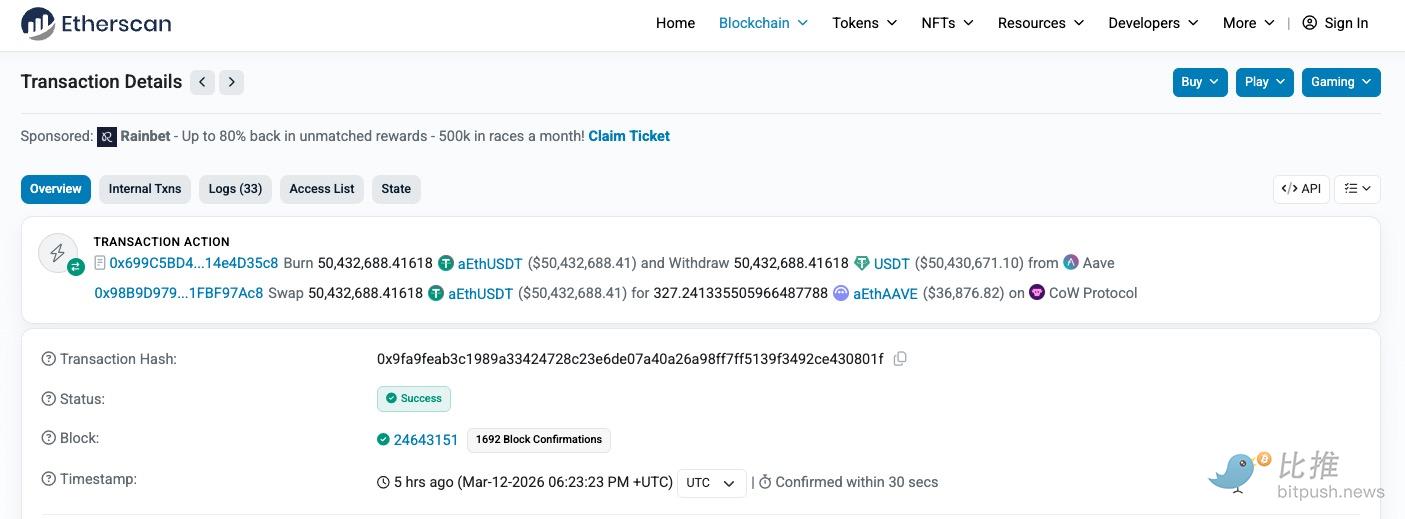
$50.43 million vs. $36,000. One transaction, nearly $50 million evaporated in an instant.

Aave's founder, Stani Kulechov, later explained the incident on social media.
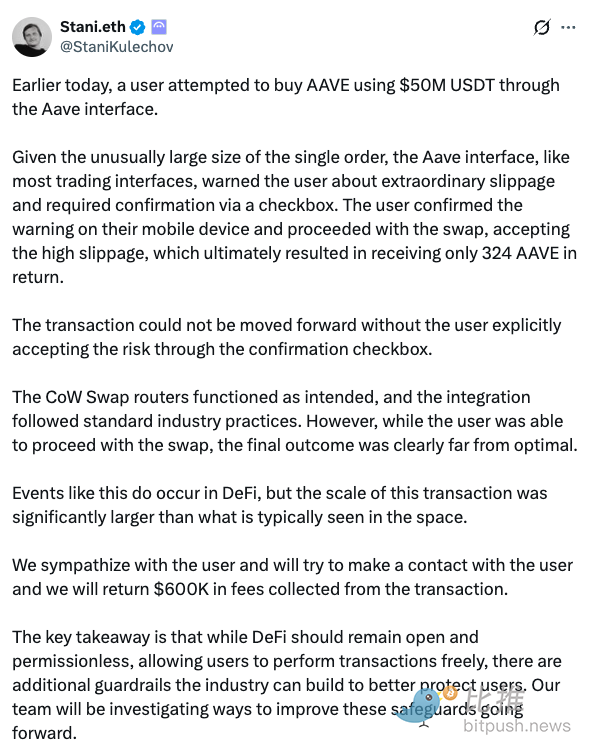
According to his description, the user completed the operation on Aave's mobile app. When the system detected the extreme slippage this massive transaction could cause, the interface popped up a risk warning and required the user to check a confirmation box to indicate they were aware of the risks. On their phone, the user checked that small box and then clicked confirm.
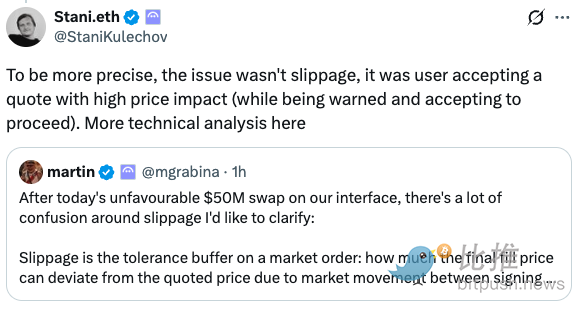
He stated that all procedures were standard and the protocol itself was functioning normally.

The event shocked the entire crypto community, combining elements of the "absurd":

1. Scale: $50 million, even in the crypto world frequented by institutions, is a huge sum of money that many would look up to.

2. Mobile operation, how bold? This was one of the most heated points of discussion in the community. A comment from one netizen received many likes: "Who keeps $50 million on their phone???"

3. Checkbox too 'makeshift'?: The most ironic part of the whole event was that decisive "checkbox." In traditional finance, a multi-million dollar transaction requires layers of approval, multiple reviews, and phone confirmations. In decentralized DeFi, the entire firewall is simplified into a checkbox that can be passed with a simple tap. The community mocked this as the "DeFi version of 'I have read and agree to the terms and conditions'."

The owner of address 0x98b sparked community speculation. Through on-chain tracing, analyst Specter believes this wallet is likely related to the 1011 insider whale Garrett Jin.
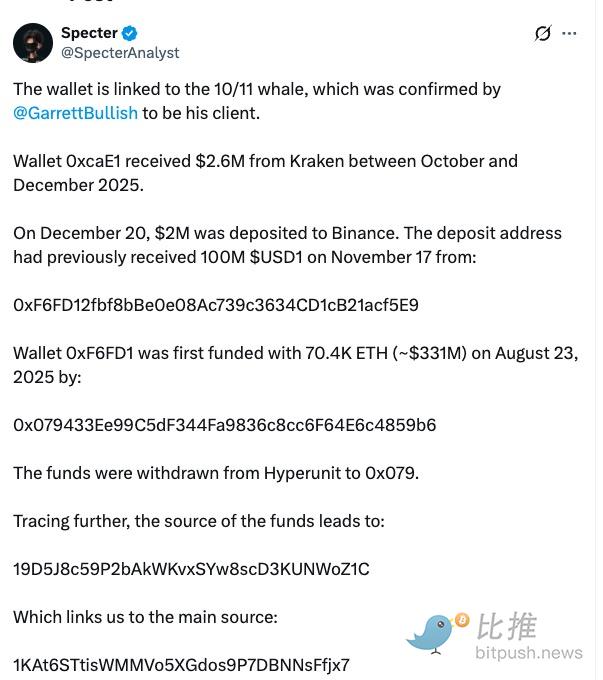
The analyst pointed out that fund flow shows the wallet received about $2.6M from Kraken (Oct-Dec 2025) and was traced back to the Bitcoin address 1KAt6STtisWMMVo5XGdos9P7DBNNsFfjx7—a famous Bitcoin cold wallet holding about 80,000 BTC (worth billions of dollars), often associated with early Bitcoin miners or institutional investors. The community speculates that this "whale" might be a Bitcoin millionaire diversifying into Ethereum, but a operational error led to huge losses.

Of course, there are also conspiracy theorists怀疑ing if this is some form of "money laundering"? But it's just speculation for now, without any solid evidence.

Blame the User, or Blame the Protocol?

The event quickly split into two main camps on social media:

One view holds that the user must be responsible for their own actions. The core spirit of DeFi is "not your keys, not your coins"; you control your assets, so you must pay for every operation you make. In a permissionless financial system, you can't expect someone to save you when you make a mistake.

More people pointed the finger at Aave's interface design. They argued that a UI that uses merely a checkbox to prevent a $50 million loss is itself a failure. Some developers suggested that for such extreme, obviously unreasonable transactions, the interface should impose more "aggressive" friction, such as forcing the user to type a specific phrase like "I confirm I will lose 99.9% of my funds" to proceed, or directly setting an insurmountable slippage上限.

The core of this debate actually touches on the biggest paradox DeFi currently faces: how to provide users with sufficient safety protections while adhering to the core principles of decentralization and permissionlessness?

Aave's team reacted quite quickly. Founder Stani promised to refund the approximately $600,000 in fees collected from this transaction to the victim. More importantly, they announced they would review and improve related protective measures, such as optimizing UI/UX design and setting stricter slippage上限s, to prevent similar tragedies from happening again.

What Does This Incident Leave Us With?

This $50 million "slip" incident, although an extreme case, once again highlights the deep-seated worries of DeFi:

1. DeFi's Risk Amplification Effect: Automation, permissionlessness, and composability—the magic of DeFi—also amplify any tiny user error. One "slip," and the cost could be losing everything.

2. Urgency of UI/UX Optimization: For DeFi to go mainstream, user experience and safety protections must be improved. How to introduce more "smart guardrails" while maintaining the spirit of decentralization, such as multiple confirmations for large transactions, AI-assisted risk assessment, etc., is a topic every protocol needs to consider.

3. Challenges of MEV and Ethereum's Mechanism: The loss being extracted by MEV highlights the "law of the jungle" on the blockchain. This might accelerate the migration to fairer mechanisms, like PBS optimizations or Layer 2 solutions.

4. Lack of User Education: Many users may not fully understand professional concepts like "slippage" and "liquidity depth." If a whale can make such a mistake, let alone the average retail investor? The entire industry needs to invest more resources to help users build necessary risk awareness.

After all, the price of such a "slip" is just too expensive.


Twitter:https://twitter.com/BitpushNewsCN

Bitpush TG Discussion Group:https://t.me/BitPushCommunity

Bitpush TG Subscription: https://t.me/bitpush

Original link:https://www.bitpush.news/articles/7619291

Trending Cryptos

Related Questions

QWhat was the main cause of the user losing nearly $50 million in the DeFi transaction?

AThe user lost nearly $50 million due to extreme slippage of over 99% caused by attempting to swap a massive amount of 50.43 million USDT for AAVE tokens, which had limited liquidity to handle such a large order.

QHow did the Aave interface attempt to warn the user about the risks of this transaction?

AThe Aave interface detected the extreme slippage risk and displayed a warning popup with a checkbox that the user had to manually select to confirm they understood the risks before proceeding.

QWhat was the community's reaction regarding the use of a simple checkbox for such a large transaction?

AThe community criticized the UI design, calling it a 'DeFi version of 'I have read and agree to the terms'' and argued that a simple checkbox was insufficient protection for a $50 million transaction, suggesting more aggressive safeguards like mandatory phrase confirmation or hard slippage limits.

QWho is suspected to be the owner of the wallet (0x98b) that initiated this transaction, according to on-chain analysts?

AOn-chain analysts, like Specter, suspect the wallet is likely associated with Garrett Jin, an insider whale, with funds traced back to a famous Bitcoin cold wallet holding around 80,000 BTC, potentially belonging to an early Bitcoin miner or institutional investor.

QWhat actions did Aave's founder take in response to this incident?

AAave's founder, Stani Kulechov, promised to refund the approximately $600,000 in protocol fees collected from the transaction to the victim and announced plans to review and improve protective measures, such as optimizing UI/UX design and implementing stricter slippage limits.

Related Reads

Wall Street Morning News: V-shaped Rebound at Month-end, but Nasdaq Suffers Worst July in 12 Years; Funds Accelerate Concentration Towards Cloud Giants

Despite a V-shaped rebound at the end of July, the Nasdaq posted its worst July since 2004, while the S&P 500 had its worst July since 2014. Markets were jolted by geopolitical shifts, as President Trump canceled a planned strike on Iran, leading WTI crude to plunge over 8%. This, alongside OPEC+ announcing a supply increase, reversed crude's sharp July gains. Treasury yields surged, with the 10-year yield rising over 30 basis points in July—its largest July increase since 2005. In a rare move, the US and Japan jointly intervened to weaken the USD/JPY, aiming to prevent potential Japanese sales of US Treasuries. While the tech sector faced deleveraging pressure throughout July, cloud giants staged a massive rally on strong earnings. Microsoft, Amazon, and Google collectively added nearly $1.5 trillion in market value last week. Amazon soared over 15% on accelerating AWS growth, Microsoft extended historic gains, Google fully recovered post-earnings losses, and Meta ended an 11-day losing streak. In contrast, Apple tumbled over 7% on supply chain and guidance concerns, ceding its "world's most valuable company" title to Nvidia. The memory and storage sector corrected sharply. Gold edged up 0.91% in July, with analysts viewing the ~30% pullback from January highs as a potential basing period, supported by long-term central bank demand. Key events to watch this week include earnings from Palantir, AMD, SpaceX (its first post-IPO report), and memory giants like Western Digital. The US July non-farm payrolls report on Friday will be critical for gauging the Fed's policy path. SpaceX also faces a significant lock-up expiration, testing market liquidity.

marsbit36m ago

Wall Street Morning News: V-shaped Rebound at Month-end, but Nasdaq Suffers Worst July in 12 Years; Funds Accelerate Concentration Towards Cloud Giants

marsbit36m ago

Rubin Ultra Makes Major Cuts, Even Nvidia Can't Handle Memory Price Hikes?

NVIDIA's Rubin Ultra, the top-tier variant of the newly announced Rubin AI accelerators, has reportedly seen significant specification downgrades, according to an industry report from SemiAnalysis. Initially designed with four compute dies (4-die), the Rubin Ultra is now said to be reduced to a 2-die design. Key changes highlighted in the report include: * **No increase in peak theoretical compute performance**, remaining at 35 PFLOPs like the standard Rubin. * **Severe reduction in memory capacity** to 192GB using 8-Hi HBM stacks, which is less than the standard Rubin's 288GB using 12-Hi stacks. * **Negligible memory bandwidth improvement** of only 1 TB/s. * **Slightly higher chip-level power consumption**. * The **primary upgrade is a massive increase in scale-up interconnect capacity**, supporting connections for up to 576 GPUs via NVLink, compared to 72 for the standard Rubin. The report suggests the redesign is primarily a cost-optimization move driven by the sharp rise in HBM (High-Bandwidth Memory) prices. By reducing the expensive HBM content and shifting investment towards enhanced system-scale networking, NVIDIA aims to maintain the platform's value for large-scale AI training clusters while managing soaring material costs. The news reportedly triggered a sell-off in South Korean memory stocks, with SK Hynix and Samsung shares falling around 8%, as markets grew concerned that NVIDIA—a major HBM buyer—might be reducing its reliance on high-capacity memory, potentially capping future pricing power for memory makers.

Odaily星球日报57m ago

Rubin Ultra Makes Major Cuts, Even Nvidia Can't Handle Memory Price Hikes?

Odaily星球日报57m ago

Can Generative Models Finally Be Trained End-to-End? The Core Is a For Loop

This article introduces a novel training paradigm for generative models called Explorative Modeling (XM), which enables true end-to-end training. Traditionally, powerful generative models like autoregressive and diffusion models are not trained end-to-end. They are trained to predict a single small step but require iterative multi-step sampling for inference. This "exposure bias" leads to error accumulation and limits performance. The core challenge XM addresses is "mode blurring." In generative tasks, a single input (e.g., "generate a dog") corresponds to many valid outputs (multiple modes). Standard training objectives like reconstruction loss force the model to average these modes, producing unrealistic, blurry outputs. To avoid this, existing models break generation into many small, almost deterministic steps, sacrificing end-to-end training. XM tackles this by restructuring the training loop itself. Its key insight is to amplify "generative expressivity." For each training input, instead of generating one sample, the model generates K candidate outputs. Only the candidate closest to the real data is used for computing the loss and updating the model via backpropagation. This simple "best-of-K" mechanism is implemented as a short for-loop. By exploring multiple possibilities, the model learns to distribute its guesses across different modes rather than collapsing to their uninformative average. The paper demonstrates that "exploration" acts as a new, powerful scaling axis. Gains from XM increase with model size, data scale, and compute. Experiments show improvements in FID scores for image generation and significant efficiency gains, sometimes outperforming larger models without exploration. When pushed to the limit, XM enables fully single-step, end-to-end generative models. In robotics tasks, an "Explorative Policy" matched the performance of a 100-step Diffusion Policy with a single forward pass, drastically improving inference speed. While the best-of-K concept is not entirely new, the authors' contribution lies in formally understanding it as a direct method to boost generative expressivity without fragmenting the generation process. This work suggests that as models scale, enhancing exploration during training may become crucial for overcoming fundamental performance bottlenecks.

marsbit1h ago

Can Generative Models Finally Be Trained End-to-End? The Core Is a For Loop

marsbit1h ago

Trading

Spot

Hot Articles

How to Buy ONE

Welcome to HTX.com! We've made purchasing Harmony (ONE) simple and convenient. Follow our step-by-step guide to embark on your crypto journey.Step 1: Create Your HTX AccountUse your email or phone number to sign up for a free account on HTX. Experience a hassle-free registration journey and unlock all features.Get My AccountStep 2: Go to Buy Crypto and Choose Your Payment MethodCredit/Debit Card: Use your Visa or Mastercard to buy Harmony (ONE) instantly.Balance: Use funds from your HTX account balance to trade seamlessly.Third Parties: We've added popular payment methods such as Google Pay and Apple Pay to enhance convenience.P2P: Trade directly with other users on HTX.Over-the-Counter (OTC): We offer tailor-made services and competitive exchange rates for traders.Step 3: Store Your Harmony (ONE)After purchasing your Harmony (ONE), store it in your HTX account. Alternatively, you can send it elsewhere via blockchain transfer or use it to trade other cryptocurrencies.Step 4: Trade Harmony (ONE)Easily trade Harmony (ONE) on HTX's spot market. Simply access your account, select your trading pair, execute your trades, and monitor in real-time. We offer a user-friendly experience for both beginners and seasoned traders.

4.7k Total ViewsPublished 2024.03.29Updated 2026.06.02

How to Buy ONE

Discussions

Welcome to the HTX Community. Here, you can stay informed about the latest platform developments and gain access to professional market insights. Users' opinions on the price of ONE (ONE) are presented below.

活动图片