HIP-3 à un tournant : après que Trade.XYZ ait avalé 90 % du marché, plusieurs acteurs quittent la scène

marsbitPublished on 2026-06-16Last updated on 2026-06-16

Abstract

Hyperliquid connaît une transformation majeure avec l’écosystème HIP-3, qui permet la création de marchés décentralisés. Depuis son lancement, HIP-3 a généré plus de 3000 milliards de dollars de volume d'échanges, mais le marché est dominé par Trade.XYZ, captant plus de 90% des parts. Ce quasi-monopole a conduit à la fermeture de plusieurs projets comme Felix et Ventuals, qui ne parvenaient pas à rivaliser face à la liquidité et aux effets de réseau de Trade.XYZ. Les nouveaux entrants font face à des obstacles financiers élevés, notamment un dépôt de garantie de 50 millions de HYPE (environ 35,89 millions de dollars), et des périodes de retour sur investissement pouvant atteindre quatre ans. En revanche, Trade.XYZ bénéficie d'une rentabilité bien supérieure, avec un délai de récupération de seulement cinq mois. Cette concentration pose des risques pour la diversité et l'innovation au sein de l'écosystème HIP-3. Des propositions ont été avancées pour assouplir les conditions d'entrée, comme un mécanisme d'échanges hiérarchisés ou une révision du modèle économique des enchères de marché, afin de favoriser un environnement plus ouvert et compétitif. Hyperliquid explore également de nouvelles pistes, comme les marchés de prédiction via HIP-4, pour diversifier ses activités au-delà des contrats perpétuels et construire un écosystème plus résilient.

Auteur : Nancy, PANews

La guerre de Hyperliquid « s'étend » à Wall Street, et les dynamiques internes à l'écosystème s'accélèrent et se polarisent.

Grâce aux capacités de déploiement de marchés sans permission apportées par le HIP-3, ainsi qu'à l'enrichissement constant des types d'actifs échangés, Hyperliquid a rapidement percé cette année, devenant le nouveau terrain de jeu des « weekend warriors ».

Alors que la taille du marché du HIP-3 se développe à grande vitesse, son écosystème traverse une consolidation brutale. Trade.XYZ, profitant de son avantage du premier arrivant, monopolise quasiment le marché, détenant plus de 90 % des parts. L'espace vital des autres projets de l'écosystème est quant à lui constamment comprimé, plusieurs projets dont Feilx et Ventuals ayant déjà annoncé successivement leur fermeture.

Le HIP-3 engrange plus de 3000 milliards de dollars de volume, Trade.XYZ monopolise 90% du marché

L'essor du HIP-3 a ouvert une nouvelle courbe de croissance pour Hyperliquid.

Les données du tableau de bord Hyperscreener montrent que sur les 24 dernières heures, le volume total de transactions Perp sur Hyperliquid a atteint 8,77 milliards de dollars, dont environ 3,5 milliards de dollars provenaient du marché HIP-3, soit 39,9 % du volume total. En d'autres termes, pour environ 10 dollars de volume généré sur les contrats perpétuels d'Hyperliquid, près de 4 dollars proviennent du HIP-3.

De fait, depuis son lancement en octobre dernier, le volume cumulé du HIP-3 a dépassé les 3198 milliards de dollars en un peu plus de six mois, une croissance bien plus rapide que prévu par le marché. Cependant, ce qui s'est étendu en parallèle de l'échelle des transactions n'est pas un écosystème florissant, mais un effet de tête de plus en plus prononcé, Trade.XYZ s'étant quasiment approprié tout le gâteau de croissance du marché.

En regardant l'encours ouvert, les données d'Hyperscreener montrent qu'au 16 juin, l'encours ouvert cumulé du marché HIP-3 s'élevait à environ 29,4 milliards de dollars, dont seulement Trade.XYZ en a contribué 28,7 milliards, soit une part de marché de 97,6 %. En comparaison, DreamCash, HyENA, Ventuals, Felix et autres projets représentaient pour la plupart moins de 1 %, quasiment négligeables.
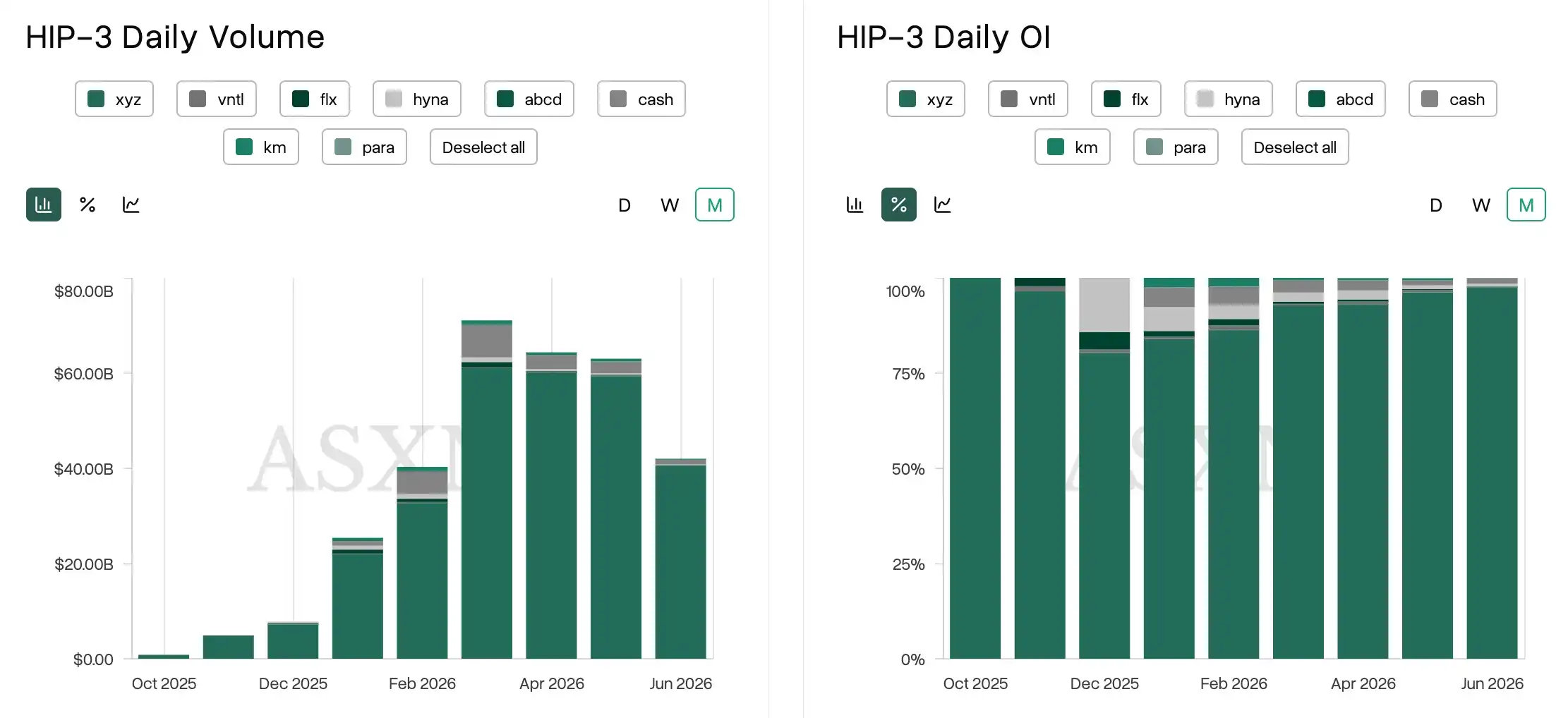
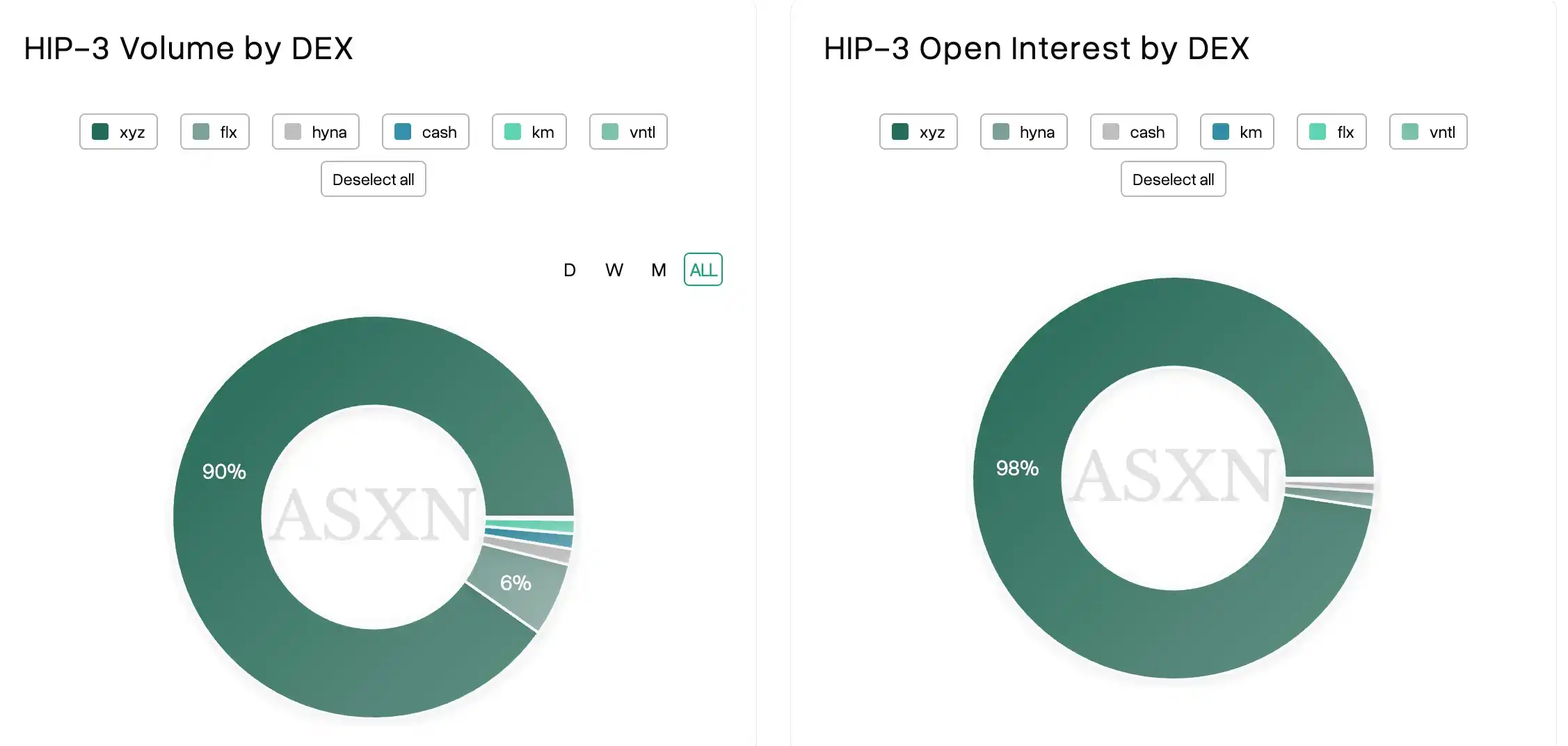
La dimension du volume de transactions confirme également cette tendance. En regardant le volume cumulé historique, Trade.XYZ détient fermement environ 90 % des parts de marché, DreamCash arrive en deuxième position avec environ 6 %, et les autres projets se disputent moins de 5 % de l'espace. Rien qu'en juin, l'effet de tête s'est encore accentué, la part de marché de Trade.XYZ grimpant à 96,65 %, tandis que Felix Exchange, Ventuals, HyENA et les 7 autres marchés restants ne représentaient ensemble que 3,35 %, certains projets atteignant même moins de 0,1 %.

En regardant plus en détail l'activité de trading des actifs, cet écart est encore plus frappant. Ce mois-ci, le volume cumulé de tous les actifs sur le HIP-3 a atteint 11,21 milliards de dollars, dont seulement le produit phare XYZ100 de Trade.XYZ (un indice suivant les 100 premières entreprises) a contribué à hauteur de 10,64 milliards de dollars. Un seul actif soutient presque à lui seul la majeure partie de l'activité de trading sur le marché HIP-3.
La polarisation de l'activité des utilisateurs est également très nette. Les données montrent que ce mois-ci, Trade.XYZ a attiré plus de 46 000 adresses de trading uniques, tandis que les traders uniques des autres marchés se comptent pour la plupart en centaines, certains même en dessous de la centaine. En termes de fréquence de trading, Trade.XYZ a enregistré ce mois-ci plus de 22,03 millions de transactions cumulées, tandis que la plupart des autres marchés n'en comptent que quelques dizaines de milliers à une centaine de milliers, un écart abyssal avec la plateforme leader.

D'une certaine manière, à ce stade, l'histoire de croissance du HIP-3 est presque celle de Trade.XYZ seul.

Le HIP-3 entre en phase d'élimination, les projets de l'écosystème quittent la scène

Alors que Trade.XYZ aspire constamment la liquidité du marché, le HIP-3 passe d'une arène d'innovation ouverte à une compétition d'élimination dominée par les acteurs majeurs, où les nouveaux venus ont de plus en plus de mal à obtenir leur part.

Récemment, plusieurs projets HIP-3 ont progressivement fermé. La semaine dernière, Charlie, cofondateur du protocole de prêt Felix sur Hyperliquid, a annoncé dans un post que le DEX HIP-3 de Felix et tous ses marchés au comptant commenceraient à fermer le 19 juin, avec une mise hors ligne complète prévue pour le 20 juin, tous les traders devant fermer leurs positions avant cette date. Cet ajustement n'affectera pas les activités de prêt et d'actions au comptant de Felix, qui se concentrera à l'avenir sur ses produits cœur de métier. Après avoir trouvé de nouvelles voies de croissance utilisateur, l'équipe ne ferme pas la porte à un retour en tant que déployeur HIP-3.

Dans sa rétrospective, Charlie a reconnu que bien que Felix ait généré environ 3 milliards de dollars de volume cumulé et des revenus de frais non négligeables grâce à son avantage du premier arrivant sur des marchés comme le pétrole brut, l'or et l'argent, sa part de marché a été progressivement dépassée après que Trade.XYZ ait lancé des marchés similaires libellés en USDC.

À ses yeux, la capacité de Trade.XYZ à construire rapidement une barrière défensive repose sur des choix clés : l'utilisation de l'USDC, plus liquide, plutôt que de l'USDH, la saisie de la fenêtre de lancement du HIP-3, l'expansion rapide du nombre de marchés, ainsi que l'effet de marque et la boucle de rétroaction positive de liquidité apportés par l'attente d'un airdrop. Avec la disparition progressive de l'USDH, maintenir un déploiement HIP-3 devenait difficile pour se différencier, poussant l'équipe à réduire ces activités.

Felix n'est pas un cas isolé. Peu après, Ventuals, l'un des plus grands acteurs proposant des transactions sur actions de sociétés privées sur Hyperliquid, a également annoncé qu'il cesserait progressivement ses opérations, l'équipe rejoignant une autre équipe de construction au sein de l'écosystème Hyperliquid. La plateforme fermera progressivement les marchés OpenAI, Anthropic, ainsi que ceux des matières premières et des indices. Les détenteurs de vHYPE pourront échanger leurs tokens au ratio 1:1 contre des HYPE et percevoir leurs récompenses de staking. Ventuals met également fin à ses programmes de points et de parrainage, et confirme qu'il n'émettra pas de token.

Ventuals a révélé avoir collecté plus de 500 000 HYPE pendant son fonctionnement, avec un volume de transactions dépassant 650 millions de dollars, faisant un temps partie des applications innovantes les plus représentatives de l'écosystème HIP-3 d'Hyperliquid.

Bien que l'équipe n'ait pas explicitement expliqué les raisons de la fermeture, le marché considère généralement que l'aspiration de liquidité par Trade.XYZ sur les actifs populaires, ainsi que les difficultés de liquidité et de pricing intrinsèques aux actifs Pre-IPO, sont des raisons majeures de la décision de quitter la scène.

La plupart des déployeurs mettent quatre ans pour atteindre le seuil de rentabilité, la pression sur l'écosystème HIP-3 s'intensifie

Outre la pression concurrentielle due à l'effet de tête, le mécanisme de déploiement même du HIP-3 comprime davantage l'espace de survie des nouveaux venus.

Selon les règles du HIP-3, toute équipe souhaitant créer un DEX doit d'abord staker 500 000 HYPE comme caution de sécurité. Au prix actuel, cela représente un montant d'environ 35,89 millions de dollars, et une fois le déploiement effectué, ces fonds doivent être verrouillés au minimum 183 jours. Parallèlement, seuls les 3 premiers actifs d'un déployeur sont exemptés d'enchère. Tout actif supplémentaire doit obtenir son droit de déploiement via une enchère de type hollandais, avec un prix de départ minimum de 500 HYPE (environ 36 000 dollars au prix actuel, mais en baisse significative par rapport aux 1750 HYPE de janvier dernier). Les HYPE payés lors de l'enchère sont directement brûlés par le protocole.

Pour les nouveaux entrants, dans un contexte où la liquidité est fortement concentrée vers les acteurs majeurs, l'investissement initial élevé, les coûts d'expansion continus et le long délai de retour sur investissement deviennent des fardeaux de plus en plus difficiles à supporter. Il est à noter qu'Hyperliquid a indiqué en mai qu'il réduirait progressivement le seuil de staking de 500 000 HYPE.
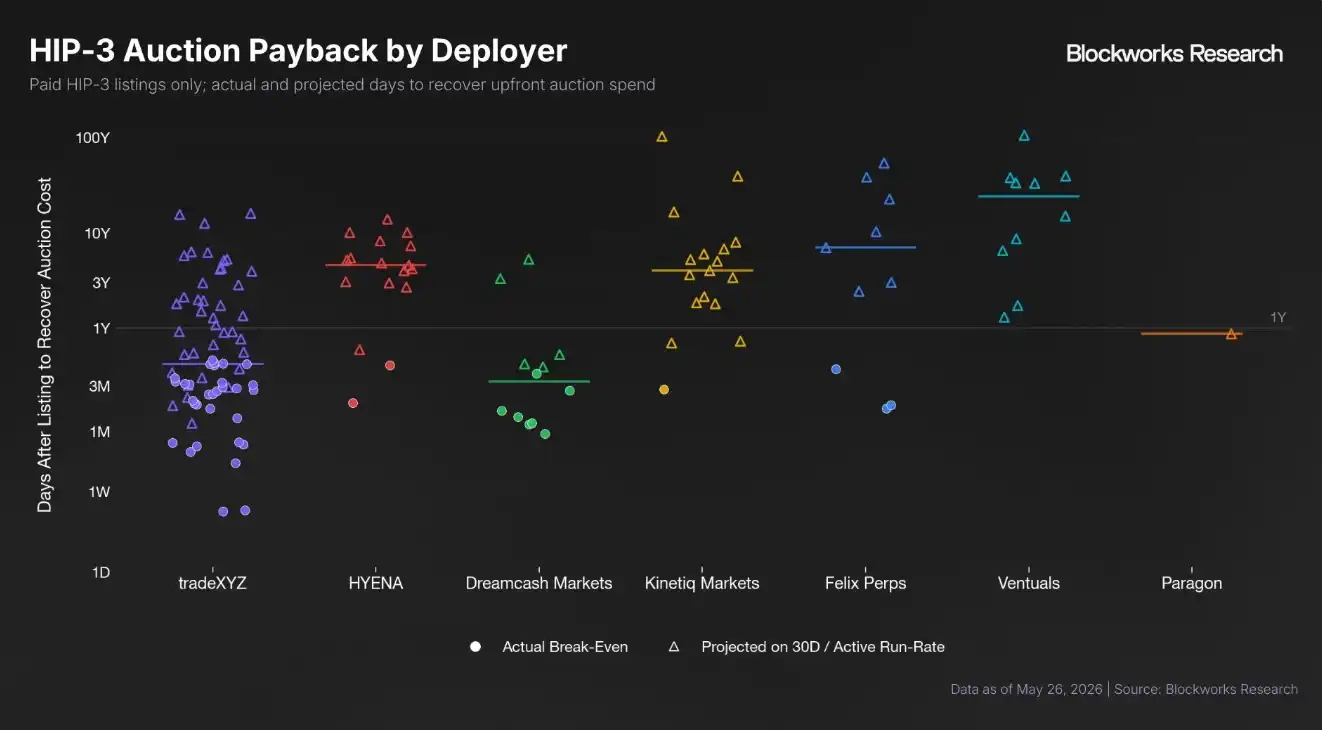
Selon les informations de l'analyste de Blockworks Research, shaunda devens, à l'exception de Trade.XYZ, la plupart des déployeurs HIP-3 ont un rendement annualisé basé sur les HYPE stakés proche ou même inférieur à 1 %, avec une période médiane de récupération des coûts d'enchère de marché s'étendant sur 4 ans. En revanche, Trade.XYZ est une exception notable, avec un rendement estimé des HYPE stakés atteignant 74 % et une période médiane de récupération des coûts d'enchère de seulement 5 mois.
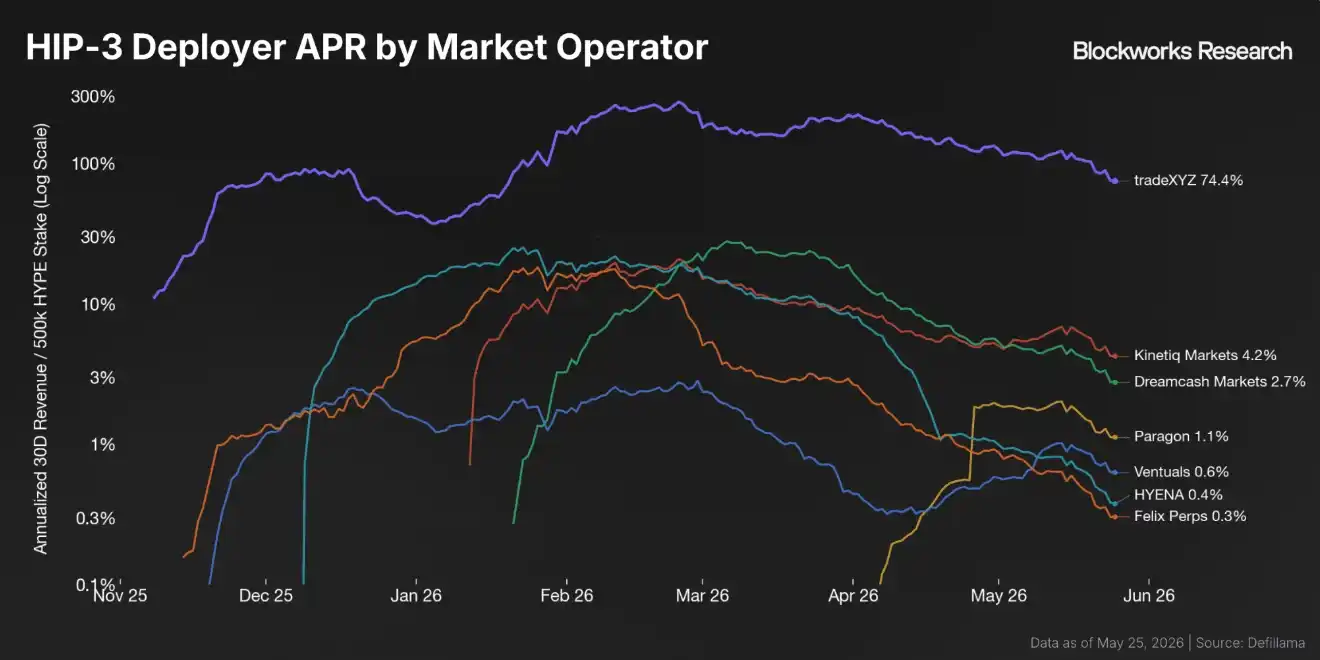
En d'autres termes, le succès de Trade.XYZ ne provient pas seulement du produit lui-même, mais d'un effet de réseau qui se renforce constamment. Plus d'utilisateurs apportent plus de liquidité, une plus grande liquidité attire plus d'actifs à être listés, et plus d'actifs de qualité consolident davantage sa position de marché. Dans le même temps, les déployeurs marginaux, en raison de rendements trop faibles, manquent non seulement de motivation pour poursuivre leur expansion, mais cela affaiblit également la demande de staking additionnel de HYPE et l'enthousiasme à participer aux enchères de marché.

Pour Hyperliquid, cette situation n'est pas sans inquiétude.

Il est indéniable que Trade.XYZ a apporté un énorme espace de croissance à Hyperliquid, devenant même le cas d'école le plus réussi du HIP-3. Mais si la majorité des droits de listing des actifs populaires et la liquidité sont concentrés entre les mains d'un seul déployeur, la compétition du HIP-3 restera une compétition de tête, peinant à évoluer vers une compétition d'écosystème ouverte et diversifiée.

À long terme, cela comprimera non seulement l'espace de survie des projets innovants, mais pourrait aussi enfermer Hyperliquid dans un récit unique centré sur les contrats perpétuels. D'autant plus que la concurrence dans la niche des Perp DEX s'intensifie, dépendre uniquement du trading de contrats perpétuels rend difficile la construction d'un écosystème d'applications on-chain suffisamment riche et d'effets de réseau durables. Il est notable que Hyperliquid tente déjà de diversifier son portefeuille d'activités via le HIP-4, qui s'attaque au marché des prédictions, un segment actuellement en vogue.

Face à ces difficultés actuelles, shaunda devens propose deux suggestions d'optimisation des mécanismes pour améliorer la durabilité de la création de marchés et renforcer la capacité de capture de valeur du HYPE.

La première est l'introduction d'un mécanisme de bourses à plusieurs niveaux. Cela permettrait à un nouveau déployeur de lancer un DEX HIP-3 avec un seuil inférieur aux 500 000 HYPE actuels, mais avec des permissions restreintes, comme une limite d'encours ouvert plus basse, un effet de levier réduit et des règles de contrôle des risques plus strictes. À mesure que le déployeur augmenterait le montant de HYPE staké, il débloquerait progressivement des fonctionnalités de niveau supérieur.

La seconde est l'ajustement du modèle économique des enchères de marché du HIP-3. Tant qu'un nouveau marché n'a pas récupéré son coût d'enchère, permettre au déployeur de percevoir jusqu'à 100 % des revenus de frais de transaction. Ou alors, tant que les revenus cumulés de l'ensemble du DEX n'ont pas couvert le coût des enchères, prioriser le retour des frais de transaction au déployeur. Une fois l'équilibre atteint, rétablir le mécanisme standard de partage 50:50 entre le protocole et le déployeur.

Pour Hyperliquid, le HIP-3 a prouvé que la création de marchés décentralisés est une voie viable, et le succès de Trade.XYZ a non seulement validé la demande pour le produit, mais est aussi devenu un moteur de croissance important pour Hyperliquid à ce stade.

Mais par rapport à la dépendance envers une super-application qui aspire continuellement la liquidité, un écosystème ouvert plus résilient et plus sain a probablement davantage besoin de permettre à des innovateurs de différents stades et de différents types de trouver un espace de survie, et de voir émerger continuellement de nouveaux actifs, de nouvelles approches et de nouveaux modèles commerciaux.


Related Questions

QQuel est le rôle de HIP-3 dans la croissance récente de Hyperliquid, et quelle a été son évolution en termes de volume d'échanges ?

AHIP-3 a permis le déploiement de marchés sans autorisation sur Hyperliquid, enrichissant les types d'actifs négociables et attirant de nouveaux traders. Depuis son lancement, il a généré plus de 3 198 milliards de dollars de volume d'échanges cumulés, contribuant significativement à la croissance de la plateforme.

QQuelle est la part de marché dominante de Trade.XYZ au sein de l'écosystème HIP-3, et quels indicateurs illustrent cette domination ?

ATrade.XYZ domine le marché HIP-3 avec plus de 90 % de part de marché en volume d'échanges. Des indicateurs comme les intérêts ouverts (97,6 % pour Trade.XYZ) et le nombre d'adresses de traders uniques (plus de 46 000, contre quelques centaines pour les autres projets) illustrent clairement cette suprématie.

QQuels sont les facteurs clés ayant permis à Trade.XYZ de construire un avantage concurrentiel aussi solide selon le cofondateur de Felix ?

ASelon Charlie, cofondateur de Felix, les facteurs clés incluent : le choix de l'USDC (plus liquide) plutôt que l'USDH, le fait d'avoir saisi la fenêtre de lancement de HIP-3, l'expansion rapide du nombre de marchés proposés, et les effets de marque et de 'roue de la liquidité' générés par les attentes d'airdrop.

QPourquoi plusieurs projets comme Felix et Ventuals ont-ils décidé de quitter l'écosystème HIP-3 ?

ALes projets comme Felix et Ventuals ont fermé en raison de la pression concurrentielle écrasante de Trade.XYZ, qui aspire la liquidité du marché. Pour Felix, la perte de parts de marché après l'arrivée de concurrents en USDC a été déterminante. Pour Ventuals, les défis de liquidité et de prix des actifs Pre-IPO, combinés à l'effet d'aspiration de Trade.XYZ, ont conduit à la décision.

QQuels sont les défis structurels et les suggestions d'amélioration mentionnés concernant le modèle économique de HIP-3 pour les nouveaux entrants ?

ALes défis incluent le coût d'entrée élevé (caution de 500 000 HYPE, ~35,89M$), les coûts d'expansion via les enchères, et des périodes de retour sur investissement très longues (environ 4 ans pour la plupart). Les suggestions pour améliorer la durabilité sont : un mécanisme d'échange à niveaux avec des barrières à l'entrée réduites, et un modèle d'enchères ajusté permettant aux déployeurs de récupérer 100% des frais jusqu'à l'équilibre.

Related Reads

Warsh's Debut: Will the FED Chair Who Knows Crypto Best Bring Surprises or Shocks to the Market?

Kevin Warsh, the new Federal Reserve Chairman, prepares for his inaugural press conference amidst a challenging macroeconomic landscape: resurgent inflation, a bond market sell-off, and political pressure from President Trump for rate cuts. Uniquely, Warsh holds indirect investments in over 20 crypto and Web3 entities (e.g., Solana, dYdX), making him the first Fed Chair with disclosed crypto exposure. His stance may combine a hawkish, inflation-focused monetary policy with a crypto-friendly regulatory philosophy that shifts from Powell’s “same risk, same rule” approach toward a framework acknowledging blockchain’s productivity value. Warsh’s leadership could impact crypto markets across three dimensions: a paradigm shift in regulation (potentially accelerating pro-innovation legislation and stable币 rules), a re-pricing of risk premiums based on clearer communication and his view of AI as a structural disinflationary force, and a long-term reallocation of global institutional capital driven by increased legitimacy. Two potential scenarios for the press conference are outlined. A “positive surprise” would involve a dovish-leaning tone on rates coupled with signals of regulatory openness, potentially boosting crypto asset valuations. Conversely, a “negative shock” would see a more hawkish-than-expected stance on inflation and rates, triggering a broad risk-asset selloff that crypto markets would not escape. While ethics rules required Warsh to divest his crypto holdings upon confirmation, his deep understanding of the technology may fundamentally lower policy uncertainty and build a more receptive long-term foundation for digital assets’ integration into the mainstream financial system.

marsbit16m ago

Warsh's Debut: Will the FED Chair Who Knows Crypto Best Bring Surprises or Shocks to the Market?

marsbit16m ago

Pricing OpenAI Pre-IPO: A New, Life-or-Death Business on Hyperliquid Lasting Half a Year

Pricing OpenAI Pre-IPO: Hyperliquid's High-Stakes, Six-Month Business Venture The article analyzes the nascent market for pre-IPO perpetual contracts on the Hyperliquid blockchain, exemplified by two contrasting teams: Trade.xyz and Ventuals. Trade.xyz, an anonymous team, successfully built the largest pre-market on Hyperliquid. Its strategy focused on near-term events, like the SpaceX IPO. By listing a SpaceX contract with a known launch date and price, the market had a tangible "anchor" (the eventual Nasdaq opening price) to converge upon, which kept speculation in check. This approach fueled significant growth. In stark contrast, Ventuals, backed by Paradigm, failed despite holding coveted contracts for OpenAI and Anthropic. Its critical flaw was its pricing mechanism for these companies, which have no imminent IPO. Ventuals' oracle price was half-derived from infrequent private market transactions and half from its own contract's moving average. This created a self-reinforcing loop where buying pressure artificially inflated the price, disconnecting it from real supply and demand. The market became illiquid and structurally skewed. Ventuals shut down nine months after launch, reportedly through an acquisition. Its final settlement prices—OpenAI at ~$1,341 and Anthropic at ~$1,618—were thus partially products of its flawed model. Ironically, some company employees and late-stage VCs reportedly used these prices for valuation reference, highlighting the desperate demand for price discovery in opaque private markets. The failure of Ventuals exposes the core challenge of this business: price for illiquid, non-public assets requires a robust, self-correcting market, which is absent without a definitive public listing event. Nevertheless, demand is driving major players like Coinbase and traditional finance (e.g., Citi) to enter the space, aiming to provide 24/7 trading for coveted private company shares. The venture's ultimate viability, however, hinges on solving the fundamental pricing problem Ventuals could not.

marsbit2h ago

Pricing OpenAI Pre-IPO: A New, Life-or-Death Business on Hyperliquid Lasting Half a Year

marsbit2h ago

Trading

Spot
Futures

Hot Articles

What is SONIC

Sonic: Pioneering the Future of Gaming in Web3 Introduction to Sonic In the ever-evolving landscape of Web3, the gaming industry stands out as one of the most dynamic and promising sectors. At the forefront of this revolution is Sonic, a project designed to amplify the gaming ecosystem on the Solana blockchain. Leveraging cutting-edge technology, Sonic aims to deliver an unparalleled gaming experience by efficiently processing millions of requests per second, ensuring that players enjoy seamless gameplay while maintaining low transaction costs. This article delves into the intricate details of Sonic, exploring its creators, funding sources, operational mechanics, and the timeline of significant events that have shaped its journey. What is Sonic? Sonic is an innovative layer-2 network that operates atop the Solana blockchain, specifically tailored to enhance the existing Solana gaming ecosystem. It accomplishes this through a customised, VM-agnostic game engine paired with a HyperGrid interpreter, facilitating sovereign game economies that roll up back to the Solana platform. The primary goals of Sonic include: Enhanced Gaming Experiences: Sonic is committed to offering lightning-fast on-chain gameplay, allowing players and developers to engage with games at previously unattainable speeds. Atomic Interoperability: This feature enables transactions to be executed within Sonic without the need to redeploy Solana programmes and accounts. This makes the process more efficient and directly benefits from Solana Layer1 services and liquidity. Seamless Deployment: Sonic allows developers to write for Ethereum Virtual Machine (EVM) based systems and execute them on Solana’s SVM infrastructure. This interoperability is crucial for attracting a broader range of dApps and decentralised applications to the platform. Support for Developers: By offering native composable gaming primitives and extensible data types - dining within the Entity-Component-System (ECS) framework - game creators can craft intricate business logic with ease. Overall, Sonic's unique approach not only caters to players but also provides an accessible and low-cost environment for developers to innovate and thrive. Creator of Sonic The information regarding the creator of Sonic is somewhat ambiguous. However, it is known that Sonic's SVM is owned by the company Mirror World. The absence of detailed information about the individuals behind Sonic reflects a common trend in several Web3 projects, where collective efforts and partnerships often overshadow individual contributions. Investors of Sonic Sonic has garnered considerable attention and support from various investors within the crypto and gaming sectors. Notably, the project raised an impressive $12 million during its Series A funding round. The round was led by BITKRAFT Ventures, with other notable investors including Galaxy, Okx Ventures, Interactive, Big Brain Holdings, and Mirana. This financial backing signifies the confidence that investment foundations have in Sonic’s potential to revolutionise the Web3 gaming landscape, further validating its innovative approaches and technologies. How Does Sonic Work? Sonic utilises the HyperGrid framework, a sophisticated parallel processing mechanism that enhances its scalability and customisability. Here are the core features that set Sonic apart: Lightning Speed at Low Costs: Sonic offers one of the fastest on-chain gaming experiences compared to other Layer-1 solutions, powered by the scalability of Solana’s virtual machine (SVM). Atomic Interoperability: Sonic enables transaction execution without redeployment of Solana programmes and accounts, effectively streamlining the interaction between users and the blockchain. EVM Compatibility: Developers can effortlessly migrate decentralised applications from EVM chains to the Solana environment using Sonic’s HyperGrid interpreter, increasing the accessibility and integration of various dApps. Ecosystem Support for Developers: By exposing native composable gaming primitives, Sonic facilitates a sandbox-like environment where developers can experiment and implement business logic, greatly enhancing the overall development experience. Monetisation Infrastructure: Sonic natively supports growth and monetisation efforts, providing frameworks for traffic generation, payments, and settlements, thereby ensuring that gaming projects are not only viable but also sustainable financially. Timeline of Sonic The evolution of Sonic has been marked by several key milestones. Below is a brief timeline highlighting critical events in the project's history: 2022: The Sonic cryptocurrency was officially launched, marking the beginning of its journey in the Web3 gaming arena. 2024: June: Sonic SVM successfully raised $12 million in a Series A funding round. This investment allowed Sonic to further develop its platform and expand its offerings. August: The launch of the Sonic Odyssey testnet provided users with the first opportunity to engage with the platform, offering interactive activities such as collecting rings—a nod to gaming nostalgia. October: SonicX, an innovative crypto game integrated with Solana, made its debut on TikTok, capturing the attention of over 120,000 users within a short span. This integration illustrated Sonic’s commitment to reaching a broader, global audience and showcased the potential of blockchain gaming. Key Points Sonic SVM is a revolutionary layer-2 network on Solana explicitly designed to enhance the GameFi landscape, demonstrating great potential for future development. HyperGrid Framework empowers Sonic by introducing horizontal scaling capabilities, ensuring that the network can handle the demands of Web3 gaming. Integration with Social Platforms: The successful launch of SonicX on TikTok displays Sonic’s strategy to leverage social media platforms to engage users, exponentially increasing the exposure and reach of its projects. Investment Confidence: The substantial funding from BITKRAFT Ventures, among others, emphasizes the robust backing Sonic has, paving the way for its ambitious future. In conclusion, Sonic encapsulates the essence of Web3 gaming innovation, striking a balance between cutting-edge technology, developer-centric tools, and community engagement. As the project continues to evolve, it is poised to redefine the gaming landscape, making it a notable entity for gamers and developers alike. As Sonic moves forward, it will undoubtedly attract greater interest and participation, solidifying its place within the broader narrative of blockchain gaming.

1.7k Total ViewsPublished 2024.04.04Updated 2024.12.03

What is SONIC

What is $S$

Understanding SPERO: A Comprehensive Overview Introduction to SPERO As the landscape of innovation continues to evolve, the emergence of web3 technologies and cryptocurrency projects plays a pivotal role in shaping the digital future. One project that has garnered attention in this dynamic field is SPERO, denoted as SPERO,$$s$. This article aims to gather and present detailed information about SPERO, to help enthusiasts and investors understand its foundations, objectives, and innovations within the web3 and crypto domains. What is SPERO,$$s$? SPERO,$$s$ is a unique project within the crypto space that seeks to leverage the principles of decentralisation and blockchain technology to create an ecosystem that promotes engagement, utility, and financial inclusion. The project is tailored to facilitate peer-to-peer interactions in new ways, providing users with innovative financial solutions and services. At its core, SPERO,$$s$ aims to empower individuals by providing tools and platforms that enhance user experience in the cryptocurrency space. This includes enabling more flexible transaction methods, fostering community-driven initiatives, and creating pathways for financial opportunities through decentralised applications (dApps). The underlying vision of SPERO,$$s$ revolves around inclusiveness, aiming to bridge gaps within traditional finance while harnessing the benefits of blockchain technology. Who is the Creator of SPERO,$$s$? The identity of the creator of SPERO,$$s$ remains somewhat obscure, as there are limited publicly available resources providing detailed background information on its founder(s). This lack of transparency can stem from the project's commitment to decentralisation—an ethos that many web3 projects share, prioritising collective contributions over individual recognition. By centring discussions around the community and its collective goals, SPERO,$$s$ embodies the essence of empowerment without singling out specific individuals. As such, understanding the ethos and mission of SPERO remains more important than identifying a singular creator. Who are the Investors of SPERO,$$s$? SPERO,$$s$ is supported by a diverse array of investors ranging from venture capitalists to angel investors dedicated to fostering innovation in the crypto sector. The focus of these investors generally aligns with SPERO's mission—prioritising projects that promise societal technological advancement, financial inclusivity, and decentralised governance. These investor foundations are typically interested in projects that not only offer innovative products but also contribute positively to the blockchain community and its ecosystems. The backing from these investors reinforces SPERO,$$s$ as a noteworthy contender in the rapidly evolving domain of crypto projects. How Does SPERO,$$s$ Work? SPERO,$$s$ employs a multi-faceted framework that distinguishes it from conventional cryptocurrency projects. Here are some of the key features that underline its uniqueness and innovation: Decentralised Governance: SPERO,$$s$ integrates decentralised governance models, empowering users to participate actively in decision-making processes regarding the project’s future. This approach fosters a sense of ownership and accountability among community members. Token Utility: SPERO,$$s$ utilises its own cryptocurrency token, designed to serve various functions within the ecosystem. These tokens enable transactions, rewards, and the facilitation of services offered on the platform, enhancing overall engagement and utility. Layered Architecture: The technical architecture of SPERO,$$s$ supports modularity and scalability, allowing for seamless integration of additional features and applications as the project evolves. This adaptability is paramount for sustaining relevance in the ever-changing crypto landscape. Community Engagement: The project emphasises community-driven initiatives, employing mechanisms that incentivise collaboration and feedback. By nurturing a strong community, SPERO,$$s$ can better address user needs and adapt to market trends. Focus on Inclusion: By offering low transaction fees and user-friendly interfaces, SPERO,$$s$ aims to attract a diverse user base, including individuals who may not previously have engaged in the crypto space. This commitment to inclusion aligns with its overarching mission of empowerment through accessibility. Timeline of SPERO,$$s$ Understanding a project's history provides crucial insights into its development trajectory and milestones. Below is a suggested timeline mapping significant events in the evolution of SPERO,$$s$: Conceptualisation and Ideation Phase: The initial ideas forming the basis of SPERO,$$s$ were conceived, aligning closely with the principles of decentralisation and community focus within the blockchain industry. Launch of Project Whitepaper: Following the conceptual phase, a comprehensive whitepaper detailing the vision, goals, and technological infrastructure of SPERO,$$s$ was released to garner community interest and feedback. Community Building and Early Engagements: Active outreach efforts were made to build a community of early adopters and potential investors, facilitating discussions around the project’s goals and garnering support. Token Generation Event: SPERO,$$s$ conducted a token generation event (TGE) to distribute its native tokens to early supporters and establish initial liquidity within the ecosystem. Launch of Initial dApp: The first decentralised application (dApp) associated with SPERO,$$s$ went live, allowing users to engage with the platform's core functionalities. Ongoing Development and Partnerships: Continuous updates and enhancements to the project's offerings, including strategic partnerships with other players in the blockchain space, have shaped SPERO,$$s$ into a competitive and evolving player in the crypto market. Conclusion SPERO,$$s$ stands as a testament to the potential of web3 and cryptocurrency to revolutionise financial systems and empower individuals. With a commitment to decentralised governance, community engagement, and innovatively designed functionalities, it paves the way toward a more inclusive financial landscape. As with any investment in the rapidly evolving crypto space, potential investors and users are encouraged to research thoroughly and engage thoughtfully with the ongoing developments within SPERO,$$s$. The project showcases the innovative spirit of the crypto industry, inviting further exploration into its myriad possibilities. While the journey of SPERO,$$s$ is still unfolding, its foundational principles may indeed influence the future of how we interact with technology, finance, and each other in interconnected digital ecosystems.

57 Total ViewsPublished 2024.12.17Updated 2024.12.17

What is $S$

What is AGENT S

Agent S: The Future of Autonomous Interaction in Web3 Introduction In the ever-evolving landscape of Web3 and cryptocurrency, innovations are constantly redefining how individuals interact with digital platforms. One such pioneering project, Agent S, promises to revolutionise human-computer interaction through its open agentic framework. By paving the way for autonomous interactions, Agent S aims to simplify complex tasks, offering transformative applications in artificial intelligence (AI). This detailed exploration will delve into the project's intricacies, its unique features, and the implications for the cryptocurrency domain. What is Agent S? Agent S stands as a groundbreaking open agentic framework, specifically designed to tackle three fundamental challenges in the automation of computer tasks: Acquiring Domain-Specific Knowledge: The framework intelligently learns from various external knowledge sources and internal experiences. This dual approach empowers it to build a rich repository of domain-specific knowledge, enhancing its performance in task execution. Planning Over Long Task Horizons: Agent S employs experience-augmented hierarchical planning, a strategic approach that facilitates efficient breakdown and execution of intricate tasks. This feature significantly enhances its ability to manage multiple subtasks efficiently and effectively. Handling Dynamic, Non-Uniform Interfaces: The project introduces the Agent-Computer Interface (ACI), an innovative solution that enhances the interaction between agents and users. Utilizing Multimodal Large Language Models (MLLMs), Agent S can navigate and manipulate diverse graphical user interfaces seamlessly. Through these pioneering features, Agent S provides a robust framework that addresses the complexities involved in automating human interaction with machines, setting the stage for myriad applications in AI and beyond. Who is the Creator of Agent S? While the concept of Agent S is fundamentally innovative, specific information about its creator remains elusive. The creator is currently unknown, which highlights either the nascent stage of the project or the strategic choice to keep founding members under wraps. Regardless of anonymity, the focus remains on the framework's capabilities and potential. Who are the Investors of Agent S? As Agent S is relatively new in the cryptographic ecosystem, detailed information regarding its investors and financial backers is not explicitly documented. The lack of publicly available insights into the investment foundations or organisations supporting the project raises questions about its funding structure and development roadmap. Understanding the backing is crucial for gauging the project's sustainability and potential market impact. How Does Agent S Work? At the core of Agent S lies cutting-edge technology that enables it to function effectively in diverse settings. Its operational model is built around several key features: Human-like Computer Interaction: The framework offers advanced AI planning, striving to make interactions with computers more intuitive. By mimicking human behaviour in tasks execution, it promises to elevate user experiences. Narrative Memory: Employed to leverage high-level experiences, Agent S utilises narrative memory to keep track of task histories, thereby enhancing its decision-making processes. Episodic Memory: This feature provides users with step-by-step guidance, allowing the framework to offer contextual support as tasks unfold. Support for OpenACI: With the ability to run locally, Agent S allows users to maintain control over their interactions and workflows, aligning with the decentralised ethos of Web3. Easy Integration with External APIs: Its versatility and compatibility with various AI platforms ensure that Agent S can fit seamlessly into existing technological ecosystems, making it an appealing choice for developers and organisations. These functionalities collectively contribute to Agent S's unique position within the crypto space, as it automates complex, multi-step tasks with minimal human intervention. As the project evolves, its potential applications in Web3 could redefine how digital interactions unfold. Timeline of Agent S The development and milestones of Agent S can be encapsulated in a timeline that highlights its significant events: September 27, 2024: The concept of Agent S was launched in a comprehensive research paper titled “An Open Agentic Framework that Uses Computers Like a Human,” showcasing the groundwork for the project. October 10, 2024: The research paper was made publicly available on arXiv, offering an in-depth exploration of the framework and its performance evaluation based on the OSWorld benchmark. October 12, 2024: A video presentation was released, providing a visual insight into the capabilities and features of Agent S, further engaging potential users and investors. These markers in the timeline not only illustrate the progress of Agent S but also indicate its commitment to transparency and community engagement. Key Points About Agent S As the Agent S framework continues to evolve, several key attributes stand out, underscoring its innovative nature and potential: Innovative Framework: Designed to provide an intuitive use of computers akin to human interaction, Agent S brings a novel approach to task automation. Autonomous Interaction: The ability to interact autonomously with computers through GUI signifies a leap towards more intelligent and efficient computing solutions. Complex Task Automation: With its robust methodology, it can automate complex, multi-step tasks, making processes faster and less error-prone. Continuous Improvement: The learning mechanisms enable Agent S to improve from past experiences, continually enhancing its performance and efficacy. Versatility: Its adaptability across different operating environments like OSWorld and WindowsAgentArena ensures that it can serve a broad range of applications. As Agent S positions itself in the Web3 and crypto landscape, its potential to enhance interaction capabilities and automate processes signifies a significant advancement in AI technologies. Through its innovative framework, Agent S exemplifies the future of digital interactions, promising a more seamless and efficient experience for users across various industries. Conclusion Agent S represents a bold leap forward in the marriage of AI and Web3, with the capacity to redefine how we interact with technology. While still in its early stages, the possibilities for its application are vast and compelling. Through its comprehensive framework addressing critical challenges, Agent S aims to bring autonomous interactions to the forefront of the digital experience. As we move deeper into the realms of cryptocurrency and decentralisation, projects like Agent S will undoubtedly play a crucial role in shaping the future of technology and human-computer collaboration.

731 Total ViewsPublished 2025.01.14Updated 2025.01.14

What is AGENT S

Discussions

Welcome to the HTX Community. Here, you can stay informed about the latest platform developments and gain access to professional market insights. Users' opinions on the price of S (S) are presented below.

活动图片