Momento crucial para HIP-3: Múltiples actores se retiran tras Trade.XYZ acaparar el 90% del mercado

marsbitPublished on 2026-06-16Last updated on 2026-06-16

Abstract

**Resumen del artículo: "El momento crucial de HIP-3: Trade.XYZ se traga el 90% del mercado y varios proyectos se retiran"** (Nancy, PANews) El ecosistema HIP-3 de Hyperliquid, que permite el despliegue sin permisos de mercados de derivados, está experimentando una rápida consolidación y una dura reestructuración. Aunque HIP-3 ha generado más de 3.198 billones de dólares en volumen de negociación desde su lanzamiento, el mercado está dominado abrumadoramente por Trade.XYZ, que controla más del 90% del volumen y cerca del 97% del interés abierto (OI). Esta supremacía ha creado un efecto de red imparable para Trade.XYZ, atrayendo la mayor parte de la liquidez y los usuarios. Como consecuencia, la presión competitiva y los elevados costes de entrada están expulsando a otros participantes. Proyectos como Felix y Ventuals han anunciado recientemente su cierre. Felix citó la incapacidad para competir después de que Trade.XYZ, con su ventaja de ser el primero y su uso de USDC, capturara su cuota de mercado. Ventuals, un mercado de acciones pre-IPO, también sucumbió ante los desafíos de liquidez y la intensa competencia. El mecanismo de HIP-3 exige un depósito de garantía de 500.000 HYPE (unos 35,89 millones de dólares) para desplegar un DEX, con costes adicionales por subasta para listar nuevos activos. Para la mayoría de los desplegadores, el periodo de recuperación de la inversión es de unos 4 años, con un rendimiento anualizado del ~1% sobre el HYPE apostado. En contraste, Tra...

Autora: Nancy, PANews

La guerra de Hyperliquid "llega" a Wall Street, y las dinámicas internas de su ecosistema se están diferenciando aceleradamente.

Gracias a la capacidad de implementación de mercados sin permisos (permissionless) de HIP-3 y a la creciente diversificación de activos para negociar, Hyperliquid ha logrado romper barreras rápidamente este año, convirtiéndose en un nuevo campo de batalla para los "guerreros del fin de semana".

Mientras el tamaño de mercado de HIP-3 se expande a gran velocidad, su ecosistema está experimentando una brutal reestructuración. Trade.XYZ, aprovechando su ventaja de ser el primero, ha logrado un cuasi monopolio, acaparando más del noventa por ciento de la cuota de mercado; el espacio de supervivencia para otros proyectos del ecosistema se ve cada vez más comprimido, y varios de ellos, incluidos Feilx y Ventuals, han anunciado sucesivamente su cierre.

HIP-3 supera los 300.000 millones de dólares en volumen, Trade.XYZ monopoliza el 90% del mercado

El auge de HIP-3 ha abierto una nueva curva de crecimiento para Hyperliquid.

Los datos del panel Hyperscreener muestran que en las últimas 24 horas, el volumen total de operaciones con Perpetuos (Perps) en toda la plataforma Hyperliquid alcanzó los 8.77 mil millones de dólares, de los cuales los mercados HIP-3 contribuyeron con aproximadamente 3.5 mil millones, representando el 39.9% del volumen total. En otras palabras, por cada aproximadamente 10 dólares de volumen de contratos perpetuos generados en Hyperliquid, casi 4 dólares provienen de HIP-3.

De hecho, desde su lanzamiento en octubre del año pasado, HIP-3 ha superado un volumen acumulado de 319.8 mil millones de dólares en poco más de medio año, con una velocidad de crecimiento que supera con creces las expectativas del mercado. Sin embargo, lo que se ha expandido junto con el volumen no es un ecosistema diverso y floreciente, sino un efecto de cabeza (efecto del ganador) cada vez más pronunciado, donde Trade.XYZ prácticamente se ha quedado con todo el pastel del crecimiento del mercado.

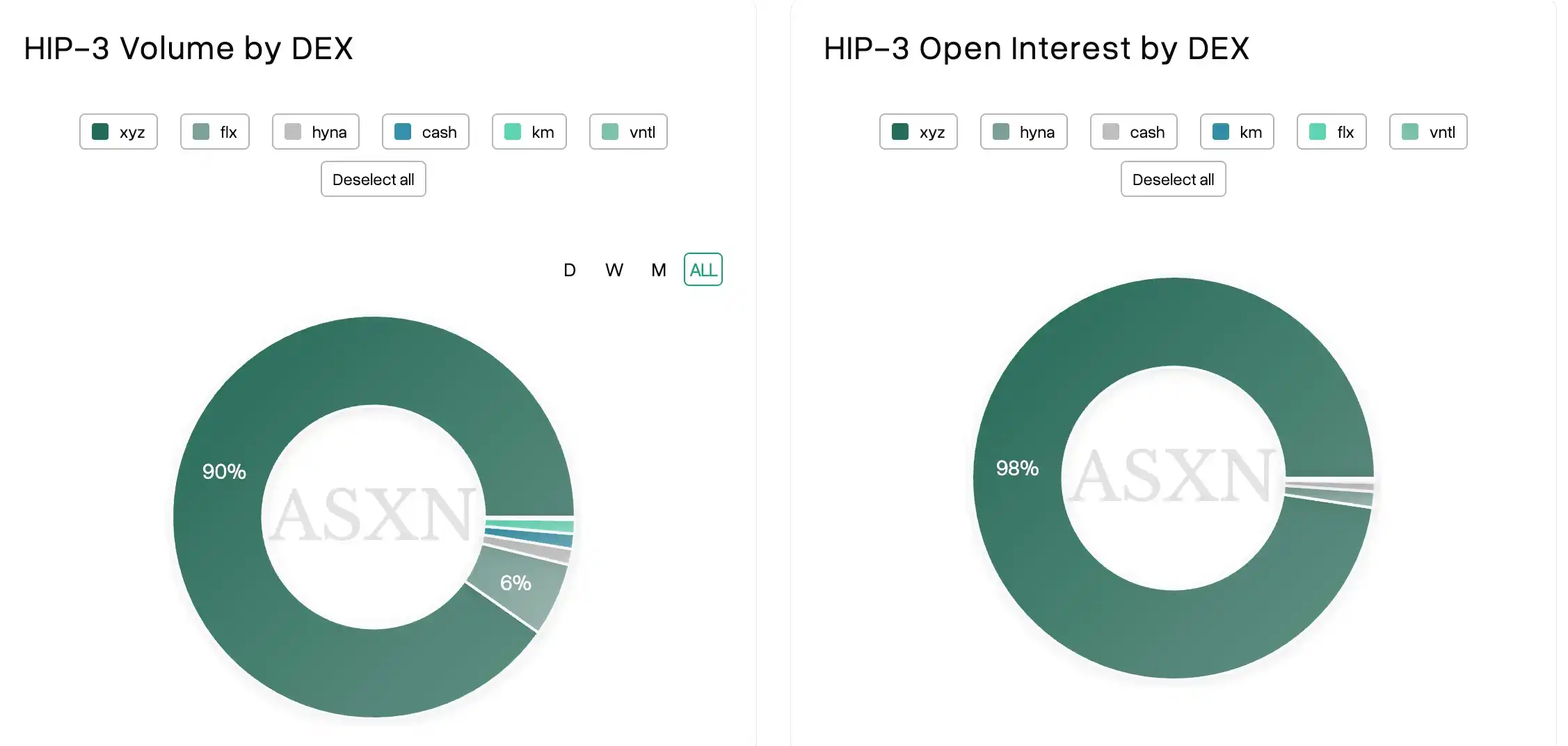
Mirando el open interest (interés abierto), los datos de Hyperscreener muestran que al 16 de junio, el tamaño acumulado de posiciones abiertas en los mercados HIP-3 era de aproximadamente 29.4 mil millones de dólares, de los cuales solo Trade.XYZ contribuyó con 28.7 mil millones, con una cuota de mercado asombrosa del 97.6%. En comparación, otros proyectos como DreamCash, HyENA, Ventuals, Felix representaban en su mayoría menos del 1%, siendo casi insignificantes.
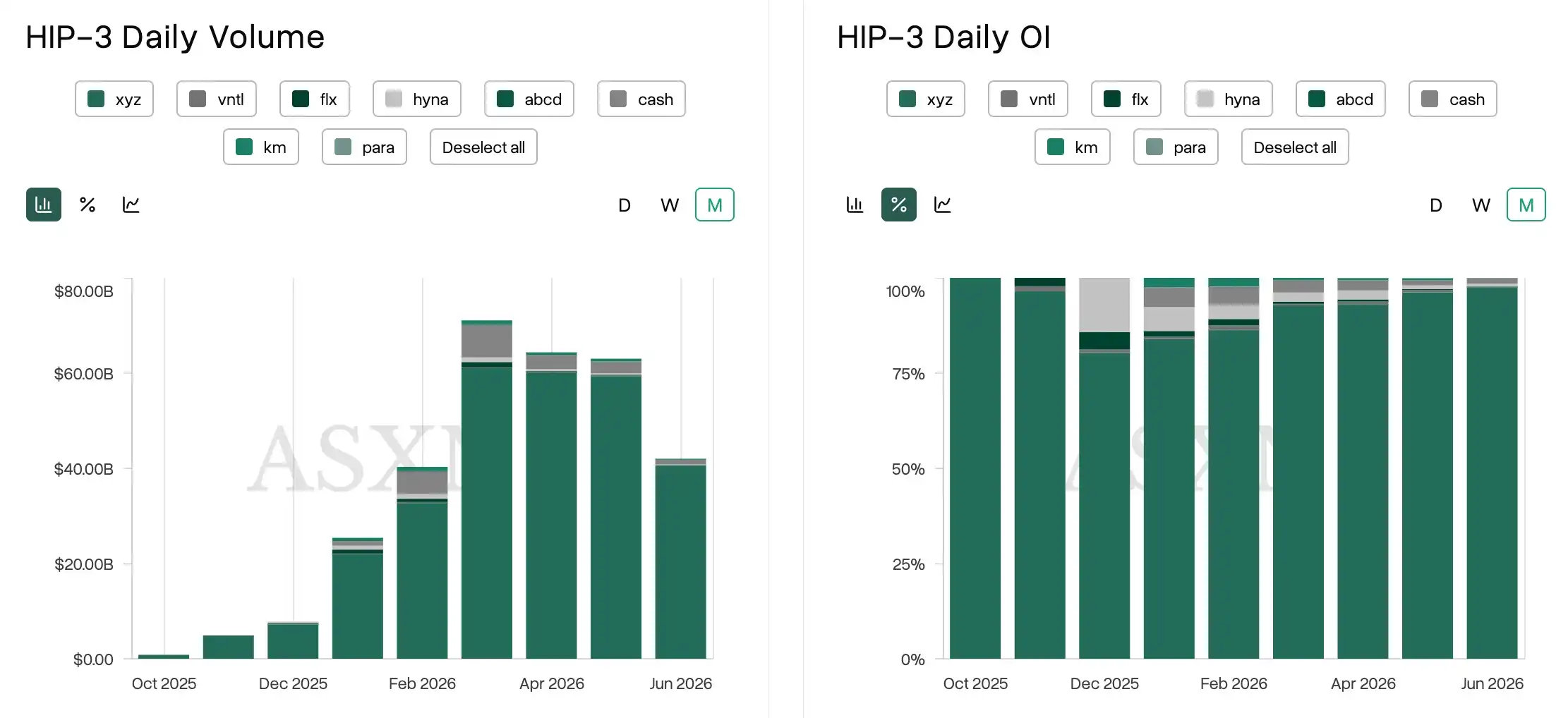
La dimensión del volumen de operaciones corrobora igualmente esta tendencia. Históricamente, mirando el volumen acumulado, Trade.XYZ se mantiene firme con aproximadamente el 90% de la cuota de mercado, DreamCash ocupa el segundo lugar con aproximadamente el 6%, y el resto de proyectos compiten por menos del 5% del espacio de mercado. Solo en junio, el efecto de cabeza se intensificó aún más, con la cuota de mercado de Trade.XYZ escalando al 96.65%, mientras que los otros 7 mercados, incluidos Felix Exchange, Ventuals, HyENA, representaban conjuntamente solo el 3.35%, y algunos proyectos incluso menos del 0.1%.

Observando más a fondo la actividad de negociación de los activos, esta brecha se vuelve aún más evidente. El volumen acumulado de operaciones de todos los activos en HIP-3 este mes alcanzó los 11.21 mil millones de dólares, de los cuales solo el producto central de Trade.XYZ, XYZ100 (un índice que rastrea las 100 principales empresas), contribuyó con 10.64 mil millones. Un solo activo prácticamente sostuvo la mayor parte de la actividad de negociación en todo el mercado HIP-3.
La divergencia en la actividad de los usuarios es igualmente marcada. Los datos muestran que este mes Trade.XYZ atrajo a más de 46,000 direcciones únicas de negociación, mientras que la mayoría de los otros mercados tuvieron solo unos cientos de comerciantes únicos, algunos incluso menos de cien. En términos de frecuencia de transacciones, Trade.XYZ acumuló más de 22.03 millones de operaciones este mes, mientras que la mayoría de los demás mercados registraron solo entre decenas de miles y algo más de cien mil operaciones, una brecha abismal con respecto a la plataforma líder.

En cierta medida, la historia de crecimiento de HIP-3 en esta etapa puede verse casi exclusivamente como la historia de crecimiento de Trade.XYZ.

HIP-3 inicia una eliminatoria, proyectos del ecosistema se retiran sucesivamente

Mientras Trade.XYZ continúa atrayendo la liquidez del mercado, HIP-3 está pasando de ser una arena de innovación abierta a una eliminatoria dominada por los actores principales, y a los recién llegados les resulta cada vez más difícil obtener una porción del pastel.

Recientemente, varios proyectos HIP-3 han cerrado sucesivamente. La semana pasada, Charlie, cofundador del protocolo de préstamo de Hyperliquid, Felix, anunció en un post que el DEX HIP-3 de Felix y todos sus mercados spot comenzarían a cerrarse el 19 de junio, completando su retirada total el 20 de junio, y que todos los operadores deberían cerrar sus posiciones antes de esa fecha. Este ajuste no afectará a los negocios de préstamos y acciones spot de Felix, y en el futuro se centrarán en su producto principal. No descartan regresar como implementadores de HIP-3 una vez encuentren un nuevo camino de crecimiento de usuarios.

Charlie admitió en su análisis que, aunque Felix inicialmente tuvo ventaja de ser el primero en mercados como petróleo crudo, oro y plata, generando un volumen acumulado de aproximadamente 3 mil millones de dólares y obteniendo ingresos considerables por comisiones, su cuota de mercado fue gradualmente superada tras el lanzamiento por parte de Trade.XYZ de mercados similares denominados en USDC.

En su opinión, la capacidad de Trade.XYZ para construir rápidamente una "zanja defensiva" (moat) se debió clave a la elección de USDC (con mayor liquidez) en lugar de USDH, a la captura de la ventana de lanzamiento inicial de HIP-3, a la rápida expansión del número de mercados, y al efecto de marca y la rueda de liquidez generados por las expectativas de airdrops. Con la gradual desaparición de USDH del panorama, mantener una implementación HIP-3 ya no permite diferenciarse de manera competitiva, por lo que el equipo decidió recortar este negocio.

Felix no es un caso aislado. Poco después, Ventuals, uno de los mayores participantes en la negociación de acciones de empresas privadas en Hyperliquid, también anunció que cesaría gradualmente sus operaciones, y que el equipo se uniría a otro equipo de desarrollo dentro del ecosistema de Hyperliquid. La plataforma irá cerrando progresivamente mercados como OpenAI, Anthropic, materias primas, índices, etc. Los poseedores de vHYPE podrán canjearlo por HYPE a una tasa 1:1 y recibir las recompensas de staking. Ventuals también terminará sus programas de puntos y referidos, y confirmó que no emitirá un token.

Ventuals reveló que durante su operación, el proyecto recaudó más de 500,000 HYPE, con un volumen de operaciones superior a los 650 millones de dólares, llegando a ser una de las aplicaciones innovadoras más representativas dentro del ecosistema HIP-3 de Hyperliquid.

Aunque el equipo no explicó públicamente las razones del cierre, el mercado generalmente considera que la absorción de liquidez de activos populares por parte de Trade.XYZ, junto con los desafíos inherentes de liquidez y fijación de precios de los activos Pre-IPO, fueron factores importantes que llevaron al proyecto a retirarse finalmente.

La mayoría de los implementadores necesitan cuatro años para recuperar la inversión, aumentan las presiones en el ecosistema HIP-3

Además de la presión competitiva del efecto de cabeza, el propio mecanismo de implementación de HIP-3 está comprimiendo aún más el espacio de supervivencia para los recién llegados.

Según las reglas de HIP-3, cualquier equipo que desee crear un DEX debe primero apostar (stake) 500,000 HYPE como garantía de seguridad. Al precio actual, esta cantidad asciende a aproximadamente 35.89 millones de dólares, y una vez implementado, debe permanecer bloqueado durante al menos 183 días. Además, cada implementador solo puede listar 3 primeros activos sin necesidad de participar en una subasta. Para agregar activos posteriores, debe obtener el derecho de listado a través de una subasta de tipo holandés (Dutch auction), con un precio de apertura mínimo de 500 HYPE (con un valor actual de aproximadamente 36,000 dólares, aunque ha disminuido significativamente desde las 1,750 HYPE de enero). Los HYPE pagados en la subasta serán directamente quemados (burned) por el protocolo.

Para los nuevos participantes, en un entorno donde la liquidez está altamente concentrada en los actores principales, la alta inversión inicial, los costos de expansión continuamente crecientes y los largos períodos de recuperación de la inversión se están convirtiendo en una carga cada vez más difícil de soportar. Es importante señalar que Hyperliquid reveló en mayo de este año que gradualmente reducirá el umbral de stake de 500,000 HYPE.
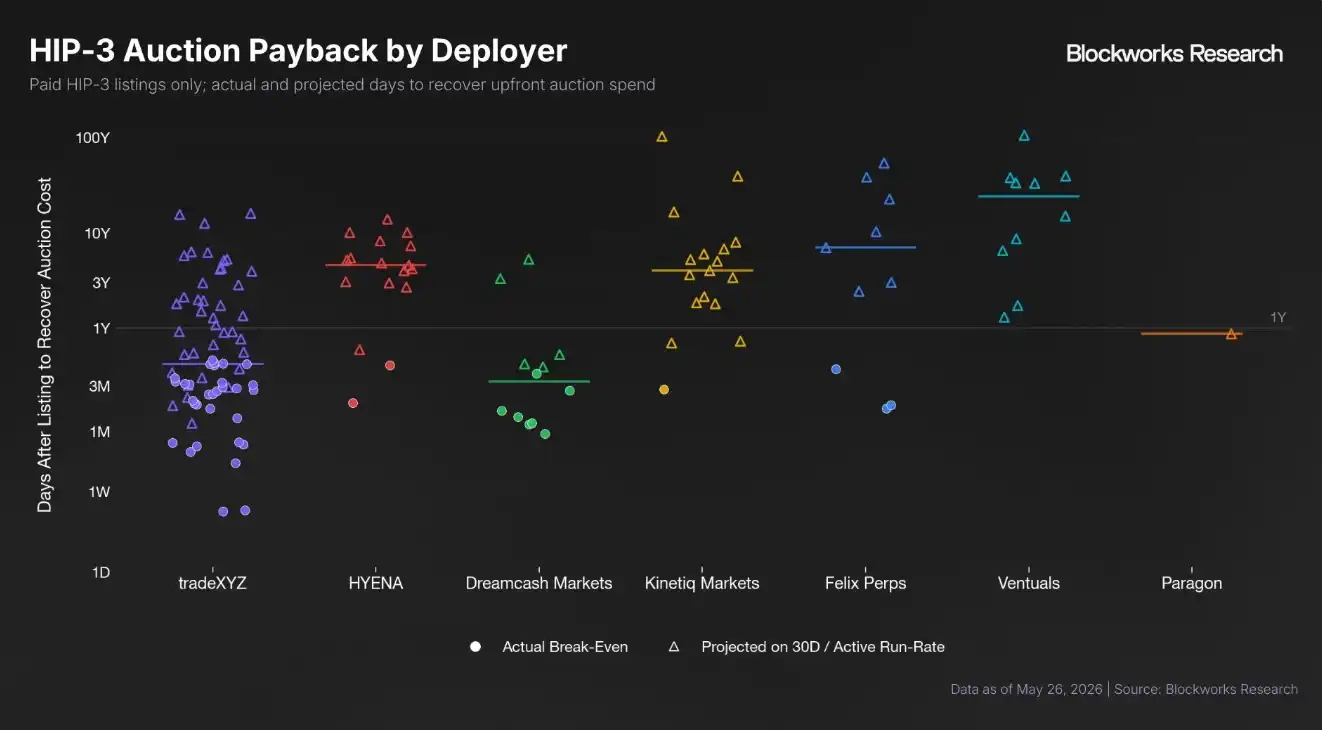
Según la analista de Blockworks Research, Shaunda Devens, excluyendo a Trade.XYZ, la mayoría de los implementadores de HIP-3 tienen un rendimiento anualizado (APY) basado en el HYPE apostado cercano o incluso inferior al 1%, y el período medio de recuperación del costo de las subastas de mercado es de hasta 4 años. En contraste, Trade.XYZ es una clara excepción, con un rendimiento estimado del HYPE apostado de hasta el 74%, y un período medio de recuperación del costo de las subastas de solo 5 meses.
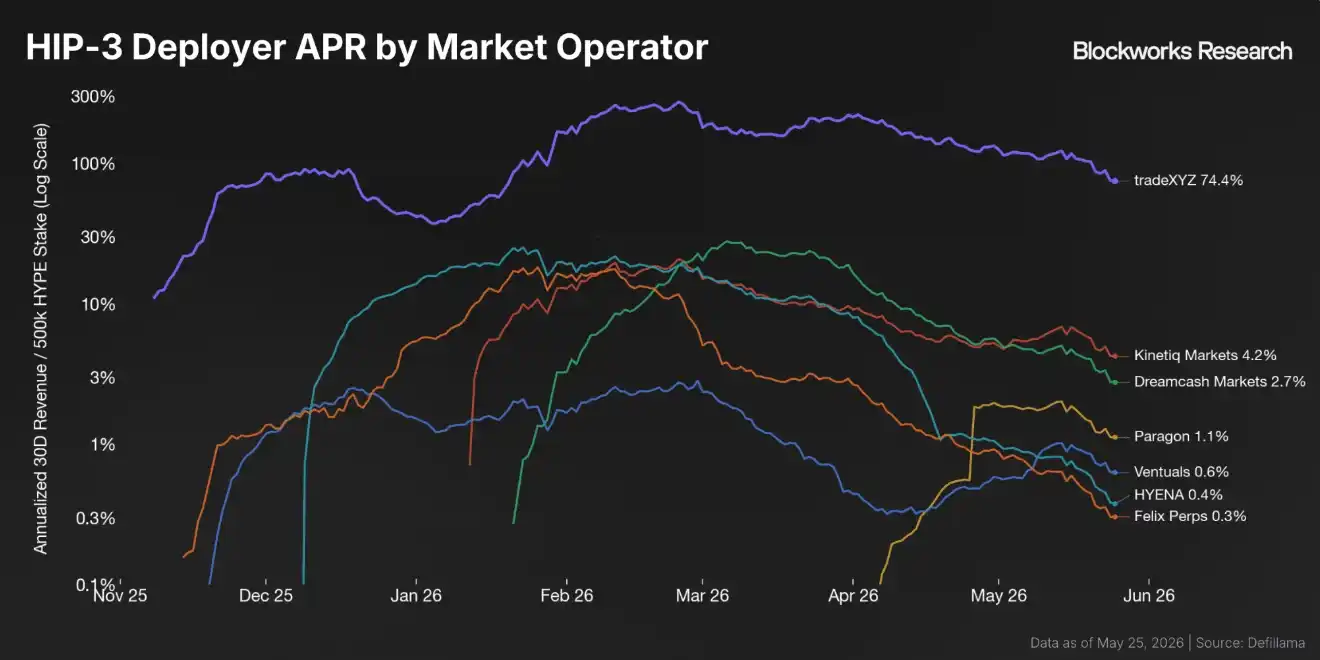
En otras palabras, el éxito de Trade.XYZ no solo se debe al producto en sí, sino a un efecto de red que se refuerza continuamente. Más usuarios traen mayor liquidez, mayor liquidez atrae más activos listados, y más activos de calidad consolidan aún más su posición en el mercado. Al mismo tiempo, los implementadores marginales, debido a los bajos rendimientos, no solo carecen de motivación para seguir expandiéndose, sino que también debilitan la demanda de nuevo stake de HYPE y la disposición a participar en subastas de mercado.

Para Hyperliquid, esta situación no está exenta de preocupaciones.

Sin duda, Trade.XYZ ha traído un enorme espacio de crecimiento incremental a Hyperliquid, e incluso se ha convertido en el caso de éxito más destacado de HIP-3. Pero si el derecho a listar la mayoría de los activos populares y su liquidez están concentrados en un solo implementador, entonces la competencia en HIP-3 se estancará en la competencia entre los cabezas, y será difícil que evolucione hacia una competencia de ecosistema abierto y diverso.

A largo plazo, esto no solo comprimirá el espacio de supervivencia para proyectos innovadores, sino que también podría mantener a Hyperliquid atrapado en una única narrativa de contratos perpetuos. Especialmente en un contexto donde la competencia en el sector de los DEX de Perps es cada vez más intensa, depender únicamente del trading de contratos perpetuos dificulta la construcción de un ecosistema de aplicaciones on-chain lo suficientemente rico y de efectos de red sostenibles. Cabe destacar que Hyperliquid ya está incursionando a través de HIP-4 en los populares mercados de predicción, intentando enriquecer aún más su portafolio de negocios.

Ante el dilema actual, Shaunda Devens propone dos sugerencias de optimización de mecanismos para mejorar la sostenibilidad de la creación de mercados y potenciar la capacidad de captura de valor de HYPE.

La primera es introducir un mecanismo de intercambios (DEX) por niveles (tiered). Permitiría a nuevos implementadores lanzar un DEX HIP-3 con un umbral inferior a los actuales 500,000 HYPE, pero con permisos limitados correspondientemente, por ejemplo, estableciendo límites máximos de open interest más bajos, multiplicadores de apalancamiento más reducidos y reglas de control de riesgo más estrictas; a medida que el implementador aumente la cantidad de HYPE en stake, se desbloquearían gradualmente funciones de nivel superior.

La segunda es ajustar el modelo económico de las subastas de mercado de HIP-3. Antes de que un nuevo mercado recupere el costo de su subasta, permitir al implementador recibir hasta el 100% de los ingresos por comisiones de trading; o bien, que antes de que los ingresos acumulados de todo el DEX cubran los costos de subasta, las comisiones se devuelvan prioritariamente al implementador, y una vez alcanzado el equilibrio, se restaure el mecanismo estándar de reparto 50:50 entre el protocolo y el implementador.

Para Hyperliquid, HIP-3 ya ha demostrado que la creación de mercados descentralizados es un camino viable, y el éxito de Trade.XYZ no solo valida la demanda del producto, sino que también se ha convertido en un motor de crecimiento crucial para Hyperliquid en esta etapa.

Pero en comparación con depender de una "super-app" que continúa absorbiendo liquidez, un ecosistema abierto más resistente y saludable quizás necesita más que nada que innovadores en diferentes etapas y de diferentes tipos puedan encontrar espacio para sobrevivir, permitiendo que surjan continuamente nuevos activos, nuevas formas de juego y nuevos modelos de negocio.


Related Questions

Q¿Qué porcentaje del mercado controla Trade.XYZ en el ecosistema HIP-3 de Hyperliquid, según el artículo?

ATrade.XYZ controla más del 90% del mercado en términos de volumen de transacciones y alrededor del 97.6% en términos de interés abierto total (Open Interest) del ecosistema HIP-3.

Q¿Qué dos proyectos del ecosistema HIP-3 menciona el artículo que han anunciado su cierre recientemente?

ALos dos proyectos mencionados que han anunciado su cierre son Felix (su DEX y mercados al contado HIP-3) y Ventuals.

Q¿Cuál es una de las principales razones clave, según el artículo, que permitió a Trade.XYZ construir una ventaja competitiva tan sólida?

AUna razón clave fue la elección de USDC, una moneda estable con mayor liquidez, en lugar de USDH, para denominar sus mercados.

Q¿Cuál es el requisito inicial de garantía (staking) en HYPE para desplegar un nuevo DEX en HIP-3, y cuál es aproximadamente su valor actual según el artículo?

AEl requisito inicial es apostar 500,000 HYPE como garantía de seguridad, lo que equivale a aproximadamente 35.89 millones de dólares al precio actual.

Q¿Qué nuevo tipo de mercado está explorando Hyperliquid a través de HIP-4 para diversificar su ecosistema más allá de los contratos perpetuos?

AHyperliquid está explorando el mercado de predicciones (prediction markets) a través de HIP-4 para enriquecer su ecosistema.

Related Reads

Warsh's Debut: Will the FED Chair Who Knows Crypto Best Bring Surprises or Shocks to the Market?

Kevin Warsh, the new Federal Reserve Chairman, prepares for his inaugural press conference amidst a challenging macroeconomic landscape: resurgent inflation, a bond market sell-off, and political pressure from President Trump for rate cuts. Uniquely, Warsh holds indirect investments in over 20 crypto and Web3 entities (e.g., Solana, dYdX), making him the first Fed Chair with disclosed crypto exposure. His stance may combine a hawkish, inflation-focused monetary policy with a crypto-friendly regulatory philosophy that shifts from Powell’s “same risk, same rule” approach toward a framework acknowledging blockchain’s productivity value. Warsh’s leadership could impact crypto markets across three dimensions: a paradigm shift in regulation (potentially accelerating pro-innovation legislation and stable币 rules), a re-pricing of risk premiums based on clearer communication and his view of AI as a structural disinflationary force, and a long-term reallocation of global institutional capital driven by increased legitimacy. Two potential scenarios for the press conference are outlined. A “positive surprise” would involve a dovish-leaning tone on rates coupled with signals of regulatory openness, potentially boosting crypto asset valuations. Conversely, a “negative shock” would see a more hawkish-than-expected stance on inflation and rates, triggering a broad risk-asset selloff that crypto markets would not escape. While ethics rules required Warsh to divest his crypto holdings upon confirmation, his deep understanding of the technology may fundamentally lower policy uncertainty and build a more receptive long-term foundation for digital assets’ integration into the mainstream financial system.

marsbit5h ago

Warsh's Debut: Will the FED Chair Who Knows Crypto Best Bring Surprises or Shocks to the Market?

marsbit5h ago

Trading

Spot
Futures

Hot Articles

What is SONIC

Sonic: Pioneering the Future of Gaming in Web3 Introduction to Sonic In the ever-evolving landscape of Web3, the gaming industry stands out as one of the most dynamic and promising sectors. At the forefront of this revolution is Sonic, a project designed to amplify the gaming ecosystem on the Solana blockchain. Leveraging cutting-edge technology, Sonic aims to deliver an unparalleled gaming experience by efficiently processing millions of requests per second, ensuring that players enjoy seamless gameplay while maintaining low transaction costs. This article delves into the intricate details of Sonic, exploring its creators, funding sources, operational mechanics, and the timeline of significant events that have shaped its journey. What is Sonic? Sonic is an innovative layer-2 network that operates atop the Solana blockchain, specifically tailored to enhance the existing Solana gaming ecosystem. It accomplishes this through a customised, VM-agnostic game engine paired with a HyperGrid interpreter, facilitating sovereign game economies that roll up back to the Solana platform. The primary goals of Sonic include: Enhanced Gaming Experiences: Sonic is committed to offering lightning-fast on-chain gameplay, allowing players and developers to engage with games at previously unattainable speeds. Atomic Interoperability: This feature enables transactions to be executed within Sonic without the need to redeploy Solana programmes and accounts. This makes the process more efficient and directly benefits from Solana Layer1 services and liquidity. Seamless Deployment: Sonic allows developers to write for Ethereum Virtual Machine (EVM) based systems and execute them on Solana’s SVM infrastructure. This interoperability is crucial for attracting a broader range of dApps and decentralised applications to the platform. Support for Developers: By offering native composable gaming primitives and extensible data types - dining within the Entity-Component-System (ECS) framework - game creators can craft intricate business logic with ease. Overall, Sonic's unique approach not only caters to players but also provides an accessible and low-cost environment for developers to innovate and thrive. Creator of Sonic The information regarding the creator of Sonic is somewhat ambiguous. However, it is known that Sonic's SVM is owned by the company Mirror World. The absence of detailed information about the individuals behind Sonic reflects a common trend in several Web3 projects, where collective efforts and partnerships often overshadow individual contributions. Investors of Sonic Sonic has garnered considerable attention and support from various investors within the crypto and gaming sectors. Notably, the project raised an impressive $12 million during its Series A funding round. The round was led by BITKRAFT Ventures, with other notable investors including Galaxy, Okx Ventures, Interactive, Big Brain Holdings, and Mirana. This financial backing signifies the confidence that investment foundations have in Sonic’s potential to revolutionise the Web3 gaming landscape, further validating its innovative approaches and technologies. How Does Sonic Work? Sonic utilises the HyperGrid framework, a sophisticated parallel processing mechanism that enhances its scalability and customisability. Here are the core features that set Sonic apart: Lightning Speed at Low Costs: Sonic offers one of the fastest on-chain gaming experiences compared to other Layer-1 solutions, powered by the scalability of Solana’s virtual machine (SVM). Atomic Interoperability: Sonic enables transaction execution without redeployment of Solana programmes and accounts, effectively streamlining the interaction between users and the blockchain. EVM Compatibility: Developers can effortlessly migrate decentralised applications from EVM chains to the Solana environment using Sonic’s HyperGrid interpreter, increasing the accessibility and integration of various dApps. Ecosystem Support for Developers: By exposing native composable gaming primitives, Sonic facilitates a sandbox-like environment where developers can experiment and implement business logic, greatly enhancing the overall development experience. Monetisation Infrastructure: Sonic natively supports growth and monetisation efforts, providing frameworks for traffic generation, payments, and settlements, thereby ensuring that gaming projects are not only viable but also sustainable financially. Timeline of Sonic The evolution of Sonic has been marked by several key milestones. Below is a brief timeline highlighting critical events in the project's history: 2022: The Sonic cryptocurrency was officially launched, marking the beginning of its journey in the Web3 gaming arena. 2024: June: Sonic SVM successfully raised $12 million in a Series A funding round. This investment allowed Sonic to further develop its platform and expand its offerings. August: The launch of the Sonic Odyssey testnet provided users with the first opportunity to engage with the platform, offering interactive activities such as collecting rings—a nod to gaming nostalgia. October: SonicX, an innovative crypto game integrated with Solana, made its debut on TikTok, capturing the attention of over 120,000 users within a short span. This integration illustrated Sonic’s commitment to reaching a broader, global audience and showcased the potential of blockchain gaming. Key Points Sonic SVM is a revolutionary layer-2 network on Solana explicitly designed to enhance the GameFi landscape, demonstrating great potential for future development. HyperGrid Framework empowers Sonic by introducing horizontal scaling capabilities, ensuring that the network can handle the demands of Web3 gaming. Integration with Social Platforms: The successful launch of SonicX on TikTok displays Sonic’s strategy to leverage social media platforms to engage users, exponentially increasing the exposure and reach of its projects. Investment Confidence: The substantial funding from BITKRAFT Ventures, among others, emphasizes the robust backing Sonic has, paving the way for its ambitious future. In conclusion, Sonic encapsulates the essence of Web3 gaming innovation, striking a balance between cutting-edge technology, developer-centric tools, and community engagement. As the project continues to evolve, it is poised to redefine the gaming landscape, making it a notable entity for gamers and developers alike. As Sonic moves forward, it will undoubtedly attract greater interest and participation, solidifying its place within the broader narrative of blockchain gaming.

1.7k Total ViewsPublished 2024.04.04Updated 2024.12.03

What is SONIC

What is $S$

Understanding SPERO: A Comprehensive Overview Introduction to SPERO As the landscape of innovation continues to evolve, the emergence of web3 technologies and cryptocurrency projects plays a pivotal role in shaping the digital future. One project that has garnered attention in this dynamic field is SPERO, denoted as SPERO,$$s$. This article aims to gather and present detailed information about SPERO, to help enthusiasts and investors understand its foundations, objectives, and innovations within the web3 and crypto domains. What is SPERO,$$s$? SPERO,$$s$ is a unique project within the crypto space that seeks to leverage the principles of decentralisation and blockchain technology to create an ecosystem that promotes engagement, utility, and financial inclusion. The project is tailored to facilitate peer-to-peer interactions in new ways, providing users with innovative financial solutions and services. At its core, SPERO,$$s$ aims to empower individuals by providing tools and platforms that enhance user experience in the cryptocurrency space. This includes enabling more flexible transaction methods, fostering community-driven initiatives, and creating pathways for financial opportunities through decentralised applications (dApps). The underlying vision of SPERO,$$s$ revolves around inclusiveness, aiming to bridge gaps within traditional finance while harnessing the benefits of blockchain technology. Who is the Creator of SPERO,$$s$? The identity of the creator of SPERO,$$s$ remains somewhat obscure, as there are limited publicly available resources providing detailed background information on its founder(s). This lack of transparency can stem from the project's commitment to decentralisation—an ethos that many web3 projects share, prioritising collective contributions over individual recognition. By centring discussions around the community and its collective goals, SPERO,$$s$ embodies the essence of empowerment without singling out specific individuals. As such, understanding the ethos and mission of SPERO remains more important than identifying a singular creator. Who are the Investors of SPERO,$$s$? SPERO,$$s$ is supported by a diverse array of investors ranging from venture capitalists to angel investors dedicated to fostering innovation in the crypto sector. The focus of these investors generally aligns with SPERO's mission—prioritising projects that promise societal technological advancement, financial inclusivity, and decentralised governance. These investor foundations are typically interested in projects that not only offer innovative products but also contribute positively to the blockchain community and its ecosystems. The backing from these investors reinforces SPERO,$$s$ as a noteworthy contender in the rapidly evolving domain of crypto projects. How Does SPERO,$$s$ Work? SPERO,$$s$ employs a multi-faceted framework that distinguishes it from conventional cryptocurrency projects. Here are some of the key features that underline its uniqueness and innovation: Decentralised Governance: SPERO,$$s$ integrates decentralised governance models, empowering users to participate actively in decision-making processes regarding the project’s future. This approach fosters a sense of ownership and accountability among community members. Token Utility: SPERO,$$s$ utilises its own cryptocurrency token, designed to serve various functions within the ecosystem. These tokens enable transactions, rewards, and the facilitation of services offered on the platform, enhancing overall engagement and utility. Layered Architecture: The technical architecture of SPERO,$$s$ supports modularity and scalability, allowing for seamless integration of additional features and applications as the project evolves. This adaptability is paramount for sustaining relevance in the ever-changing crypto landscape. Community Engagement: The project emphasises community-driven initiatives, employing mechanisms that incentivise collaboration and feedback. By nurturing a strong community, SPERO,$$s$ can better address user needs and adapt to market trends. Focus on Inclusion: By offering low transaction fees and user-friendly interfaces, SPERO,$$s$ aims to attract a diverse user base, including individuals who may not previously have engaged in the crypto space. This commitment to inclusion aligns with its overarching mission of empowerment through accessibility. Timeline of SPERO,$$s$ Understanding a project's history provides crucial insights into its development trajectory and milestones. Below is a suggested timeline mapping significant events in the evolution of SPERO,$$s$: Conceptualisation and Ideation Phase: The initial ideas forming the basis of SPERO,$$s$ were conceived, aligning closely with the principles of decentralisation and community focus within the blockchain industry. Launch of Project Whitepaper: Following the conceptual phase, a comprehensive whitepaper detailing the vision, goals, and technological infrastructure of SPERO,$$s$ was released to garner community interest and feedback. Community Building and Early Engagements: Active outreach efforts were made to build a community of early adopters and potential investors, facilitating discussions around the project’s goals and garnering support. Token Generation Event: SPERO,$$s$ conducted a token generation event (TGE) to distribute its native tokens to early supporters and establish initial liquidity within the ecosystem. Launch of Initial dApp: The first decentralised application (dApp) associated with SPERO,$$s$ went live, allowing users to engage with the platform's core functionalities. Ongoing Development and Partnerships: Continuous updates and enhancements to the project's offerings, including strategic partnerships with other players in the blockchain space, have shaped SPERO,$$s$ into a competitive and evolving player in the crypto market. Conclusion SPERO,$$s$ stands as a testament to the potential of web3 and cryptocurrency to revolutionise financial systems and empower individuals. With a commitment to decentralised governance, community engagement, and innovatively designed functionalities, it paves the way toward a more inclusive financial landscape. As with any investment in the rapidly evolving crypto space, potential investors and users are encouraged to research thoroughly and engage thoughtfully with the ongoing developments within SPERO,$$s$. The project showcases the innovative spirit of the crypto industry, inviting further exploration into its myriad possibilities. While the journey of SPERO,$$s$ is still unfolding, its foundational principles may indeed influence the future of how we interact with technology, finance, and each other in interconnected digital ecosystems.

58 Total ViewsPublished 2024.12.17Updated 2024.12.17

What is $S$

What is AGENT S

Agent S: The Future of Autonomous Interaction in Web3 Introduction In the ever-evolving landscape of Web3 and cryptocurrency, innovations are constantly redefining how individuals interact with digital platforms. One such pioneering project, Agent S, promises to revolutionise human-computer interaction through its open agentic framework. By paving the way for autonomous interactions, Agent S aims to simplify complex tasks, offering transformative applications in artificial intelligence (AI). This detailed exploration will delve into the project's intricacies, its unique features, and the implications for the cryptocurrency domain. What is Agent S? Agent S stands as a groundbreaking open agentic framework, specifically designed to tackle three fundamental challenges in the automation of computer tasks: Acquiring Domain-Specific Knowledge: The framework intelligently learns from various external knowledge sources and internal experiences. This dual approach empowers it to build a rich repository of domain-specific knowledge, enhancing its performance in task execution. Planning Over Long Task Horizons: Agent S employs experience-augmented hierarchical planning, a strategic approach that facilitates efficient breakdown and execution of intricate tasks. This feature significantly enhances its ability to manage multiple subtasks efficiently and effectively. Handling Dynamic, Non-Uniform Interfaces: The project introduces the Agent-Computer Interface (ACI), an innovative solution that enhances the interaction between agents and users. Utilizing Multimodal Large Language Models (MLLMs), Agent S can navigate and manipulate diverse graphical user interfaces seamlessly. Through these pioneering features, Agent S provides a robust framework that addresses the complexities involved in automating human interaction with machines, setting the stage for myriad applications in AI and beyond. Who is the Creator of Agent S? While the concept of Agent S is fundamentally innovative, specific information about its creator remains elusive. The creator is currently unknown, which highlights either the nascent stage of the project or the strategic choice to keep founding members under wraps. Regardless of anonymity, the focus remains on the framework's capabilities and potential. Who are the Investors of Agent S? As Agent S is relatively new in the cryptographic ecosystem, detailed information regarding its investors and financial backers is not explicitly documented. The lack of publicly available insights into the investment foundations or organisations supporting the project raises questions about its funding structure and development roadmap. Understanding the backing is crucial for gauging the project's sustainability and potential market impact. How Does Agent S Work? At the core of Agent S lies cutting-edge technology that enables it to function effectively in diverse settings. Its operational model is built around several key features: Human-like Computer Interaction: The framework offers advanced AI planning, striving to make interactions with computers more intuitive. By mimicking human behaviour in tasks execution, it promises to elevate user experiences. Narrative Memory: Employed to leverage high-level experiences, Agent S utilises narrative memory to keep track of task histories, thereby enhancing its decision-making processes. Episodic Memory: This feature provides users with step-by-step guidance, allowing the framework to offer contextual support as tasks unfold. Support for OpenACI: With the ability to run locally, Agent S allows users to maintain control over their interactions and workflows, aligning with the decentralised ethos of Web3. Easy Integration with External APIs: Its versatility and compatibility with various AI platforms ensure that Agent S can fit seamlessly into existing technological ecosystems, making it an appealing choice for developers and organisations. These functionalities collectively contribute to Agent S's unique position within the crypto space, as it automates complex, multi-step tasks with minimal human intervention. As the project evolves, its potential applications in Web3 could redefine how digital interactions unfold. Timeline of Agent S The development and milestones of Agent S can be encapsulated in a timeline that highlights its significant events: September 27, 2024: The concept of Agent S was launched in a comprehensive research paper titled “An Open Agentic Framework that Uses Computers Like a Human,” showcasing the groundwork for the project. October 10, 2024: The research paper was made publicly available on arXiv, offering an in-depth exploration of the framework and its performance evaluation based on the OSWorld benchmark. October 12, 2024: A video presentation was released, providing a visual insight into the capabilities and features of Agent S, further engaging potential users and investors. These markers in the timeline not only illustrate the progress of Agent S but also indicate its commitment to transparency and community engagement. Key Points About Agent S As the Agent S framework continues to evolve, several key attributes stand out, underscoring its innovative nature and potential: Innovative Framework: Designed to provide an intuitive use of computers akin to human interaction, Agent S brings a novel approach to task automation. Autonomous Interaction: The ability to interact autonomously with computers through GUI signifies a leap towards more intelligent and efficient computing solutions. Complex Task Automation: With its robust methodology, it can automate complex, multi-step tasks, making processes faster and less error-prone. Continuous Improvement: The learning mechanisms enable Agent S to improve from past experiences, continually enhancing its performance and efficacy. Versatility: Its adaptability across different operating environments like OSWorld and WindowsAgentArena ensures that it can serve a broad range of applications. As Agent S positions itself in the Web3 and crypto landscape, its potential to enhance interaction capabilities and automate processes signifies a significant advancement in AI technologies. Through its innovative framework, Agent S exemplifies the future of digital interactions, promising a more seamless and efficient experience for users across various industries. Conclusion Agent S represents a bold leap forward in the marriage of AI and Web3, with the capacity to redefine how we interact with technology. While still in its early stages, the possibilities for its application are vast and compelling. Through its comprehensive framework addressing critical challenges, Agent S aims to bring autonomous interactions to the forefront of the digital experience. As we move deeper into the realms of cryptocurrency and decentralisation, projects like Agent S will undoubtedly play a crucial role in shaping the future of technology and human-computer collaboration.

732 Total ViewsPublished 2025.01.14Updated 2025.01.14

What is AGENT S

Discussions

Welcome to the HTX Community. Here, you can stay informed about the latest platform developments and gain access to professional market insights. Users' opinions on the price of S (S) are presented below.

活动图片