NVIDIA's $20 Billion Bond Issuance Adds Fuel to the Story of Bitcoin Miners Transitioning to AI

marsbitPublished on 2026-06-16Last updated on 2026-06-16

Abstract

Nvidia is reportedly joining the AI bond issuance wave, planning to raise at least $20 billion through a multi-tranche bond offering. This financing move underscores sustained high market demand for AI infrastructure and data centers. It also highlights a growing trend among Bitcoin miners, who are pivoting to repurpose their high-power facilities and existing energy agreements into high-performance computing and AI hosting sites. Companies like HIVE Digital, TeraWulf, Hut 8, and CleanSpark are shifting their business models from solely relying on Bitcoin mining revenue to becoming providers of data center computing power. The primary driver for this transition is the increasingly challenging economics of Bitcoin mining, especially following the April 2024 halving event. The combination of the halving, persistently high mining difficulty, and operational costs has severely squeezed profit margins, leading miners to sell BTC reserves and seek alternative revenue streams. Analysts note that major mining firms are expected to increasingly transform into AI infrastructure suppliers, capitalizing on the ongoing AI construction boom to secure new growth opportunities.

Author: Sam Bourgi

Compilation: TechFlow

TechFlow Introduction: NVIDIA's plan to issue at least $20 billion in bonds lends further credibility to the intense demand for AI infrastructure. The connection to the crypto world lies in the fact that a number of Bitcoin miners are repurposing their idle power capacity and facilities into AI data centers. Companies like HIVE, TeraWulf, Hut 8, and CleanSpark are all pivoting in this direction, driven by the underlying pressure that the mining business is becoming increasingly less profitable, a situation exacerbated post the 2024 halving. This short report pieces together this industry subplot.

Chipmaker NVIDIA has reportedly joined the AI bond issuance wave, planning to sell $20 billion in bonds. This fundraising move underscores the robust market demand for AI infrastructure and data centers, opening a new door for Bitcoin miners seeking to move beyond their crypto-centric operations.

On Monday, Bloomberg reported that NVIDIA intends to raise at least $20 billion through a multi-tranche bond offering to fund AI-related investments and repay existing debt.

The report, citing sources familiar with the matter, stated that NVIDIA plans to issue bonds across seven different maturities, ranging from 2-year to 30-year terms. The yield on the longest-dated bonds is expected to be about 0.9 percentage points higher than comparable U.S. Treasuries.

This bond issuance indicates that investors still have an appetite for funding AI expansion and that one of the most influential companies in the industry believes the demand for AI infrastructure will remain elevated.
Source Cointelegraph

NVIDIA is the leading supplier of GPUs powering large language models, sitting at the heart of the entire AI ecosystem. Its chips are heavily adopted by major hyperscale cloud providers and cloud service providers, making its capital expenditure plans a closely watched barometer for the industry.

This ongoing wave of AI construction is also benefiting a growing number of Bitcoin miners. These miners are beginning to convert their power-hungry facilities and electrical infrastructure into sites for high-performance computing and AI hosting.

Companies like HIVE Digital, TeraWulf, Hut 8, and CleanSpark, which previously relied almost solely on Bitcoin mining revenue, are now rebranding themselves as providers of data center computing power. They are leveraging their existing infrastructure and power agreements to capture the benefits of rising demand for computing resources.

Profit Margins in the Mining Business Continue to Be Squeezed

The reason miners are scrambling to pivot to AI is that the economic viability of their core crypto business is becoming increasingly difficult, a situation made particularly clear after the halving in April 2024. The halving, combined with persistently high mining difficulty and operational costs, has severely compressed profit margins.

Some analysts have described this period as the "most brutal profit environment ever." As a result, many miners have started selling portions of their Bitcoin inventories, reducing leverage, and seeking new revenue sources beyond mining.

According to data from TheEnergyMag, between October last year and March this year, Bitcoin miners collectively sold over 15,000 BTC.
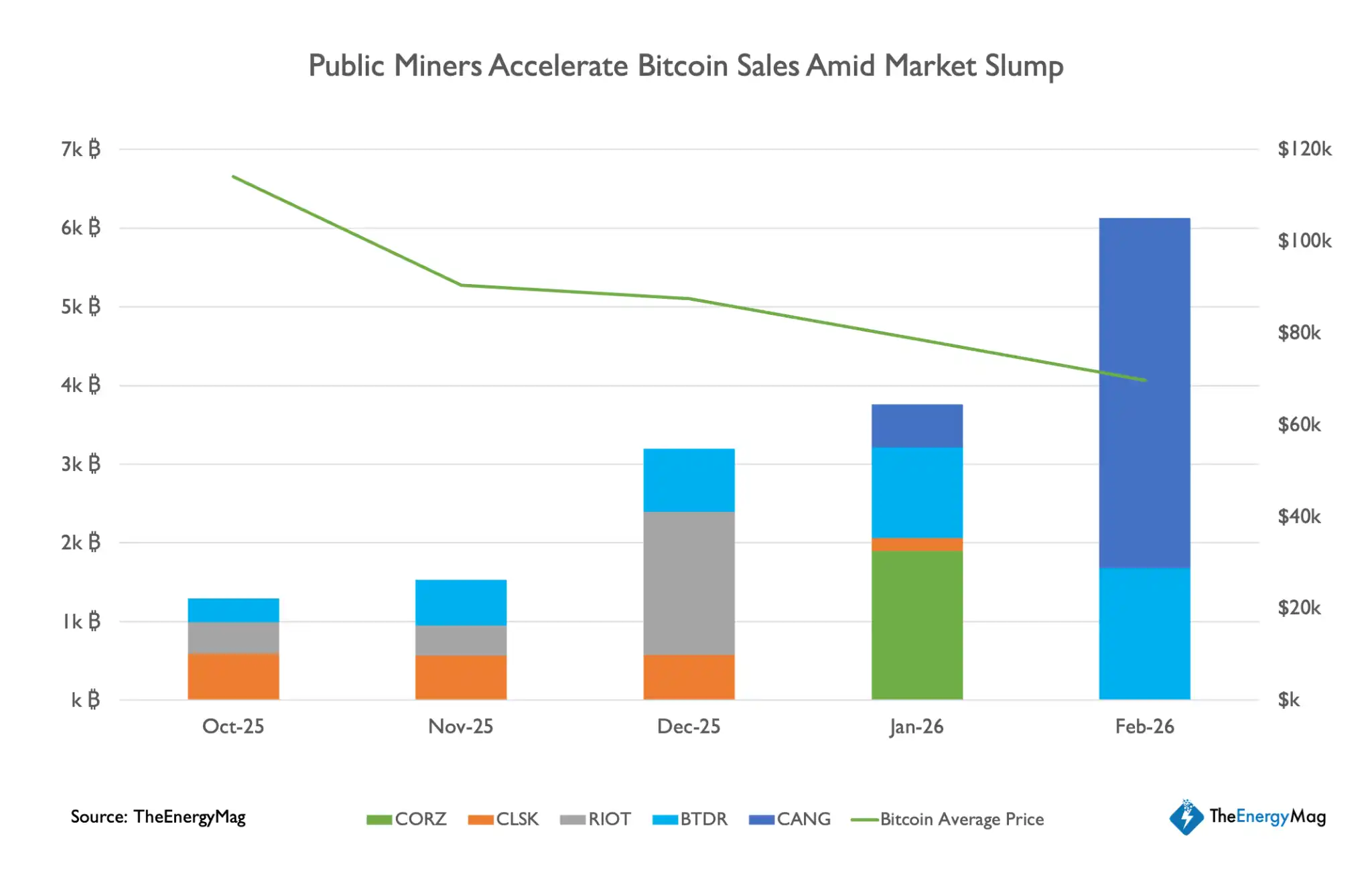
Caption: Miners' inventory sell-offs accelerated after BTC surged past $126,000 last October.

Source TheEnergyMag

Against this backdrop, analysts expect large mining firms to gradually transform into AI infrastructure providers. For instance, Bernstein recently stated that it believes the vast majority of IREN's future value will come from AI infrastructure, citing the company's rapid growth in its cloud AI business.


Related Questions

QWhat is the main reason NVIDIA's $20 billion bond issuance is significant for the AI infrastructure market?

ANVIDIA's plan to issue at least $20 billion in bonds is significant because it signals strong investor appetite for funding AI expansion and underscores the company's belief that the demand for AI infrastructure will remain high, serving as a key industry benchmark.

QWhy are Bitcoin miners pivoting towards AI infrastructure and data centers?

ABitcoin miners are pivoting towards AI infrastructure and data centers because the profitability of Bitcoin mining has been severely squeezed, especially after the 2024 halving event, due to high mining difficulty and operational costs. They are leveraging their existing power and facility infrastructure to tap into the growing demand for computational power in AI.

QWhich specific Bitcoin mining companies are mentioned as transitioning into AI data center providers?

AThe specific Bitcoin mining companies mentioned as transitioning into AI data center providers are HIVE Digital, TeraWulf, Hut 8, and CleanSpark.

QHow much Bitcoin did miners reportedly sell between October last year and March this year, according to TheEnergyMag?

AAccording to TheEnergyMag, Bitcoin miners sold a combined total of over 15,000 BTC between October last year and March this year.

QWhat future value shift does Bernstein predict for IREN, and why?

ABernstein predicts that the future value of IREN will largely come from its AI infrastructure business, citing the company's rapid growth in its cloud AI operations as the primary reason.

Related Reads

Warsh's Debut: Will the FED Chair Who Knows Crypto Best Bring Surprises or Shocks to the Market?

Kevin Warsh, the new Federal Reserve Chairman, prepares for his inaugural press conference amidst a challenging macroeconomic landscape: resurgent inflation, a bond market sell-off, and political pressure from President Trump for rate cuts. Uniquely, Warsh holds indirect investments in over 20 crypto and Web3 entities (e.g., Solana, dYdX), making him the first Fed Chair with disclosed crypto exposure. His stance may combine a hawkish, inflation-focused monetary policy with a crypto-friendly regulatory philosophy that shifts from Powell’s “same risk, same rule” approach toward a framework acknowledging blockchain’s productivity value. Warsh’s leadership could impact crypto markets across three dimensions: a paradigm shift in regulation (potentially accelerating pro-innovation legislation and stable币 rules), a re-pricing of risk premiums based on clearer communication and his view of AI as a structural disinflationary force, and a long-term reallocation of global institutional capital driven by increased legitimacy. Two potential scenarios for the press conference are outlined. A “positive surprise” would involve a dovish-leaning tone on rates coupled with signals of regulatory openness, potentially boosting crypto asset valuations. Conversely, a “negative shock” would see a more hawkish-than-expected stance on inflation and rates, triggering a broad risk-asset selloff that crypto markets would not escape. While ethics rules required Warsh to divest his crypto holdings upon confirmation, his deep understanding of the technology may fundamentally lower policy uncertainty and build a more receptive long-term foundation for digital assets’ integration into the mainstream financial system.

marsbit9h ago

Warsh's Debut: Will the FED Chair Who Knows Crypto Best Bring Surprises or Shocks to the Market?

marsbit9h ago

Trading

Spot
Futures

Hot Articles

What is $BITCOIN

DIGITAL GOLD ($BITCOIN): A Comprehensive Analysis Introduction to DIGITAL GOLD ($BITCOIN) DIGITAL GOLD ($BITCOIN) is a blockchain-based project operating on the Solana network, which aims to combine the characteristics of traditional precious metals with the innovation of decentralized technologies. While it shares a name with Bitcoin, often referred to as “digital gold” due to its perception as a store of value, DIGITAL GOLD is a separate token designed to create a unique ecosystem within the Web3 landscape. Its goal is to position itself as a viable alternative digital asset, although specifics regarding its applications and functionalities are still developing. What is DIGITAL GOLD ($BITCOIN)? DIGITAL GOLD ($BITCOIN) is a cryptocurrency token explicitly designed for use on the Solana blockchain. In contrast to Bitcoin, which provides a widely recognized value storage role, this token appears to focus on broader applications and characteristics. Notable aspects include: Blockchain Infrastructure: The token is built on the Solana blockchain, known for its capacity to handle high-speed and low-cost transactions. Supply Dynamics: DIGITAL GOLD has a maximum supply capped at 100 quadrillion tokens (100P $BITCOIN), although details regarding its circulating supply are currently undisclosed. Utility: While precise functionalities are not explicitly outlined, there are indications that the token could be utilized for various applications, potentially involving decentralized applications (dApps) or asset tokenization strategies. Who is the Creator of DIGITAL GOLD ($BITCOIN)? At present, the identity of the creators and development team behind DIGITAL GOLD ($BITCOIN) remains unknown. This situation is typical among many innovative projects within the blockchain space, particularly those aligning with decentralized finance and meme coin phenomena. While such anonymity may foster a community-driven culture, it intensifies concerns about governance and accountability. Who are the Investors of DIGITAL GOLD ($BITCOIN)? The available information indicates that DIGITAL GOLD ($BITCOIN) does not have any known institutional backers or prominent venture capital investments. The project seems to operate on a peer-to-peer model focused on community support and adoption rather than traditional funding routes. Its activity and liquidity are primarily situated on decentralized exchanges (DEXs), such as PumpSwap, rather than established centralized trading platforms, further highlighting its grassroots approach. How DIGITAL GOLD ($BITCOIN) Works The operational mechanics of DIGITAL GOLD ($BITCOIN) can be elaborated on based on its blockchain design and network attributes: Consensus Mechanism: By leveraging Solana’s unique proof-of-history (PoH) combined with a proof-of-stake (PoS) model, the project ensures efficient transaction validation contributing to the network's high performance. Tokenomics: While specific deflationary mechanisms have not been extensively detailed, the vast maximum token supply implies that it may cater to microtransactions or niche use cases that are still to be defined. Interoperability: There exists the potential for integration with Solana’s broader ecosystem, including various decentralized finance (DeFi) platforms. However, the details regarding specific integrations remain unspecified. Timeline of Key Events Here is a timeline that highlights significant milestones concerning DIGITAL GOLD ($BITCOIN): 2023: The initial deployment of the token occurs on the Solana blockchain, marked by its contract address. 2024: DIGITAL GOLD gains visibility as it becomes available for trading on decentralized exchanges like PumpSwap, allowing users to trade it against SOL. 2025: The project witnesses sporadic trading activity and potential interest in community-led engagements, although no noteworthy partnerships or technical advancements have been documented as of yet. Critical Analysis Strengths Scalability: The underlying Solana infrastructure supports high transaction volumes, which could enhance the utility of $BITCOIN in various transaction scenarios. Accessibility: The potential low trading price per token could attract retail investors, facilitating wider participation due to fractional ownership opportunities. Risks Lack of Transparency: The absence of publicly known backers, developers, or an audit process may yield skepticism regarding the project's sustainability and trustworthiness. Market Volatility: The trading activity is heavily reliant on speculative behavior, which can result in significant price volatility and uncertainty for investors. Conclusion DIGITAL GOLD ($BITCOIN) emerges as an intriguing yet ambiguous project within the rapidly evolving Solana ecosystem. While it attempts to leverage the “digital gold” narrative, its departure from Bitcoin's established role as a store of value underscores the need for a clearer differentiation of its intended utility and governance structure. Future acceptance and adoption will likely depend on addressing the current opacity and defining its operational and economic strategies more explicitly. Note: This report encompasses synthesised information available as of October 2023, and developments may have transpired beyond the research period.

376 Total ViewsPublished 2025.05.13Updated 2025.05.13

What is $BITCOIN

Discussions

Welcome to the HTX Community. Here, you can stay informed about the latest platform developments and gain access to professional market insights. Users' opinions on the price of BTC (BTC) are presented below.

活动图片