SharpLink CEO: How to Interpret Ethereum Developers Surpassing 1 Million?

marsbitPublished on 2026-06-16Last updated on 2026-06-16

Abstract

SharpLink CEO reflects on the milestone of Ethereum surpassing one million historical developers, a figure unmatched in crypto. Based on Electric Capital data and observations from Asian developer hubs, the article argues that Ethereum’s true strength isn't raw speed, but where top builders choose to build long-term. The core advantage is a decade-deep ecosystem of standards, tools, liquidity, and culture. Of the over one million developers, about 232,000 were active in the past year, working on hard problems: protocol scalability (e.g., the upcoming Glamsterdam upgrade), synchronous composability across rollups, and post-quantum security preparedness. Ethereum’s defensibility stems from network effects beyond numbers: deep composability (the "financial Lego" of DeFi), the universal EVM/Solidity stack, credible neutrality (secured by ~900k validators), and its role as the trusted settlement layer for major institutions. The convergence of top researchers, a modular rollup ecosystem, and a culture of long-term thinking create a compounding advantage that is difficult to replicate. The conclusion is that Ethereum has consolidated its position as the default operating system for programmable finance and internet-native capital, attracting the builders who are architecting the next generation of financial infrastructure.

Author: Joseph Chalom

Compiled by: Jiahuan, ChainCatcher

I just returned from Asia, where I spent time with Ethereum developers and ecosystem leaders. Special thanks to Nonce Classic, Four Pillars, and DSRV in Seoul, our friends at SNZ, and the newly opened Ethereum Community Hub in Hong Kong. This hub is the first long-term, physically operational Ethereum community space in Asia, supported by the Ethereum Foundation.

What impressed me most was not just the vibrancy, but the rigor and ambition of the builders. The high-caliber projects, the spirit of experimentation, and the long-term thinking emerging from the global Ethereum ecosystem were truly inspiring.

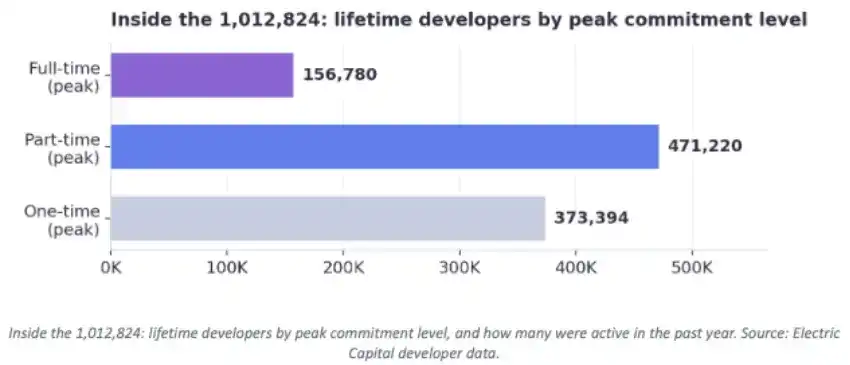
This also gave life to a statistic: According to Electric Capital's data, the total number of historical Ethereum developers has now surpassed one million, with 1,012,824 individuals having contributed to the ecosystem. No other ecosystem in the crypto space comes close.

A Milestone Worth Noting

One million is a round number, and round numbers can sometimes feel hollow. But this one is not. It represents the largest pool of technical talent ever assembled around an open, permissionless blockchain network. More importantly, this pool continues to deepen and broaden.

Of these one million developers, approximately 232,000 have remained active in the past twelve months.
Why Ethereum: The Truly Important Question

For years, discussions in the crypto industry have revolved around speed, fees, and throughput. Every new chain claims to be "faster than Ethereum." But the core question in crypto has never been which chain is the fastest, but rather another:

"Where will the most talented builders choose to build long-term?"

On this question, Ethereum still holds a significant advantage. This advantage isn't merely technical; it's institutional, cultural, economic, and ecological—a complex of a decade's accumulation of developers, infrastructure, standards, tools, liquidity, research, applications, and social coordination that no other ecosystem can replicate.

Ethereum has become the default operating system for programmable finance and internet-native capital formation.

What These Million Builders Are Building, and Why It Strengthens the Moat

The importance of the million builders lies crucially in what they are doing now. The current focus is on the hardest, riskiest problems in the industry: core protocol scalability, privacy, quantum resistance, and the autonomous agent systems that will run on top of it.

The Glamsterdam Upgrade: Innovating Without Compromising Core Principles. The Glamsterdam upgrade, expected in 2026, exemplifies how Ethereum progresses while holding fast to its core values. Core changes include enshrined Proposer-Builder Separation (ePBS) and Block-Level Access Lists (BALs), unlocking parallel execution and higher throughput, potentially raising the Gas limit and significantly increasing Layer 1 capacity.

Scaling for future demand while defending credible neutrality, security, and MEV fairness is a moat that evolves.

Synchronous Composability: Making Many Rollups Act Like One Chain. Composability has always been Ethereum's superpower; the next leap is extending it to Layer 2. Native Rollups and Based Rollups, combined with synchronous composability, solve this. A contract on one rollup can call a contract on the mainnet or another rollup in a single atomic transaction—no bridges, no waiting.

Linea, the Ethereum Economic Zone, Gnosis, Zisk, and the Ethereum Foundation are collaborating to couple this design with live proofs. The result is that dozens of rollups no longer function as isolated networks but begin to operate like a unified chain. This is a direct response to fragmentation criticism.

Quantum Resistance: Ethereum's Most Obvious Lead. No mainstream ecosystem is better prepared for the post-quantum era. The "Lean Ethereum" roadmap, the Ethereum Foundation's Post-Quantum Security team established in early 2026, pq.ethereum.org, and over a dozen client teams already running weekly post-quantum interoperability devnets constitute a coordinated open-source migration targeting readiness by 2029.

When quantum risk materializes, institutions holding trillions in assets will care about one thing above all: which chain prepared the earliest and most thoroughly.

The Moat Beyond Developers: Composability, Standards, and Trust

The aggregation of developer talent creates compound interest, thanks to how Ethereum is built. Its deepest network effect isn't liquidity; it's the depth of composability: applications interact like interoperable financial LEGO bricks.

Lending, stablecoins, exchanges, wallets, tokenized assets, oracles, and Layer 2 rollups all interact through shared standards, and developers never need to start from scratch. The EVM is the application layer of crypto; Solidity skills are transferable across Base, Arbitrum, Optimism, Polygon, zkSync, Scroll, Linea, and hundreds of other networks.

Learning the Ethereum tech stack maximizes optionality, which in turn spins the flywheel: more developers, more tools, more liquidity, more institutions, attracting even more developers to build composable protocols and assets. Liquidity begets liquidity, and composability begets composability.
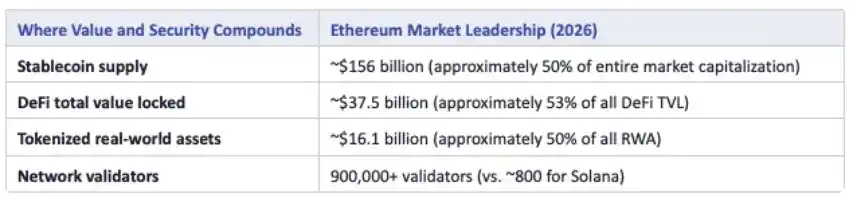
Moreover, Ethereum dominates where true value settles, not just where the most noise is made:

Three forces reinforce this lead.

Credible Neutrality: Ethereum is secured by over 900,000 validators, compared to roughly 800 for Solana. Major institutions place immense value on this degree of decentralization and platform neutrality.

Modularity: Rollups like Base, Arbitrum, and Optimism don't fragment Ethereum; they extend it into an increasingly connected modular internet economy that inherits the security of the mainnet.

Culture: Ethereum attracts top researchers, cryptographers, and EIP standards drafters far beyond any other ecosystem, setting the direction for the entire industry. This is also the advantage most difficult for others to copy.

There's Only One Ethereum

There's a fundamental difference between generating on-chain activity and being the long-term coordination layer for internet-native finance. The latter means being the layer trusted by the world's largest financial institutions.

Ethereum firmly holds the mindshare of large asset holders, institutions that value trust, security, and liquidity above all. I witnessed this firsthand from the front row during my tenure at BlackRock.

In technology markets, ecosystems consolidate over time around standards, liquidity, and developer mindshare. This is Ethereum's moat.

After meeting these developers, builders, and ecosystem leaders in Seoul and Hong Kong, I am more convinced than ever of Ethereum's competitive edge. I met the talent building the next generation of financial infrastructure—the future founders of our industry and the architects of agentic finance. It is these individuals and teams who will change the world.

The future of Ethereum is happening now.

Related Questions

QAccording to the article, what is the significance of Ethereum surpassing 1 million total developers?

AIt represents the largest and most skilled technical talent pool ever assembled around an open, permissionless blockchain network. It signifies deep, broad, and sustainable developer engagement that forms a critical competitive moat for Ethereum.

QBeyond just technical speed, what does the author argue is the most important question in the crypto space?

AThe most important question is not which chain is the fastest, but: 'Where will the very best builders choose to build for the long term?'

QWhat are three key technical areas the article highlights where Ethereum's large developer base is focusing to build its moat?

A1) Core protocol scalability through upgrades like Glamsterdam (ePBS, BALs). 2) Synchronous composability across rollups to unify the ecosystem. 3) Post-quantum resistance via coordinated research and migration efforts.

QWhat three reinforcing forces does the article identify as strengthening Ethereum's leading position?

A1) Credible neutrality, secured by extensive decentralization (e.g., ~900k+ validators). 2) A modular architecture where rollups extend rather than fragment the network. 3) A deeply rooted culture that attracts top-tier researchers and sets industry standards.

QHow does the article describe the difference between generating on-chain activity and being a long-term coordination layer for internet-native finance?

AThe latter means becoming the trusted layer for the world's largest financial institutions. It involves capturing the 'mindshare' of large asset holders who prioritize trust, security, and liquidity over mere transaction speed or volume.

Related Reads

OpenAI's Hyperliquid Pre-IPO Pricing Venture: Why Did It Last Only Half a Year?

The article discusses the rise and fall of Pre-IPO pricing markets on the Hyperliquid blockchain. Trade.xyz, an anonymous team, successfully built the largest pre-market for SpaceX (SPCX) by launching a contract with a clear anchor: the eventual Nasdaq listing price. This provided inherent price stability and validation. In contrast, Ventuals, a team backed by Paradigm, failed despite holding exclusive contracts for highly sought-after companies like OpenAI and Anthropic. Its key mistake was its pricing mechanism. For companies with no near-term IPO date, Ventuals' oracle relied partly on opaque private market transactions and, critically, partly on its own contract's moving average price. This created a self-referential feedback loop where prices were artificially propped up and detached from genuine supply and demand, leading to illiquid markets. Ventuals shut down after nine months, settling positions at final prices of $1,341.80 for OpenAI and $1,618.90 for Anthropic. Ironically, some employees and late-stage investors of these very companies reportedly used these flawed Ventuals prices for valuation reference, highlighting the acute demand for any price signal in illiquid private markets. The article concludes that while demand for pre-IPO trading is real and growing, with players like Coinbase now entering the space, the fundamental challenge remains: without a public listing to provide a definitive price anchor, these markets struggle to establish truly accurate and liquid pricing. The need for a transparent, self-correcting market is the critical lesson from Ventuals' failure.

marsbit23m ago

OpenAI's Hyperliquid Pre-IPO Pricing Venture: Why Did It Last Only Half a Year?

marsbit23m ago

With Daily Active Users Reaching 3-4 Times That of the Industry's Second Place, Which Crack in the Office Agent Market Has Tencent's WorkBuddy Torn Open?

Tencent's AI office assistant, WorkBuddy, has achieved daily active users (DAU) 3-4 times that of the industry's second-place product, primarily driven by non-technical users like HR, operations, and administrative staff. Its rapid growth, starting with a public beta in March 2026, highlights a key strategic divergence from competitors like OpenAI's Codex and Anthropic's Claude Code. Unlike those tools, which originated as developer-focused assistants (in command lines or IDEs) and are now expanding towards office scenarios, WorkBuddy was built from the ground up for non-technical office workers. Its development was user-driven, initiated after腾讯云's team observed non-technical employees using their CodeBuddy coding tool for general tasks. WorkBuddy's design is defined by three core decisions aimed at lowering barriers: 1) Using natural language instead of technical concepts, so users describe their goal without needing to understand prompts or agents. 2) Providing pre-packaged "Skill" templates for common office tasks like data processing, content creation, and research. 3) Natively integrating into existing腾讯 ecosystems like腾讯 Docs and WeChat, making the agent a seamless part of the user's workflow rather than a separate tool. This "scenario encapsulation" approach, prioritizing the shortest path for users to get work done, contrasts with the "underlying capability" focus of Codex and Claude, which offer more flexibility but require more technical setup. Analysts confirm WorkBuddy's leading market position in China by mid-2026, with massive user and request growth following its launch. Recognizing the same trend of surging non-technical adoption, OpenAI and Anthropic are now pivoting their products with features like role-based plugins (Codex) and a simplified desktop interface (Claude Cowork). However, adapting tools built for developers requires significant changes to interaction models and integrations. WorkBuddy currently holds an estimated six-month lead in delivering a complete solution for non-technical office users. Its recently launched enterprise version aims to solidify this advantage. The competition underscores two valid paths: embedding agent capabilities directly into familiar work environments versus building powerful, general-purpose agents that users must learn to access. WorkBuddy's early success demonstrates the effectiveness of the former strategy for mainstream office adoption.

marsbit31m ago

With Daily Active Users Reaching 3-4 Times That of the Industry's Second Place, Which Crack in the Office Agent Market Has Tencent's WorkBuddy Torn Open?

marsbit31m ago

Trading

Spot
Futures

Hot Articles

Discussions

Welcome to the HTX Community. Here, you can stay informed about the latest platform developments and gain access to professional market insights. Users' opinions on the price of ETH (ETH) are presented below.

活动图片