Microsoft annonce la construction d'un ordinateur quantique commercial dans trois ans : Le rêve pourra-t-il se réaliser ?

marsbitPublished on 2026-06-15Last updated on 2026-06-15

Abstract

Microsoft annonce avoir développé le nouveau puce quantique Majorana 2, où les qubits affichent une durée de cohérence moyenne record de 20 secondes, soit une fiabilité multipliée par 1000 par rapport à la génération précédente. Sur cette base, la société fixe un objectif ambitieux : construire un ordinateur quantique commercial viable d'ici 2029. Cette percée repose sur deux piliers. D'abord, la technologie des *qubits topologiques* utilisée par Microsoft, qui exploite les propriétés des quasi-particules de Majorana pour protéger l'information quantique des perturbations, offrant une stabilité intrinsèque supérieure. Ensuite, le rôle crucial joué par l'IA dite "agentique" de la plateforme Microsoft Discovery. Celle-ci a accéléré la recherche en optimisant les paramètres de fabrication, en analysant des données complexes et en résolvant des problèmes expérimentaux, réduisant considérablement le temps de développement. Si cet avancement est salué comme une étape majeure, des défis immenses persistent pour atteindre l'objectif de 2029. Le Majorana 2 ne contient que 12 qubits, alors qu'un ordinateur quantique universel et utile nécessitera probablement des millions de qubits. De plus, des questions pratiques subsistent : la durée de cohérence, bien que prolongée, sera-t-elle suffisante pour les algorithmes complexes ? Les coûts de compilation et la vérification des résultats posent également des problèmes non résolus. Microsoft, en misant sur la voie topologique qu'elle estim...

Microsoft a récemment dévoilé sa nouvelle puce quantique de nouvelle génération, Majorana 2. Le fabricant affirme que le temps de cohérence moyen des qubits sur cette puce atteint 20 secondes, une fiabilité 1000 fois supérieure à celle de la génération précédente. Sur cette base, Microsoft a lancé une déclaration fracassante : « D'ici 2029, nous disposerons d'un ordinateur quantique évolutif ayant une valeur commerciale. » L'année dernière encore, les prévisions dominantes dans le secteur évoquaient « d'ici dix ans ». Microsoft vient donc de diviser ce délai par deux.

Au cours du développement de cette puce, Microsoft s'est largement appuyé sur son IA agentique de la plateforme « Microsoft Discovery », permettant à une équipe d'IA de collaborer comme un groupe de recherche humain, en analysant de manière autonome des volumes massifs de données expérimentales, en émettant des hypothèses et en optimisant les procédés de fabrication. D'un côté, une percée matérielle en calcul quantique, de l'autre, une assistance logicielle par l'intelligence artificielle, les deux domaines les plus avancés sont en train de se renforcer mutuellement.

Qu'est-ce qu'une puce quantique ?

Une puce quantique manipule des qubits. Un qubit peut être dans un état de superposition de 0 et 1 ; avant mesure, il est comme une pièce de monnaie en rotation, portant simultanément la possibilité d'être 0 et 1. L'état de superposition de deux qubits peut contenir les quatre possibilités 00, 01, 10, 11 ; pour trois qubits, cela correspond à huit possibilités... et ainsi de suite, l'état quantique de n qubits est de dimension 2^n. Ensuite, par des opérations soigneusement conçues, les portes quantiques (portes logiques en calcul quantique) manipulent la phase de l'état quantique, provoquant une interférence des amplitudes de probabilité dans la superposition, amplifiant ainsi la réponse correcte. C'est la raison pour laquelle on dit que l'ordinateur quantique possède une « puissance de calcul exponentielle ».

En outre, deux qubits intriqués présentent une corrélation particulière : en mesurant l'un, l'état de l'autre se détermine instantanément, quelle que soit la distance qui les sépare. En exploitant ces propriétés quantiques, les ordinateurs quantiques pourraient accomplir des tâches difficiles à réaliser efficacement pour les ordinateurs classiques.

La puce quantique est le processeur spécialement conçu pour générer, manipuler et mesurer ces qubits. Elle n'utilise pas de transistors traditionnels, mais capte les états quantiques via des circuits supraconducteurs, des ions piégés, des photons ou même des matériaux topologiques, les faisant calculer selon une logique définie par l'homme, c'est-à-dire les portes quantiques.

Les faiblesses de la puce quantique

Bien que puissants, les qubits présentent une faiblesse fatale : ils sont extrêmement sensibles et fragiles.

L'état de superposition d'un qubit, s'il est légèrement perturbé par l'environnement (comme des fluctuations de température, des radiations électromagnétiques ou des rayons cosmiques), s'effondre instantanément en un 0 ou un 1 déterminé, perdant ainsi sa capacité de calcul parallèle. Ce phénomène est appelé décohérence.

Avant la puce Majorana 1 de Microsoft, la durée de vie typique des qubits supraconducteurs dominants n'était que de quelques dizaines de microsecondes. Autrement dit, à peine préparé, avant même d'avoir effectué quelques calculs, le qubit « meurt ». Par conséquent, un indicateur clé de la qualité d'une puce quantique est la durée de vie des qubits, également appelée temps de cohérence.

L'annonce par Microsoft d'un temps de cohérence de 20 secondes a provoqué des réactions sismiques dans le secteur. Car pour les opérations quantiques, 20 secondes représentent déjà un chiffre astronomique. Il faut savoir qu'exécuter une opération de porte quantique ne prend qu'une microseconde (un millionième de seconde). 20 secondes signifient que l'on peut effectuer vingt millions d'opérations, ce qui est théoriquement suffisant pour exécuter des algorithmes quantiques assez complexes. Microsoft a même fait une comparaison frappante : « Cette amélioration équivaut presque à inventer une batterie de téléphone portable qui, au lieu de durer un jour, tient près de trois ans après une seule charge. »

20 secondes n'est qu'une moyenne, certains qubits pouvant même se maintenir pendant une minute. La génération précédente, Majorana 1, n'atteignait qu'un temps de cohérence de l'ordre de la milliseconde, d'où l'affirmation de Microsoft d'une « fiabilité améliorée de 1000 fois ».

Alors, comment Microsoft a-t-il fait ? La réponse se cache dans sa feuille de route technologique : le calcul quantique topologique.

L'arme secrète de Microsoft : le qubit topologique

La plupart des puces quantiques dominantes, comme celles de Google et d'IBM, utilisent des qubits supraconducteurs. Cette technologie est relativement mature, mais pour éviter les interférences environnementales, elle nécessite des températures extrêmement basses, proches du zéro absolu (-273 °C), et présente une courte durée de vie, sujette aux erreurs.

Microsoft a passé 20 ans à emprunter une voie plus difficile mais théoriquement plus avantageuse : le qubit topologique.

Sur une feuille de papier, percez un ou deux trous, froissez la feuille en boule, le papier se déforme, mais les trous restent là. Un trou ne devient pas deux trous, deux trous ne fusionnent pas en un seul ; le nombre de trous sur la feuille est une invariante topologique. De même, le fait de tresser deux cordes ensemble, l'ordre dans lequel les cordes échangent leurs positions est aussi une invariante topologique. Le qubit topologique exploite justement cette invariance topologique pour protéger l'information quantique. L'information n'est pas stockée sur des particules spécifiques, mais dans la texture de tressage résultant de l'échange de positions entre des quasiparticules (une excitation collective d'un système de particules). Ce mode de stockage est non local, ce qui signifie que des perturbations mineures comme le bruit ou la chaleur ont du mal à détruire la structure topologique globale. Par conséquent, les qubits topologiques sont intrinsèquement bien moins sensibles au bruit environnemental et sont beaucoup plus stables que les autres types de qubits.

La quasiparticule utilisée par Microsoft porte un nom légendaire : le fermion de Majorana. En 1937, le physicien italien Ettore Majorana a prédit l'existence d'un fermion particulier dont l'antiparticule serait elle-même. Cette particule n'a pas encore été découverte. Au début du XXIe siècle, les scientifiques ont commencé à en chercher une analogie en physique de la matière condensée : un mode appelé mode de Majorana à énergie nulle. Lorsque des modes de Majorana à énergie nulle échangent leurs positions dans un espace bidimensionnel, l'état quantique global change ; l'ordre des échanges influence le résultat final, un peu comme différentes façons de tresser les cheveux donnent des tresses différentes.

En 1997, le physicien Alexei Kitaev, alors à l'Institut Landau en Russie, a été le premier à proposer la théorie de l'utilisation des fermions de Majorana pour le calcul quantique topologique. En 2005, Microsoft a créé Station Q, Kitaev en étant l'un des membres fondateurs. Microsoft s'est ainsi engagé sur cette voie technologique, y consacrant près de 20 ans. En 2025, Microsoft a publié la première puce Majorana, prouvant la faisabilité en principe du qubit topologique. Ils ont révolutionné l'utilisation de supraconducteurs topologiques, permettant de créer un nouvel état de la matière pour un calcul quantique plus stable. Aujourd'hui, Majorana 2 transforme ce principe en un véritable bond de performance.

Une amélioration clé réside dans le changement de matériau : le supraconducteur topologique de la première puce Majorana utilisait de l'aluminium, tandis que la seconde génération utilise du plomb. Le plomb est couramment utilisé comme matériau de blindage contre les radiations. En l'utilisant comme supraconducteur, on peut considérablement épaissir le bouclier du qubit, protégeant l'état quantique fragile des interférences des rayons cosmiques. Cette modification, qui peut sembler peu révolutionnaire, combinée à l'optimisation par l'IA de centaines de paramètres de fabrication, a finalement permis une amélioration de la fiabilité de 1000 fois.

Cependant, Majorana 2 ne compte actuellement que 12 qubits intégrés. Pour réaliser un ordinateur quantique universel ayant une valeur commerciale, le secteur estime généralement qu'il faut au moins un million de qubits. Passer de 12 à 1 million implique de surmonter d'innombrables défis techniques et physiques. Le fait que Microsoft ose annoncer 2029 montre leur grande confiance dans leur approche topologique. En effet, en théorie, la surcharge de correction d'erreurs des qubits topologiques est bien inférieure à celle des autres solutions dominantes. Une fois mis en pratique, ils pourraient se concrétiser plus rapidement que les autres approches.

L'IA à l'honneur : comment l'IA agentique accélère le développement des puces quantiques

L'amélioration de 1000 fois de la fiabilité réalisée par Microsoft cette fois-ci bénéficie également d'un « coup de pouce » indéniable : l'IA agentique. Microsoft dispose de la plateforme Microsoft Discovery. La capacité centrale de cette plateforme est de déployer des IA agentiques, c'est-à-dire plusieurs agents d'IA pouvant jouer différents rôles, comme analyste de données, concepteur d'expériences ou chercheur documentaire, accomplissant de manière autonome des flux de travail de recherche sous la direction de scientifiques humains.

Tout commence avec le matériau au cœur de la puce Majorana. La première génération utilisait de l'aluminium comme supraconducteur, tandis que la deuxième génération utilise du plomb. Changer de matériau affecte tout le système, et l'équipe a passé plusieurs années à explorer les divers compromis. Trouver la formulation de dopage précise nécessitait des centaines, voire des milliers d'expériences. Désormais, l'IA délimite d'abord les cibles à haute probabilité par simulation ; idéalement, une seule expérience peut suffire.

Ce n'est que le début. La fabrication d'une puce quantique implique d'innombrables étapes : logiciel, architecture, empilement de matériaux, procédés, mesure, etc. La modification d'un paramètre peut provoquer un effet domino. Les ingénieurs humains ont du mal à surveiller simultanément toutes les variables, mais les agents d'IA le peuvent. Plus crucial encore, l'équipe quantique de Microsoft a accumulé près de vingt ans de données expérimentales massives, dans des formats divers, dispersées entre des scientifiques de différents pays et de différentes spécialités. Les agents d'IA peuvent les synthétiser à nouveau et trouver des corrélations invisibles pour nous, humains, car aucune personne ne possède une vue aussi large.

L'autre atout majeur de l'IA est l'accélération des expériences. La création d'un état quantique topologique nécessite d'ajuster simultanément des centaines de paramètres de tension, puis d'effectuer des mesures, et la mesure est précisément l'étape la plus longue et la plus délicate du calcul quantique. Auparavant, un scientifique mettait plusieurs semaines à effectuer manuellement une série de mesures. L'équipe avait tenté une automatisation avec des méthodes d'apprentissage automatique précoces, sans succès. Ce n'est qu'après avoir formé un agent d'IA spécialisé sur la plateforme Microsoft Discovery qu'ils ont réduit le cycle complet de plusieurs ordres de grandeur. L'IA peut balayer en parallèle tout l'espace des paramètres, déterminant automatiquement où se trouve le point minimal permettant un fonctionnement normal, puis le localiser avec précision.

Enfin, l'IA a également aidé l'équipe à résoudre le problème du « bruit fantôme ». Une fois, les données expérimentales étaient toujours incohérentes, et les scientifiques ont longtemps cherché sans trouver la cause. Plus tard, un agent d'IA a synthétisé le modèle physique, les journaux d'appareils et les connaissances des procédés, extrayant des données brutes un capteur de température non calibré qui perturbait silencieusement les résultats de mesure.

On peut dire que sans la participation de l'IA, le bond de performance de 1000 fois de Majorana 2 aurait pu prendre encore plusieurs années à se réaliser. Cela confirme également un consensus en formation : le calcul quantique et l'intelligence artificielle peuvent se renforcer mutuellement. L'IA accélère le développement du matériel de calcul quantique, et les futurs ordinateurs quantiques soutiendront à leur tour l'IA en fournissant une puissance de calcul exponentielle pour l'apprentissage automatique.

Le rêve pourra-t-il se réaliser ?

Sur ce terrain de compétition, Microsoft n'est pas le seul participant. Les chemins vers « l'autre rive quantique » ne se limitent pas à la puce quantique topologique ; il existe également les puces quantiques supraconductrices, à ions piégés, photoniques et à spins dans le silicium. Les gouvernements intensifient également leurs investissements. La Chine a des projets à grande échelle dans les domaines de la communication quantique et du calcul quantique ; les États-Unis accordent des subventions importantes aux entreprises de calcul quantique ; l'Union européenne a également lancé le programme « Quantum Flagship ».

En 2029, Microsoft pourra-t-elle réellement créer un ordinateur quantique de niveau commercial ? Paul Stevenson, professeur de physique à l'Université du Surrey au Royaume-Uni, commente que Microsoft semble avoir réalisé une percée dans la fabrication de qubits fiables. Si les résultats résistent à l'examen, ce délai semble raisonnable. Mais en même temps, de nombreux scientifiques souhaitent voir plus de données détaillées ayant passé l'examen par les pairs, car les articles connexes publiés par Microsoft à cette occasion n'ont pas encore terminé le processus d'examen par les pairs.

Bien sûr, derrière la déclaration tapageuse et l'enthousiasme de Microsoft, plusieurs points méritent une réflexion plus froide. Premièrement, 20 secondes, est-ce suffisant ? Un temps de cohérence de 20 secondes représente certes un bond prodigieux par rapport à quelques dizaines de microsecondes. Mais les algorithmes quantiques pratiques nécessitent des centaines de millions d'opérations de portes quantiques. Même en comptant une microseconde par opération, 20 secondes ne permettent que vingt millions d'étapes, ce qui est encore éloigné de plusieurs ordres de grandeur des nombres requis pour casser le chiffrement RSA ou simuler précisément des molécules pharmaceutiques. Rappelons que la décohérence est une limite imposée par les lois de la physique, que l'ingénierie ne pourra jamais totalement éliminer. Deuxièmement, le problème du coût de compilation. Chaque fois qu'on utilise un ordinateur quantique pour résoudre un problème, il faut d'abord effectuer une compilation sur un ordinateur classique, traduisant le problème en un circuit quantique spécifique, puis résoudre des équations en fonction des paramètres de la puce quantique pour obtenir les séquences d'impulsions électromagnétiques correspondant aux portes quantiques. Ce processus de compilation n'est pas universel ; il est unique à chaque problème, et la puissance de calcul classique consommée par la compilation elle-même peut être proche, voire supérieure, au coût de résolution directe par des méthodes classiques. Troisièmement, que se passe-t-il si l'ordinateur quantique fournit une réponse erronée ? L'homme ne peut pas la vérifier avec un ordinateur classique (si c'était possible, on n'aurait pas besoin de l'ordinateur quantique). En fin de compte, si la réponse est fausse, on ignore où se situe l'erreur.

Le rêve de construire un ordinateur quantique commercial ressemble à une botte suspendue en l'air, tardant à toucher le sol. Un jour, même si elle touche le sol, ce ne sera peut-être qu'un bruit sourd. En parcourant l'histoire des sciences, le progrès technologique ressemble parfois à « planter un saule sans intention qu'il prospère, vouloir cultiver une fleur mais échouer ». Ce sur quoi on fonde de grands espoirs ne se réalise pas forcément, tandis que les solutions et les percées se trouvent peut-être là où on ne les attend pas.

Références

https://news.microsoft.com/source/features/innovation/majorana-2-microsoft-discovery-agentic-ai/

https://www.bluequbit.io/blog/quantum-chips

https://www.bbc.com/news/articles/cj4p7gyvp52o

https://zhuanlan.zhihu.com/p/2035004303467917427?share_code=14f9XN3e5wlBq&utm_psn=2035105136662553502&utm_source=wechat_session&utm_medium=social&s_r=0&wechatShare=1

Cet article provient du compte WeChat : 心智观察所 , Auteur : 心智观察所

Related Questions

QQu'est-ce que Microsoft a annoncé concernant son ordinateur quantique ?

AMicrosoft a annoncé qu'il construira un ordinateur quantique commercialisable et évolutif d'ici 2029, en s'appuyant sur sa nouvelle puce quantique Majorana 2 dont les qubits ont une durée de vie moyenne de 20 secondes.

QQuel est le principal avantage des qubits topologiques de Microsoft par rapport aux qubits supraconducteurs traditionnels ?

ALes qubits topologiques de Microsoft sont intrinsèquement plus stables et résistants au bruit environnemental car l'information quantique est stockée de manière non locale dans la structure topologique (la 'tresse') des quasi-particules, ce qui la protège des petites perturbations.

QComment l'IA a-t-elle contribué au développement de la puce Majorana 2 ?

AMicrosoft a utilisé des IA agentiques sur sa plateforme 'Microsoft Discovery'. Ces agents IA ont automatisé et accéléré des tâches comme l'analyse de vastes ensembles de données expérimentales, l'optimisation des paramètres de fabrication (ex: la composition du plomb), la localisation précise des paramètres de fonctionnement et la résolution de problèmes complexes comme le 'bruit fantôme'.

QQuels sont les principaux défis ou limites qui subsistent pour réaliser l'ordinateur quantique commercial de Microsoft ?

ALes principaux défis sont : passer de 12 qubits à plusieurs millions nécessaires pour un ordinateur quantique utile ; bien que la durée de vie de 20 secondes soit une avancée majeure, elle pourrait ne pas suffire pour les algorithmes quantiques les plus complexes ; les coûts et la complexité de la compilation des problèmes en circuits quantiques ; et la difficulté de vérifier la justesse des résultats d'un calcul quantique.

QQu'est-ce qu'un qubit quantique et en quoi est-il différent d'un bit classique ?

AUn qubit (bit quantique) est l'unité fondamentale de l'information quantique. Contrairement à un bit classique qui est soit 0 soit 1, un qubit peut exister dans un état de superposition, simultanément 0 ET 1 avec des probabilités variables. De plus, plusieurs qubits peuvent être intriqués, créant des corrélations fortes et instantanées quelle que soit la distance qui les sépare.

Related Reads

For Those Still Obsessed with Altcoins, Just Go All-in on HOOD

Title: "For Those Still Fixated on Altcoins, Just Bet on HOOD" The article argues that Robinhood (HOOD) stock is a compelling alternative for investors still holding onto hopes for altcoin rallies. It highlights HOOD's recent strong performance, briefly touching $100, and expresses continued optimism. The bullish thesis is multi-faceted: HOOD's operational data for May showed record highs in key metrics like total assets and funded customers, though crypto volume was weaker. Positive catalysts include Robinhood launching its own prediction market (Rothera) to capture more revenue, gaining approval to act as an IPO underwriter for major upcoming listings, and being selected to manage the new "Trump Account" government savings program for millions of future US newborns. Insider and institutional buying, along with raised price targets, provide further confidence. The core argument is that HOOD is successfully decoupling from the crypto market's fortunes. While crypto-related revenue was once a major contributor, its share of total revenue has been declining, hitting 13% in Q1 2026. Although HOOD's price historically moved with Bitcoin, a recent divergence is noted. The author posits that Robinhood's growing equity trading, prediction markets, and IPO-related businesses can drive growth independently of a crypto bull market. Thus, HOOD offers asymmetric exposure: it stands to benefit if the crypto market recovers but is no longer wholly dependent on it. For those disillusioned with altcoins' risks, HOOD presents a potentially safer way to maintain exposure to the fintech and speculative trading space.

marsbit9m ago

For Those Still Obsessed with Altcoins, Just Go All-in on HOOD

marsbit9m ago

For Those Still Obsessed with Altcoins, Just Buy HOOD

The author expresses bullish sentiment on Robinhood (HOOD) stock, citing multiple positive catalysts. Recent monthly operational data shows record highs in key metrics like total assets, funded customers, and margin balances. On the news front, Robinhood launched its own prediction market (Rothera), received approval to act as an IPO underwriter, and was selected to manage the new "Trump Accounts" for U.S. newborns, ensuring a long-term user base. Insiders and institutions are also buying or raising price targets. The core investment thesis, however, focuses on HOOD's evolving valuation narrative. Historically viewed as a "crypto proxy," its stock price was highly correlated with Bitcoin and its revenue heavily dependent on cryptocurrency trading fees. Recent data indicates this dependence is waning: crypto-related revenue hit a multi-quarter low of 13% of total revenue in Q1 2026, and the stock price has recently decoupled from BTC's trend. The author argues HOOD is transforming into a more diversified platform. Its growth is now driven by equities, options, prediction markets, and IPO-related services. This reduces its cyclical vulnerability to crypto bear markets. Crucially, if the crypto market recovers, HOOD would still benefit from increased trading activity. Therefore, for investors still hoping for gains from altcoins but concerned about their risks and liquidity, the author suggests HOOD offers a compelling alternative with higher safety margins—it can rise with a crypto bull run but isn't reliant on one.

Odaily星球日报13m ago

For Those Still Obsessed with Altcoins, Just Buy HOOD

Odaily星球日报13m ago

Cryptocurrency & Stock Market Indicator丨SpaceX Discloses Holding 18,712 Bitcoins Worth $1.18 Billion; Strategy Spends $100 Million Two Weeks in a Row to Scoop Up BTC at Low Levels (June 16)

"Coin-Stock Barometer: SpaceX discloses holding 18,712 Bitcoin worth $1.18B; Strategy spends another $100M accumulating BTC (June 16) SpaceX has officially disclosed holding 18,712 Bitcoin in its S-1 filing, valued at ~$1.18B, becoming the 8th largest public company Bitcoin holder. Its average cost is ~$35,000 per BTC. In weekly BTC treasury news, Strategy (formerly MicroStrategy) purchased another 1,587 BTC (~$100M) last week, increasing its total to 846,842 BTC. Mara Holdings added 1,000 BTC. However, Metaplanet and others made no purchases. Nakamoto sold ~600 BTC to repay ~$45M in debt. Global public companies (excluding miners) now hold 1,121,341 BTC. In other crypto treasury developments: - Metaplanet acquired Siiibo Securities to build a Bitcoin-focused financial ecosystem in Japan. - Bitmine increased its ETH holdings by 76,881 last week. - SharpLink's cumulative ETH staking rewards surpassed 21,119 ETH. - Forward Industries' acquisition offers for two SOL treasury companies, including Brera Holdings (holding 2.1M SOL), were rejected. - Tron Inc.'s TRX holdings surpassed 700 million. - Avalanche Treasury Co. (AVAT) begins trading on Nasdaq. - AIFC detailed plans to use WLFI tokens for collateral/loans. Market perspectives on U.S. stocks vary. 'White-Haired Stock God' Serenity sees the current cycle as retail-to-institution transfers, where negative reports may signal institutional accumulation. Morgan Stanley suggests a rotation from tech to cyclical stocks could occur. Citrini believes the U.S. stock market hasn't peaked but expects frequent 10-15% pullbacks in the coming months."

marsbit18m ago

Cryptocurrency & Stock Market Indicator丨SpaceX Discloses Holding 18,712 Bitcoins Worth $1.18 Billion; Strategy Spends $100 Million Two Weeks in a Row to Scoop Up BTC at Low Levels (June 16)

marsbit18m ago

Do Robots Also Need Encrypted Wallets? Stablecoin Giant Tether Bets on German Company NEURA Robotics

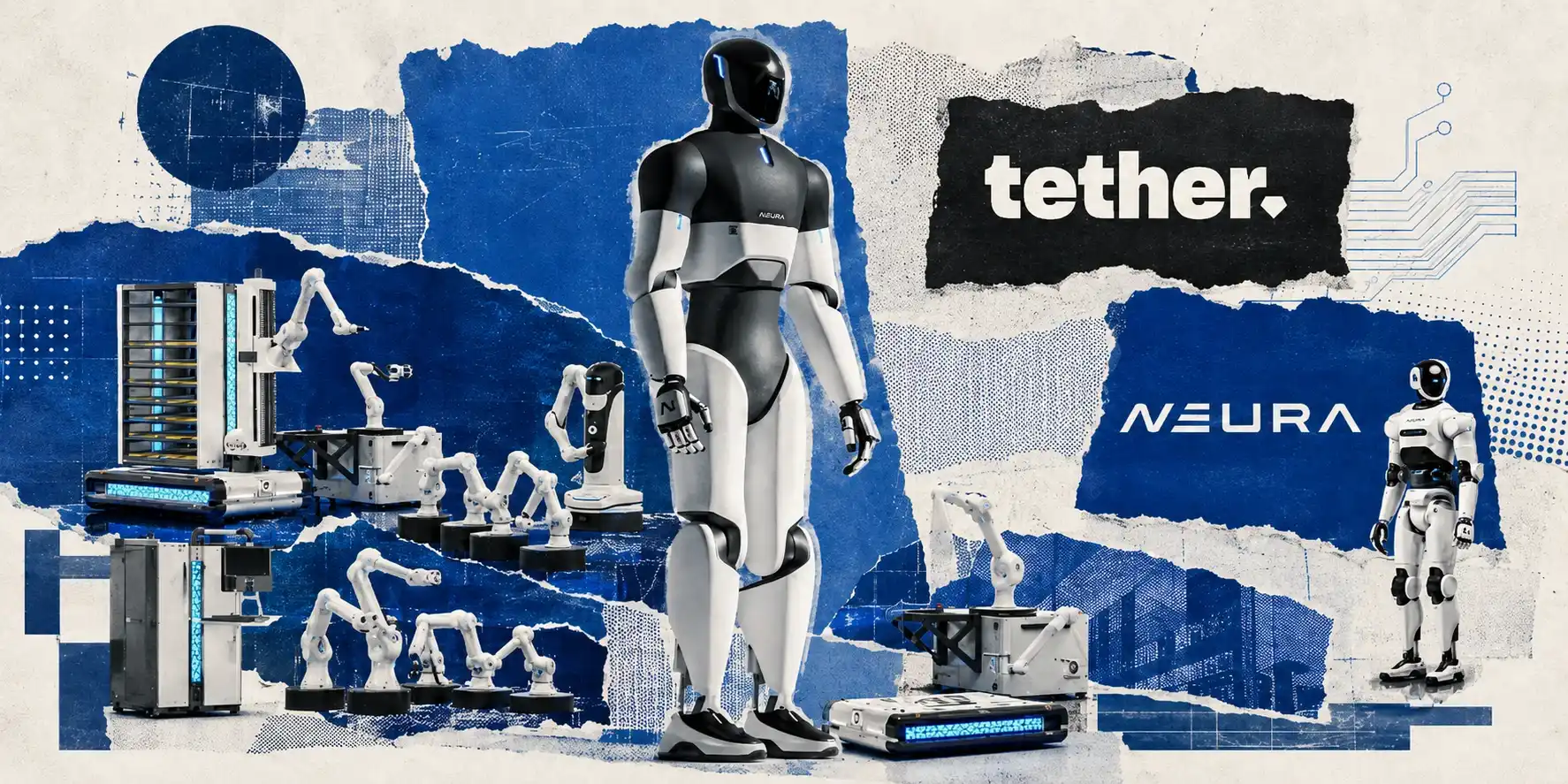
Do Robots Need Crypto Wallets? Stablecoin Giant Tether Bets on German Firm NEURA Robotics German robotics company NEURA Robotics has secured up to $1.4 billion in what is claimed to be the largest-ever funding round in the full-stack robotics industry, valuing the company at $7 billion. The Series C round attracted major investors like Tether, Qualcomm, Amazon, NVIDIA, Bosch, and the European Investment Bank. NEURA, founded in 2019, initially focused on AI-powered collaborative robots (cobots) for industrial automation, later expanding to autonomous mobile robots, service robots, and humanoid robots. Its core strategy is evolving from a hardware manufacturer to the operator of "Neuraverse," a platform designed to enable different robots to share learned experiences and data, creating network effects. A key, crypto-focused aspect of this investment is Tether's involvement. Tether plans to integrate its open-source Wallet Development Kit (WDK) into NEURA's robot platforms. This would embed self-custody wallet functionality, allowing robots to autonomously handle payments and settlements for tasks under pre-set rules—envisioning use cases in logistics or Robotics-as-a-Service (RaaS) models. This move could position stablecoins and crypto wallets as potential "machine payment infrastructure." Additionally, the partnership will see Tether's QVAC (QuantumVerse Automatic Computer) edge-AI framework tested and deployed within Neuraverse. This aims to enable low-latency, offline-capable AI decision-making directly on robots, reducing reliance on cloud computing for critical, time-sensitive operations. The investment underscores Tether's broader ambition to expand beyond being just a stablecoin issuer into AI, energy, and digital infrastructure, with NEURA's robotics network serving as a testbed for merging crypto-based financial layers with edge-based intelligence for the future of automation.

marsbit36m ago

Do Robots Also Need Encrypted Wallets? Stablecoin Giant Tether Bets on German Company NEURA Robotics

marsbit36m ago

Trading

Spot
Futures

Hot Articles

What is LINON

Linde plc Tokenized Stock (Ondo): Revolutionizing Traditional Equity Access Through Blockchain Innovation The emergence of Linde plc Tokenized Stock (Ondo), represented by the ticker $LINON, signifies a monumental shift in the fusion of traditional financial structures and decentralized finance (DeFi). This innovative financial instrument showcases the tremendous potential of blockchain technology to democratize access to traditional equity markets while ensuring the security and regulatory compliance necessary for institutional-grade financial products. Through Ondo Finance's pioneering tokenization platform, $LINON provides a seamless pathway for global investors to engage with one of the world's leading industrial gas companies, Linde plc, creating a blockchain-native representation of the underlying equity. Introduction to Linde plc Tokenized Stock The landscape of financial markets is witnessing a groundbreaking transformation through the tokenization of real-world assets. Linde plc Tokenized Stock (Ondo) epitomizes this revolutionary approach by bridging the gap between conventional stock ownership and blockchain-enabled financial infrastructure. The $LINON token allows investors to gain exposure to one of the prominent industrial companies worldwide through decentralized technology. Operating within Ondo Finance's comprehensive ecosystem, $LINON symbolizes a practical application of tokenization technology that enhances accessibility, efficiency, and global connectivity in traditional financial markets. By leveraging blockchain infrastructure, this tokenized stock enables international investors to participate in U.S. equity markets, overcoming traditional barriers associated with cross-border investing. The significance of $LINON goes beyond technological innovation; it represents a fundamental shift in asset structuring, distribution, and trading in the digital age. This tokenized stock maintains all the economic benefits associated with traditional Linde plc shares while offering improved liquidity, programmable compliance features, and seamless integration with decentralized finance protocols. The development of $LINON indicates a growing acceptance of blockchain technology as a viable means for traditional finance, exemplifying how even well-established assets like Linde plc can integrate into blockchain systems. This approach preserves the core attributes that appeal to investors while introducing advanced capabilities that enhance the overall investment proposition. Project Overview and Objectives Linde plc Tokenized Stock (Ondo) encapsulates a strategic effort to democratize access to traditional equity markets through advanced blockchain technologies. The primary objective of $LINON is to provide approved global investors seamless access to the economic exposure associated with Linde plc shares, furthering an effort to create a more inclusive financial ecosystem. Beyond the digital representation of traditional assets, $LINON endeavors to eliminate barriers of geography and time zones that limit investor participation. Its design ensures that blockchain technology can elevate traditional investment vehicles without undermining the security or compliance requirements expected by investors. Key goals of the project include enhanced liquidity provision, programmable compliance mechanisms, and interoperability with other blockchain networks. Each $LINON token is fortified by actual Linde plc securities housed at U.S.-registered broker-dealers, allowing holders to reap economic advantages akin to traditional stockholders, such as dividend reinvestment. Furthermore, $LINON aims to establish new industry standards for institutional-grade tokenized securities, paving the way for traditional assets to embrace blockchain technology while remaining compliant with regulatory frameworks. By associating itself with a company as reputable as Linde plc, the project opens avenues for exploring tokenized equities catering to both conservative institutional players and daring retail investors. Project Creator and Development Team The vision for Linde plc Tokenized Stock (Ondo) comes from Nathan Allman, founder and CEO of Ondo Finance. His background in traditional finance coupled with expertise in blockchain technology positions him uniquely to navigate the complexities of asset tokenization. Allman's academic journey began at Brown University, focusing on Economics and Biology, equipping him with valuable analytical skills. His time at Goldman Sachs in the Digital Assets division strengthened his understanding of the interplay between financial institutions and emerging technologies, laying the groundwork for his later endeavors in alternative investment strategies. Under Allman's guidance, Ondo Finance has emerged as a leader in asset tokenization, launching $LINON as a flagship example of the company's larger mission towards revolutionizing traditional financial systems using blockchain technology. His commitment to leveraging blockchain for creating institutional-grade financial products has shaped the landscape of real-world asset tokenization. Investment and Funding Structure The growth of Ondo Finance, the platform powering Linde plc Tokenized Stock (Ondo), is bolstered by robust financial backing from prestigious venture capital firms and strategic investors. This strong investment foundation underpins the development of the key infrastructure essential for compliant tokenized securities like $LINON. In August 2021, Ondo Finance secured $4 million in seed funding led by a major venture capital firm, which enabled the company to commence platform development and establish the necessary regulatory processes for tokenizing real-world assets. This early investment cemented Ondo Finance's credibility within the industry. The Series A funding round followed, garnering $20 million with participation from renowned firms committed to transformative technology companies. This backing demonstrated substantial institutional confidence in Ondo Finance's vision, allowing it to hone its approach to asset tokenization through mechanisms that ensure compliance and accessibility. Noteworthy contributors, including institutional investors and experienced partners, have added significant value to Ondo Finance’s development efforts. Their involvement underscores the confidence across sectors in Ondo Finance's approach to bridging traditional finance with blockchain innovations. Technical Infrastructure and Innovation The technical architecture that underpins Linde plc Tokenized Stock (Ondo) represents a sophisticated melding of traditional finance systems and cutting-edge blockchain technology. The architecture's foundation is built on the Ethereum network, renowned for its security and programmability—both critical for intricate financial instruments. The $LINON tokenization process comprises creating a blockchain-native representation of Linde plc shares that preserves economic benefits while augmenting investor capabilities. Each token corresponds to actual shares held at U.S.-registered broker-dealers, creating a compliant custody structure that legitimizes the asset's existence and value. Automated compliance systems are integrated into the tokenization process, managing critical components such as know-your-customer (KYC) verification and anti-money laundering (AML) protocols. This incorporation of programmable compliance empowers $LINON to uphold regulatory standards essential for institutional proliferation. Cross-chain interoperability characterizes the advanced technical features of $LINON. While initially deployed on Ethereum, the framework is designed for expansion to other networks such as Solana and BNB Chain. This adaptability enhances liquidity and accessibility, allowing investors to select their preferred blockchain ecosystems. Historical Timeline and Development Crafting the history of Linde plc Tokenized Stock (Ondo) unfolds in parallel with the evolution of Ondo Finance's tokenization platform. The timeline's inception dates back to March 2021 when Nathan Allman laid the foundations for creating institutional-grade financial products on blockchain infrastructure. The initial funding round in August 2021 provided crucial resources for developing the platform and establishing partnerships necessary for effective tokenization. By January 2023, Ondo Finance launched its tokenized treasury products, establishing mechanisms that would facilitate future tokenized equities such as $LINON. A pivotal milestone arose in February 2025 when Ondo Chain—a Layer 1 blockchain designed specifically for asset tokenization—was introduced. This infrastructure enhances capabilities vital for institutional markets, demonstrating Ondo Finance's long-term commitment to tokenization. Subsequently, the launch of Ondo Global Markets in September 2025 marked the official debut of $LINON. This milestone showcased the successful transition from development to active trading, enabling investors around the world to access American financial markets seamlessly. Ongoing development plans include a targeted expansion of available tokenized assets to over 1,000 by the end of 2025, pointing to a bright future for Ondo Finance's ecosystem and its mission to broaden tokenized equity accessibility. Regulatory Compliance and Legal Framework The legal architecture governing Linde plc Tokenized Stock (Ondo) emphasizes a sophisticated approach to regulatory compliance, allowing tokenized securities to be implemented within a blockchain-based framework. The legal structure governing $LINON spans multiple jurisdictions while maintaining a robust legal footing. Compliance systems ensure that only eligible investors can access the token, enforced through automated verification that aligns with international regulations. This innovative regulatory technology promises real-time enforcement of complex requirements, considerably enhancing efficiency in operating within the regulatory landscape. The custody framework undergirding $LINON ensures that the underlying shares are securely held at U.S.-registered broker-dealers, complying with necessary regulations while delivering blockchain-driven access to investors. The token maintains its economic equivalency and security through this carefully structured custody arrangement. KYC and AML compliance systems are embedded within the smart contract architecture, ensuring integrity and adherence to regulatory practices while fostering transparency for investors. The jurisdictional restrictions mark a commitment to navigating the evolving landscape of international securities laws. Market Impact and Industry Significance The advent of Linde plc Tokenized Stock (Ondo) holds profound implications for the broader financial landscape, symbolizing a clear shift towards blockchain-enabled markets. $LINON serves as a proof-of-concept for integrating traditional companies into blockchain ecosystems, showcasing the potential benefits such as broader accessibility and improved efficiency. The market's response to $LINON indicates a growing acceptance of tokenization among institutional investors, contributing to the emergence of an expanding sector wherein traditional assets can be interconnected with blockchain innovations. The success of $LINON further solidifies market confidence, indicating an overarching shift towards recognizing asset tokenization as a transformative force in finance. Future Development and Expansion Plans The future trajectory for Linde plc Tokenized Stock (Ondo) centers around the expansion of the tokenization ecosystem and enhanced infrastructure supporting blockchain-enabled financial services. Plans for cross-chain integration usher in new opportunities for liquidity and flexibility within the investment framework, with existing capabilities poised for continuous enhancement. With the introduction of Ondo Chain, Ondo Finance aims to transition $LINON to an optimized blockchain environment specifically designed for asset tokenization. This new infrastructure heralds exciting prospects for the development of institutional-grade financial products, ensuring ongoing compatibility with contemporary investment strategies. Further integration with decentralized finance protocols signifies a commitment to empowering $LINON holders through advanced financial strategies. The anticipated expansion of available tokenized assets promises to broaden investor access, enhancing the utility and appeal of the platform. In alignment with ambitions for regulatory expansion, ongoing efforts to secure approvals for new jurisdictions will enhance investor access, further positioning $LINON at the forefront of the burgeoning tokenization market. Conclusion Linde plc Tokenized Stock (Ondo), as represented by the $LINON token, stands at the intersection of traditional finance and blockchain innovation. It embodies a transformative milestone in how financial assets are structured, distributed, and engaged within modern investment ecosystems. The technical sophistication behind $LINON, combined with its regulatory compliance framework, illustrates that asset tokenization can improve financial infrastructure rather than simply digitizing existing products. This pioneering effort not only enhances investor access to U.S. equity markets but also signifies an evolution of how traditional financial services can integrate blockchain technology. As the asset tokenization market grows exponentially, with prospects suggesting significant valuation increases, $LINON paves the way for a future where tokenized securities become standard fixtures in the financial landscape. The trajectory of $LINON will undoubtedly influence how traditional finance adapts to a transformed, blockchain-powered world.

3.2k Total ViewsPublished 2025.12.05Updated 2025.12.05

What is LINON

What is CRMON

Salesforce Tokenized Stock (Ondo): Revolutionising Traditional Equity Access Through Blockchain Innovation The emergence of Salesforce Tokenized Stock (CRMON) marks a pivotal advancement in integrating traditional financial markets with blockchain technology. This innovative approach offers investors unprecedented access to equity exposure through tokenisation. Developed by Ondo Finance, CRMON provides tokenholders with economic exposure equivalent to holding Salesforce stock (CRM) while automatically reinvesting dividends. This effectively bridges the gap between conventional equity markets and decentralised finance (DeFi). Introduction and Comprehensive Overview of Salesforce Tokenized Stock In recent years, the financial landscape has dramatically transformed due to blockchain technology, fundamentally altering how investors access and interact with traditional assets. The development of Salesforce Tokenized Stock (CRMON) is a prime example of this evolution, representing a sophisticated fusion of conventional equity markets with cutting-edge distributed ledger technology. CRMON is a tokenised version of Salesforce stock, emerging from the innovative work of Ondo Finance, a leading platform in the real-world asset tokenisation sector that positions itself as a bridge between traditional finance and decentralised systems. Designed to provide tokenholders with economic exposure that mirrors the performance of the underlying Salesforce stock, CRMON incorporates automatic dividend reinvestment mechanisms. This eliminates many traditional barriers associated with international equity investment, such as complex brokerage relationships, currency conversion challenges, and restricted trading hours. The tokenisation process reimagines stock ownership as a blockchain-native asset while maintaining its economic equivalence with the underlying security, offering enhanced portability and integration capabilities within decentralised finance ecosystems. CRMON transcends its individual utility as an investment instrument to represent a fundamental shift in how financial markets can operate in an increasingly digital world. By maintaining full backing through U.S.-registered broker-dealers and implementing robust compliance frameworks, CRMON demonstrates that tokenised securities can achieve the regulatory standards necessary for institutional adoption while delivering the technological advantages of blockchain infrastructure. Understanding Tokenized Real-World Assets and CRMON's Strategic Position Tokenised real-world assets signify one of the most significant innovations in modern finance, fundamentally reimagining how traditional securities are represented, traded, and utilised within digital ecosystems. CRMON operates as a tokenised equity instrument correlating directly with Salesforce stock while optimising accessibility and efficiency. This aligns with Ondo Finance's broader mission to democratise access to institutional-grade financial products through innovative tokenisation strategies. The tokenisation process guarantees complete economic equivalence with the underlying Salesforce equity. Each CRMON token represents a proportional claim on Salesforce stock held by qualified custodians, with dividend payments automatically reinvested to maintain continuous exposure to total return performance. This structure simplifies dividend management and ensures that tokenholders receive the full economic benefit of their equity exposure, encompassing both capital appreciation and income generation. Ondo Finance's strategy in tokenising Salesforce stock demonstrates its expertise in creating compliant, institutional-grade products that meet traditional financial markets' stringent requirements. The platform’s focus on merging regulatory compliance with blockchain benefits positions it at the forefront of decentralised finance, captivating both institutional and retail investors seeking blockchain-native solutions. The Technology and Innovation Framework Behind CRMON The technological infrastructure supporting CRMON integrates blockchain technology with traditional financial mechanisms, delivering institutional-grade security and compliance while maintaining the operational advantages of decentralised systems. Built on the Ethereum blockchain, CRMON utilises robust smart contract capabilities to ensure transparent, secure operations. The smart contract architecture incorporates layered security and compliance mechanisms, enabling automated compliance checks and real-time asset backing verification. Integration with oracle services maintains accurate pricing and dividend information, ensuring CRMON reflects the underlying Salesforce stock's accurate performance. This architecture delivers automated dividend reinvestments and other corporate actions, eliminating manual processing requirements and directly enhancing tokenholder benefits. Ondo Finance ensures CRMON's security structure includes daily third-party verification of holdings, independent collateral agents, and a multiple-layer custody system through partnerships with established financial institutions. This framework safeguards tokenholder interests against operational risks while providing robust asset backing. The user interface enhances integration capabilities, allowing seamless interaction between CRMON and various decentralised finance protocols, as well as cryptocurrency exchanges. This interoperability enables users to leverage their tokenised equity across multiple platforms, creating sophisticated investment strategies that marry traditional equity characteristics with blockchain-native innovation. Leadership and Corporate Structure of Ondo Finance The leadership team behind CRMON and Ondo Finance blends expertise from traditional finance and blockchain technology, presenting a robust combination of skills essential for successfully bridging conventional markets with decentralised finance. Nathan Allman, the founder and CEO, emerged from a distinguished financial background before establishing Ondo Finance in 2021. Allman's experience includes notable roles at major financial institutions, including significant contributions to developing cryptocurrency market services. His insights into regulatory compliance were paramount in developing products like CRMON that successfully unify traditional securities with blockchain technology. With a team of professionals boasting substantial experience in both conventional finance and blockchain sectors, Ondo Finance's leadership comprises diverse expertise that covers every aspect of tokenised asset development. Justin Schmidt serves as President and COO, contributing unique operational expertise, while Chris Tyrell brings essential compliance knowledge. Investment Landscape and Funding History The investment landscape surrounding Ondo Finance reflects significant institutional confidence in its mission to tokenise real-world assets. The company has raised substantial funds through various investment rounds, attracting leading venture capital firms and strategic investors that recognise the transformative potential of tokenised securities like CRMON. Notably, Ondo Finance completed a successful Series A funding round in 2022, led by well-known venture capital firms. This funding success validates Ondo Finance's innovative approach to creating compliant, institutional-grade tokenised products. In total, Ondo Finance has successfully secured substantial funding, raising significant capital for product development and market expansion, including a noteworthy token sale that reinforced its governance structure through the establishment of the ONDO token. The diverse composition of investors reflects broad market confidence in Ondo Finance's business model, demonstrating support from both traditional and blockchain-native organisations. Operational Mechanics and Technical Implementation The operational framework supporting CRMON exemplifies sophisticated integration of traditional financial mechanisms with blockchain technology. The technical implementation introduces multiple layers of security, compliance, and operational efficiency to meet institutional standards while enhancing accessibility. The tokenisation process begins by acquiring actual Salesforce stock through U.S.-registered broker-dealers, ensuring each CRMON token maintains direct correlation with the underlying equity performance. Smart contracts automate operational processes, including dividend reinvestment and corporate action processing, facilitating a streamlined user experience. The Minting and redemption processes allow authorised participants to manage CRMON tokens effectively. During U.S. trading hours, institutions can mint new tokens by depositing stablecoins that are used to purchase corresponding Salesforce equity. This structure maintains a tight correlation with underlying assets, enhancing liquidity and price discovery. Additionally, the infrastructure supports twenty-four-hour token transfer capabilities, providing CRMON holders with operations outside traditional market hours. This represents a significant advantage over conventional securities ownership, thus promoting integration with decentralised finance applications. Plans for cross-chain compatibility through partnerships signal further ambitions for CRMON's market reach. By expanding to other blockchain networks, Ondo Finance aims to enhance accessibility and user engagement with tokenised equity products. Timeline and Historical Development of Tokenized Equity Innovation The timeline of CRMON's development and Ondo Finance's broader tokenised capabilities demonstrates a systematic innovation process beginning with the company's founding in 2021. 2021: Ondo Finance is founded by Nathan Allman and co-founders, launching initial products focused on structured vault offerings on the Ethereum blockchain. 2022: The company completes substantial funding rounds—both equity and token sales—totaling significant capital and launching initial tokenised U.S. Treasury products. 2023-2024: Ondo Finance experiences substantial growth, establishing partnerships with major financial institutions while expanding its product offerings beyond fixed-income securities. February 2025: Ondo Global Markets is announced, marking the transition into equity tokenisation with plans for accessing over one hundred U.S. stocks and ETFs. September 2025: The official launch of Ondo Global Markets includes CRMON alongside other tokenised equity offerings, marking a significant evolution in Ondo Finance's product ecosystem. This timeline highlights the organisation's rapid growth and its capability to adapt its technological and compliance frameworks to accommodate different asset classes effectively while maintaining security and regulatory integrity. Regulatory Framework and Compliance Approach Ondo Finance's regulatory framework showcases a sophisticated compliance strategy, essential for achieving institutional adoption in the tokenised securities market. The company's strong partnerships with U.S.-registered broker-dealers promote adherence to Securities and Exchange Commission regulations and apply robust investor protections. Acquisitions, such as Oasis Pro—a registered broker-dealer—significantly enhance Ondo Finance's compliance capabilities, ensuring thorough alignment with existing regulatory structures. The company employs independent verification procedures that foster transparency, aiming for a solid performance standards reputation. Furthermore, Ondo Finance's commitment extends to international regulatory compliance, ensuring token access remains restricted to eligible investors while adhering to pertinent cross-border securities regulations. Comprehensive attention to tax implications and reporting requirements fortifies the security and compliance landscape of CRMON, ensuring that investor obligations remain manageable. Future Prospects and Market Positioning The forward-looking landscape for CRMON and Ondo Finance illustrates substantial growth opportunities driven by institutional adoption of blockchain technology and escalating demand for efficient alternatives to conventional securities ownership. Market projections indicate the tokenised asset sector could value multiple trillion dollars by 2030. With plans to scale CRMON offerings significantly and integrate it with a dedicated blockchain infrastructure—Ondo Chain—Ondo Finance aims to elevate its institutional-grade tokenised asset operations. Additionally, the development of strategic partnerships enhances distribution capabilities while establishing the company's credibility in the financial market. Furthermore, the integration of tokenised equity with decentralised finance protocols offers new potential for innovative financial products and strategies previously impossible with traditional securities. These factors underscore CRMON's positioning to effectively capture increased market share and deliver innovative solutions for international investment exposure. Conclusion Salesforce Tokenized Stock (CRMON) symbolises a transformative development within financial markets, successfully bridging traditional equity ownership with blockchain technology to create unprecedented accessibility for global investors. Through Ondo Finance's sophisticated tokenisation framework, CRMON provides complete economic exposure to Salesforce equity performance while enhancing operational advantages that exceed traditional ownership. The launch of CRMON reflects the broader evolution of financial markets towards blockchain infrastructures that maintain regulatory compliance while delivering increased efficiency. Ondo Finance's extensive approach to regulatory adherence, institutional-grade security, and technological innovation solidifies CRMON as a model for future tokenised securities, delivering access previously unattainable in conventional brokerage structures. As the tokenised asset sector continues to develop, CRMON is well-positioned to address historical inefficiencies in capital markets while providing investors with innovative solutions for accessing traditional securities. The outlook for CRMON looks exceptionally promising, supported by ambitious expansion plans, technological innovations, and strategic partnerships, thereby representing a pioneering model of modern financial infrastructure evolving through blockchain integration.

3.3k Total ViewsPublished 2025.12.05Updated 2025.12.05

What is CRMON

What is SHOPON

Shopify Tokenized Stock (Ondo): A Comprehensive Analysis of Real-World Asset Tokenization in Web3 This article delves into the Shopify Tokenized Stock (Ondo), recognised by its ticker symbol $SHOPON, exploring its implications at the intersection of traditional finance and blockchain technology. As a part of Ondo Finance's tokenized securities platform, Shopify’s tokenized stock exemplifies advancements in democratizing access to global capital markets through innovative digital assets. Introduction and Overview of Shopify Tokenized Stock (Ondo) Shopify Tokenized Stock (Ondo), or $SHOPON, portrays a pivotal innovation in the realm of tokenized securities, allowing investors to gain economic exposure akin to directly owning shares of Shopify Inc. This token, developed under the umbrella of Ondo Finance, not only provides investors with the ability to hold digital representations of the company’s stock but also integrates features such as automatic reinvestment of dividends. This advancement represents a substantial shift in the landscape of decentralized finance (DeFi), linking conventional equity markets with blockchain solutions designed to enhance accessibility, transparency, and liquidity. By eliminating geographical barriers and enabling 24/7 trading capabilities, $SHOPON is positioned as a bridge connecting traditional financial instruments and the emerging Web3 ecosystem. What is Shopify Tokenized Stock (Ondo), $SHOPON? The $SHOPON token serves as a digital manifestation of Shopify Inc.'s shares, engineered to provide a direct correlation to the underlying asset's performance. Through the utilization of blockchain technology, the token gives holders a mechanism to participate in the economic benefits associated with equity ownership, including capital appreciation and dividend distribution. The unique aspect of $SHOPON lies in its automatic dividend reinvestment mechanism, which allows returns to compound without necessitating active management by the investor. This feature inherently enhances its attractiveness as an investment vehicle, particularly for individuals seeking passive income growth alongside exposure to high-performing equities. The tokenization process is facilitated by the custody of actual Shopify shares through regulated intermediaries, ensuring that every $SHOPON token is verifiably backed by real equity. This structure empowers investors with the dual advantages of both traditional financial characteristics and the innovative benefits tied to blockchain technology. Who is the Creator of Shopify Tokenized Stock (Ondo)? The creator of Shopify Tokenized Stock (Ondo), Nathan Allman, is an experienced figure in the finance sector, formerly associated with Goldman Sachs. His rich background includes significant expertise in digital asset development, bridging the gap between traditional finance and cryptocurrencies. Allman’s educational journey, marked by studies at Brown University, provided him with a deep understanding of economics and biology, equipping him with analytical skills that inform his strategic vision. In 2021, he founded Ondo Finance, committing to developing tokenized securities that meet institutional-grade standards while leveraging blockchain's transformative capabilities. Under Allman's leadership, Ondo Finance has focused on creating compliant and innovative financial products that empower a diverse investor base. Who are the Investors of Shopify Tokenized Stock (Ondo)? The investment landscape surrounding Shopify Tokenized Stock (Ondo) is notably robust, underpinned by significant institutional support. Primarily, Pantera Capital stands out as a strategic partner through the Ondo Catalyst initiative, a $250 million commitment aimed at accelerating the development of on-chain capital markets. This partnership not only signifies institutional confidence in the potential of tokenized assets but also reinforces Ondo Finance's operational capabilities and market positioning. The funding pathways have included earlier rounds that amassed millions in seed funding and further structural investments, solidifying relationships with both venture capital firms and private investors. Moreover, the financial framework is complemented by strategic partnerships with established financial institutions and technology companies, enhancing Ondo’s infrastructure and operational expertise. How Does Shopify Tokenized Stock (Ondo), $SHOPON Work? At the core of $SHOPON's operational framework is a sophisticated system integrating traditional finance mechanisms with blockchain technology. The custody of actual Shopify shares ensures that token holders retain authentic economic exposure, safeguarding their investments in line with recognized legal structures. The smart contracts employed in managing $SHOPON handle various functions, including automatic dividend reinvestment and ownership transfer, offering instant settlement and increased liquidity, marking a significant departure from conventional trading systems plagued by multi-day settlement delays. By providing interoperability with other decentralized finance applications, $SHOPON empowers holders with potentially lucrative opportunities for advanced investment strategies, including lending and automated market making. This complex integration presents a unique value proposition, catering to both traditional and crypto-native investors. The innovative structure of $SHOPON also allows for real-time settlements and transactions documented on the blockchain, delivering unparalleled transparency and security—a major advancement over standard equity trading practices. Timeline of Shopify Tokenized Stock (Ondo) March 2021: Nathan Allman establishes Ondo Finance, initially focusing on decentralized finance yield optimization. August 2021: Completion of a $4 million seed funding round led by Pantera Capital. January 2023: Launch of initial tokenized treasury security products, laying the groundwork for future equity tokenization. July 2025: Announcement of the Ondo Catalyst initiative, a strategic investment program valued at $250 million, aimed at propelling the development of tokenization in capital markets. September 3, 2025: Launch of Ondo Global Markets featuring over 100 tokenized U.S. stocks and ETFs, including $SHOPON. Technical Implementation and Blockchain Infrastructure Shopify Tokenized Stock (Ondo) operates on a technical architectural framework that marries blockchain protocols with traditional financial custody arrangements. The ecosystem leverages Ethereum's smart contract capabilities, providing seamless transaction management while ensuring compliance with regulatory standards through established financial custodians. Central to this architecture are security measures and transparent transaction records that affirm the legitimacy of each tokenholder's economic stake. With automated features managed by intricate smart contracts, $SHOPON not only streamlines ownership transfers but also allows for the tactical reinvestment of dividends—a hallmark of modern investment strategies. Moreover, the incorporation of LayerZero technology facilitates cross-chain interoperability, making $SHOPON accessible across multiple blockchain environments while preserving its functional robustness. This forward-thinking technical design positions $SHOPON as an adaptable asset within the larger DeFi milieu. Regulatory Framework and Compliance Architecture $SHOPON's regulatory framework is built upon the meticulous navigation of existing financial regulations that govern securities. The custody arrangements for the underlying Shopify shares are managed by U.S.-regulated broker-dealers, ensuring compliance and protection for investors. By maintaining a separation between the blockchain tokenization process and traditional custody, $SHOPON adheres to legal requirements while offering innovative functionalities that challenge conventional constraints. This dual-layered compliance approach enhances investor confidence and underscores Ondo Finance's commitment to regulatory integrity. Notably, the availability of $SHOPON is tailored to international investors from regions such as Asia-Pacific, Europe, and Africa, as regulatory parameters in the U.S. and U.K. present challenges in accessing tokenized securities. Market Access and Global Distribution Strategy The distribution strategy of $SHOPON is keenly designed to optimize global access while conforming to regulatory standards. The platform aims to establish comprehensive coverage for eligible investors across multiple regions, effectively dismantling traditional barriers through the implementation of blockchain technology. Integration with various cryptocurrency wallets and exchanges also promotes user-friendliness and accessibility, establishing a streamlined experience for investors to manage their holdings. Moreover, the 24/7 trading capabilities afforded by the tokenized model allow participants to react promptly to market shifts, fundamentally transforming how global equities are accessed and traded. Technology Integration and Cross-Chain Functionality The remarkable technological underpinnings of $SHOPON propagate its multi-chain functionality, set to expand its reach beyond Ethereum to networks such as Solana and BNB Chain. Such cross-chain capabilities allow users flexibility when navigating between blockchains, concurrently leveraging distinct network attributes to optimize their trading experience. LayerZero serves as the backbone for ensuring decentralized transfers between networks while providing the requisite security and speed, quintessential for maintaining investor trust. This comprehensive interoperability illustrates $SHOPON's commitment to being a versatile, user-centric asset in the evolving investment landscape. Ecosystem Integration and DeFi Compatibility Incorporating $SHOPON into broader DeFi protocols signifies its potential beyond traditional stock ownership. Token holders can leverage their holdings for various sophisticated strategies and applications, enhancing investment returns and liquidity management. By establishing a presence in lending protocols and automated trading systems, $SHOPON effectively democratizes access to advanced financial strategies previously limited to institutional investors. Such integration contributes to a more competitive and dynamic financial landscape, where individual investors can capitalize on tools typically reserved for larger entities. Risk Management and Security Framework Security remains paramount in the operational infrastructure of $SHOPON. The tokenization framework employs multiple layers of protection—beginning with regulated custody of the underlying Shopify shares. The operational protocols establish rigorous auditing, key management, and transaction monitoring standards, thus safeguarding against potential vulnerabilities. Moreover, meticulous adherence to evolving regulatory requirements provides an extra layer of security, fortifying investor protections and institutional compliance. Market Impact and Industry Implications The introduction of Shopify Tokenized Stock (Ondo) heralds a transformative shift in how financial markets operate, emphasizing the potential of tokenized securities to reshape traditional investment paradigms. The successful integration of $SHOPON encapsulates the efficiencies inherent in blockchain technology and opens avenues for new user demographics previously barred from extensive market participation. The impact extends beyond the immediate benefits to token holders, indicating broader trends that may challenge the status quo of investment services, particularly in addressing geographic restrictions and operational costs typically associated with traditional brokerage platforms. Undeniably, $SHOPON encapsulates the potential for traditional institutions to innovate further, leveraging the increasing demand for seamless blockchain access to complement existing financial infrastructure. Future Development Roadmap and Strategic Vision As Ondo Finance looks forward, the trajectory of $SHOPON rests on ambitious goals aimed at broadening the spectrum of available tokenized assets significantly. Over the next few years, plans are in place to expand to more than 1,000 tokenized securities, further enhancing market participation and investment options for individuals worldwide. Continued integration with traditional financial actors, development of specialized institutional products, and enhancements in automated trading capabilities will ensure that $SHOPON maintains its position at the forefront of financial innovation. Regulatory collaboration will also remain a focal point, establishing a framework that not only supports the compliance requirements but also promotes a healthy environment for tokenized asset proliferation. Conclusion and Market Significance In summary, Shopify Tokenized Stock (Ondo), represented by the ticker $SHOPON, is more than merely a tokenized equity offering; it embodies the innovation possible when traditional finance collides with modern blockchain applications. With a robust technical architecture, a commitment to compliance, and a clear strategic vision, $SHOPON exemplifies the potential for tokenized assets to enhance liquidity, accessibility, and functionality in capital markets. As the global investment landscape evolves, the transformative implications of $SHOPON extend beyond individual investors to revolutionize how financial instruments are perceived, traded, and utilized within both traditional and decentralized frameworks.

3.2k Total ViewsPublished 2025.12.05Updated 2025.12.05

What is SHOPON

Discussions

Welcome to the HTX Community. Here, you can stay informed about the latest platform developments and gain access to professional market insights. Users' opinions on the price of CHIP (CHIP) are presented below.

活动图片