特朗普言行反转:所谓「协议将至」,只是战争烟雾弹

marsbitPublished on 2026-06-11Last updated on 2026-06-11

Abstract

本文以6月10日美军空袭伊朗霍尔木兹海峡附近目标为背景,尖锐批评特朗普政府在伊朗问题上的政策反复与自相矛盾。文章指出,特朗普在美军直升机坠毁事件后,其表态在24小时内从“没什么大不了”急转为指责伊朗“击落”并发动军事打击。作者认为,这种转变揭示了其政府外交的表演性质。 文章核心揭露了特朗普政府反复制造“协议将至”的舆论烟雾。自冲突爆发以来,特朗普已超过三十次宣称协议“接近达成”或“几天内签署”,但与此同时却不断升级军事行动、公开羞辱伊朗。这些承诺从未兑现,真正的目标——重开霍尔木兹海峡——也未能实现,反而导致地区紧张升级、伊朗报复性打击以及平民基础设施受损。 作者总结,当“非常接近”一次次取代真实进展,最理性的反应是记录这些承诺,并假设现实很可能正好相反。所谓的外交谈判更像是一场服务于新闻周期的政治表演,“协议承诺”早已不是可信的外交政策。

编者按:本文围绕美军于北京时间 6 月 10 日清晨对伊朗霍尔木兹海峡附近目标发动的空袭展开。Dean Blundell 以强烈讽刺口吻,批评特朗普政府在伊朗问题上的政策反复:一架美军 AH-64「阿帕奇」直升机在霍尔木兹海峡附近坠毁,两名飞行员获救,事件原因仍存在争议;特朗普起初称此事「没什么大不了」,随后却在 Truth Social 上将其定性为伊朗「击落」美军直升机,并以此为由,对伊朗沿岸防空、雷达和地面控制设施发动打击。

文章真正批判的,并不只是这次军事回应,而是特朗普政府反复制造「协议马上就要达成」的舆论烟雾。一边声称谈判进入「最后阶段」、协议「两三天内」即可签署,一边升级军事行动、公开羞辱伊朗,所谓外交谈判更像是一场服务于新闻周期的政治表演。与此同时,美军所谓「比例回应」进一步引发伊朗对美国地区基地的报复性打击,霍尔木兹海峡依然未能恢复正常,油价和市场压力仍在。作者提醒读者,当「非常接近」一次次取代真实进展,最理性的反应或许不是相信,而是记录下来,并假设现实很可能正好相反。

以下为原文:

先从时间线说起,因为这条时间线本身,就是整场骗局的核心。

周一晚上,一架美国陆军 AH-64「阿帕奇」武装直升机在阿曼海岸外的霍尔木兹海峡坠落。两名飞行员均幸存,且没有大碍——他们在两小时内被一艘无人艇救起。必须承认,那确实是一件相当酷的军事装备,也是整个故事里唯一真正运转正常的部分。

但有一段,特朗普不会写进那些全大写的社交媒体帖文里:一名美国官员告诉美联社,这架「阿帕奇」是在与一架伊朗无人机相撞后坠落的,而且目前尚不清楚这次相撞是否为有意行为。特朗普本人也曾告诉《华尔街日报》,整件事「没什么大不了」,而且「飞行员没事」。

所以,请先记住这一点:没什么大不了。飞行员没事。原因仍在调查。也许只是一起事故。

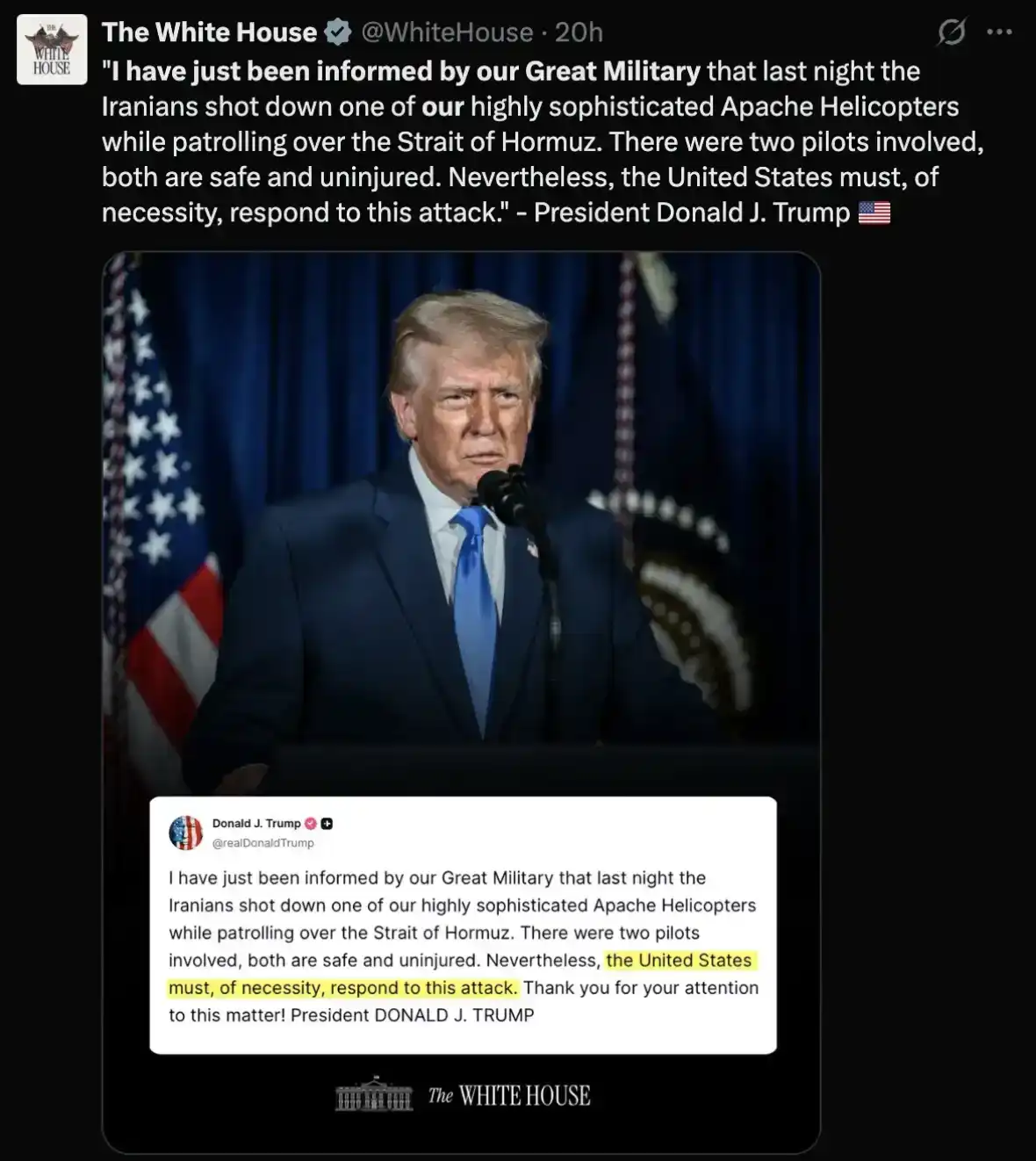
周二早上,同一个人,换了一副情绪。他又跑到 Truth Social 上写道:「我刚刚收到我们伟大军方的通知,昨晚,伊朗人在霍尔木兹海峡上空巡逻时,击落了我们一架高度先进的阿帕奇直升机......美国有必要对此次袭击作出回应。感谢各位对此事的关注!」

从「没什么大不了」,到「有必要作出回应」,只隔了一个新闻周期。这个人在不到 24 小时内就推翻了自己的说法,而我们似乎还被期待着像面对某种国家治理艺术一样点头接受。
周二深夜至周三凌晨,美军中央司令部开始对伊朗沿海地区发动打击。行动从周二格林尼治时间 22:00 持续到周三将近 01:00,目标约 20 个,包括防空系统、地面控制站和监视雷达站,地点覆盖格什姆岛、Goruk、阿巴斯港、贾斯克、Sirik 和 Minab,一路沿着霍尔木兹海峡展开,并深入海峡内部。五角大楼给出的说法是:「自卫性打击」,是对「伊朗无端侵略」的「相称回应」。

而据伊朗国家电视台报道,所谓「相称回应」在地面上的结果是:Sirik 附近两座蓄水池遭到打击,导致 Bamani 地区约 2 万人的饮用水供应中断。下次再听到「外科手术式打击」这个词时,请记住这一幕。

同一晚,伊朗作出反击。伊朗革命卫队称,他们对该地区的美国目标发动了 21 次打击——无人机袭击了巴林的美国第五舰队、科威特的阿里·萨利姆基地,远程导弹则打向约旦的 Azraq 空军基地;他们声称在那里摧毁了一座 F-35 机库。约旦方面表示,已击落 5 枚导弹。伊朗外长阿拉格齐用一种特朗普自以为拥有的威慑口吻说道:「想要安全,就离开我们的地区。」伊朗议会议长加利巴夫则说:「我们更愿意使用外交语言,但其他语言,我们说得更流利。」

周三早上。然后——就在这里——真正的关键一幕出现了。特朗普又回到了 Truth Social,这位「首席交易大师」彻底摘下了面具:

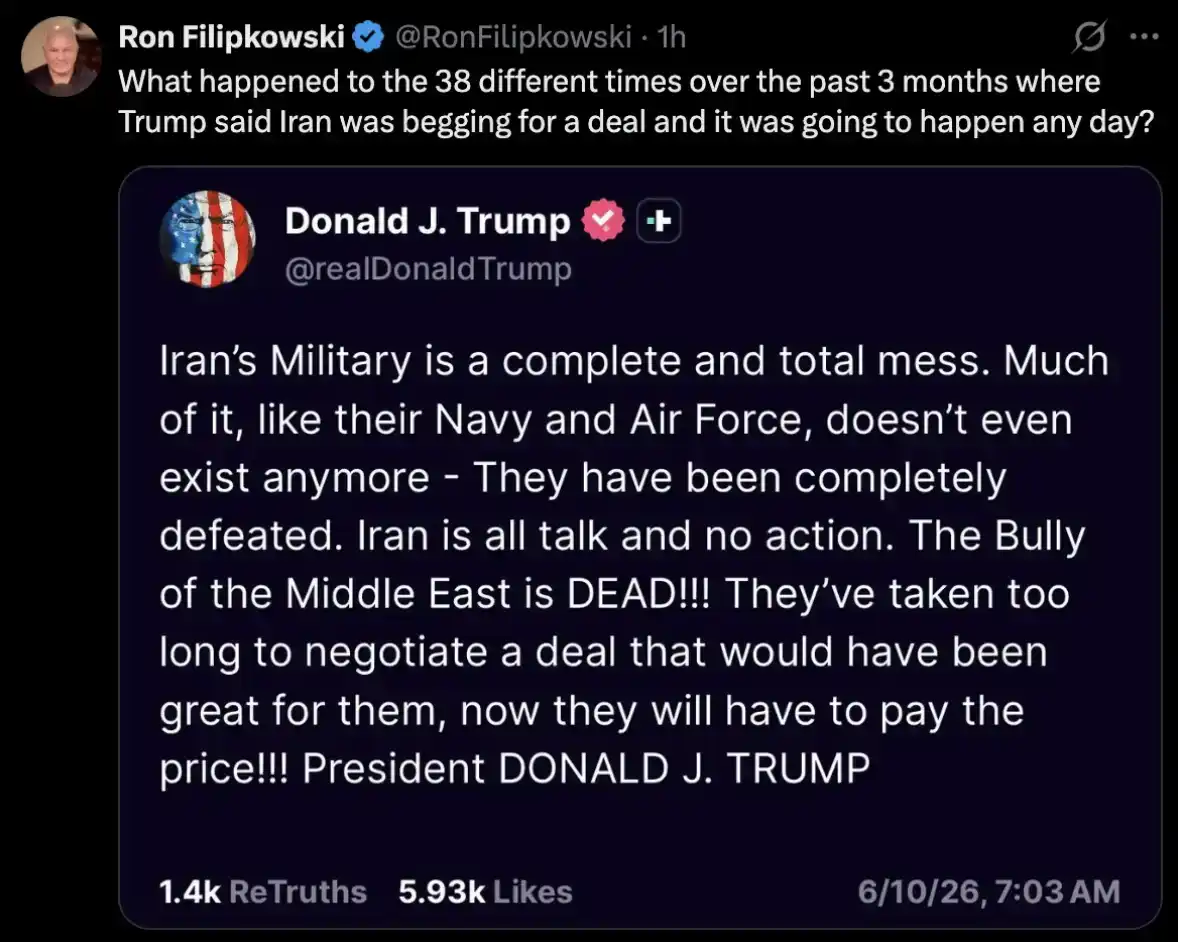
「伊朗军队已经彻底乱成一团。他们的大部分力量,比如海军和空军,甚至已经不复存在——他们已经被彻底击败。伊朗只会说,不会做。中东恶霸已经死了!!!他们花了太长时间来谈判一项本来对他们极其有利的协议,现在他们必须付出代价!!!」

「他们花了太长时间来谈判。」
太长了。说这话的人,正是前一天早上还声称协议已经进入「最后阶段」、可能在「两三天内」签署的人。也是周一晚上离开 NBA 总决赛现场后,还说双方正处在一份「非常、非常好的协议」的最后阶段,而该协议一经签署就会「立即」重开霍尔木兹海峡的人。

「两三天」产业复合体

有件事我希望你认真想一想。整场战争期间,特朗普一直在告诉我们:协议就快到了。到周日,这场战争已经超过 100 天了。按我的统计——是的,我把每一次都记录了下来,因为总得有人做这件事——自从这场冲突在 2 月底爆发以来,特朗普已经承诺过一份即将达成、光鲜亮丽、近在咫尺的协议,次数超过三十多次。
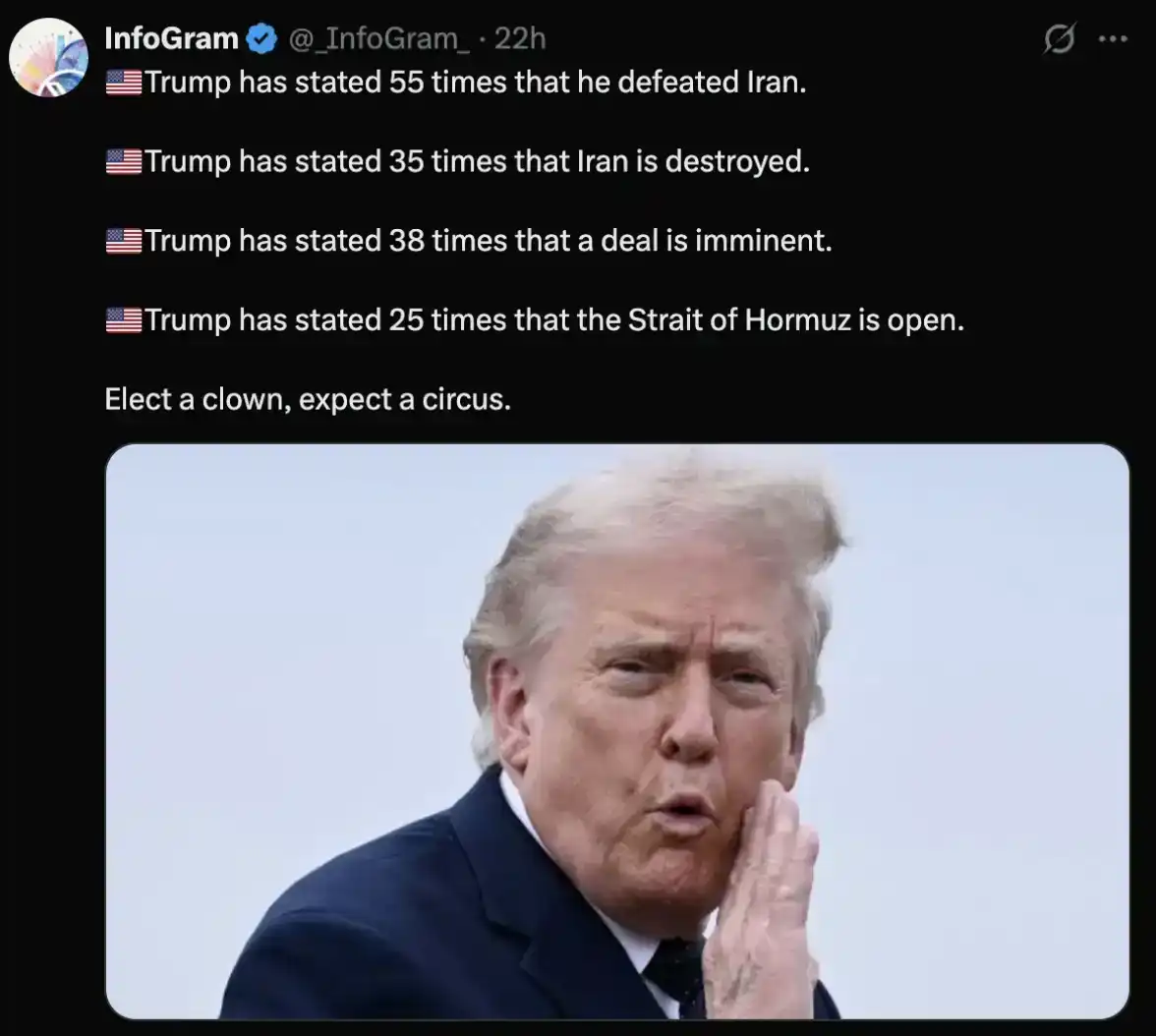
随手从「收据抽屉」里翻几张出来:

3 月 23 日:宣布双方进行了「非常良好且富有成效的对话」,并将此前威胁的发电厂打击行动推迟五天。伊朗的回应是什么?他们直接否认发生过任何会谈。油价先是下跌,随后在德黑兰戳穿他说法后又反弹回去。

3 月下旬:威胁说,如果伊朗不开放海峡,就将在 48 小时内「摧毁」伊朗的发电厂。他们没有开放。他也没有动手。

4 月:宣布「暂停能源设施摧毁期 10 天」。停火被宣布。随后在巴基斯坦举行谈判,主要由伊斯兰堡斡旋,最后无果而终。

本周:「最后阶段。」「两三天。」「一经签署立即开放。」

周三:「他们花了太长时间。必须付出代价。」

这不是谈判。这是一台只会吐出媒体曝光率的老虎机。每一次拉下拉杆,屏幕上都会跳出同样的三个樱桃:协议快成了,对方很弱,相信我。

而每一次,JD Vance 都会站在旁边帮他背书——周日,他告诉 CBS,政府已经「非常接近」达成协议。非常接近。这个政府里被滥用得最严重的两个词,恐怕也就勉强输给「完美通话」。

让我们把面具摘下来

所谓「哥们,相信我」背后,藏着的是这些东西。

如果你真的掌控谈判,你不需要炸掉蓄水池来证明自己正在赢。如果你真的掌控谈判,对方不会在同一晚朝你的三个基地发射 21 枚导弹。如果你真的掌控谈判,你的外交姿态就不会像情绪戒指一样,在 18 小时内从「非常、非常好的协议」变成「中东的恶霸已经死了」——而这种转变,外界唯一能看出来的依据,似乎只是他对有线电视报道的心情如何。

他一直吹嘘的那场封锁——用他自己的话说,是「海战史上最成功的封锁」——没有阻止伊朗在整个地区发动袭击,没有让霍尔木兹海峡重新开放,也没有促成任何协议。德黑兰一名店主本周甚至告诉 CBS,他的商店货架仍然是满的。但当然,这仍然可以叫「史上最成功」。他还真的写了一句「赞美真主」——对此我有很多问题,但那是另一篇文章的事。

真正露馅的地方在这里:海峡仍然关闭。这场战争据说唯一真正关乎的具体目标——重新开放全球五分之一石油供应所经过的通道——在 100 多天后仍然没有实现。期间经历了几十次「即将达成」的协议、一场海上封锁,以及如今新一轮打击。油价上涨了近 2%。市场下跌。而整件事中心的那个人,还在用全大写字母发帖,宣称一个「恶霸」已经死了。

这不是筹码。这是一个人从 3 月左右开始就已经失控地把车开偏了,却花了三个月坚持说自己本来就打算把车漂移进护栏。

底线

两名飞行员平安无事,这当然是好事,也是整件事里唯一干净的结果。但今晚,伊朗南部有 2 万人没有饮用水,三个美国盟友遭到导弹袭击,约旦一座 F-35 机库可能已经变成冒烟的废墟,而那个该为此负责的人,却把整件事处理得像一段职业摔角赛前宣传词。

每一次「两三天」,不是谎言,就是妄想。而到了现在,这两者之间的区别已经不重要了。你不能周二说协议进入「最后阶段」,周三又说「他们花太久了」,然后还指望任何一个记忆正常的人继续相信你对周四局势的判断。

所以,下次当你再听到「我们非常接近」,不管这句话是特朗普说的,是 Vance 说的,还是他们中任何一个人说的,请做唯一还算理智的事。

数下来。记下来。然后默认事实正好相反。

因为「哥们,相信我」早在第十二次协议承诺左右,就已经不再是外交政策了。如今,我们早已超过三十多次。

这件事,显然值得被记住。

Related Questions

Q文章主要批评了特朗普政府在伊朗问题上的哪一核心行为?

A文章主要批评了特朗普政府在伊朗问题上,一边反复对外宣称与伊朗的协议“即将达成”,一边却在升级军事行动,制造“协议将至”的舆论烟雾,认为所谓外交谈判更像是一场服务于新闻周期的政治表演。

Q作者以直升机事件为例,揭示了特朗普言行的哪些关键矛盾?

A在直升机事件中,特朗普先是公开表示此事“没什么大不了”,飞行员安全,事件原因尚在调查。但在不到24小时后,他就在社交媒体上将其定性为伊朗“击落”美军直升机,并以此为理由下令对伊朗进行军事打击。这揭示了他言论的反复无常和前后矛盾。

Q文中提到美军对伊朗的军事打击造成了什么附带损害?

A根据伊朗国家电视台报道,美军的所谓“相称回应”或“外科手术式打击”打击了Sirik附近的两座蓄水池,导致Bamani地区约2万人的饮用水供应中断。

Q文章中所谓的“两三天产业复合体”指的是什么现象?

A“两三天产业复合体”是作者创造的一个讽刺性说法,指代特朗普政府在整个冲突期间,持续不断、超过三十次地宣布与伊朗的协议“即将在两三天内达成”,但从未兑现。这成了一种循环往复、只为制造新闻效应的模式,如同不断吐出同样奖品的“老虎机”。

Q作者建议读者在面对特朗普政府“非常接近”达成协议的说法时,应采取什么态度?

A作者建议读者,当再次听到特朗普或他的政府成员说“我们非常接近”达成协议时,应该“数下来,记下来,然后默认事实正好相反”。因为根据过去的记录,这些承诺多是空话,不具备可信度。

Related Reads

Google TPU Shipments Revised Up by 50%

Recent industry research indicates a significant upward revision in the shipments of Google's TPU (Tensor Processing Unit) chips. Previous expectations for 2027 were set at around 10 million units, but new estimates now point to 15 million units, a 50% increase. This substantial boost directly translates to higher demand across the entire supporting supply chain. Google's TPU clusters utilize a standardized all-optical interconnect architecture. Consequently, key hardware components are deeply integrated and scaled in fixed ratios with the chips. The 15 million TPU target will drive corresponding demand increases for NPO optical engines (roughly a 1:1 match), 1.6T optical modules, OCS optical switches, high-end server power supplies, fiber optics & MPO connectors, and liquid cooling solutions. Among these, liquid cooling is highlighted as the sector experiencing the most significant transformation and offering the most stable potential for excess returns. As next-generation TPU chips reach power levels where traditional air cooling is insufficient, liquid cooling becomes essential. 2026 is forecasted as the first year of substantial adoption for Google's liquid cooling solutions. This shift, coupled with delivery and capacity bottlenecks faced by incumbent overseas manufacturers, is creating a prime window for domestic Chinese suppliers to enter and secure Google's core supply chain. The market size for Google-specific liquid cooling is projected to potentially triple from a baseline of hundreds of billions to around 300 billion units by 2028. The logic for the fiber optic sector is also being rewritten. Once considered a cyclical commodity tied to telecom operator procurement, fiber is now a strategic and scarce resource for AI Data Centers (AIDC). A severe supply-demand imbalance, driven by the long lead time for preform production (18-24 months) and surging demand from cloud giants, is supporting strong performance. Chinese fiber manufacturers are well-positioned to capture a significant share of global AIDC demand, with exports potentially reaching 200-300 million core kilometers in 2026. Overall, the investment focus within the AI computing industry is shifting from pure "chip performance speculation" towards the more certain incremental growth in computing infrastructure and its supporting ecosystem. The upward revision in Google TPU shipments, along with the potential for further doubling by 2028, is seen as solidifying performance visibility for the entire supporting supply chain over the next two years.

marsbit35m ago

Google TPU Shipments Revised Up by 50%

marsbit35m ago

What Wall Street Really Wants After the Crypto Story Recedes

The tide of speculative crypto narratives has receded, revealing Wall Street's true objective: building a controlled, yield-generating, and compliant financial pipeline on distributed ledgers. They are migrating core functions onto blockchains, not for decentralization, but for efficiency and new revenue streams. Key developments include BlackRock's BUIDL fund, a tokenized treasury fund acting as a foundational reserve asset, and the rise of Securitize, which is going public and partnering with the NYSE to build a 24/7 digital securities trading and settlement system. This signals a major shift of securities clearing to blockchain technology. To make volatile assets like Bitcoin palatable for institutional investors, firms like BlackRock and Goldman Sachs are creating "covered call" ETFs (e.g., BITA). These products systematically sell options on Bitcoin holdings, transforming price volatility into stable monthly income, effectively repackaging crypto as a yield-bearing asset. Stablecoins are being positioned not as speculative tools but as efficient payment rails. Companies like Stripe and Mastercard are integrating them for instant, low-cost merchant settlements and cross-border card payments, respectively. Critically, new legislation like the GENIUS Act shapes them as non-interest-bearing, heavily regulated extensions of the US dollar system. In summary, Wall Street is quietly constructing a parallel, blockchain-based financial infrastructure featuring tokenized traditional assets, structured crypto yields, and programmable dollar pipelines—all under its control and fully integrated with existing regulatory and credit frameworks.

marsbit52m ago

What Wall Street Really Wants After the Crypto Story Recedes

marsbit52m ago

Tying Itself to SpaceX: Cursor's $60 Billion Rise

This article recounts the rapid rise of AI-powered coding startup Cursor and its 25-year-old MIT graduate CEO, Michael Truell. Launched in 2023, Cursor achieved explosive growth, reaching over 10 billion USD in revenue by late 2025. However, its journey highlights a central dilemma for AI application companies: dependence on foundational model providers. Cursor initially relied heavily on Anthropic's models but faced an existential threat when Anthropic launched its own competing coding tool, Claude Code. In response, Cursor declared an internal emergency in early 2026 and accelerated development of its own model, Composer. To secure the immense computing power needed, Truell struck a pivotal deal with Elon Musk's SpaceX in April 2026. The collaboration grants Cursor access to SpaceX's supercomputing resources for Composer, while SpaceX's Grok model benefits from Cursor's programming data. The agreement includes a potential 600 billion USD acquisition of Cursor by SpaceX later in the year, though a substantial termination fee is in place if the deal falls through. The story explores Cursor's intense, sometimes controversial hiring practices involving lengthy unpaid "work trials," its complex partnership-turned-rivalry with Anthropic, and its high-stakes gamble to ensure independence through the SpaceX alliance. The core question remains: will Cursor evolve into a defining, independent "generational" software company, or become a key piece in a tech giant's AI arsenal?

marsbit57m ago

Tying Itself to SpaceX: Cursor's $60 Billion Rise

marsbit57m ago

Warsh's Debut: Will the FED Chair Who Knows Crypto Best Bring Surprises or Shocks to the Market?

Kevin Warsh, the new Federal Reserve Chairman, prepares for his inaugural press conference amidst a challenging macroeconomic landscape: resurgent inflation, a bond market sell-off, and political pressure from President Trump for rate cuts. Uniquely, Warsh holds indirect investments in over 20 crypto and Web3 entities (e.g., Solana, dYdX), making him the first Fed Chair with disclosed crypto exposure. His stance may combine a hawkish, inflation-focused monetary policy with a crypto-friendly regulatory philosophy that shifts from Powell’s “same risk, same rule” approach toward a framework acknowledging blockchain’s productivity value. Warsh’s leadership could impact crypto markets across three dimensions: a paradigm shift in regulation (potentially accelerating pro-innovation legislation and stable币 rules), a re-pricing of risk premiums based on clearer communication and his view of AI as a structural disinflationary force, and a long-term reallocation of global institutional capital driven by increased legitimacy. Two potential scenarios for the press conference are outlined. A “positive surprise” would involve a dovish-leaning tone on rates coupled with signals of regulatory openness, potentially boosting crypto asset valuations. Conversely, a “negative shock” would see a more hawkish-than-expected stance on inflation and rates, triggering a broad risk-asset selloff that crypto markets would not escape. While ethics rules required Warsh to divest his crypto holdings upon confirmation, his deep understanding of the technology may fundamentally lower policy uncertainty and build a more receptive long-term foundation for digital assets’ integration into the mainstream financial system.

marsbit11h ago

Warsh's Debut: Will the FED Chair Who Knows Crypto Best Bring Surprises or Shocks to the Market?

marsbit11h ago

Trading

Spot
Futures

Hot Articles

What is SONIC

Sonic: Pioneering the Future of Gaming in Web3 Introduction to Sonic In the ever-evolving landscape of Web3, the gaming industry stands out as one of the most dynamic and promising sectors. At the forefront of this revolution is Sonic, a project designed to amplify the gaming ecosystem on the Solana blockchain. Leveraging cutting-edge technology, Sonic aims to deliver an unparalleled gaming experience by efficiently processing millions of requests per second, ensuring that players enjoy seamless gameplay while maintaining low transaction costs. This article delves into the intricate details of Sonic, exploring its creators, funding sources, operational mechanics, and the timeline of significant events that have shaped its journey. What is Sonic? Sonic is an innovative layer-2 network that operates atop the Solana blockchain, specifically tailored to enhance the existing Solana gaming ecosystem. It accomplishes this through a customised, VM-agnostic game engine paired with a HyperGrid interpreter, facilitating sovereign game economies that roll up back to the Solana platform. The primary goals of Sonic include: Enhanced Gaming Experiences: Sonic is committed to offering lightning-fast on-chain gameplay, allowing players and developers to engage with games at previously unattainable speeds. Atomic Interoperability: This feature enables transactions to be executed within Sonic without the need to redeploy Solana programmes and accounts. This makes the process more efficient and directly benefits from Solana Layer1 services and liquidity. Seamless Deployment: Sonic allows developers to write for Ethereum Virtual Machine (EVM) based systems and execute them on Solana’s SVM infrastructure. This interoperability is crucial for attracting a broader range of dApps and decentralised applications to the platform. Support for Developers: By offering native composable gaming primitives and extensible data types - dining within the Entity-Component-System (ECS) framework - game creators can craft intricate business logic with ease. Overall, Sonic's unique approach not only caters to players but also provides an accessible and low-cost environment for developers to innovate and thrive. Creator of Sonic The information regarding the creator of Sonic is somewhat ambiguous. However, it is known that Sonic's SVM is owned by the company Mirror World. The absence of detailed information about the individuals behind Sonic reflects a common trend in several Web3 projects, where collective efforts and partnerships often overshadow individual contributions. Investors of Sonic Sonic has garnered considerable attention and support from various investors within the crypto and gaming sectors. Notably, the project raised an impressive $12 million during its Series A funding round. The round was led by BITKRAFT Ventures, with other notable investors including Galaxy, Okx Ventures, Interactive, Big Brain Holdings, and Mirana. This financial backing signifies the confidence that investment foundations have in Sonic’s potential to revolutionise the Web3 gaming landscape, further validating its innovative approaches and technologies. How Does Sonic Work? Sonic utilises the HyperGrid framework, a sophisticated parallel processing mechanism that enhances its scalability and customisability. Here are the core features that set Sonic apart: Lightning Speed at Low Costs: Sonic offers one of the fastest on-chain gaming experiences compared to other Layer-1 solutions, powered by the scalability of Solana’s virtual machine (SVM). Atomic Interoperability: Sonic enables transaction execution without redeployment of Solana programmes and accounts, effectively streamlining the interaction between users and the blockchain. EVM Compatibility: Developers can effortlessly migrate decentralised applications from EVM chains to the Solana environment using Sonic’s HyperGrid interpreter, increasing the accessibility and integration of various dApps. Ecosystem Support for Developers: By exposing native composable gaming primitives, Sonic facilitates a sandbox-like environment where developers can experiment and implement business logic, greatly enhancing the overall development experience. Monetisation Infrastructure: Sonic natively supports growth and monetisation efforts, providing frameworks for traffic generation, payments, and settlements, thereby ensuring that gaming projects are not only viable but also sustainable financially. Timeline of Sonic The evolution of Sonic has been marked by several key milestones. Below is a brief timeline highlighting critical events in the project's history: 2022: The Sonic cryptocurrency was officially launched, marking the beginning of its journey in the Web3 gaming arena. 2024: June: Sonic SVM successfully raised $12 million in a Series A funding round. This investment allowed Sonic to further develop its platform and expand its offerings. August: The launch of the Sonic Odyssey testnet provided users with the first opportunity to engage with the platform, offering interactive activities such as collecting rings—a nod to gaming nostalgia. October: SonicX, an innovative crypto game integrated with Solana, made its debut on TikTok, capturing the attention of over 120,000 users within a short span. This integration illustrated Sonic’s commitment to reaching a broader, global audience and showcased the potential of blockchain gaming. Key Points Sonic SVM is a revolutionary layer-2 network on Solana explicitly designed to enhance the GameFi landscape, demonstrating great potential for future development. HyperGrid Framework empowers Sonic by introducing horizontal scaling capabilities, ensuring that the network can handle the demands of Web3 gaming. Integration with Social Platforms: The successful launch of SonicX on TikTok displays Sonic’s strategy to leverage social media platforms to engage users, exponentially increasing the exposure and reach of its projects. Investment Confidence: The substantial funding from BITKRAFT Ventures, among others, emphasizes the robust backing Sonic has, paving the way for its ambitious future. In conclusion, Sonic encapsulates the essence of Web3 gaming innovation, striking a balance between cutting-edge technology, developer-centric tools, and community engagement. As the project continues to evolve, it is poised to redefine the gaming landscape, making it a notable entity for gamers and developers alike. As Sonic moves forward, it will undoubtedly attract greater interest and participation, solidifying its place within the broader narrative of blockchain gaming.

1.7k Total ViewsPublished 2024.04.04Updated 2024.12.03

What is SONIC

What is $S$

Understanding SPERO: A Comprehensive Overview Introduction to SPERO As the landscape of innovation continues to evolve, the emergence of web3 technologies and cryptocurrency projects plays a pivotal role in shaping the digital future. One project that has garnered attention in this dynamic field is SPERO, denoted as SPERO,$$s$. This article aims to gather and present detailed information about SPERO, to help enthusiasts and investors understand its foundations, objectives, and innovations within the web3 and crypto domains. What is SPERO,$$s$? SPERO,$$s$ is a unique project within the crypto space that seeks to leverage the principles of decentralisation and blockchain technology to create an ecosystem that promotes engagement, utility, and financial inclusion. The project is tailored to facilitate peer-to-peer interactions in new ways, providing users with innovative financial solutions and services. At its core, SPERO,$$s$ aims to empower individuals by providing tools and platforms that enhance user experience in the cryptocurrency space. This includes enabling more flexible transaction methods, fostering community-driven initiatives, and creating pathways for financial opportunities through decentralised applications (dApps). The underlying vision of SPERO,$$s$ revolves around inclusiveness, aiming to bridge gaps within traditional finance while harnessing the benefits of blockchain technology. Who is the Creator of SPERO,$$s$? The identity of the creator of SPERO,$$s$ remains somewhat obscure, as there are limited publicly available resources providing detailed background information on its founder(s). This lack of transparency can stem from the project's commitment to decentralisation—an ethos that many web3 projects share, prioritising collective contributions over individual recognition. By centring discussions around the community and its collective goals, SPERO,$$s$ embodies the essence of empowerment without singling out specific individuals. As such, understanding the ethos and mission of SPERO remains more important than identifying a singular creator. Who are the Investors of SPERO,$$s$? SPERO,$$s$ is supported by a diverse array of investors ranging from venture capitalists to angel investors dedicated to fostering innovation in the crypto sector. The focus of these investors generally aligns with SPERO's mission—prioritising projects that promise societal technological advancement, financial inclusivity, and decentralised governance. These investor foundations are typically interested in projects that not only offer innovative products but also contribute positively to the blockchain community and its ecosystems. The backing from these investors reinforces SPERO,$$s$ as a noteworthy contender in the rapidly evolving domain of crypto projects. How Does SPERO,$$s$ Work? SPERO,$$s$ employs a multi-faceted framework that distinguishes it from conventional cryptocurrency projects. Here are some of the key features that underline its uniqueness and innovation: Decentralised Governance: SPERO,$$s$ integrates decentralised governance models, empowering users to participate actively in decision-making processes regarding the project’s future. This approach fosters a sense of ownership and accountability among community members. Token Utility: SPERO,$$s$ utilises its own cryptocurrency token, designed to serve various functions within the ecosystem. These tokens enable transactions, rewards, and the facilitation of services offered on the platform, enhancing overall engagement and utility. Layered Architecture: The technical architecture of SPERO,$$s$ supports modularity and scalability, allowing for seamless integration of additional features and applications as the project evolves. This adaptability is paramount for sustaining relevance in the ever-changing crypto landscape. Community Engagement: The project emphasises community-driven initiatives, employing mechanisms that incentivise collaboration and feedback. By nurturing a strong community, SPERO,$$s$ can better address user needs and adapt to market trends. Focus on Inclusion: By offering low transaction fees and user-friendly interfaces, SPERO,$$s$ aims to attract a diverse user base, including individuals who may not previously have engaged in the crypto space. This commitment to inclusion aligns with its overarching mission of empowerment through accessibility. Timeline of SPERO,$$s$ Understanding a project's history provides crucial insights into its development trajectory and milestones. Below is a suggested timeline mapping significant events in the evolution of SPERO,$$s$: Conceptualisation and Ideation Phase: The initial ideas forming the basis of SPERO,$$s$ were conceived, aligning closely with the principles of decentralisation and community focus within the blockchain industry. Launch of Project Whitepaper: Following the conceptual phase, a comprehensive whitepaper detailing the vision, goals, and technological infrastructure of SPERO,$$s$ was released to garner community interest and feedback. Community Building and Early Engagements: Active outreach efforts were made to build a community of early adopters and potential investors, facilitating discussions around the project’s goals and garnering support. Token Generation Event: SPERO,$$s$ conducted a token generation event (TGE) to distribute its native tokens to early supporters and establish initial liquidity within the ecosystem. Launch of Initial dApp: The first decentralised application (dApp) associated with SPERO,$$s$ went live, allowing users to engage with the platform's core functionalities. Ongoing Development and Partnerships: Continuous updates and enhancements to the project's offerings, including strategic partnerships with other players in the blockchain space, have shaped SPERO,$$s$ into a competitive and evolving player in the crypto market. Conclusion SPERO,$$s$ stands as a testament to the potential of web3 and cryptocurrency to revolutionise financial systems and empower individuals. With a commitment to decentralised governance, community engagement, and innovatively designed functionalities, it paves the way toward a more inclusive financial landscape. As with any investment in the rapidly evolving crypto space, potential investors and users are encouraged to research thoroughly and engage thoughtfully with the ongoing developments within SPERO,$$s$. The project showcases the innovative spirit of the crypto industry, inviting further exploration into its myriad possibilities. While the journey of SPERO,$$s$ is still unfolding, its foundational principles may indeed influence the future of how we interact with technology, finance, and each other in interconnected digital ecosystems.

58 Total ViewsPublished 2024.12.17Updated 2024.12.17

What is $S$

What is AGENT S

Agent S: The Future of Autonomous Interaction in Web3 Introduction In the ever-evolving landscape of Web3 and cryptocurrency, innovations are constantly redefining how individuals interact with digital platforms. One such pioneering project, Agent S, promises to revolutionise human-computer interaction through its open agentic framework. By paving the way for autonomous interactions, Agent S aims to simplify complex tasks, offering transformative applications in artificial intelligence (AI). This detailed exploration will delve into the project's intricacies, its unique features, and the implications for the cryptocurrency domain. What is Agent S? Agent S stands as a groundbreaking open agentic framework, specifically designed to tackle three fundamental challenges in the automation of computer tasks: Acquiring Domain-Specific Knowledge: The framework intelligently learns from various external knowledge sources and internal experiences. This dual approach empowers it to build a rich repository of domain-specific knowledge, enhancing its performance in task execution. Planning Over Long Task Horizons: Agent S employs experience-augmented hierarchical planning, a strategic approach that facilitates efficient breakdown and execution of intricate tasks. This feature significantly enhances its ability to manage multiple subtasks efficiently and effectively. Handling Dynamic, Non-Uniform Interfaces: The project introduces the Agent-Computer Interface (ACI), an innovative solution that enhances the interaction between agents and users. Utilizing Multimodal Large Language Models (MLLMs), Agent S can navigate and manipulate diverse graphical user interfaces seamlessly. Through these pioneering features, Agent S provides a robust framework that addresses the complexities involved in automating human interaction with machines, setting the stage for myriad applications in AI and beyond. Who is the Creator of Agent S? While the concept of Agent S is fundamentally innovative, specific information about its creator remains elusive. The creator is currently unknown, which highlights either the nascent stage of the project or the strategic choice to keep founding members under wraps. Regardless of anonymity, the focus remains on the framework's capabilities and potential. Who are the Investors of Agent S? As Agent S is relatively new in the cryptographic ecosystem, detailed information regarding its investors and financial backers is not explicitly documented. The lack of publicly available insights into the investment foundations or organisations supporting the project raises questions about its funding structure and development roadmap. Understanding the backing is crucial for gauging the project's sustainability and potential market impact. How Does Agent S Work? At the core of Agent S lies cutting-edge technology that enables it to function effectively in diverse settings. Its operational model is built around several key features: Human-like Computer Interaction: The framework offers advanced AI planning, striving to make interactions with computers more intuitive. By mimicking human behaviour in tasks execution, it promises to elevate user experiences. Narrative Memory: Employed to leverage high-level experiences, Agent S utilises narrative memory to keep track of task histories, thereby enhancing its decision-making processes. Episodic Memory: This feature provides users with step-by-step guidance, allowing the framework to offer contextual support as tasks unfold. Support for OpenACI: With the ability to run locally, Agent S allows users to maintain control over their interactions and workflows, aligning with the decentralised ethos of Web3. Easy Integration with External APIs: Its versatility and compatibility with various AI platforms ensure that Agent S can fit seamlessly into existing technological ecosystems, making it an appealing choice for developers and organisations. These functionalities collectively contribute to Agent S's unique position within the crypto space, as it automates complex, multi-step tasks with minimal human intervention. As the project evolves, its potential applications in Web3 could redefine how digital interactions unfold. Timeline of Agent S The development and milestones of Agent S can be encapsulated in a timeline that highlights its significant events: September 27, 2024: The concept of Agent S was launched in a comprehensive research paper titled “An Open Agentic Framework that Uses Computers Like a Human,” showcasing the groundwork for the project. October 10, 2024: The research paper was made publicly available on arXiv, offering an in-depth exploration of the framework and its performance evaluation based on the OSWorld benchmark. October 12, 2024: A video presentation was released, providing a visual insight into the capabilities and features of Agent S, further engaging potential users and investors. These markers in the timeline not only illustrate the progress of Agent S but also indicate its commitment to transparency and community engagement. Key Points About Agent S As the Agent S framework continues to evolve, several key attributes stand out, underscoring its innovative nature and potential: Innovative Framework: Designed to provide an intuitive use of computers akin to human interaction, Agent S brings a novel approach to task automation. Autonomous Interaction: The ability to interact autonomously with computers through GUI signifies a leap towards more intelligent and efficient computing solutions. Complex Task Automation: With its robust methodology, it can automate complex, multi-step tasks, making processes faster and less error-prone. Continuous Improvement: The learning mechanisms enable Agent S to improve from past experiences, continually enhancing its performance and efficacy. Versatility: Its adaptability across different operating environments like OSWorld and WindowsAgentArena ensures that it can serve a broad range of applications. As Agent S positions itself in the Web3 and crypto landscape, its potential to enhance interaction capabilities and automate processes signifies a significant advancement in AI technologies. Through its innovative framework, Agent S exemplifies the future of digital interactions, promising a more seamless and efficient experience for users across various industries. Conclusion Agent S represents a bold leap forward in the marriage of AI and Web3, with the capacity to redefine how we interact with technology. While still in its early stages, the possibilities for its application are vast and compelling. Through its comprehensive framework addressing critical challenges, Agent S aims to bring autonomous interactions to the forefront of the digital experience. As we move deeper into the realms of cryptocurrency and decentralisation, projects like Agent S will undoubtedly play a crucial role in shaping the future of technology and human-computer collaboration.

732 Total ViewsPublished 2025.01.14Updated 2025.01.14

What is AGENT S

Discussions

Welcome to the HTX Community. Here, you can stay informed about the latest platform developments and gain access to professional market insights. Users' opinions on the price of S (S) are presented below.

活动图片