警报拉满:日本央行加息25bp在即,美股、加密重现2024式闪崩?

marsbitPublished on 2026-06-11Last updated on 2026-06-11

Abstract

日本央行预计在6月会议将短期政策利率从0.75%上调至1.0%,为1995年以来最高。市场加息概率已飙升至98%。此举主要因能源冲击与输入性通胀压力,以及日元疲软加剧物价上涨。日本央行行长已转向抗通胀叙事,标志着日本正从“全球最后贷款人”向正常化央行转变。 日本长期超低利率催生了规模庞大的日元套利交易,投资者借入日元投资于美股、科技股、加密货币等高收益资产。本次加息将推高日元融资成本并可能引发日元升值,迫使杠杆投资者平仓,形成“抛售资产-价格下跌-更多平仓”的连锁反应。据估计,目前市场上仍有约5000亿美元未平仓日元融资头寸,构成显著风险。 全球风险资产将面临冲击。AI驱动的科技股对流动性敏感,高估值成长股将首当其冲;能源成本上升也会挤压AI公司利润率。加密货币作为高贝塔资产更不容乐观,融资成本上升将迫使杠杆头寸平仓,而市场流动性本就趋紧。历史表明,日本央行政策收紧曾多次引发全球市场剧烈波动,例如2024年7月的加息就曾导致全球股市与加密货币大幅闪崩。 当前,中东地缘冲突推高油价、AI资本支出消耗流动性、美联储政策不确定性等多重因素叠加,进一步压缩了市场缓冲空间。投资者需对高杠杆、高估值的AI科技股和加密货币板块保持高度警惕,注意短期波动与杠杆风险。

原创 | Odaily星球日报(@OdailyChina)

作者 | 秦晓峰(@QinXiaofeng 888 )

据日经新闻报道,日本央行(BoJ)预计在 6 月 15 日至 16 日的货币政策会议上,将短期政策利率从 0.75%上调至 1.0%,这也是 1995 年以来的最高政策利率水平。目前,市场定价加息概率极高,PolyMarket 上“加息 25bp(基点)”的概率也从 4 月初的 25%飙升至 98%。
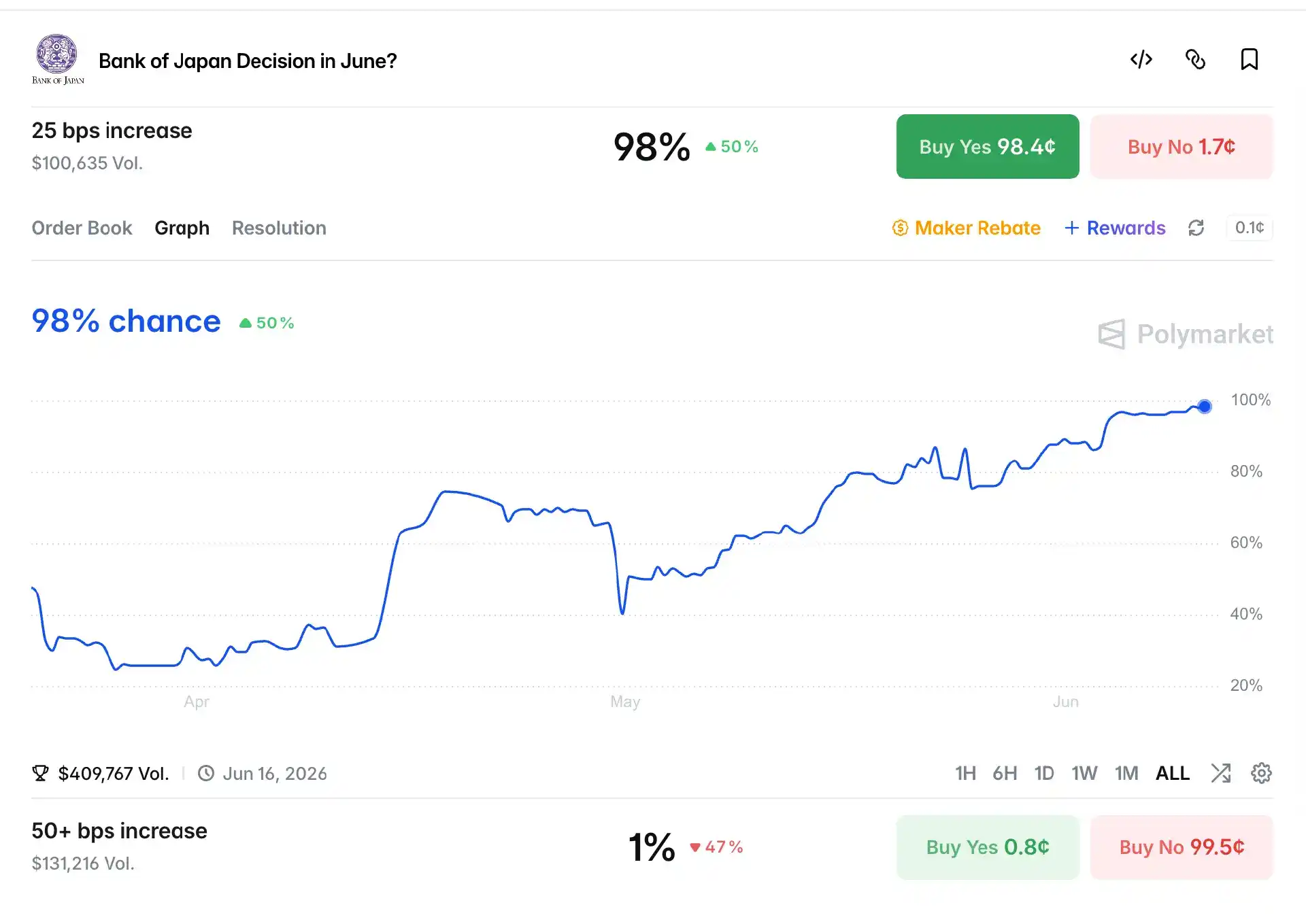
BOJ 加息迫在眉睫,大量通过日元套利交易的投资者可能被迫卖出海外资产、换回日元并偿还贷款引发连锁反应,进而放大全球风险资产的波动性——2024 年 8 月闪崩即为典型案例,当时日元急升导致全球股市短期重挫,比特币单日暴跌近 2 万美元,最大跌幅 15%。

Odaily星球日报将剖析 BOJ 加息的宏观背景、传导机制,并重点评估对 AI 科技股和加密货币的风险影响,供读者参考。

一、通胀风险推动 BOJ 加息

过去两年,BOJ 内部鹰派声音越发增强,最终于 2024 年 3 月结束了长达 17 年的负利率政策,将政策利率从 -0.1% 上调至 0% ~ 0.1% 范围,这也是本轮周期中的首次加息。2024 年 7 月,BOJ 再次加息 15bp 至 0.25%并宣布渐进缩表;2025 年 1 月、12 月分别加息 25bp,利率升至 0.75%;2026 年前三次会议维持不变。以下是 BOJ 几次会议加息情况:
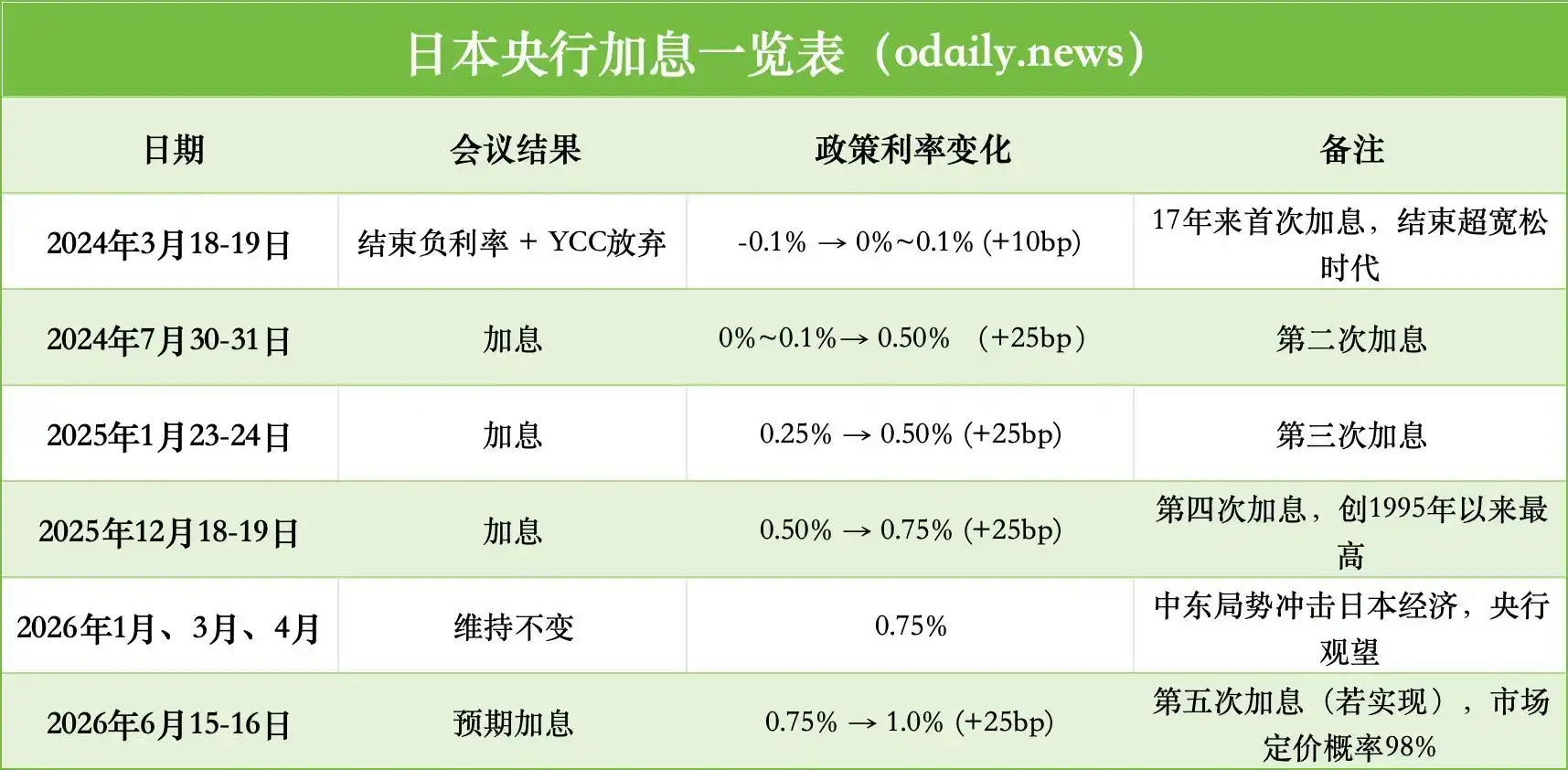
在维持利率不变长达半年后,BOJ 为什么又迫不及待开始了新一轮加息?本次加息主要源于两个方面。

一是能源冲击与输入性通胀压力。随着上半年中东冲突导致油价波动,日本作为高度依赖进口能源的国家,进口成本显著上升。5 月企业物价指数(CGPI)同比上涨 6.3%,为 2023 年以来最快增速,其中石油产品上涨 9.6%、公用事业上涨 8.5%。BOJ 预计 2026 财年核心 CPI 将升至 2.5-3.0%,远高于 2%的既定目标。

二是日元疲软加剧输入型通胀。当前 USD/JPY 汇率持续徘徊在 158-160 高位附近,已接近历史极端弱势区间。日元大幅贬值直接削弱了日本企业的进口购买力,导致能源、原材料等大宗商品的进口成本显著上升,进一步推高国内物价水平。尽管日本财务省多次出手干预外汇市场,但效果较为有限且难以持续。这一局面正迫使 BOJ 在 6 月会议上收紧货币政策(即加息),以避免通胀预期失控。

BOJ 行长上田和夫在 6 月 3 日演讲中,明确转向抗通胀叙事,强调若价格上行风险大于经济下行风险,必须讨论加息利弊。

路透社援引三位知情人士报道,除非中东冲突急剧升级,否则 BOJ 将在 6 月加息,并可能放缓债券缩表步伐以维持市场稳定。 彭博社和 ING 等机构也维持类似的判断,并预计 BOJ 2026 年总计加息 50bp。

这一系列转变,标志着日本从“全球最后贷款人”向正常化央行的转变,对依赖廉价日元融资的全球资产构成直接挑战。

二、日元套利交易平仓,流动性持续收紧

日本央行长期维持超宽松货币政策,日元套利交易也是过去十余年全球流动性的重要组成部分。投资者借入接近零利率的日元,投资于美股、科技股、新兴市场、加密货币等高收益资产,赚取息差和资本利得。

BOJ 本次加息将直接推高日元融资成本,并可能引发日元升值(USD/JPY 下行),迫使杠杆投资者平仓,形成正反馈循环:日元升值导致汇兑损失扩大 → 融资成本上升 → 投资者强制去杠杆 → 大规模抛售风险资产 → 资产价格进一步下跌 → 更多止损盘触发 → 平仓压力加剧。

历史上,BOJ 每次政策收紧信号都会引发市场剧烈波动。

2024 年 7 月 31 日,BOJ 加息 15bp 至 0.25%并宣布渐进缩表,叠加美国疲软就业数据,引发全球市场剧烈动荡。 当时韩国两大股指(KOSPI 和 KOSDAQ)双双暴跌并触发熔断机制;日股崩盘,日经 225 单日暴跌 12.4%,一周累计跌幅超 20%,创 1987 年以来最差表现;全球股市联动下跌,美股、科技股同步调整,VIX 恐慌指数飙升。加密同样遭受重创,比特币、ETH 短短一周暴跌超过 30%,杠杆清算激增。

根据摩根士丹利估计,虽然自 2024 年以来已有大量头寸逐步平仓,但目前市场上仍存在约 5000 亿美元的未平仓日元融资头寸。尽管市场已提前对部分风险有所定价,但这些头寸仍构成显著隐患。摩根士丹利警告,若日元快速升值,可能会在流动性较薄的时段触发连锁平仓,尤其对高杠杆资产影响剧烈。

J.P. Morgan 全球市场策略主管 Dubravko Lakos-Bujas 以及外汇策略师 Meera Chandan 均指出,BOJ 与美联储的政策分化将加剧套利平仓的不稳定性,可能导致全球风险资产的估值重估。

三、全球风险资产受伤,美股、币圈无一幸免

AI 驱动的科技热潮是 2026 年上半年美股主线,Nvidia、Broadcom 等芯片股及超大规模云服务商引领纳斯达克屡创新高。

但进入 6 月,市场出现显著轮动与回调,特别是 6 月 5 日,美股迎来 2026 年迄今最剧烈的一次单日回调。纳指重挫 4.18%,创下 2025 年 4 月以来最大单日跌幅;标普 500 下跌 2.64%,终结连续九周上涨纪录;道指下跌 1.35%,费半指数暴跌逾 10%,英伟达、博通、美光、马威尔等 AI 核心股领跌。(推荐阅读:《纳指单日跌幅 4.2%,“黑色星期五”戳破美股泡沫?》)

美股回调,既有宏观上地缘政治紧张、美联储政策的不确定,但不可忽视的因素还有来自 BOJ 潜在的加息影响。

首先,流动性收紧将直接打击高估值成长股。 AI 公司资本支出规模巨大,对廉价融资高度依赖。日元套利交易平仓将减少全球风险偏好资金流入,高贝塔科技股首当其冲。Nvidia、Broadcom 等半导体龙头以及 Meta、Microsoft 等 hyperscalers 估值敏感度极高,极易遭受抛售。Investing.com 分析指出,高估值成长板块对全球流动性变化最为敏感,一旦套利平仓启动,往往出现快速去杠杆。

其次,能源成本上升将显著压缩 AI 利润率。 中东冲突推高油价,导致数据中心电力和冷却成本大幅攀升,与 BOJ 加息共同形成“滞胀式”宏观环境,严重考验 AI 商业模式的可持续性。

BitMex 创始人 Arthur Hayes 在其最新文章《Reality Test》中明确警告:“能源现实正在测试市场当前的‘做梦’状态。” 高油价不仅抬升运营成本,还可能放缓企业 token 使用增长,进一步打击 AI 相关收入预期。

最后是巨型 IPO 供给冲击与政治监管风险。 SpaceX、Anthropic、OpenAI 等巨头计划在 2026 年下半年密集上市,估值动辄百倍销售额,锁定期解禁将带来巨量供给压力。同时,特朗普为中期选举可能转向反 AI,增加监管不确定性。

加密货币作为全球最高贝塔风险资产,更是不容乐观。一边是日元加息带来融资成本上升,直接推高全球杠杆交易成本,迫使加密杠杆头寸大规模平仓;另一边是在与 AI 竞争流动性上,AI 资本支出已吸纳大量市场资金,加密本就落后,BOJ 行动将进一步收紧边际流动性。

雅虎财经分析师 Lockridge Okoth 表示,98% 概率的加息可能引发比特币下一轮流动性冲击。Investing.com分析指出,日元升值与 BTC 走弱往往高度同步,是全球风险厌恶上升的典型信号。

Arthur Hayes 也在多篇分析中强调,日元套利交易的动态仍是影响比特币流动性的关键变量之一,提醒投资者关注政策信号引发的短期流动性冲击。 在近期的文章中,Arthur Hayes 强调需警惕短期能源成本与货币政策风险叠加的影响;BTC/ETH 短期可能随风险资产调整,长期取决于流动性重启。

结束语:

BOJ 加息担忧重燃并非孤立事件,而是全球流动性边际收紧的信号。特别是当前中东地缘冲突推高油价、AI 资本支出消耗流动性,以及美联储政策不确定性等多重因素叠加,进一步压缩了缓冲空间。

对投资者而言,短期内全球风险资产尤其是高杠杆、高估值板块(AI 科技股和加密货币)可能面临显著回调压力,波动率将明显抬升,需要保持高度警惕,注意杠杆风险。

Related Questions

Q日本央行预计在2026年6月的货币政策会议上可能加息多少基点?

A预计将短期政策利率上调25个基点,从0.75%提高至1.0%。

Q根据文章,日本央行本次决定加息的主要原因是什么?

A主要原因有两个:一是能源冲击与输入性通胀压力,日本作为能源进口国,油价波动推高了进口成本和企业物价;二是日元疲软加剧了输入型通胀,日元大幅贬值削弱了进口购买力,进一步推高国内物价水平。

Q什么是“日元套利交易平仓”,它如何放大全球风险资产的波动?

A“日元套利交易平仓”是指投资者借入低利率的日元,投资于美股、加密等高收益资产。当日本央行加息推高日元融资成本或导致日元升值时,投资者会被迫卖出海外资产、换回日元偿还贷款。这会形成抛售潮,正反馈循环导致资产价格下跌,引发更多止损盘,从而放大全球风险资产的波动性。

Q文章提到,2024年8月日本央行政策变化曾导致哪些市场出现剧烈动荡?

A2024年8月,日元急升导致全球股市短期重挫,比特币单日暴跌近2万美元,跌幅达15%。此外,在2024年7月日本央行加息并宣布渐进缩表后,韩国两大股指暴跌并触发熔断,日经225指数单日暴跌12.4%,全球股市联动下跌,美股和科技股同步调整,加密货币也在一周内暴跌超过30%。

Q日本央行的加息预期,为什么被认为会对AI科技股和加密货币造成显著冲击?

A原因主要有三点:首先,流动性收紧直接打击高估值成长股,AI公司依赖廉价融资,套利交易平仓减少风险资金流入;其次,能源成本上升(如油价)会压缩AI数据中心的利润率;最后,加密货币作为全球最高贝塔的风险资产,融资成本上升会迫使杠杆头寸平仓,同时在与AI竞争流动性时本就处于劣势,边际流动性进一步收紧将加剧其压力。

Related Reads

Warsh's Debut: Will the FED Chair Who Knows Crypto Best Bring Surprises or Shocks to the Market?

Kevin Warsh, the new Federal Reserve Chairman, prepares for his inaugural press conference amidst a challenging macroeconomic landscape: resurgent inflation, a bond market sell-off, and political pressure from President Trump for rate cuts. Uniquely, Warsh holds indirect investments in over 20 crypto and Web3 entities (e.g., Solana, dYdX), making him the first Fed Chair with disclosed crypto exposure. His stance may combine a hawkish, inflation-focused monetary policy with a crypto-friendly regulatory philosophy that shifts from Powell’s “same risk, same rule” approach toward a framework acknowledging blockchain’s productivity value. Warsh’s leadership could impact crypto markets across three dimensions: a paradigm shift in regulation (potentially accelerating pro-innovation legislation and stable币 rules), a re-pricing of risk premiums based on clearer communication and his view of AI as a structural disinflationary force, and a long-term reallocation of global institutional capital driven by increased legitimacy. Two potential scenarios for the press conference are outlined. A “positive surprise” would involve a dovish-leaning tone on rates coupled with signals of regulatory openness, potentially boosting crypto asset valuations. Conversely, a “negative shock” would see a more hawkish-than-expected stance on inflation and rates, triggering a broad risk-asset selloff that crypto markets would not escape. While ethics rules required Warsh to divest his crypto holdings upon confirmation, his deep understanding of the technology may fundamentally lower policy uncertainty and build a more receptive long-term foundation for digital assets’ integration into the mainstream financial system.

marsbit2h ago

Warsh's Debut: Will the FED Chair Who Knows Crypto Best Bring Surprises or Shocks to the Market?

marsbit2h ago

Trading

Spot
Futures

Hot Articles

What is $BANK

Bank AI: A Revolutionary Step in the Future of Banking Introduction In an era marked by rapid advancements in technology, Bank AI stands at the intersection of artificial intelligence (AI) and banking services. This innovative project seeks to redefine the financial landscape, enhancing operational efficiency, security measures, and customer experiences through the power of AI. As we embark on this exploration of Bank AI, we will delve into what the project entails, its operational dynamics, its historical context, and significant milestones. What is Bank AI? At its core, Bank AI represents a transformative initiative aimed at integrating artificial intelligence into various banking operations. This project harnesses the capabilities of AI to automate processes, improve risk management protocols, and enhance customer interaction through personalised services. The primary objectives of Bank AI include: Automation of Banking Functions: By leveraging AI technologies, Bank AI aims to automate routine tasks, reducing the burden on human resources and enhancing efficiency. Enhanced Risk Management: The project utilises AI algorithms to predict and identify risks, thereby fortifying security measures against fraud and other threats. Personalisation of Banking Services: Bank AI focuses on offering tailored financial products and services by analysing customer data and behaviours. Improving Customer Experience: The implementation of AI-driven solutions, such as chatbots and virtual assistants, aims to provide users with more human-like interactions, revolutionising the way customers engage with banks. With these goals, Bank AI positions itself as a crucial player in rendering banking more efficient, secure, and user-centric. Who is the Creator of Bank AI? Details regarding the creator of Bank AI remain unknown. As such, no specific individual or organisation has been identified in the available information. The anonymity surrounding the project's inception raises questions but does not detract from its ambitious vision and objectives. Who are the Investors of Bank AI? Similar to the project's creator, specific information regarding the investors or supporting organisations of Bank AI has not been disclosed. Without this information, it is challenging to outline the financial backing and institutional support that might be propelling the project forward. Nevertheless, the importance of having a robust investment foundation is pivotal for sustaining development in such an innovative field. How Does Bank AI Work? Bank AI operates on several innovative fronts, focusing on unique factors that differentiate it from traditional banking frameworks. Below are key operational features: Automation: By applying machine learning algorithms, Bank AI automates various manual processes within banks. This results in reduced operational costs and allows human workers to redirect their efforts towards more strategic activities. Advanced Risk Management: The integration of AI into risk management practices equips banks with tools to accurately predict potential threats such as fraud, ensuring that customer information and assets remain secure. Tailored Financial Recommendations: Through continuous learning from customer interactions, the AI systems develop a nuanced understanding of user needs, enabling them to offer tailored advice on financial decisions. Enhanced Customer Interactions: Utilizing chatbots and virtual assistants powered by AI, Bank AI enables a more engaging customer experience, allowing users to have their queries resolved quickly, thus reducing wait times and improving satisfaction levels. Together, these operational features position Bank AI as a pioneer in the banking sector, establishing new benchmarks for service delivery and operational excellence. Timeline of Bank AI Understanding the trajectory of Bank AI requires a look at its historical context. Below is a timeline highlighting important milestones and developments: Early 2010s: The conceptualisation of AI integration into banking services began to gain attention as banking institutions recognised the potential benefits. 2018: A marked increase in the implementation of AI technologies occurred when banks started using AI tools like chatbots for basic customer service and risk management systems for improved security handling. 2023: The sophistication of AI continued to advance, with generative AI being introduced for more complex tasks such as document processing and real-time investment analysis. This year marked a significant leap in the capabilities afforded to banks by AI technology. 2024-Current Status: As of this year, Bank AI is on an upward trajectory, with ongoing research and developments poised to further enhance capabilities in banking operations. Continued exploration of AI applications hints at exciting developments yet to come. Key Points About Bank AI Integration of AI in Banking: Bank AI focuses on adopting artificial intelligence to streamline banking processes and improve user experiences. Automation and Risk Management Focus: The project strongly emphasises these areas, aiming to shift the burden of routine tasks while enhancing security frameworks through predictive analytics. Personalised Banking Solutions: By harnessing customer data, Bank AI enables tailored banking services that cater to individual user needs. Commitment to Development: Bank AI remains committed to ongoing research and development efforts, ensuring its adaptability and ongoing relevance as technology continues to evolve. Conclusion In summary, Bank AI exemplifies a crucial step forward in the banking industry, leveraging artificial intelligence to reshape operational paradigms, enhance security, and promote customer satisfaction. Despite gaps in information surrounding the creator and investors, the clear objectives and functional mechanisms of Bank AI provide a strong foundation for its ongoing evolution. As AI technology continues to advance and merge with the banking sector, Bank AI is well-positioned to significantly impact the future of financial services, enhancing the way we understand and interact with banking.

155 Total ViewsPublished 2024.04.06Updated 2024.12.03

What is $BANK

Discussions

Welcome to the HTX Community. Here, you can stay informed about the latest platform developments and gain access to professional market insights. Users' opinions on the price of BANK (BANK) are presented below.

活动图片