Zcash Founder Says Ironwood Will Verify ZEC Supply On Day One

bitcoinistPublished on 2026-06-10Last updated on 2026-06-10

Abstract

Le fondateur de Zcash, Zooko Wilcox, explique que la mise à niveau proposée Ironwood permettra aux utilisateurs de vérifier de manière immédiate et sans confiance que l'offre circulante de ZEC est saine, dès le premier bloc d'activation. Cela répond aux préoccupations concernant la vérification de l'offre sans dépendre des développeurs ou d'hypothèses, suite à une vulnérabilité récemment corrigée dans le pool privé Orchard. Wilcox précise qu'Ironwood ne vise pas principalement à prouver si une contrefaçon a déjà eu lieu dans Orchard. Son objectif est de rendre l'offre circulante actuelle (16 millions de ZEC, 21 millions à terme) vérifiable de manière indépendante par tout nœud complet. Le mécanisme clé est un "tourniquet" comptable qui empêcherait tout ZEC excédentaire dans l'ancien pool Orchard de continuer à circuler ou de sortir après l'activation d'Ironwood. Ainsi, tout excès potentiel serait immédiatement neutralisé. Wilcox affirme croire personnellement qu'il n'y a pas de ZEC contrefait, mais souligne qu'Ironwood est conçu pour éliminer le besoin de faire confiance à son jugement ou à celui de quiconque. La proposition permettrait aux utilisateurs de vérifier dès le premier jour que l'offre ne dépasse pas 16 millions de ZEC, qu'un aboit ait eu lieu ou non, et pourrait également fournir des preuves au fil du temps sur d'éventuelles exploitations passées.

Zcash founder Zooko Wilcox says the proposed Ironwood upgrade will give users immediate, trustless verification that ZEC’s circulating supply is sound from the first block of activation. His comments address a central concern in the Zcash community following the disclosure of a recently remediated Orchard vulnerability: whether users can verify the supply without relying on developers, auditors, or post-hoc assumptions.

In a post on X and a follow-up discussion on the Zcash Community Forum, Wilcox argued that Ironwood’s purpose is not primarily to prove whether counterfeiting ever occurred inside Orchard. Instead, he framed the upgrade as a way to make the current circulating supply independently verifiable by any user running a full node.

“When Zcash Ironwood activates, you will immediately, on Day 1 of Ironwood, gain trustless verification from your own full node that the actual supply of Zcash is correct,” Wilcox wrote, referring to “16M ZEC now, 21M ZEC eventually.”

Zcash Ironwood To Enable Trustless Supply Checks

The distinction matters because the Orchard pool is shielded. That privacy property is central to Zcash’s design, but it also complicates the question of whether a past soundness bug could have been exploited without leaving the kind of public trace visible in a transparent ledger. Wilcox’s response is to separate two issues that have become conflated in the debate: whether counterfeit coins were ever created, and whether the current supply can be verified as sound after Ironwood.

“This appears to be super confusing to almost everyone, because they are confusing two different things: No counterfeit coins were created. The current supply is sound,” Wilcox wrote. “These are different things! I’m prioritizing the second one.”

Under the Ironwood proposal, the old Orchard pool would effectively be prevented from continuing as an active internal circulation venue. Transactions creating new outputs in the old Orchard pool would be rejected, meaning funds could no longer keep moving privately inside that pool after activation. Instead, funds would have to exit through Zcash’s turnstile accounting mechanism before entering the new Ironwood pool.

That turnstile is the key to the argument. It tracks how much ZEC legitimately entered and exited a pool and blocks attempts to move out more than the amount that entered. According to Wilcox, that means users do not need to wait for every Orchard user to migrate, nor rely on game-theoretic assumptions about how a hypothetical attacker might behave.

“And what I said above — that you will immediately gain that trustless, local verification of the soundness of the Zcash supply — is true regardless of whether or not there are any counterfeit coins in the Orchard pool,” he wrote. “How is this possible!? Because Ironwood will, on Day 1, in the first block that activates Ironwood, snuff out any excess ZEC in the Orchard pool.”

Wilcox specified the relevant threshold as the amount “legitimately part of the supply of ZEC in the Orchard pool,” which he put at 4.5 million ZEC. Any excess ZEC above that would be unable to remain economically useful under the new rules, because it could not continue circulating within the old Orchard pool or escape into another pool beyond the turnstile limit.

“It will snuff out any excess ZEC immediately, trustlessly, and globally,” he added. “It will snuff out any excess ZEC regardless of whether there actually is any excess ZEC. If there isn’t, then all Ironwood does is give you the ability to prove to yourself that there isn’t.”

Wilcox said he personally believes there is no counterfeit ZEC, citing reasons he said he had previously given. But he emphasized that Ironwood is designed to remove the need for trust in his assessment, or in any other individual’s judgment. In his forum post, he laid out two possible worlds: one in which an unlimited amount of counterfeit ZEC was created inside Orchard before the vulnerability was closed, and one in which it was not. In both, he argued, Ironwood should allow users to verify on Day 1 that no more than 16 million ZEC is currently circulating.

The proposal may also produce evidence over time about whether Orchard was ever exploited. If no excess ZEC attempts to leave the old pool as users migrate, that would support the view that no counterfeiting occurred. If excess ZEC does try to leave, the turnstile should reject it, preserving the circulating supply while exposing that counterfeiting had taken place.

At press time, ZEC traded at $
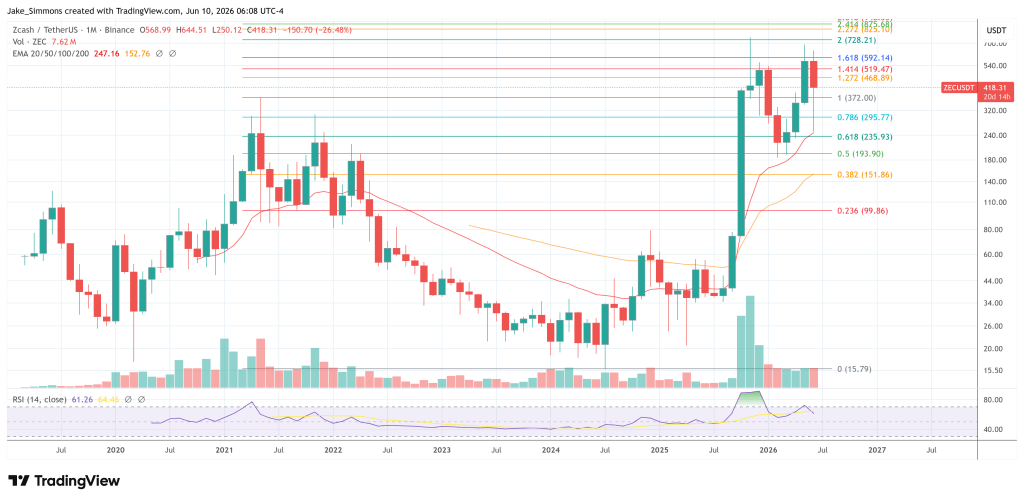
ZEC remains above the prior all-time high, 1-month chart | Source: ZECUSDT on TradingView.com

Related Reads

Warsh's Debut: Will the FED Chair Who Knows Crypto Best Bring Surprises or Shocks to the Market?

Kevin Warsh, the new Federal Reserve Chairman, prepares for his inaugural press conference amidst a challenging macroeconomic landscape: resurgent inflation, a bond market sell-off, and political pressure from President Trump for rate cuts. Uniquely, Warsh holds indirect investments in over 20 crypto and Web3 entities (e.g., Solana, dYdX), making him the first Fed Chair with disclosed crypto exposure. His stance may combine a hawkish, inflation-focused monetary policy with a crypto-friendly regulatory philosophy that shifts from Powell’s “same risk, same rule” approach toward a framework acknowledging blockchain’s productivity value. Warsh’s leadership could impact crypto markets across three dimensions: a paradigm shift in regulation (potentially accelerating pro-innovation legislation and stable币 rules), a re-pricing of risk premiums based on clearer communication and his view of AI as a structural disinflationary force, and a long-term reallocation of global institutional capital driven by increased legitimacy. Two potential scenarios for the press conference are outlined. A “positive surprise” would involve a dovish-leaning tone on rates coupled with signals of regulatory openness, potentially boosting crypto asset valuations. Conversely, a “negative shock” would see a more hawkish-than-expected stance on inflation and rates, triggering a broad risk-asset selloff that crypto markets would not escape. While ethics rules required Warsh to divest his crypto holdings upon confirmation, his deep understanding of the technology may fundamentally lower policy uncertainty and build a more receptive long-term foundation for digital assets’ integration into the mainstream financial system.

marsbit3h ago

Warsh's Debut: Will the FED Chair Who Knows Crypto Best Bring Surprises or Shocks to the Market?

marsbit3h ago

Trading

Spot
Futures

Hot Articles

How to Buy ZEC

Welcome to HTX.com! We've made purchasing Zcash (ZEC) simple and convenient. Follow our step-by-step guide to embark on your crypto journey.Step 1: Create Your HTX AccountUse your email or phone number to sign up for a free account on HTX. Experience a hassle-free registration journey and unlock all features.Get My AccountStep 2: Go to Buy Crypto and Choose Your Payment MethodCredit/Debit Card: Use your Visa or Mastercard to buy Zcash (ZEC) instantly.Balance: Use funds from your HTX account balance to trade seamlessly.Third Parties: We've added popular payment methods such as Google Pay and Apple Pay to enhance convenience.P2P: Trade directly with other users on HTX.Over-the-Counter (OTC): We offer tailor-made services and competitive exchange rates for traders.Step 3: Store Your Zcash (ZEC)After purchasing your Zcash (ZEC), store it in your HTX account. Alternatively, you can send it elsewhere via blockchain transfer or use it to trade other cryptocurrencies.Step 4: Trade Zcash (ZEC)Easily trade Zcash (ZEC) on HTX's spot market. Simply access your account, select your trading pair, execute your trades, and monitor in real-time. We offer a user-friendly experience for both beginners and seasoned traders.

3.4k Total ViewsPublished 2024.03.29Updated 2026.06.02

How to Buy ZEC

Discussions

Welcome to the HTX Community. Here, you can stay informed about the latest platform developments and gain access to professional market insights. Users' opinions on the price of ZEC (ZEC) are presented below.

活动图片