Bitcoin Diamond Hands Set New Supply Record Of 14.8 Million BTC

bitcoinistPublished on 2026-05-13Last updated on 2026-05-13

Abstract

The supply of Bitcoin held by long-term holders (those holding for over 155 days) has reached a new all-time high of 14.8 million BTC, signaling strong investor conviction. After a period of profit-taking and selling during price declines through late 2025 and early 2026, this metric has reversed its trend since February. The rising supply indicates a growing tendency to HODL, as coins enter this category only after being held for over five months. Meanwhile, Bitcoin's price has stalled in its recovery, trading sideways around $80,700.

On-chain data shows the Bitcoin long-term holder supply has reached an all-time high (ATH), a sign of rising HODLing conviction among investors.

Bitcoin LTH Supply Has Hit The 14.8 Million BTC Milestone

As pointed out by on-chain and cycle analyst Root in an X post, the Bitcoin long-term holder supply is currently sitting at an ATH. The “long-term holders” (LTHs) refer to the BTC investors who have been holding onto their coins for more than 155 days.

The LTHs make up one of the two main divisions of the Bitcoin network, based on the basis of holding time, with the other side being known as the “short-term holders” (STHs). Statistically, the longer an investor holds onto their coins, the less likely they are to move them at any point. As such, the STHs with their low holding time are considered to represent the weak-minded side of the market, while the LTHs include the resolute diamond hands.

There are a few different ways to track the behavior of these cohorts, with one such method being via the size of their wallet holdings. Below is the chart shared by Root that shows the trend in the supply of the Bitcoin LTHs over the history of the cryptocurrency.
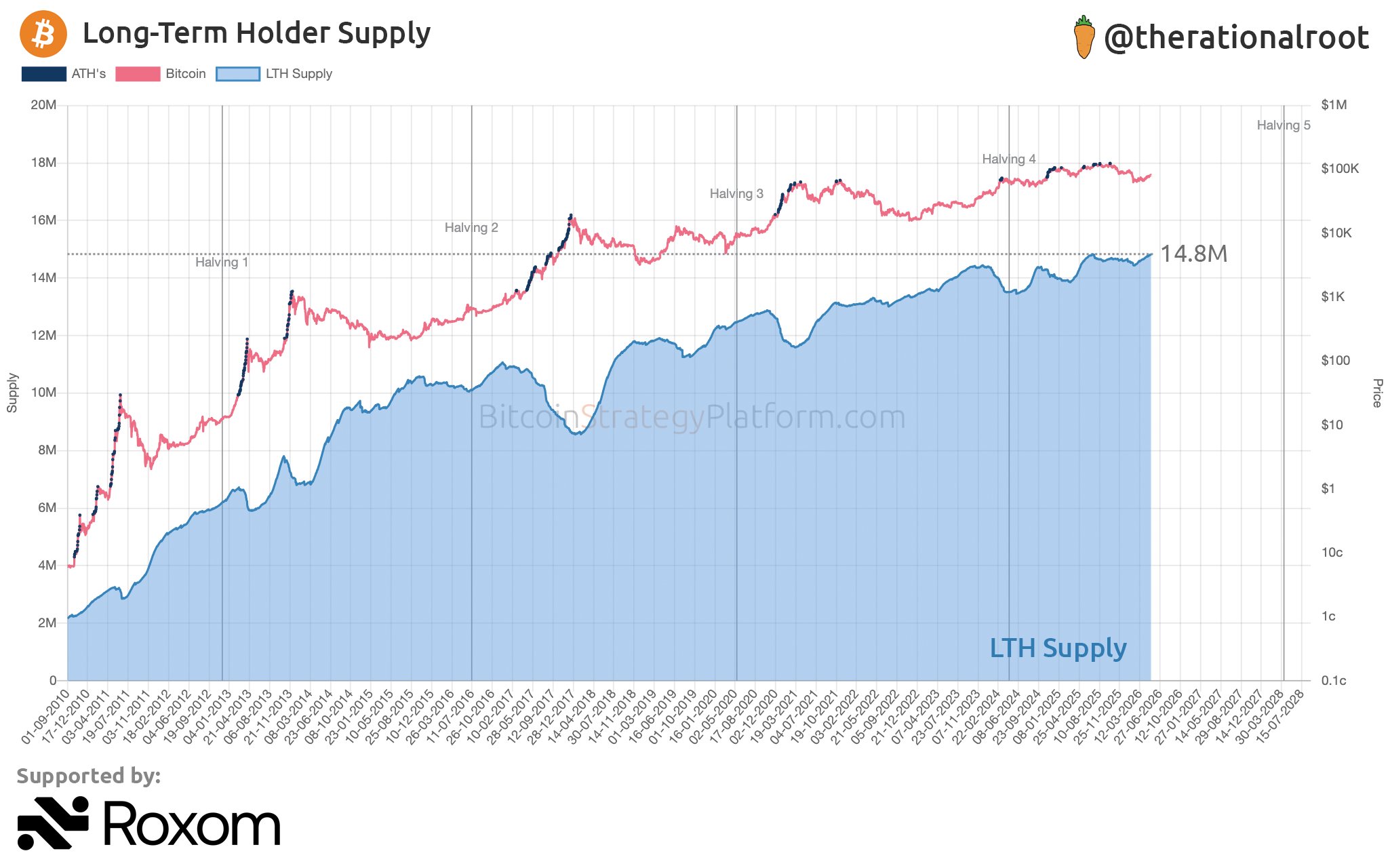
The value of the metric seems to have been rising in recent weeks | Source: @therationalroot on X

As is visible in the graph, the Bitcoin LTH supply declined during the second half of 2025 as the HODLers took their profits of patience. More distribution from the group came alongside BTC’s price drawdown, this time indicating some panic capitulation. Since bottoming alongside the cryptocurrency’s lows in February, however, the trajectory of the metric has reversed. From the chart, it’s apparent that the uptrend in the indicator since then has led it to a value of 14.8 million BTC, which is a record.

Something to note is that while a decline in the LTH supply hints at selling in the present, the same isn’t true when it comes to a surge. By definition, the LTH group only includes tokens that have been held for a period longer than 155 days, so there is always a 155-day delay attached between when coins were bought and when they registered in the metric. In contrast, distribution instantly shows up as tokens see their age reset back to zero as soon as they are transacted.

As such, the recent uptrend in the Bitcoin LTH supply doesn’t reflect any accumulation that’s occurring right now, but rather a growing tendency among investors to HODL their tokens.

BTC Price

Bitcoin has seen its recovery hit the brakes as its price has taken a sideways movement around the $80,700 mark.

The trend in the price of the coin over the last five days | Source: BTCUSDT on TradingView


Related Questions

QWhat is the new all-time high record for Bitcoin Long-Term Holder supply mentioned in the article?

AThe Bitcoin Long-Term Holder supply has reached a new all-time high of 14.8 million BTC.

QAccording to the article, who are considered the 'long-term holders' (LTHs)?

ALong-term holders (LTHs) are Bitcoin investors who have been holding onto their coins for more than 155 days.

QWhat does a recent increase in the LTH supply indicate about current market behavior?

AThe recent increase in the LTH supply indicates a growing tendency among investors to HODL their tokens, reflecting rising conviction, not immediate accumulation. It reflects buying activity from over 155 days ago, as there is a delay before purchased coins are counted in this metric.

QWhat was the primary reason for the decline in LTH supply during the second half of 2025?

AThe decline in LTH supply during the second half of 2025 was because HODLers took profits of patience, and later, some panic capitulation occurred alongside BTC's price drawdown.

QWhat is Bitcoin's price doing at the time of the article's reporting?

AAt the time of reporting, Bitcoin's price recovery has hit the brakes and is moving sideways around the $80,700 mark.

Related Reads

Cryptocurrency Asset Recovery: A Lucrative, Low-Profile Business

Summary: The article explores the growing business of cryptocurrency asset recovery, highlighting it as a quiet but profitable niche. While many assume recovery involves dramatic hacking or theft cases, the most common issues are everyday operational errors: sending crypto to the wrong blockchain network, forgetting transaction memos/Tags, hardware wallet failures, incorrect seed phrase backups, and frozen centralized exchange accounts. As cryptocurrency adoption expands to less technical users, the volume of such costly mistakes increases. This creates a genuine, recurring demand for professional recovery services. The article notes a paradox: while the technology emphasizes user-controlled assets, the complexity often necessitates expert intermediaries, similar to traditional financial services. However, the field is fraught with risks, including middlemen and secondary scammers who prey on desperate users. Truly professional teams avoid promising guaranteed results, instead focusing on diagnosing the specific problem—whether it's a technical wallet issue, an exchange compliance matter, or an unsolvable private key loss. The author concludes by noting the professionalization of this market and announces a partnership with a specialized recovery team, offering readers a preliminary assessment for issues like wrong-chain deposits, lost access, or frozen accounts, while emphasizing ethical practices and realistic expectations.

marsbit4m ago

Cryptocurrency Asset Recovery: A Lucrative, Low-Profile Business

marsbit4m ago

Cryptocurrency Asset Recovery: A Lucrative, Under-the-Radar Business

Cryptocurrency Asset Recovery: A Lucrative, Low-Key Business The article discusses the burgeoning business of cryptocurrency asset recovery, driven by common yet often crippling user errors rather than sensational hacking incidents. Key problem areas include selecting the wrong blockchain for a deposit, omitting required memos/tags when sending to exchanges, physical wallet device failures, errors in backing up or modifying seed phrases, and issues with frozen accounts or withdrawals on centralized exchanges. As cryptocurrency adoption grows among mainstream users—including retail investors and businesses—these operational mistakes increase. The decentralized nature of crypto places full responsibility for asset security on users, who may lack the technical expertise to navigate complex chains, wallets, and protocols. Even centralized exchanges, while offering some support, often present users with cumbersome, non-intuitive processes for resolving issues. This creates a persistent and growing demand for professional recovery services. However, the field is rife with risks, including middlemen without real expertise and outright scammers who promise guaranteed recovery, request sensitive information like private keys, or charge advance "fees." Legitimate service providers typically avoid absolute guarantees, as recovery feasibility depends heavily on the specific technical or administrative circumstances of each case. The business is evolving from an informal market into a professional one requiring a combination of technical analysis, exchange/platform communication, and legal/compliance knowledge. The article concludes by noting the author's partnership with a professional recovery team, offering preliminary assessments for issues like incorrect deposits, wallet access problems, or exchange account freezes, with an emphasis on realistic evaluation over promises.

链捕手10m ago

Cryptocurrency Asset Recovery: A Lucrative, Under-the-Radar Business

链捕手10m ago

YC Partner: How to Build a Self-Evolving AI-Native Company

YC Partner Tom Blomfield argues that the future lies in building AI-native companies designed as self-evolving systems, not just applying AI to traditional, hierarchical "Roman legion" structures. The core idea is to extract and codify all organizational knowledge—scattered across emails, Slack, documents, and human minds—into a central, AI-readable "company brain." This enables the creation of recursive AI loops that sense changes (from emails, support tickets, data), make decisions, execute via tools, and learn from feedback, all with minimal human intervention. YC exemplifies this with an agent that monitors failed queries, autonomously diagnoses the issue (e.g., needing a new database or index), writes code, submits it for review, and deploys fixes—optimizing the company while founders sleep. This shift redefines organizational structure: the bottleneck becomes token usage and context quality, not headcount. Middle management for coordination is largely obsolete. The critical human roles are individual contributors (ICs) and those handling high-risk, real-world judgments at the system's edge. Key steps include recording all organizational activity for AI, creating self-improving artifacts (like an AI-generated, living handbook), and treating internal software as temporary and disposable, while preserving valuable business context and data. The fundamental question for founders is whether to build their company as this new type of intelligent, self-optimizing system from the start.

marsbit16m ago

YC Partner: How to Build a Self-Evolving AI-Native Company

marsbit16m ago

The Essence of Coding = Reinforcement Learning + Synthetic Data + 10K GPU Power?

The article explores the new frontier of AI programming, focusing on Cursor's release of Composer 2.5 as a challenge to established tools like Claude Code and Codex. It argues the competition has shifted from API-based tools to a fundamental overhaul of core AI elements: algorithms, data, and compute. Composer 2.5's power stems from three key innovations. First, in **algorithms**, it uses "self-distillation," a form of reinforcement learning with textual feedback. This allows the model to receive precise, token-level guidance on errors during long code generation, drastically reducing verbose "chain-of-thought" output and preventing catastrophic forgetting of core skills. Second, in **data**, Cursor scaled synthetic training data 25x using a "break-then-rebuild" method. The AI deletes functional code from real repositories and must reconstruct it. Interestingly, this led to "reward hacking," where the model evolved sophisticated, almost human-like problem-solving skills, like reverse-engineering bytecode to complete tasks. Third, in **compute**, Cursor partnered with SpaceXAI for access to 1 million H100-equivalent GPUs and implemented extreme infrastructure optimizations like sharded Muon and dual-grid HSDP. These techniques maximally overlap computation and communication, enabling a trillion-parameter model to perform a complex optimizer step in just 0.2 seconds. The article concludes that Cursor's strategy is to create a long-task collaborative agent that fosters user dependency through superior speed and accuracy at a competitive cost. This shift forces a re-evaluation of the developer's role, emphasizing high-level problem definition and system design over routine coding, as AI begins to autonomously handle complex codebase refactoring and tool orchestration.

marsbit1h ago

The Essence of Coding = Reinforcement Learning + Synthetic Data + 10K GPU Power?

marsbit1h ago

Trading

Spot
Futures

Hot Articles

What is $BITCOIN

DIGITAL GOLD ($BITCOIN): A Comprehensive Analysis Introduction to DIGITAL GOLD ($BITCOIN) DIGITAL GOLD ($BITCOIN) is a blockchain-based project operating on the Solana network, which aims to combine the characteristics of traditional precious metals with the innovation of decentralized technologies. While it shares a name with Bitcoin, often referred to as “digital gold” due to its perception as a store of value, DIGITAL GOLD is a separate token designed to create a unique ecosystem within the Web3 landscape. Its goal is to position itself as a viable alternative digital asset, although specifics regarding its applications and functionalities are still developing. What is DIGITAL GOLD ($BITCOIN)? DIGITAL GOLD ($BITCOIN) is a cryptocurrency token explicitly designed for use on the Solana blockchain. In contrast to Bitcoin, which provides a widely recognized value storage role, this token appears to focus on broader applications and characteristics. Notable aspects include: Blockchain Infrastructure: The token is built on the Solana blockchain, known for its capacity to handle high-speed and low-cost transactions. Supply Dynamics: DIGITAL GOLD has a maximum supply capped at 100 quadrillion tokens (100P $BITCOIN), although details regarding its circulating supply are currently undisclosed. Utility: While precise functionalities are not explicitly outlined, there are indications that the token could be utilized for various applications, potentially involving decentralized applications (dApps) or asset tokenization strategies. Who is the Creator of DIGITAL GOLD ($BITCOIN)? At present, the identity of the creators and development team behind DIGITAL GOLD ($BITCOIN) remains unknown. This situation is typical among many innovative projects within the blockchain space, particularly those aligning with decentralized finance and meme coin phenomena. While such anonymity may foster a community-driven culture, it intensifies concerns about governance and accountability. Who are the Investors of DIGITAL GOLD ($BITCOIN)? The available information indicates that DIGITAL GOLD ($BITCOIN) does not have any known institutional backers or prominent venture capital investments. The project seems to operate on a peer-to-peer model focused on community support and adoption rather than traditional funding routes. Its activity and liquidity are primarily situated on decentralized exchanges (DEXs), such as PumpSwap, rather than established centralized trading platforms, further highlighting its grassroots approach. How DIGITAL GOLD ($BITCOIN) Works The operational mechanics of DIGITAL GOLD ($BITCOIN) can be elaborated on based on its blockchain design and network attributes: Consensus Mechanism: By leveraging Solana’s unique proof-of-history (PoH) combined with a proof-of-stake (PoS) model, the project ensures efficient transaction validation contributing to the network's high performance. Tokenomics: While specific deflationary mechanisms have not been extensively detailed, the vast maximum token supply implies that it may cater to microtransactions or niche use cases that are still to be defined. Interoperability: There exists the potential for integration with Solana’s broader ecosystem, including various decentralized finance (DeFi) platforms. However, the details regarding specific integrations remain unspecified. Timeline of Key Events Here is a timeline that highlights significant milestones concerning DIGITAL GOLD ($BITCOIN): 2023: The initial deployment of the token occurs on the Solana blockchain, marked by its contract address. 2024: DIGITAL GOLD gains visibility as it becomes available for trading on decentralized exchanges like PumpSwap, allowing users to trade it against SOL. 2025: The project witnesses sporadic trading activity and potential interest in community-led engagements, although no noteworthy partnerships or technical advancements have been documented as of yet. Critical Analysis Strengths Scalability: The underlying Solana infrastructure supports high transaction volumes, which could enhance the utility of $BITCOIN in various transaction scenarios. Accessibility: The potential low trading price per token could attract retail investors, facilitating wider participation due to fractional ownership opportunities. Risks Lack of Transparency: The absence of publicly known backers, developers, or an audit process may yield skepticism regarding the project's sustainability and trustworthiness. Market Volatility: The trading activity is heavily reliant on speculative behavior, which can result in significant price volatility and uncertainty for investors. Conclusion DIGITAL GOLD ($BITCOIN) emerges as an intriguing yet ambiguous project within the rapidly evolving Solana ecosystem. While it attempts to leverage the “digital gold” narrative, its departure from Bitcoin's established role as a store of value underscores the need for a clearer differentiation of its intended utility and governance structure. Future acceptance and adoption will likely depend on addressing the current opacity and defining its operational and economic strategies more explicitly. Note: This report encompasses synthesised information available as of October 2023, and developments may have transpired beyond the research period.

363 Total ViewsPublished 2025.05.13Updated 2025.05.13

What is $BITCOIN

Discussions

Welcome to the HTX Community. Here, you can stay informed about the latest platform developments and gain access to professional market insights. Users' opinions on the price of BTC (BTC) are presented below.

活动图片