Arbitraje de Harness, rescatando DeFi desde el borde del SaaS

marsbitPublished on 2026-04-19Last updated on 2026-04-19

Abstract

# Resumen en español europeo El artículo explora la intersección entre la inteligencia artificial (IA) y las finanzas descentralizadas (DeFi), argumentando que el modelo organizativo y de *tokens* de la IA es más eficiente que el de DeFi. Señala que el capitalismo ha evolucionado hacia la cuantificación de la mano de obra y los datos de los usuarios, pero la organización humana sigue siendo difícil de medir. La IA, mediante *tokens* asequibles y *agents* prácticos, está transformando esto al convertir las capacidades humanas en *skills* cuantificables y redefinir la colaboración en espacios digitales (*Harness*). DeFi, aunque pionera, se ha convertido en un modelo SaaS tradicional, centrado en cobrar por transacciones en lugar de innovar. La IA amenaza este modelo al vender "capacidad de trabajo" en lugar de *tokens*, democratizando habilidades antes monopolizadas por grandes empresas. El autor sugiere que la IA puede reformar DeFi mejorando la seguridad de los contratos inteligentes (ej. con sistemas como Mythos), optimizando la organización humana y reinventando la economía de *tokens* para reflejar mejor el rendimiento del capital y el riesgo en tiempo real. Concluye que, aunque la IA reduce el valor de los datos y el contenido hasta casi cero, abre nuevas oportunidades económicas para los individuos, con *agents* manejando tareas repetitivas y micro-pagos, mientras el valor real reside en el comportamiento humano único.

Escrito por: Zuoye

Mirando hacia atrás 500 años, la contradicción entre el trabajo y el capital bajo el sistema capitalista siempre ha estado marcada por la continua victoria del capital.

En el lado de la producción, la participación de la fuerza laboral se ha reducido gradualmente al nivel de operar máquinas; en el lado del consumo, el valor del usuario radica en producir datos de uso para las plataformas.

Ambas fuerzas se combinan para respaldar la valoración de las empresas en el mercado de capitales.

Sin embargo, los modelos de organización humana no han podido ser completamente cuantificados a largo plazo; los KPI/OKR de los trabajadores de cuello blanco siguen siendo una variante del sistema burocrático, y los salarios anuales de un millón y los salarios a destajo son variantes del taylorismo.

Sin una fórmula clara, el capital no puede valorarlo, lo que afecta la eficiencia del capital. Si las stablecoins algorítmicas son el santo grial de DeFi aún no está claro, pero la capacidad de cálculo de las organizaciones es ciertamente la medida del apalancamiento financiero.

Los modelos grandes decidieron resolverlo con la fuerza bruta de los tokens; el colapso del SaaS de seguridad es solo la apariencia, el diseño de productos también en camino, reemplazar capacidades profesionales especializadas y escalarlas es la clave, la innovación avanza hacia territorio inexplorado.

Esto nos trae infinitas revelaciones, especialmente en el momento presente donde el modelo DAO de DeFi se está desmoronando gradualmente y la economía de los tokens se está arruinando.

En una palabra, ¿por qué el modelo organizativo y el modelo de tokens de la IA son más eficientes que DeFi?

¿Cómo empezó todo esto?

Tokens abaratados, Agent utilitarios.

Por un beneficio del 300%, el capitalista puede vender su propia soga;

Para salvar su trabajo actual, el trabajador puede escribir Skills para el Agent.

A nivel de capital, el Agent potenciado por Skills tiene un estatus tan sagrado como el beneficio.

El Agent representa la "capacidad humana" refinada en Skill; no solo eso, la organización humana se convierte en una cadena ritual de interacción centrada en el Agent.

Los llamados Prompt, Context y ahora la ingeniería Harness, están convirtiendo el modelo organizativo humano en territorio inexplorado, al menos reduciendo a las personas.

Tu próximo colega no es un robot, sino un "instinto de capacidad".

Esto no es una fantasía; la Ley de Escalado a nivel de datos está fallando gradualmente, pero la recolección y producción de datos ya no son importantes; antes de que la AGI tenga éxito, se necesitan nuevos objetivos de valoración.
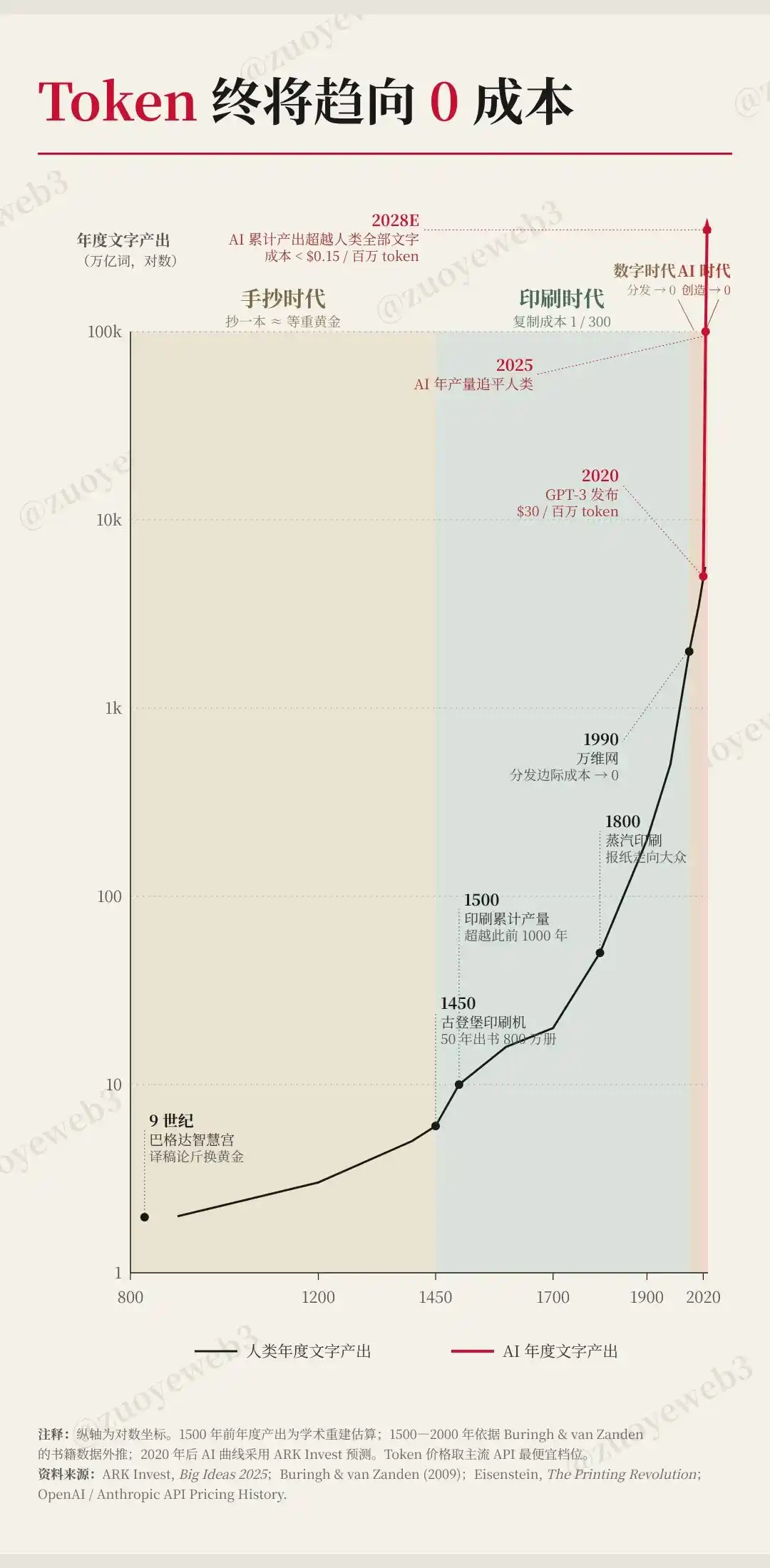
Descripción de la imagen: El contenido ya no vale dinero

Información integral:@ARKInvest

Desde que Claude eligió el campo de la programación para dar el primer paso hacia la AGI, la IA ha superado el modo de entretenimiento del chat para ingresar en mercados existentes de la realidad, como la programación, la seguridad y el diseño recién lanzado.

Esta innovación disruptiva, ¿terminará creando un nuevo incremento económico o arrastrará la economía a un modo permanente de bajo empleo donde los tokens consiguen trabajo y las personas lo pierden? Estamos presenciando este proceso.

Pero el abaratamiento actual de los tokens está descentralizando capacidades que antes monopolizaban unas pocas grandes empresas hacia pequeñas y medianas empresas, moldeando así superindividuos, y esto no es una fantasía.

Tomando China como ejemplo, el volumen de llamadas a tokens pasó de 100.000 millones/día en 2024 -> 100 billones/día a finales de 2025 -> ahora 140 billones/día; la producción de contenido y datos está a punto de entrar en una era de coste cero.

Cabe señalar que la escasez de potencia de cálculo es un estado relativo; las grandes empresas ya no monopolizan la "capacidad", pero aún intentan mantener su ventaja existente monopolizando la "potencia de cálculo", pero no pueden detener la tendencia inevitable del abaratamiento general de los tokens.

Hay muchas comparaciones de paradigmas para los modelos base grandes, pero la evolución de "cómo la IA ayuda a las personas" no ha recibido mucha atención durante mucho tiempo.

En mi opinión, Harness es una forma de espacio que permite a los Agent concentrarse por primera vez en tareas dentro de un límite, una estrategia de profundidad primero, a diferencia de la amplitud primero de los sistemas de preguntas y respuestas.
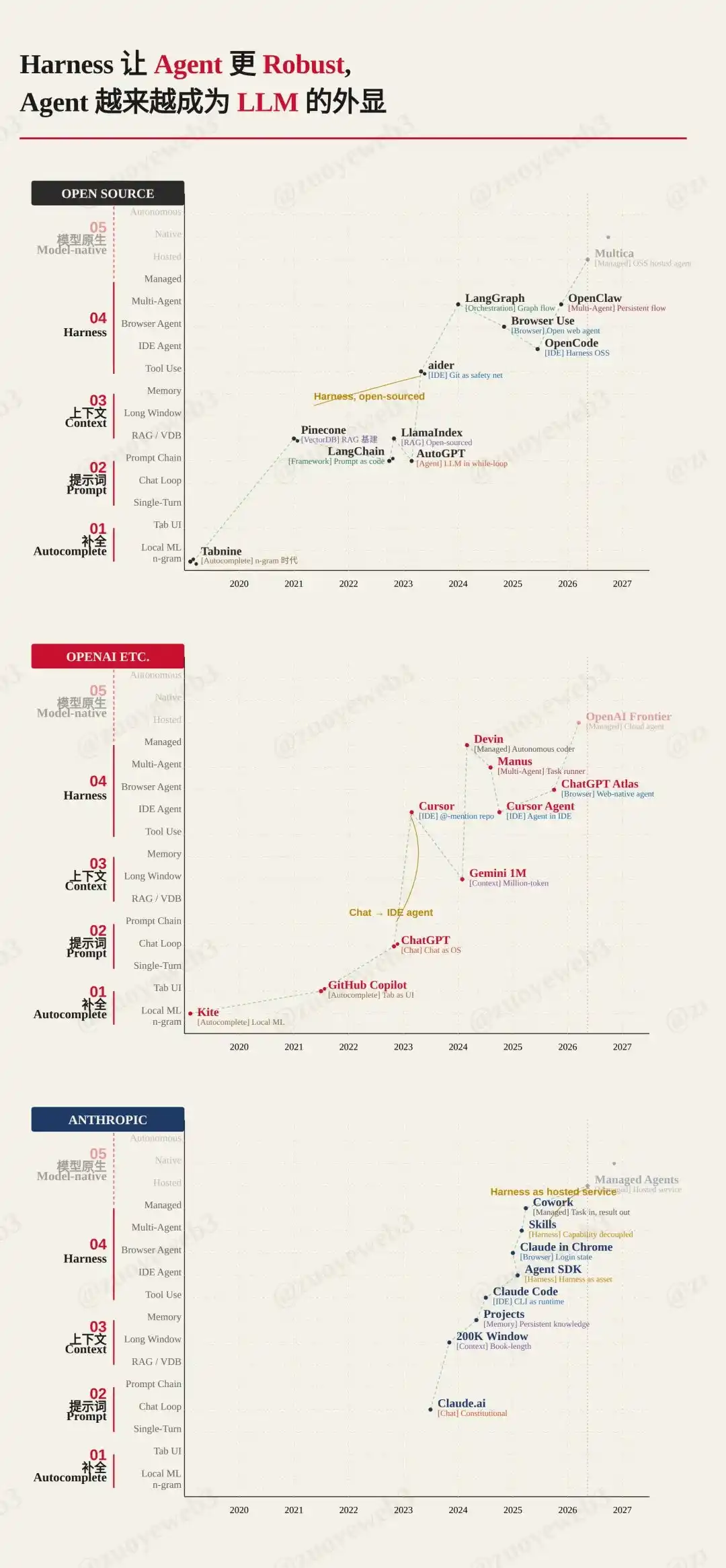
Descripción de la imagen: Historia de la evolución del Agent

Fuente de la imagen:@zuoyeweb3

Desde que la tecla Tab se usó por primera vez para autocompletar código, era solo cuestión de tiempo que los humanos se convirtieran en la capa de entrada de la IA.

El coste de experimentación se reduce exponencialmente, permitiendo intentos más interesantes sobre los modos de colaboración humana:

  • Software: SaaS, la fuente de capacidad humana ya no son las personas, sino la emergencia del Agent
  • Hardware: Tarjetas de cálculo + HBM, los centros de datos sirven directamente a la demanda de IA por primera vez
  • Espacio: Harness, no es un espacio físico de colaboración humana, sino un espacio digital de interacción de Agents
  • Interacción: El teléfono Doubao fracasa, Google soporta GUI Agent en el nivel del sistema Android

La capacidad de la IA para "decir" no tiene un gran valor comercial; el coste de generar texto es bajo incluso para los humanos, pero "hacer" hará que el consumo de tokens supere a la generación de imágenes y videos, similar a como AWS no vende servidores, sino tiempo de uso.

La IA no vende Tokens, sino "capacidad de trabajo", esta es la raíz del miedo en la industria SaaS; lamentablemente, DeFi se ha convertido en SaaS, no en un modelo grande.

La SaaS-ificación de los protocolos DeFi

DeFi no está obsoleto, pero es excesivamente precoz.

La IA está reinventando la ingeniería de software; no solo el SaaS está siendo reemplazado, pero el SaaS es sin duda el más típico.

Incluso la terminal Bloomberg, su valor comercial más importante no es la avanzada tecnología, sino la autoridad de la información, una autoridad sedimentada durante décadas de conexiones industriales, contactos y otros datos no estandarizados.

El Agent ofrece una opción: inferir el futuro a partir de los datos, incluso el siguiente paso arriesgado podría superar a la competencia y obtener un pequeño beneficio.
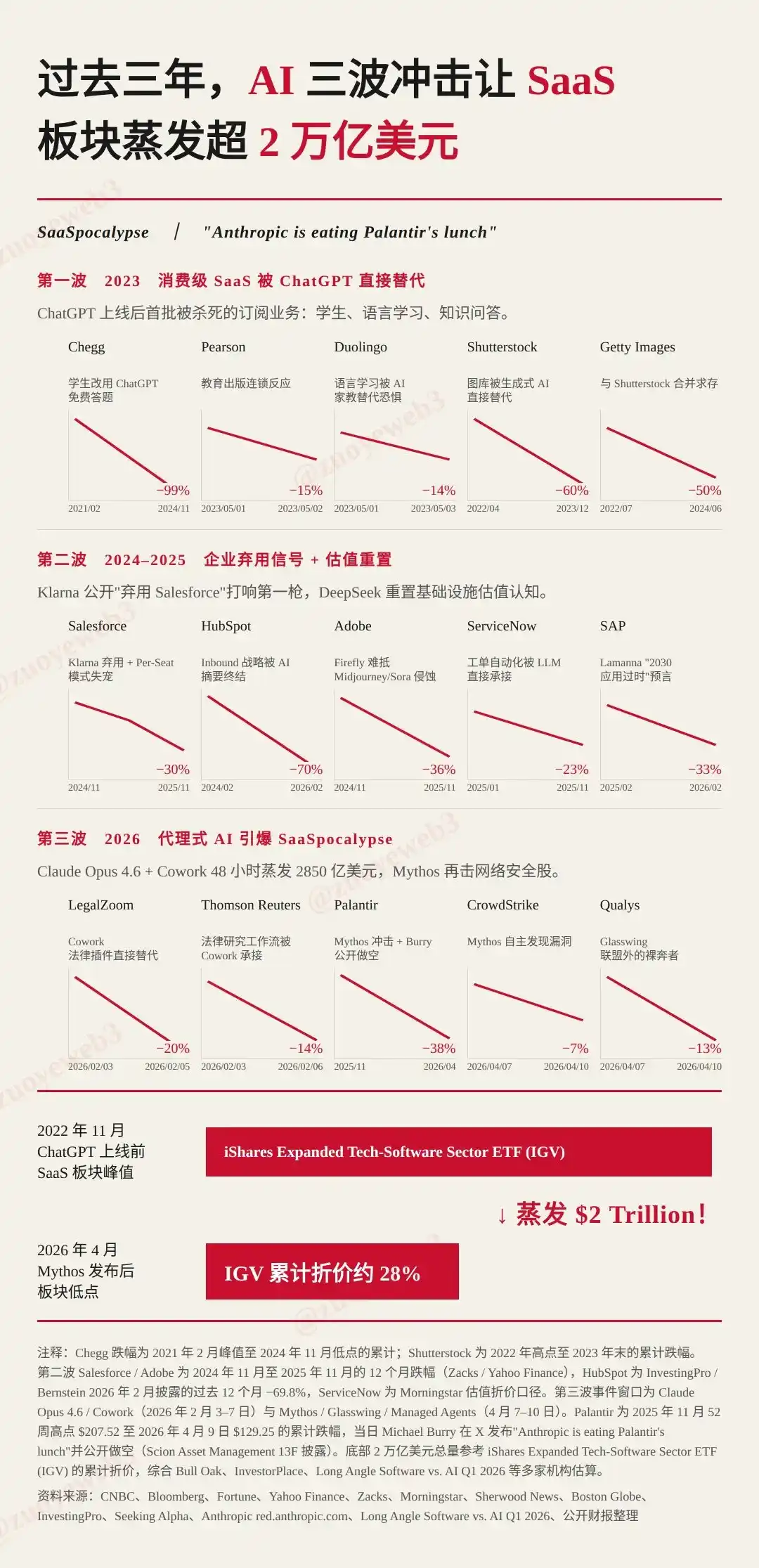
Descripción de la imagen: SaaS colapsando

Fuente de la imagen:@zuoyeweb3

Se puede entender que el Agent aprovecha astutamente la naturaleza lucrativa del capital; por supuesto, se puede esperar la información completa de la terminal Bloomberg, o se pueden usar datos incompletos e inexactos para intentar obtener un beneficio.

Esto no es nuevo; Thomas Peterfi, fundador de IBKR, "inventó" o ensambló por primera vez una terminal de trading física en el ámbito financiero, y todo comenzó con una P101 inactiva.

Si una forma de utilizar los datos puede generar más beneficios, entonces se pueden obtener más datos, y así comienza el vuelo.

SaaS monopoliza el pasado, la IA vende el futuro.

Desafortunadamente, debemos abordar DeFi desde aquí. ¿Recuerdan el muro de pago de API de Dune/DeFiLlama? Abrazando datos valiosos y pidiendo limosna, o el cierre final de Arkham Exchange.

Los datos en la industria crypto nunca han valido dinero.

Pero la industria crypto es, a su vez, un sistema financiero abierto directo, cuyos datos generados pueden ser aprendidos repetidamente; incluso antes de la IA, la velocidad de bifurcación de proyectos ya se había reducido a meses, y los memes de imitación de PumpFun se pueden comprimir al límite a segundos.

Existe una inferencia contraria a la intuición: DeFi es el servidor de pruebas pionero del sistema financiero; lo que probamos hoy con IA+DeFi se convertirá en la plantilla para la evolución financiera futura.

  • Por ejemplo, antes de la crisis financiera de 2008, el LIBOR de transacciones no garantizadas "desencadenó" el tsunami financiero, luego reemplazado por el indicador SOFR generado por transacciones de bonos del Tesoro, pero el mecanismo de sobrecolateralización garantiza la finalidad de liquidación de DeFi.

  • Por ejemplo, los productores de modelos grandes no quieren vender Tokens por consumo, sino que insisten en comercializarlos por niveles, personalizar capacidades, modificar profesionalmente; la economía de los tokens ya ha retorcido el "valor de uso".

Los Crypto Token se obsesionan con el valor de uso, los AI Token se obsesionan con el valor económico.

Desde esta perspectiva, los ataques de hackers a DeFi son solo pruebas de estrés rutinarias; un sistema abierto no puede parchear bugs por sí mismo de la entropía externa.

Similar al humor negro de la Trampa-22, sin estímulos de un sistema de señales externo, crypto asume por defecto que el entorno actual es seguro; una vez que ocurre una crisis de seguridad, colapsa a un sistema de procesamiento centralizado.

Por ejemplo, en el incidente de Drift, el objeto de las acusaciones se convirtió en Circle por congelar lentamente.
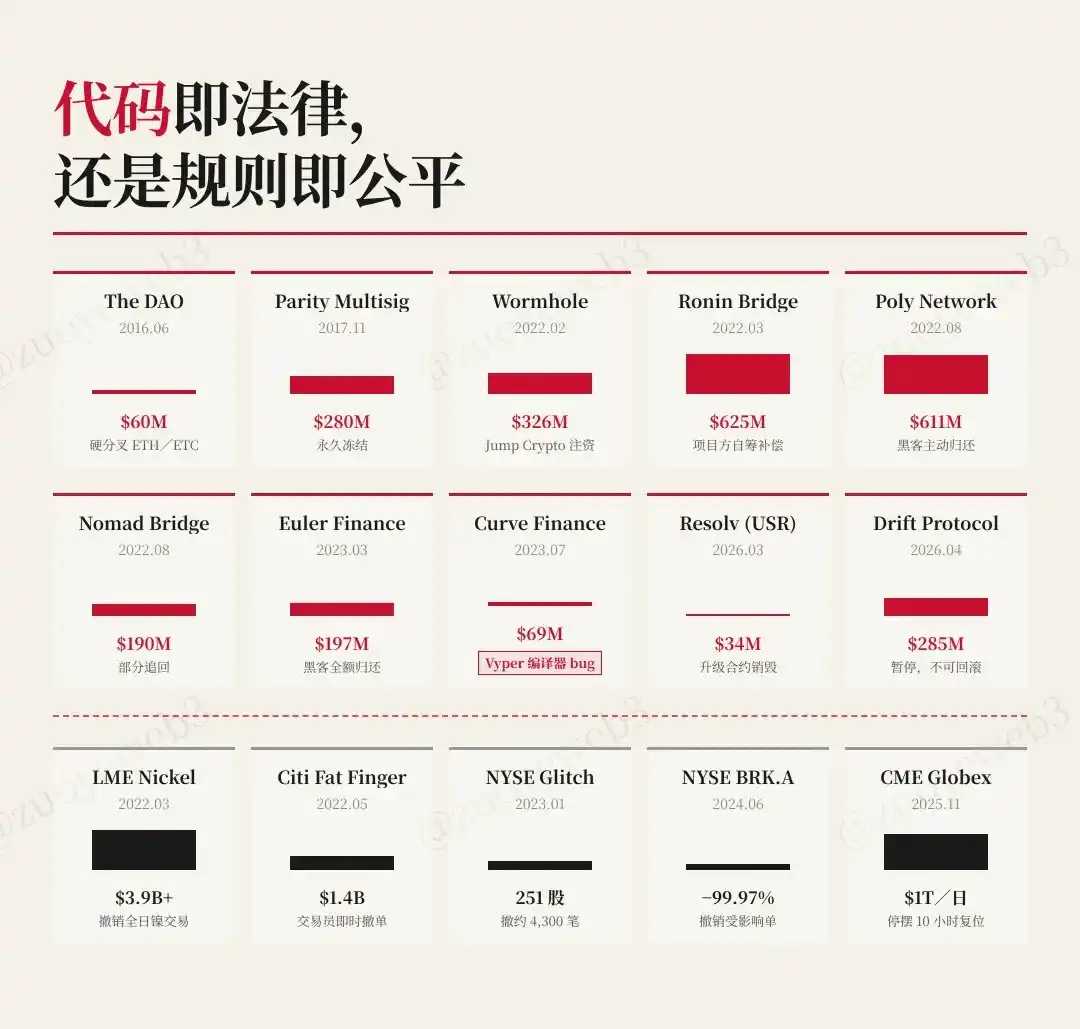
Descripción de la imagen: El código no puede resolver problemas de seguridad

Fuente de la imagen:@zuoyeweb3

Se puede decir que, antes del salto de capacidad de la IA, DeFi ya se ha SaaS-ificado, solo puede cobrar por número de transacciones, no hay forma de trasladar directamente las "finanzas" a la cadena.

RWA en la cadena carece de liquidez; DeFi no tiene una buena solución para esto.

Pero la evolución de la capacidad de los Agent parece traer un amanecer aún poco claro para reescribir las reglas de DeFi.

  1. Economía de tokens: Distribuir el volumen de uso por canales, desplegar según la "eficiencia de capital";

  2. Configuración de reglas: Mythos proporciona la finalidad de seguridad, la IA defiende contra crisis de día cero;

  3. Organización humana: Genial, DeFi ya lo gestionan unas pocas personas cientos de miles de millones.

El renacimiento de la narrativa de ingeniería

¿De dónde viene la seguridad? De la determinación de la máquina de Turing. ¿De dónde viene el peligro? De la infinita posibilidad.

Lo que dijo YC Garry Tan, "Fat Skill, Thin Harness", me llega profundamente; esencialmente se trata de establecer bien las reglas básicas, una "libertad basada en el orden".

La máquina de Turing puede combinar infinitamente, la arquitectura von Neumann siempre tiene una diferencia de tiempo entre almacenamiento y cálculo, y los modelos grandes tampoco pueden generar números verdaderamente aleatorios.

En un futuro donde los datos no valen dinero, solo el comportamiento humano puede hacer que el flujo de dinero genere valor.

Pero el comportamiento humano aún necesita tiempo para ser aprendido completamente por la IA, internalizándose luego como expresiones de ingeniería y código.

Perseguir lo infinito con lo finito es finalmente inalcanzable; los LLM no pueden eliminar completamente las alucinaciones, deben aproximarse al punto de 'esto no es alcanzable por la IA, ni por el esfuerzo humano' para que el mecanismo de mercado les ponga precio, y entonces podamos confiar verdaderamente en los contratos inteligentes.

Los contratos inteligentes actuales distan de ser exitosos; la bifurcación de The DAO, el bug del lenguaje de programación de Curve, incluso la multisig de Drift, demuestran que "los humanos tienen el control final sobre el código".

El interrogatorio moral no tiene valor económico; el modo de colaboración en el campo de DeFi se ha colapsado de DAO a fundaciones y "equipos" porque, en última instancia, existe la necesidad real de actualizaciones de contratos y cooperación empresarial.

Pero los humanos simplemente no pueden escribir código que sea siempre seguro y dinámicamente actualizable; recuerden, es imposible para siempre.

Si nunca se actualiza, la experiencia de Curve nos dice que la pila de dependencias tecnológicas también puede fallar.

El presente determina el pasado, el pasado determina el futuro.

Desde el fondo de medallas Simons hasta Numerai ejecutando estrategias de IA, la IA no es rara en el campo financiero; otro caso contrario a la intuición es que las señales de trading反而 ayudan a la evolución de la IA.
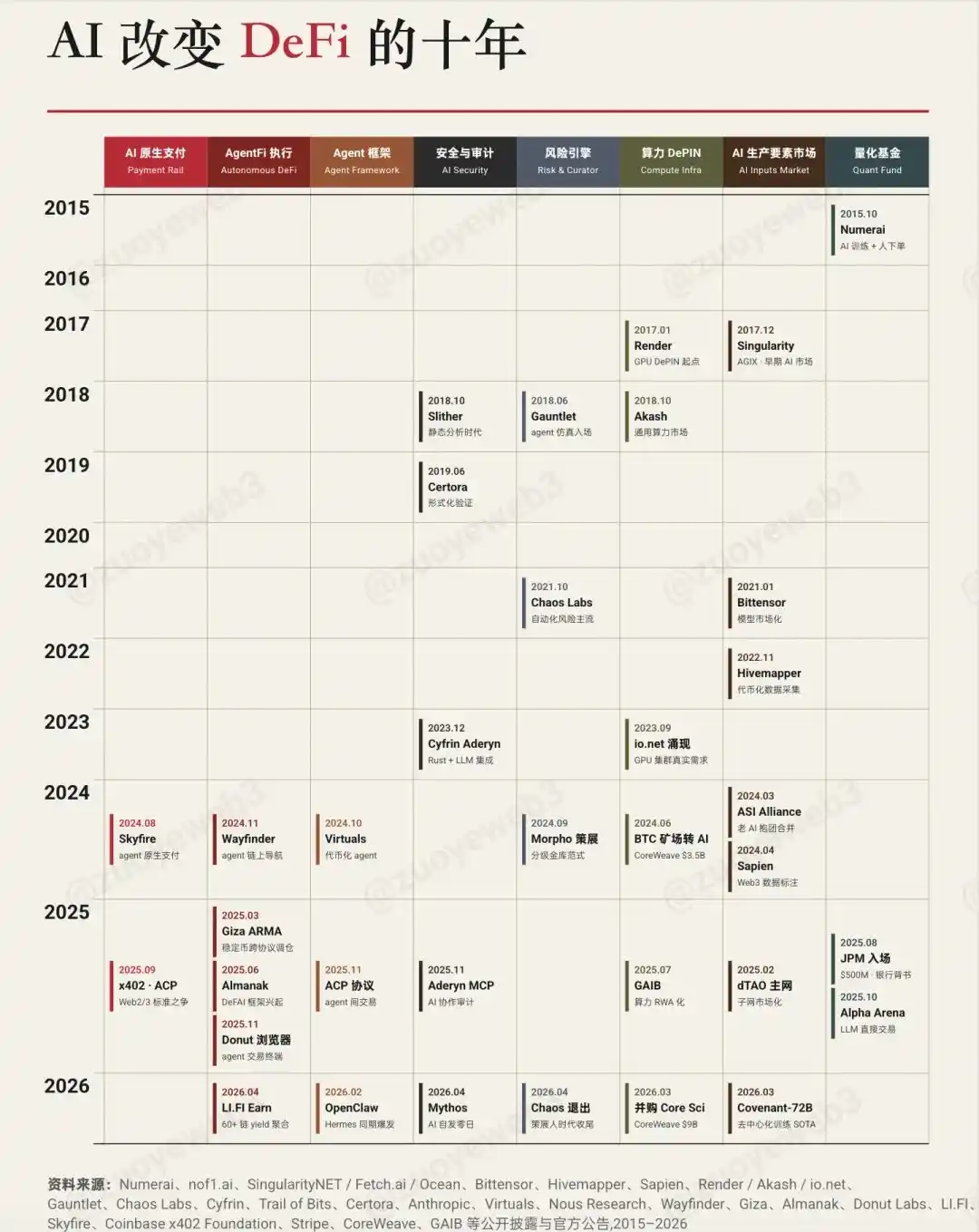
Descripción de la imagen: IA y DeFi 10 años

Fuente de la imagen:@zuoyeweb3

Los modelos de IA siguen siendo un paradigma informático, máquinas de estado que procesan señales; sin señales externas, carecen internamente de la capacidad de simular el mundo exterior; la apuesta de Yang LeCun y Li Fei-Fei por los modelos mundiales tiene sentido en este camino.

Pero desde la perspectiva de DeFi, permitir que la IA negocie autónomamente requiere que la intención humana sea aprendida por el Agent a través del comportamiento; esta es también la importancia del humano para la IA, incluso si el Agent reemplaza la mano de obra, imita y resume el comportamiento humano.

Incluso, los humanos no pueden ser intencionalmente aleatorios; la mínima intencionalidad tiene regularidad estadística; incluso las características fisiológicas humanas tienen aleatoriedad, por ejemplo, "me gusta fisiológicamente la estrategia de market making de Ethena, y detesto la estrategia de arbitraje de XX", lo que反而 conlleva una preferencia borrosa.

Es muy cierto que hacer que blockchain/DeFi sea la infraestructura de la IA ha encontrado un fracaso lamentable en la última década; deAI/deAgent/deOpenclaw encontrarán situaciones similares.

Usar directamente los últimos modelos grandes para改造 las diversas estructuras de DeFi, por ejemplo, que los contratos probados por Mythos tengan seguridad por defecto, cualquier cambio sea detectado en tiempo real, aumentando así el nivel de peligro.

Y en la organización humana, la elección de la IA es "no querer personas", solo la "capacidad" humana; DeFi es la industria más adecuada para esto, incluso no tiene igual; después del diseño de reglas, DeFi solo mejora la eficiencia del capital bajo la premisa de seguridad, refiriéndose a la clasificación L1/2/3/4 de la conducción autónoma, que inevitablemente pasará por el proceso de autorización de información -> derecho de uso limitado de fondos -> derecho de uso completo de fondos.

Si el Agent continúa aprendiendo capacidades de traders de ingeniería, capacidades de gestión de Curator, entonces inevitablemente superará a los humanos en el campo de las transacciones y los beneficios; pero lamentablemente, los datos de DeFi acumulados aún no han sido aprendidos y entrenados sistemáticamente por sistemas de IA; la IA actual en el mundo de las criptomonedas aún está en la etapa de recaudar dinero.

Pero estoy muy seguro de que el uso real de los fondos es la próxima ola principal de la transformación de DeFi por la IA, es inevitable.

Entonces, después de que la seguridad (contratos) y la organización (humanos) sean actualizadas, ¿en qué forma se convertirá la economía de los tokens?

  • Los tokens de la era PoW eran certificados de consumo de potencia de cálculo, básicamente iguales a los AI Token actuales;

  • Los tokens de la era PoS erancertificados de descuento de ingresos esperados, los AI Token están evolucionando en esta dirección (proporcionar la capacidad de reemplazar a las personas es la expresión de IA de este valor económico);

  • Los Crypto Token de la era de la IA ya han superado nuestro alcance de ingeniería, solo podemos predecir de manera irresponsable basándonos en la teoría.

Consultando a Sky usando la asignación de tokens para controlar el APY de cada canal, Claude usando el consumo de tokens para valorar la capacidad del modelo, es probable que los futuros Crypto Token sean un certificado de "tasa de retorno de capital".

Aquí presten atención a la distinción: los tokens de la era PoS, comoETH etc., sus ingresos esperados son una suposición económica, un razonamiento experiencial basado en lo a priori, pero el diseño de ingeniería de la IA, los diversos parámetros de DeFi se acercarán infinitamente a la situación real, su tasa de retorno y tasa de riesgo son altamente confiables y se verifican en tiempo real.

Incluso, los usuarios pueden determinar el precio actual del Token según el modelo grande utilizado por el protocolo DeFi y el Agent, y la puntuación del indicador de optimización de Harness; comprar si son optimistas, vender si son pesimistas.

Conclusión

Miles de sufrimientos indescriptibles y el futuro impredecible de la humanidad.

El futuro de DeFi se divide en nivel económico y técnico; la economía de los tokens aún no tiene una buena solución, pero la seguridad vislumbra un rayo de esperanza; Claude Mythos puede amenazar al mundo, pero pensándolo al revés, puede gestionar el dinero.

AlphaGo resolvió completamente el problema del Go, Claude resolvió completamente el problema de la programación; tales escenarios solo serán más en el futuro; los contratos de DeFi, la organización humana, incluso la unidad de valoración económica, tienen espacio teórico para ser optimizados.

Al menos, las personas no deben preocuparse por ser reemplazadas por completo; en una era donde los datos no valen dinero, el comportamiento tiene su propio significado; al menos por ahora, la toma de control del Agent sobre las personas sigue siendo en "microtareas", "micropagos" y otros detalles, repitiéndose constantemente; debemos hacer que este comportamiento repetitivo y de copia genere valor; la IA hace que el valor de los datos y el contenido descienda infinitamente, acercándose al coste cero, y el valor económico unitario (coste) de los AI Token y los Crypto Token está cayendo constantemente, esta es la tendencia general.

Incluso se puede decir que esta es la primera vez que el dinero realmente se abre de par en par a los individuos, ya sea para el trabajo de IA o para el consumo de Crypto.

Related Questions

Q¿Qué significa 'Harness' en el contexto de la evolución de los agentes de IA y cómo se relaciona con la eficiencia organizativa?

AEn el contexto de la evolución de los agentes de IA, 'Harness' se refiere a un espacio digital donde los agentes interactúan y se enfocan en tareas específicas dentro de límites definidos, utilizando una estrategia de profundidad prioritaria. Esto contrasta con los modelos de preguntas y respuestas, que son de amplitud prioritaria. Este enfoque permite una colaboración más eficiente, reduciendo la dependencia de la participación humana directa y optimizando la forma en que se organizan' las capacidades humanas convertidas en 'Skills' para los agentes.

Q¿Por qué el artículo sugiere que DeFi se ha 'SaaS-ificado' y cómo afecta esto a su valor económico?

AEl artículo argumenta que DeFi se ha 'SaaS-ificado' porque, al igual que el Software como Servicio (SaaS), se ha centrado en monetizar el acceso a través de tarifas por transacción (por ejemplo, APIs de pago de Dune/DeFiLlama) en lugar de capturar el valor fundamental de los datos financieros abiertos que produce. Los datos en sí se consideran commoditizados y de bajo valor, lo que limita su potencial económico y lo sitúa en una posición vulnerable frente a la disrupción de los agentes de IA, que pueden generar y utilizar datos de manera más eficiente para crear valor.

QSegún el autor, ¿cómo podría la IA regenerar las reglas de DeFi en términos de seguridad y organización humana?

AEl autor propone que la IA, a través de avances como Claude Mythos, podría regenerar las reglas de DeFi proporcionando una 'finalidad de seguridad' al detectar y prevenir vulnerabilidades en tiempo real. En cuanto a la organización humana, la IA opta por 'no necesitar personas', sino solo sus 'capacidades'. Al aprender y emular el comportamiento de traders o gestores humanos, los agentes de IA podrían eventualmente superar a los humanos en eficiencia, transformando la colaboración en DeFi hacia un modelo donde los agentes autónomos gestionan el capital dentro de parámetros de seguridad predefinidos.

Q¿Qué paralelismo establece el artículo entre la evolución de los tokens de cripto (PoW -> PoS) y los tokens de IA?

AEl artículo establece un paralelismo donde los tokens de la era PoW (Proof of Work) eran un comprobante de consumo de poder computacional, similar a los tokens de IA actuales que representan el consumo de recursos de cálculo. Los tokens de la era PoS (Proof of Stake) son un comprobante de descuento de ganancias esperadas (valor económico anticipado). Los tokens de IA están evolucionando hacia este segundo modelo, donde su valor representa la capacidad de proporcionar 'habilidades' que reemplazan el trabajo humano, convirtiéndose así en una expresión de valor económico.

Q¿Por qué el autor considera que los datos en la industria de las criptomonedas 'nunca han tenido valor' y cómo cambia esto con la IA?

AEl autor afirma que los datos en la industria de las criptomonedas 'nunca han tenido valor' porque son abiertos, gratuitos y fácilmente replicables, lo que los convierte en una commodity. Plataformas como Arkham Exchange que intentaron monetizarlos directamente fracasaron. Sin embargo, con la IA, esto cambia. Aunque el coste de producción de datos y contenido se acerca a cero, la IA puede extraer valor de estos datos abiertos aprendiendo de ellos de forma iterativa. Los agentes de IA pueden utilizar estos datos para simular comportamientos, identificar oportunidades de beneficio y, en última instancia, crear nuevo valor económico a partir de lo que antes era un recurso infrautilizado.

Related Reads

The 'Chip' Challenge and Breakthroughs in China's Optical Industry Chain

China's Photonics Industry: Bottlenecks and Breakthroughs In the global AI race, computing chips dominate the narrative, but the underlying bottleneck increasingly defining the scale of AI clusters is light—or more specifically, optical connectivity. Optical modules, which translate electrical signals to light and vice versa, are crucial for connecting thousands of GPUs in AI data centers, preventing data congestion and ensuring efficient model training. High-speed modules (800G, 1.6T) are now standard, with performance hinging on advanced DSP (Digital Signal Processor) chips. This is where a critical dependency lies. Two US giants—Marvell and Broadcom—collectively dominate over 90% of the high-end DSP chip market. Chinese optical module leaders like Zhongji Innolight and Eoptolink rely on these chips to manufacture modules for overseas AI customers, primarily in North America. While this creates a supply chain vulnerability, complete decoupling is difficult. Marvell derives over half its revenue from Greater China, and the US firms depend on Chinese partners for chip packaging and optical components. The risk from laser chips (e.g., from Lumentum), another key component, is considered more manageable due to multiple global suppliers and faster progress in domestic alternatives from companies like YOFC and Accelink. To mitigate risks, China's industry is pursuing a multi-pronged strategy: diversifying supply chains and locking in long-term orders; fostering a domestic market ecosystem to adopt homegrown DSPs from firms like Huawei HiSilicon and CETC; accelerating R&D in high-speed DSPs and advanced packaging; and investing in next-gen technologies like silicon photonics and Co-Packaged Optics (CPO) to reduce reliance on discrete DSPs. The ultimate solution lies not in short-term博弈 but in persistent advancement of domestic high-end chip R&D and manufacturing. While challenges remain in performance, certification, and ecosystem building, China's vast domestic market and manufacturing base provide a crucial buffer, buying time for the industry to achieve greater technological independence.

marsbit4m ago

The 'Chip' Challenge and Breakthroughs in China's Optical Industry Chain

marsbit4m ago

Behind SpaceX's $2 Trillion Market Cap: Why Does Musk Always Have the Next Move Planned?

On June 12th, SpaceX debuted on the Nasdaq, reaching a valuation that briefly touched $2 trillion. This marked the culmination of a 24-year journey from its founding in 2002, driven by Elon Musk's frustration at the high cost of buying rockets. The company's path was defined by early failures, with its first three Falcon 1 launches ending in explosions before a successful 2008 flight opened the era of commercial spaceflight. Key to its model was a fixed-price NASA contract, incentivizing cost reduction. SpaceX mastered rocket reusability, first achieving a Falcon 9 landing in 2015, which drastically cut launch costs. This enabled its profitable Starlink satellite internet constellation, envisioned years before reusability was proven, to create an internal market for frequent launches. Similarly, the next-generation Starship rocket was in development long before its first flight, with its business case evolving from Mars colonization to supporting the emerging concept of in-orbit data centers for AI—a story now central to its valuation. The company's recent IPO, a reversal of its long-standing "no IPO" stance, is funding this ambitious "space-based compute" vision. While major tech players like Google, Blue Origin, and others are investing heavily, significant technical and cost hurdles remain. Ultimately, SpaceX's history is one of creating its own demand: first with Starlink and now with space-based AI compute, betting that its next rocket will enable its next giant market.

marsbit6m ago

Behind SpaceX's $2 Trillion Market Cap: Why Does Musk Always Have the Next Move Planned?

marsbit6m ago

When Crypto Meets the World Cup: CoinW and Modrić's Art of "Navigating Cycles"

When Encryption Meets the World Cup: CoinW and Modrić's "Transcending Cycles" Philosophy In the context of the 2026 FIFA World Cup and its massive global audience, the crypto exchange CoinW announced football legend Luka Modrić as its global brand ambassador. This move is framed not merely as a marketing tactic, but as a strategic experiment in user profile migration. It targets mature, financially stable football fans—particularly in Europe, Southeast Asia, and Latin America—who traditionally have low crypto awareness but value trusted, time-tested authority figures like Modrić. The article draws parallels between Modrić's enduring, disciplined career—marked by consistency and success at the highest level over two decades—and CoinW's own development path. Founded in 2017 during a volatile industry period, CoinW focused on building robust infrastructure and risk management. It weathered the 2022 industry crisis without major security incidents, subsequently earning recognition like "Europe's Most Trusted Exchange" and growing to over 20 million registered users. This "long-termism" is translated into user-centric products. CoinW Academy lowers the initial knowledge barrier. Its integrated ecosystem (CoinW, GemW, DeriW, PropW) and the recent launch of a TradFi section—offering perpetual contracts on traditional assets like stocks, gold, and oil—aim to create a unified platform for diverse assets. For the World Cup, CoinW launched the "We Are The Game" campaign, collaborating with Alchemy Pay to offer zero-fee deposits and local payment options, aiming to transform spectators into participants and lower entry barriers. Ultimately, CoinW's sports partnerships and product strategy are presented as a concerted effort to build trust and accessibility for the "silent majority" still outside crypto—shifting the industry narrative toward inclusivity and long-term value.

Foresight News12m ago

When Crypto Meets the World Cup: CoinW and Modrić's Art of "Navigating Cycles"

Foresight News12m ago

A Panoramic View of the Solana Privacy Ecosystem: The Complete Privacy Stack from Computation to AI

**Solana Privacy Ecosystem: A Comprehensive Overview from Computation to AI** Solana's privacy ecosystem, while nascent, is rapidly evolving to address key challenges across multiple layers. Key figures like Helius CEO Mert acknowledge that Solana has lagged in privacy but highlight its unique potential for scalable, composable privacy protocols, potentially leveraging technologies like ZK compression without persistent rollups. The foundational layer is **Private Compute**, addressed by providers like Arcium and Magic Block. Arcium utilizes Multi-Party Computation (MPC) networks to process encrypted data off-chain with final settlement on Solana, supporting use cases like confidential payments (via its C-SPL token standard) and encrypted data analysis. Magic Block employs Trusted Execution Environments (TEEs) to create private, ephemeral rollups, offering confidentiality, scalability, and composability. Both enable private order books, dark pools, and DeFi rails. Building on this infrastructure are applications for **Private Transfers and Balances**. Umbra, built on Arcium, offers encrypted token accounts with amount, balance, and sender-receiver linkage privacy, plus compliance features. Privacy Cash uses Tornado-style shielded pools for SOL, while Hush provides private staking and trading with integrated swaps via Jupiter. To eliminate **On-Chain Trails** from everyday activities like trading, protocols like encifherio and VanishTrade are emerging. encifherio privately routes swaps through Jupiter by encrypting transaction details within TEEs. VanishTrade routes trades through shielded liquidity pools. Darklake offers a ZK-native "blind slippage" AMM and private perpetuals to hide trading intent and prevent front-running. More advanced applications include **Private Prediction Markets**. Platforms like Melee Markets use Arcium's MPC to encrypt order books, allowing participants to place hidden bets without revealing their market position until settlement. Finally, the ecosystem is expanding into **Private AI**. Loyal leverages both Magic Block and Arcium to create a decentralized protocol where user-AI interactions, queries, and preferences are encrypted on-chain, giving users ownership and control over their data while enabling private transactions and yield generation. In summary, Solana's privacy stack is developing from core compute and transfer privacy towards sophisticated applications in DeFi, prediction markets, and AI, aiming for a future where Fully Homomorphic Encryption (FHE) and Zero-Knowledge (ZK) proofs combine for a complete privacy solution.

marsbit14m ago

A Panoramic View of the Solana Privacy Ecosystem: The Complete Privacy Stack from Computation to AI

marsbit14m ago

Trading

Spot
Futures

Hot Articles

What is LINON

Linde plc Tokenized Stock (Ondo): Revolutionizing Traditional Equity Access Through Blockchain Innovation The emergence of Linde plc Tokenized Stock (Ondo), represented by the ticker $LINON, signifies a monumental shift in the fusion of traditional financial structures and decentralized finance (DeFi). This innovative financial instrument showcases the tremendous potential of blockchain technology to democratize access to traditional equity markets while ensuring the security and regulatory compliance necessary for institutional-grade financial products. Through Ondo Finance's pioneering tokenization platform, $LINON provides a seamless pathway for global investors to engage with one of the world's leading industrial gas companies, Linde plc, creating a blockchain-native representation of the underlying equity. Introduction to Linde plc Tokenized Stock The landscape of financial markets is witnessing a groundbreaking transformation through the tokenization of real-world assets. Linde plc Tokenized Stock (Ondo) epitomizes this revolutionary approach by bridging the gap between conventional stock ownership and blockchain-enabled financial infrastructure. The $LINON token allows investors to gain exposure to one of the prominent industrial companies worldwide through decentralized technology. Operating within Ondo Finance's comprehensive ecosystem, $LINON symbolizes a practical application of tokenization technology that enhances accessibility, efficiency, and global connectivity in traditional financial markets. By leveraging blockchain infrastructure, this tokenized stock enables international investors to participate in U.S. equity markets, overcoming traditional barriers associated with cross-border investing. The significance of $LINON goes beyond technological innovation; it represents a fundamental shift in asset structuring, distribution, and trading in the digital age. This tokenized stock maintains all the economic benefits associated with traditional Linde plc shares while offering improved liquidity, programmable compliance features, and seamless integration with decentralized finance protocols. The development of $LINON indicates a growing acceptance of blockchain technology as a viable means for traditional finance, exemplifying how even well-established assets like Linde plc can integrate into blockchain systems. This approach preserves the core attributes that appeal to investors while introducing advanced capabilities that enhance the overall investment proposition. Project Overview and Objectives Linde plc Tokenized Stock (Ondo) encapsulates a strategic effort to democratize access to traditional equity markets through advanced blockchain technologies. The primary objective of $LINON is to provide approved global investors seamless access to the economic exposure associated with Linde plc shares, furthering an effort to create a more inclusive financial ecosystem. Beyond the digital representation of traditional assets, $LINON endeavors to eliminate barriers of geography and time zones that limit investor participation. Its design ensures that blockchain technology can elevate traditional investment vehicles without undermining the security or compliance requirements expected by investors. Key goals of the project include enhanced liquidity provision, programmable compliance mechanisms, and interoperability with other blockchain networks. Each $LINON token is fortified by actual Linde plc securities housed at U.S.-registered broker-dealers, allowing holders to reap economic advantages akin to traditional stockholders, such as dividend reinvestment. Furthermore, $LINON aims to establish new industry standards for institutional-grade tokenized securities, paving the way for traditional assets to embrace blockchain technology while remaining compliant with regulatory frameworks. By associating itself with a company as reputable as Linde plc, the project opens avenues for exploring tokenized equities catering to both conservative institutional players and daring retail investors. Project Creator and Development Team The vision for Linde plc Tokenized Stock (Ondo) comes from Nathan Allman, founder and CEO of Ondo Finance. His background in traditional finance coupled with expertise in blockchain technology positions him uniquely to navigate the complexities of asset tokenization. Allman's academic journey began at Brown University, focusing on Economics and Biology, equipping him with valuable analytical skills. His time at Goldman Sachs in the Digital Assets division strengthened his understanding of the interplay between financial institutions and emerging technologies, laying the groundwork for his later endeavors in alternative investment strategies. Under Allman's guidance, Ondo Finance has emerged as a leader in asset tokenization, launching $LINON as a flagship example of the company's larger mission towards revolutionizing traditional financial systems using blockchain technology. His commitment to leveraging blockchain for creating institutional-grade financial products has shaped the landscape of real-world asset tokenization. Investment and Funding Structure The growth of Ondo Finance, the platform powering Linde plc Tokenized Stock (Ondo), is bolstered by robust financial backing from prestigious venture capital firms and strategic investors. This strong investment foundation underpins the development of the key infrastructure essential for compliant tokenized securities like $LINON. In August 2021, Ondo Finance secured $4 million in seed funding led by a major venture capital firm, which enabled the company to commence platform development and establish the necessary regulatory processes for tokenizing real-world assets. This early investment cemented Ondo Finance's credibility within the industry. The Series A funding round followed, garnering $20 million with participation from renowned firms committed to transformative technology companies. This backing demonstrated substantial institutional confidence in Ondo Finance's vision, allowing it to hone its approach to asset tokenization through mechanisms that ensure compliance and accessibility. Noteworthy contributors, including institutional investors and experienced partners, have added significant value to Ondo Finance’s development efforts. Their involvement underscores the confidence across sectors in Ondo Finance's approach to bridging traditional finance with blockchain innovations. Technical Infrastructure and Innovation The technical architecture that underpins Linde plc Tokenized Stock (Ondo) represents a sophisticated melding of traditional finance systems and cutting-edge blockchain technology. The architecture's foundation is built on the Ethereum network, renowned for its security and programmability—both critical for intricate financial instruments. The $LINON tokenization process comprises creating a blockchain-native representation of Linde plc shares that preserves economic benefits while augmenting investor capabilities. Each token corresponds to actual shares held at U.S.-registered broker-dealers, creating a compliant custody structure that legitimizes the asset's existence and value. Automated compliance systems are integrated into the tokenization process, managing critical components such as know-your-customer (KYC) verification and anti-money laundering (AML) protocols. This incorporation of programmable compliance empowers $LINON to uphold regulatory standards essential for institutional proliferation. Cross-chain interoperability characterizes the advanced technical features of $LINON. While initially deployed on Ethereum, the framework is designed for expansion to other networks such as Solana and BNB Chain. This adaptability enhances liquidity and accessibility, allowing investors to select their preferred blockchain ecosystems. Historical Timeline and Development Crafting the history of Linde plc Tokenized Stock (Ondo) unfolds in parallel with the evolution of Ondo Finance's tokenization platform. The timeline's inception dates back to March 2021 when Nathan Allman laid the foundations for creating institutional-grade financial products on blockchain infrastructure. The initial funding round in August 2021 provided crucial resources for developing the platform and establishing partnerships necessary for effective tokenization. By January 2023, Ondo Finance launched its tokenized treasury products, establishing mechanisms that would facilitate future tokenized equities such as $LINON. A pivotal milestone arose in February 2025 when Ondo Chain—a Layer 1 blockchain designed specifically for asset tokenization—was introduced. This infrastructure enhances capabilities vital for institutional markets, demonstrating Ondo Finance's long-term commitment to tokenization. Subsequently, the launch of Ondo Global Markets in September 2025 marked the official debut of $LINON. This milestone showcased the successful transition from development to active trading, enabling investors around the world to access American financial markets seamlessly. Ongoing development plans include a targeted expansion of available tokenized assets to over 1,000 by the end of 2025, pointing to a bright future for Ondo Finance's ecosystem and its mission to broaden tokenized equity accessibility. Regulatory Compliance and Legal Framework The legal architecture governing Linde plc Tokenized Stock (Ondo) emphasizes a sophisticated approach to regulatory compliance, allowing tokenized securities to be implemented within a blockchain-based framework. The legal structure governing $LINON spans multiple jurisdictions while maintaining a robust legal footing. Compliance systems ensure that only eligible investors can access the token, enforced through automated verification that aligns with international regulations. This innovative regulatory technology promises real-time enforcement of complex requirements, considerably enhancing efficiency in operating within the regulatory landscape. The custody framework undergirding $LINON ensures that the underlying shares are securely held at U.S.-registered broker-dealers, complying with necessary regulations while delivering blockchain-driven access to investors. The token maintains its economic equivalency and security through this carefully structured custody arrangement. KYC and AML compliance systems are embedded within the smart contract architecture, ensuring integrity and adherence to regulatory practices while fostering transparency for investors. The jurisdictional restrictions mark a commitment to navigating the evolving landscape of international securities laws. Market Impact and Industry Significance The advent of Linde plc Tokenized Stock (Ondo) holds profound implications for the broader financial landscape, symbolizing a clear shift towards blockchain-enabled markets. $LINON serves as a proof-of-concept for integrating traditional companies into blockchain ecosystems, showcasing the potential benefits such as broader accessibility and improved efficiency. The market's response to $LINON indicates a growing acceptance of tokenization among institutional investors, contributing to the emergence of an expanding sector wherein traditional assets can be interconnected with blockchain innovations. The success of $LINON further solidifies market confidence, indicating an overarching shift towards recognizing asset tokenization as a transformative force in finance. Future Development and Expansion Plans The future trajectory for Linde plc Tokenized Stock (Ondo) centers around the expansion of the tokenization ecosystem and enhanced infrastructure supporting blockchain-enabled financial services. Plans for cross-chain integration usher in new opportunities for liquidity and flexibility within the investment framework, with existing capabilities poised for continuous enhancement. With the introduction of Ondo Chain, Ondo Finance aims to transition $LINON to an optimized blockchain environment specifically designed for asset tokenization. This new infrastructure heralds exciting prospects for the development of institutional-grade financial products, ensuring ongoing compatibility with contemporary investment strategies. Further integration with decentralized finance protocols signifies a commitment to empowering $LINON holders through advanced financial strategies. The anticipated expansion of available tokenized assets promises to broaden investor access, enhancing the utility and appeal of the platform. In alignment with ambitions for regulatory expansion, ongoing efforts to secure approvals for new jurisdictions will enhance investor access, further positioning $LINON at the forefront of the burgeoning tokenization market. Conclusion Linde plc Tokenized Stock (Ondo), as represented by the $LINON token, stands at the intersection of traditional finance and blockchain innovation. It embodies a transformative milestone in how financial assets are structured, distributed, and engaged within modern investment ecosystems. The technical sophistication behind $LINON, combined with its regulatory compliance framework, illustrates that asset tokenization can improve financial infrastructure rather than simply digitizing existing products. This pioneering effort not only enhances investor access to U.S. equity markets but also signifies an evolution of how traditional financial services can integrate blockchain technology. As the asset tokenization market grows exponentially, with prospects suggesting significant valuation increases, $LINON paves the way for a future where tokenized securities become standard fixtures in the financial landscape. The trajectory of $LINON will undoubtedly influence how traditional finance adapts to a transformed, blockchain-powered world.

3.2k Total ViewsPublished 2025.12.05Updated 2025.12.05

What is LINON

What is CRMON

Salesforce Tokenized Stock (Ondo): Revolutionising Traditional Equity Access Through Blockchain Innovation The emergence of Salesforce Tokenized Stock (CRMON) marks a pivotal advancement in integrating traditional financial markets with blockchain technology. This innovative approach offers investors unprecedented access to equity exposure through tokenisation. Developed by Ondo Finance, CRMON provides tokenholders with economic exposure equivalent to holding Salesforce stock (CRM) while automatically reinvesting dividends. This effectively bridges the gap between conventional equity markets and decentralised finance (DeFi). Introduction and Comprehensive Overview of Salesforce Tokenized Stock In recent years, the financial landscape has dramatically transformed due to blockchain technology, fundamentally altering how investors access and interact with traditional assets. The development of Salesforce Tokenized Stock (CRMON) is a prime example of this evolution, representing a sophisticated fusion of conventional equity markets with cutting-edge distributed ledger technology. CRMON is a tokenised version of Salesforce stock, emerging from the innovative work of Ondo Finance, a leading platform in the real-world asset tokenisation sector that positions itself as a bridge between traditional finance and decentralised systems. Designed to provide tokenholders with economic exposure that mirrors the performance of the underlying Salesforce stock, CRMON incorporates automatic dividend reinvestment mechanisms. This eliminates many traditional barriers associated with international equity investment, such as complex brokerage relationships, currency conversion challenges, and restricted trading hours. The tokenisation process reimagines stock ownership as a blockchain-native asset while maintaining its economic equivalence with the underlying security, offering enhanced portability and integration capabilities within decentralised finance ecosystems. CRMON transcends its individual utility as an investment instrument to represent a fundamental shift in how financial markets can operate in an increasingly digital world. By maintaining full backing through U.S.-registered broker-dealers and implementing robust compliance frameworks, CRMON demonstrates that tokenised securities can achieve the regulatory standards necessary for institutional adoption while delivering the technological advantages of blockchain infrastructure. Understanding Tokenized Real-World Assets and CRMON's Strategic Position Tokenised real-world assets signify one of the most significant innovations in modern finance, fundamentally reimagining how traditional securities are represented, traded, and utilised within digital ecosystems. CRMON operates as a tokenised equity instrument correlating directly with Salesforce stock while optimising accessibility and efficiency. This aligns with Ondo Finance's broader mission to democratise access to institutional-grade financial products through innovative tokenisation strategies. The tokenisation process guarantees complete economic equivalence with the underlying Salesforce equity. Each CRMON token represents a proportional claim on Salesforce stock held by qualified custodians, with dividend payments automatically reinvested to maintain continuous exposure to total return performance. This structure simplifies dividend management and ensures that tokenholders receive the full economic benefit of their equity exposure, encompassing both capital appreciation and income generation. Ondo Finance's strategy in tokenising Salesforce stock demonstrates its expertise in creating compliant, institutional-grade products that meet traditional financial markets' stringent requirements. The platform’s focus on merging regulatory compliance with blockchain benefits positions it at the forefront of decentralised finance, captivating both institutional and retail investors seeking blockchain-native solutions. The Technology and Innovation Framework Behind CRMON The technological infrastructure supporting CRMON integrates blockchain technology with traditional financial mechanisms, delivering institutional-grade security and compliance while maintaining the operational advantages of decentralised systems. Built on the Ethereum blockchain, CRMON utilises robust smart contract capabilities to ensure transparent, secure operations. The smart contract architecture incorporates layered security and compliance mechanisms, enabling automated compliance checks and real-time asset backing verification. Integration with oracle services maintains accurate pricing and dividend information, ensuring CRMON reflects the underlying Salesforce stock's accurate performance. This architecture delivers automated dividend reinvestments and other corporate actions, eliminating manual processing requirements and directly enhancing tokenholder benefits. Ondo Finance ensures CRMON's security structure includes daily third-party verification of holdings, independent collateral agents, and a multiple-layer custody system through partnerships with established financial institutions. This framework safeguards tokenholder interests against operational risks while providing robust asset backing. The user interface enhances integration capabilities, allowing seamless interaction between CRMON and various decentralised finance protocols, as well as cryptocurrency exchanges. This interoperability enables users to leverage their tokenised equity across multiple platforms, creating sophisticated investment strategies that marry traditional equity characteristics with blockchain-native innovation. Leadership and Corporate Structure of Ondo Finance The leadership team behind CRMON and Ondo Finance blends expertise from traditional finance and blockchain technology, presenting a robust combination of skills essential for successfully bridging conventional markets with decentralised finance. Nathan Allman, the founder and CEO, emerged from a distinguished financial background before establishing Ondo Finance in 2021. Allman's experience includes notable roles at major financial institutions, including significant contributions to developing cryptocurrency market services. His insights into regulatory compliance were paramount in developing products like CRMON that successfully unify traditional securities with blockchain technology. With a team of professionals boasting substantial experience in both conventional finance and blockchain sectors, Ondo Finance's leadership comprises diverse expertise that covers every aspect of tokenised asset development. Justin Schmidt serves as President and COO, contributing unique operational expertise, while Chris Tyrell brings essential compliance knowledge. Investment Landscape and Funding History The investment landscape surrounding Ondo Finance reflects significant institutional confidence in its mission to tokenise real-world assets. The company has raised substantial funds through various investment rounds, attracting leading venture capital firms and strategic investors that recognise the transformative potential of tokenised securities like CRMON. Notably, Ondo Finance completed a successful Series A funding round in 2022, led by well-known venture capital firms. This funding success validates Ondo Finance's innovative approach to creating compliant, institutional-grade tokenised products. In total, Ondo Finance has successfully secured substantial funding, raising significant capital for product development and market expansion, including a noteworthy token sale that reinforced its governance structure through the establishment of the ONDO token. The diverse composition of investors reflects broad market confidence in Ondo Finance's business model, demonstrating support from both traditional and blockchain-native organisations. Operational Mechanics and Technical Implementation The operational framework supporting CRMON exemplifies sophisticated integration of traditional financial mechanisms with blockchain technology. The technical implementation introduces multiple layers of security, compliance, and operational efficiency to meet institutional standards while enhancing accessibility. The tokenisation process begins by acquiring actual Salesforce stock through U.S.-registered broker-dealers, ensuring each CRMON token maintains direct correlation with the underlying equity performance. Smart contracts automate operational processes, including dividend reinvestment and corporate action processing, facilitating a streamlined user experience. The Minting and redemption processes allow authorised participants to manage CRMON tokens effectively. During U.S. trading hours, institutions can mint new tokens by depositing stablecoins that are used to purchase corresponding Salesforce equity. This structure maintains a tight correlation with underlying assets, enhancing liquidity and price discovery. Additionally, the infrastructure supports twenty-four-hour token transfer capabilities, providing CRMON holders with operations outside traditional market hours. This represents a significant advantage over conventional securities ownership, thus promoting integration with decentralised finance applications. Plans for cross-chain compatibility through partnerships signal further ambitions for CRMON's market reach. By expanding to other blockchain networks, Ondo Finance aims to enhance accessibility and user engagement with tokenised equity products. Timeline and Historical Development of Tokenized Equity Innovation The timeline of CRMON's development and Ondo Finance's broader tokenised capabilities demonstrates a systematic innovation process beginning with the company's founding in 2021. 2021: Ondo Finance is founded by Nathan Allman and co-founders, launching initial products focused on structured vault offerings on the Ethereum blockchain. 2022: The company completes substantial funding rounds—both equity and token sales—totaling significant capital and launching initial tokenised U.S. Treasury products. 2023-2024: Ondo Finance experiences substantial growth, establishing partnerships with major financial institutions while expanding its product offerings beyond fixed-income securities. February 2025: Ondo Global Markets is announced, marking the transition into equity tokenisation with plans for accessing over one hundred U.S. stocks and ETFs. September 2025: The official launch of Ondo Global Markets includes CRMON alongside other tokenised equity offerings, marking a significant evolution in Ondo Finance's product ecosystem. This timeline highlights the organisation's rapid growth and its capability to adapt its technological and compliance frameworks to accommodate different asset classes effectively while maintaining security and regulatory integrity. Regulatory Framework and Compliance Approach Ondo Finance's regulatory framework showcases a sophisticated compliance strategy, essential for achieving institutional adoption in the tokenised securities market. The company's strong partnerships with U.S.-registered broker-dealers promote adherence to Securities and Exchange Commission regulations and apply robust investor protections. Acquisitions, such as Oasis Pro—a registered broker-dealer—significantly enhance Ondo Finance's compliance capabilities, ensuring thorough alignment with existing regulatory structures. The company employs independent verification procedures that foster transparency, aiming for a solid performance standards reputation. Furthermore, Ondo Finance's commitment extends to international regulatory compliance, ensuring token access remains restricted to eligible investors while adhering to pertinent cross-border securities regulations. Comprehensive attention to tax implications and reporting requirements fortifies the security and compliance landscape of CRMON, ensuring that investor obligations remain manageable. Future Prospects and Market Positioning The forward-looking landscape for CRMON and Ondo Finance illustrates substantial growth opportunities driven by institutional adoption of blockchain technology and escalating demand for efficient alternatives to conventional securities ownership. Market projections indicate the tokenised asset sector could value multiple trillion dollars by 2030. With plans to scale CRMON offerings significantly and integrate it with a dedicated blockchain infrastructure—Ondo Chain—Ondo Finance aims to elevate its institutional-grade tokenised asset operations. Additionally, the development of strategic partnerships enhances distribution capabilities while establishing the company's credibility in the financial market. Furthermore, the integration of tokenised equity with decentralised finance protocols offers new potential for innovative financial products and strategies previously impossible with traditional securities. These factors underscore CRMON's positioning to effectively capture increased market share and deliver innovative solutions for international investment exposure. Conclusion Salesforce Tokenized Stock (CRMON) symbolises a transformative development within financial markets, successfully bridging traditional equity ownership with blockchain technology to create unprecedented accessibility for global investors. Through Ondo Finance's sophisticated tokenisation framework, CRMON provides complete economic exposure to Salesforce equity performance while enhancing operational advantages that exceed traditional ownership. The launch of CRMON reflects the broader evolution of financial markets towards blockchain infrastructures that maintain regulatory compliance while delivering increased efficiency. Ondo Finance's extensive approach to regulatory adherence, institutional-grade security, and technological innovation solidifies CRMON as a model for future tokenised securities, delivering access previously unattainable in conventional brokerage structures. As the tokenised asset sector continues to develop, CRMON is well-positioned to address historical inefficiencies in capital markets while providing investors with innovative solutions for accessing traditional securities. The outlook for CRMON looks exceptionally promising, supported by ambitious expansion plans, technological innovations, and strategic partnerships, thereby representing a pioneering model of modern financial infrastructure evolving through blockchain integration.

3.3k Total ViewsPublished 2025.12.05Updated 2025.12.05

What is CRMON

What is SHOPON

Shopify Tokenized Stock (Ondo): A Comprehensive Analysis of Real-World Asset Tokenization in Web3 This article delves into the Shopify Tokenized Stock (Ondo), recognised by its ticker symbol $SHOPON, exploring its implications at the intersection of traditional finance and blockchain technology. As a part of Ondo Finance's tokenized securities platform, Shopify’s tokenized stock exemplifies advancements in democratizing access to global capital markets through innovative digital assets. Introduction and Overview of Shopify Tokenized Stock (Ondo) Shopify Tokenized Stock (Ondo), or $SHOPON, portrays a pivotal innovation in the realm of tokenized securities, allowing investors to gain economic exposure akin to directly owning shares of Shopify Inc. This token, developed under the umbrella of Ondo Finance, not only provides investors with the ability to hold digital representations of the company’s stock but also integrates features such as automatic reinvestment of dividends. This advancement represents a substantial shift in the landscape of decentralized finance (DeFi), linking conventional equity markets with blockchain solutions designed to enhance accessibility, transparency, and liquidity. By eliminating geographical barriers and enabling 24/7 trading capabilities, $SHOPON is positioned as a bridge connecting traditional financial instruments and the emerging Web3 ecosystem. What is Shopify Tokenized Stock (Ondo), $SHOPON? The $SHOPON token serves as a digital manifestation of Shopify Inc.'s shares, engineered to provide a direct correlation to the underlying asset's performance. Through the utilization of blockchain technology, the token gives holders a mechanism to participate in the economic benefits associated with equity ownership, including capital appreciation and dividend distribution. The unique aspect of $SHOPON lies in its automatic dividend reinvestment mechanism, which allows returns to compound without necessitating active management by the investor. This feature inherently enhances its attractiveness as an investment vehicle, particularly for individuals seeking passive income growth alongside exposure to high-performing equities. The tokenization process is facilitated by the custody of actual Shopify shares through regulated intermediaries, ensuring that every $SHOPON token is verifiably backed by real equity. This structure empowers investors with the dual advantages of both traditional financial characteristics and the innovative benefits tied to blockchain technology. Who is the Creator of Shopify Tokenized Stock (Ondo)? The creator of Shopify Tokenized Stock (Ondo), Nathan Allman, is an experienced figure in the finance sector, formerly associated with Goldman Sachs. His rich background includes significant expertise in digital asset development, bridging the gap between traditional finance and cryptocurrencies. Allman’s educational journey, marked by studies at Brown University, provided him with a deep understanding of economics and biology, equipping him with analytical skills that inform his strategic vision. In 2021, he founded Ondo Finance, committing to developing tokenized securities that meet institutional-grade standards while leveraging blockchain's transformative capabilities. Under Allman's leadership, Ondo Finance has focused on creating compliant and innovative financial products that empower a diverse investor base. Who are the Investors of Shopify Tokenized Stock (Ondo)? The investment landscape surrounding Shopify Tokenized Stock (Ondo) is notably robust, underpinned by significant institutional support. Primarily, Pantera Capital stands out as a strategic partner through the Ondo Catalyst initiative, a $250 million commitment aimed at accelerating the development of on-chain capital markets. This partnership not only signifies institutional confidence in the potential of tokenized assets but also reinforces Ondo Finance's operational capabilities and market positioning. The funding pathways have included earlier rounds that amassed millions in seed funding and further structural investments, solidifying relationships with both venture capital firms and private investors. Moreover, the financial framework is complemented by strategic partnerships with established financial institutions and technology companies, enhancing Ondo’s infrastructure and operational expertise. How Does Shopify Tokenized Stock (Ondo), $SHOPON Work? At the core of $SHOPON's operational framework is a sophisticated system integrating traditional finance mechanisms with blockchain technology. The custody of actual Shopify shares ensures that token holders retain authentic economic exposure, safeguarding their investments in line with recognized legal structures. The smart contracts employed in managing $SHOPON handle various functions, including automatic dividend reinvestment and ownership transfer, offering instant settlement and increased liquidity, marking a significant departure from conventional trading systems plagued by multi-day settlement delays. By providing interoperability with other decentralized finance applications, $SHOPON empowers holders with potentially lucrative opportunities for advanced investment strategies, including lending and automated market making. This complex integration presents a unique value proposition, catering to both traditional and crypto-native investors. The innovative structure of $SHOPON also allows for real-time settlements and transactions documented on the blockchain, delivering unparalleled transparency and security—a major advancement over standard equity trading practices. Timeline of Shopify Tokenized Stock (Ondo) March 2021: Nathan Allman establishes Ondo Finance, initially focusing on decentralized finance yield optimization. August 2021: Completion of a $4 million seed funding round led by Pantera Capital. January 2023: Launch of initial tokenized treasury security products, laying the groundwork for future equity tokenization. July 2025: Announcement of the Ondo Catalyst initiative, a strategic investment program valued at $250 million, aimed at propelling the development of tokenization in capital markets. September 3, 2025: Launch of Ondo Global Markets featuring over 100 tokenized U.S. stocks and ETFs, including $SHOPON. Technical Implementation and Blockchain Infrastructure Shopify Tokenized Stock (Ondo) operates on a technical architectural framework that marries blockchain protocols with traditional financial custody arrangements. The ecosystem leverages Ethereum's smart contract capabilities, providing seamless transaction management while ensuring compliance with regulatory standards through established financial custodians. Central to this architecture are security measures and transparent transaction records that affirm the legitimacy of each tokenholder's economic stake. With automated features managed by intricate smart contracts, $SHOPON not only streamlines ownership transfers but also allows for the tactical reinvestment of dividends—a hallmark of modern investment strategies. Moreover, the incorporation of LayerZero technology facilitates cross-chain interoperability, making $SHOPON accessible across multiple blockchain environments while preserving its functional robustness. This forward-thinking technical design positions $SHOPON as an adaptable asset within the larger DeFi milieu. Regulatory Framework and Compliance Architecture $SHOPON's regulatory framework is built upon the meticulous navigation of existing financial regulations that govern securities. The custody arrangements for the underlying Shopify shares are managed by U.S.-regulated broker-dealers, ensuring compliance and protection for investors. By maintaining a separation between the blockchain tokenization process and traditional custody, $SHOPON adheres to legal requirements while offering innovative functionalities that challenge conventional constraints. This dual-layered compliance approach enhances investor confidence and underscores Ondo Finance's commitment to regulatory integrity. Notably, the availability of $SHOPON is tailored to international investors from regions such as Asia-Pacific, Europe, and Africa, as regulatory parameters in the U.S. and U.K. present challenges in accessing tokenized securities. Market Access and Global Distribution Strategy The distribution strategy of $SHOPON is keenly designed to optimize global access while conforming to regulatory standards. The platform aims to establish comprehensive coverage for eligible investors across multiple regions, effectively dismantling traditional barriers through the implementation of blockchain technology. Integration with various cryptocurrency wallets and exchanges also promotes user-friendliness and accessibility, establishing a streamlined experience for investors to manage their holdings. Moreover, the 24/7 trading capabilities afforded by the tokenized model allow participants to react promptly to market shifts, fundamentally transforming how global equities are accessed and traded. Technology Integration and Cross-Chain Functionality The remarkable technological underpinnings of $SHOPON propagate its multi-chain functionality, set to expand its reach beyond Ethereum to networks such as Solana and BNB Chain. Such cross-chain capabilities allow users flexibility when navigating between blockchains, concurrently leveraging distinct network attributes to optimize their trading experience. LayerZero serves as the backbone for ensuring decentralized transfers between networks while providing the requisite security and speed, quintessential for maintaining investor trust. This comprehensive interoperability illustrates $SHOPON's commitment to being a versatile, user-centric asset in the evolving investment landscape. Ecosystem Integration and DeFi Compatibility Incorporating $SHOPON into broader DeFi protocols signifies its potential beyond traditional stock ownership. Token holders can leverage their holdings for various sophisticated strategies and applications, enhancing investment returns and liquidity management. By establishing a presence in lending protocols and automated trading systems, $SHOPON effectively democratizes access to advanced financial strategies previously limited to institutional investors. Such integration contributes to a more competitive and dynamic financial landscape, where individual investors can capitalize on tools typically reserved for larger entities. Risk Management and Security Framework Security remains paramount in the operational infrastructure of $SHOPON. The tokenization framework employs multiple layers of protection—beginning with regulated custody of the underlying Shopify shares. The operational protocols establish rigorous auditing, key management, and transaction monitoring standards, thus safeguarding against potential vulnerabilities. Moreover, meticulous adherence to evolving regulatory requirements provides an extra layer of security, fortifying investor protections and institutional compliance. Market Impact and Industry Implications The introduction of Shopify Tokenized Stock (Ondo) heralds a transformative shift in how financial markets operate, emphasizing the potential of tokenized securities to reshape traditional investment paradigms. The successful integration of $SHOPON encapsulates the efficiencies inherent in blockchain technology and opens avenues for new user demographics previously barred from extensive market participation. The impact extends beyond the immediate benefits to token holders, indicating broader trends that may challenge the status quo of investment services, particularly in addressing geographic restrictions and operational costs typically associated with traditional brokerage platforms. Undeniably, $SHOPON encapsulates the potential for traditional institutions to innovate further, leveraging the increasing demand for seamless blockchain access to complement existing financial infrastructure. Future Development Roadmap and Strategic Vision As Ondo Finance looks forward, the trajectory of $SHOPON rests on ambitious goals aimed at broadening the spectrum of available tokenized assets significantly. Over the next few years, plans are in place to expand to more than 1,000 tokenized securities, further enhancing market participation and investment options for individuals worldwide. Continued integration with traditional financial actors, development of specialized institutional products, and enhancements in automated trading capabilities will ensure that $SHOPON maintains its position at the forefront of financial innovation. Regulatory collaboration will also remain a focal point, establishing a framework that not only supports the compliance requirements but also promotes a healthy environment for tokenized asset proliferation. Conclusion and Market Significance In summary, Shopify Tokenized Stock (Ondo), represented by the ticker $SHOPON, is more than merely a tokenized equity offering; it embodies the innovation possible when traditional finance collides with modern blockchain applications. With a robust technical architecture, a commitment to compliance, and a clear strategic vision, $SHOPON exemplifies the potential for tokenized assets to enhance liquidity, accessibility, and functionality in capital markets. As the global investment landscape evolves, the transformative implications of $SHOPON extend beyond individual investors to revolutionize how financial instruments are perceived, traded, and utilized within both traditional and decentralized frameworks.

3.3k Total ViewsPublished 2025.12.05Updated 2025.12.05

What is SHOPON

Discussions

Welcome to the HTX Community. Here, you can stay informed about the latest platform developments and gain access to professional market insights. Users' opinions on the price of EDGE (EDGE) are presented below.

活动图片