Tracking 'Insider Signals' from Public Data: Screening Strategies for High-Win-Rate Addresses on Polymarket

比推Published on 2026-03-02Last updated on 2026-03-02

Abstract

Title: Tracking "Insider Signals" from Public Data: Strategies for Identifying High-Accuracy Addresses on Polymarket Polymarket, a blockchain-based prediction market platform, offers fully transparent on-chain data, enabling users to analyze trading behaviors and identify addresses with potentially significant informational advantages. Unlike traditional financial markets, all transactions, positions, and timing are publicly accessible, but the key challenge lies in interpreting meaningful signals from vast datasets. High-performing addresses often exhibit distinct patterns: - New addresses making large, concentrated bets in low-liquidity markets. - Specialization in specific sectors (e.g., politics, crypto) rather than diversified trading. - Sudden increases in position sizes, indicating heightened conviction. - Repeatedly accurate timing, entering positions hours before major public news breaks. A systematic approach to identifying such addresses involves: 1. **Screening via Polymarket Analytics**: Filter addresses with consistent 30-day profitability, >55% win rates, and significant net gains in liquid markets. 2. **Analyzing Event-Specific Holdings**: Examine top holders in active markets, focusing on addresses that repeatedly build large positions before full market pricing. 3. **Scrutinizing Trading Behavior**: Assess entry timing (pre-news vs. post-news), concentration of buys, holding duration, and sector focus. Advanced strategies include mo...

Author: Aleiah

Compiled by: Asher

Original title: How to Systematically Track High-Win-Rate Addresses on Polymarket?


An address on Polymarket rolled $35,000 into $442,000, achieving a 12.6x return. Notably, the position was established hours before a major market movement, with the trade largely completed and cashed out before the news spread to mainstream channels. This is not an isolated incident; before the news of the "Venezuela Raid" political event became public, three addresses made early moves and collectively profited $630,000 from the same event.

If such trading occurred in traditional financial markets, one might easily think of information asymmetry. But in prediction markets, all fund flows and position changes are recorded on the public blockchain—there are no hidden accounts or private transactions.

Public does not mean without gaps. The key is not whether the trades can be seen, but whether one can discern the truly informative signals from the vast amount of data.
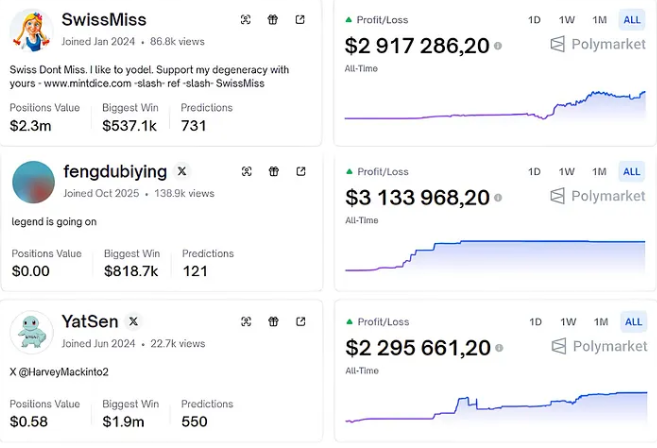
Every Trade on Polymarket is Public Data

Many prediction market participants still view Polymarket as a traditional betting platform: watch the odds, choose a direction, and bet on the outcome. But Polymarket's underlying structure is completely different from DraftKings or ordinary sports betting. All transactions occur on-chain; fund flows, position sizes, and entry/exit times are all publicly viewable. The operational paths of the most accurate and timely addresses are not post-hoc speculation but real-time on-chain records.
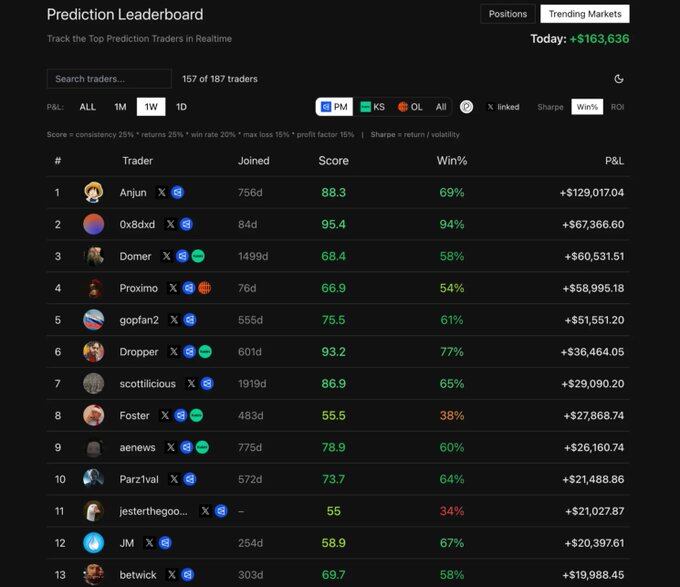
Polymarket's API is also open. Transaction records, market data, historical trades—anyone can directly call it; there is no permission barrier.

Therefore, the gap is not about who can see the data, but about who can extract meaning from it. On-chain information is public, but what is truly valuable are the wallets worth tracking continuously and the ability to recognize behavioral changes before prices fully reflect them.

What Characteristics Do True "Insider Addresses" Typically Have?

It is important to emphasize that not all profitable wallets imply insider information. Some traders have solid research capabilities, while others rely on quantitative models and algorithmic advantages. But when profitability is repeatedly combined with specific behavioral patterns, one can observe structural features that distinguish them from "luck."

First Type: New Addresses Combined with Unusually Large Bets

A wallet created just days ago, with very few transactions, suddenly invests a large amount of capital in a low-liquidity niche market—this behavior is not common. Especially in the absence of public catalysts, large, concentrated positions often carry stronger informational significance.

Second Type: Highly Vertical Trading Focus

Some addresses do not operate across markets but focus long-term on a specific niche, maintaining a stable and significant win rate in that area. They do not diversify across crypto prices, elections, sports, and other sectors but concentrate their firepower on a single theme, with more decisive position decisions.

Third Type: Abnormal Changes in Position Size

When an address that has been betting medium-sized amounts for a long time suddenly significantly increases its position in a certain market, this behavior often indicates a change in the strength of conviction. Position size itself is an attitude; a sudden change in scale usually reflects an upgrade in information or belief.

Fourth Type: Excessively Precise Timing

Occasional early moves can be attributed to coincidence, but if an address repeatedly completes position building hours before major news announcements, with highly consistent direction, such timing lead is difficult to simply explain as luck. Once is random; repeated occurrences are more likely to reflect an information advantage.

How to Systematically Screen for Potential "Information-Advantaged Addresses"

Step 1: Analyze Polymarket Leaderboard Performance

Start with the Polymarket Analytics leaderboard (link: https://polymarketanalytics.com/traders), sorted by 30-day P&L, using recent stable profitability as the first filter. Focus on wallet addresses with overall positive returns for 30 consecutive days, a win rate above 55%, and total profits significantly higher than total losses. Also, confirm that their trading is concentrated in markets with real liquidity, not low-volume prediction events with little participation.
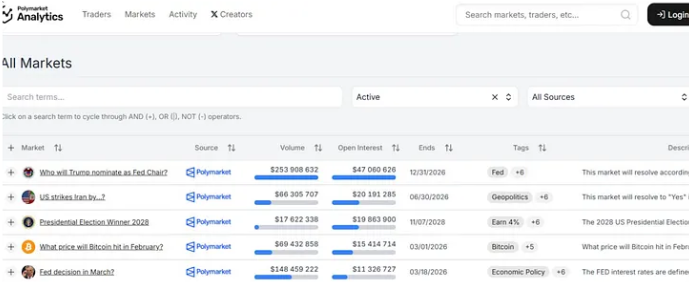
The goal at this stage is not to directly judge whether they have an information advantage, but to establish a watchlist of addresses with sustained profitability. A stable profit record is the foundation for subsequent behavioral analysis.

Step 2: Analyze Position Structure in Specific Events

After the initial screening, drill down into specific trading events. Enter active prediction markets and check the Top Holders list for that event. Polymarket publicly displays the addresses with the largest current positions; these large positions often represent stronger conviction.
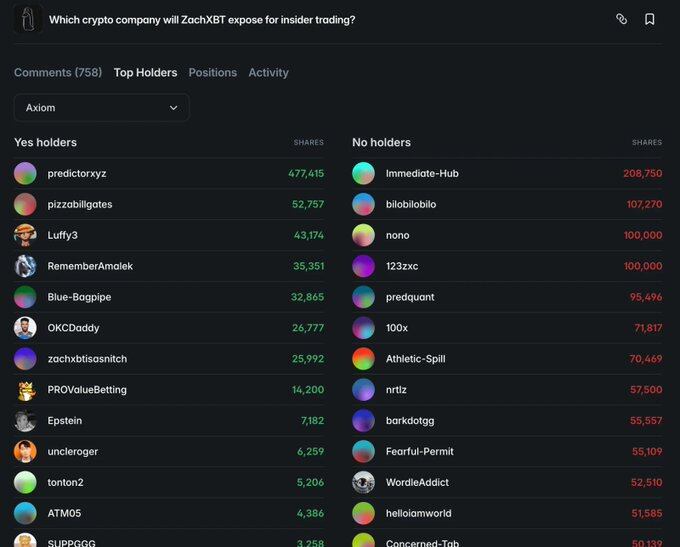
The key is not whether an address hits a single large bet, but whether its behavior is sustained. If a wallet repeatedly appears in the top holder lists of multiple important events, and these positions are built before the market has fully priced them in, then this repetition itself constitutes a signal.

A single successful bet might be偶然, but repeatedly making large, early-stage positions with consistent direction and validated outcomes often indicates a stable advantage in their judgment system.

Step 3: Analyze Trading Behavior and Position Timing

After identifying candidate addresses, further回溯 their on-chain transaction history, focusing on entry timing, position structure, and holding rhythm.
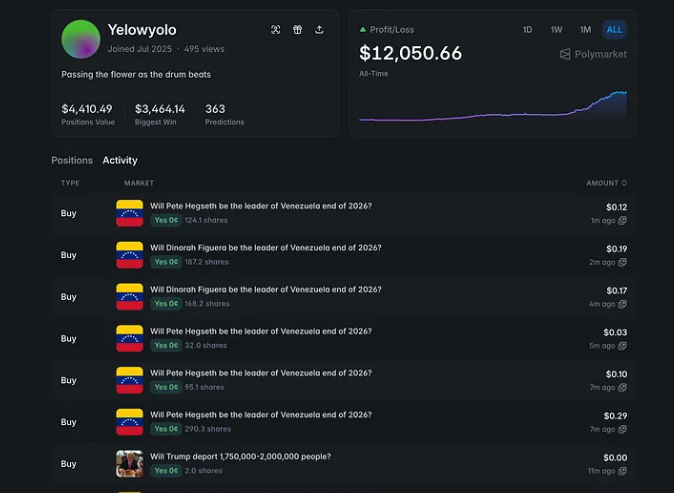
First, observe the entry time. If the purchase occurs hours before the official news release and repeats multiple times, the timing advantage itself becomes an important variable; entering after media reports is more likely to be just information following.

Second, analyze the position building method. Mature traders typically build positions in batches and add gradually, while wallets with strong information judgment often complete concentrated布局 quickly in a short time because their window is limited.

Third, pay attention to the holding period. Some high-quality addresses choose to exit during the mid-stage of行情发酵, rather than waiting for the tail end of extreme volatility, indicating their goal is to lock in the main trend rather than gamble on marginal profits.

Finally, observe their trading scope. Addresses that are highly vertical and long-term focused on a single niche are more likely to form stable information advantages; addresses that frequently operate across sectors are more likely to rely on market sentiment rather than specific domain judgment.

Advanced Address Tracking Strategies

After mastering the basic screening methods, what truly makes the difference is the further decomposition of details in fund behavior.

First, focus on exit behavior, not just entry timing. Addresses with information advantages often not only enter early but also actively reduce positions before potential negative news emerges. When a large address with long-term stable holdings suddenly significantly reduces its position without obvious catalysts, the information content is often higher than the initial buying behavior. Especially when the reduction reaches a significant proportion, this change itself is a signal.

Second, perform wallet clustering analysis using on-chain data. The relationships between addresses are not completely untraceable. Identical funding sources, similar Gas usage patterns, and transactions occurring consecutively within a very short time may reveal relationships between addresses. Many seemingly "brand new" accounts can often be traced back to a long-active old address through 2-3 fund transfers. Tracking along the fund flow path helps identify new potential high-quality accounts before the market notices.

Additionally, pay attention to abnormal volume changes in冷门 markets. If a market with usually small daily trading volume suddenly experiences significant fund inflows without public news, this structural volume increase often means some participants have already acted early. Analyzing the specific addresses driving the volume change can help build a new watchlist.

Finally, cross-verify on-chain behavior with external public information. The so-called "Pizza Index" once used abnormal order volume changes at pizza shops near the Pentagon to speculate on potential military actions. Similarly, flight tracking data, social media activity of key figures, public schedule adjustments, and other information can provide corroboration or反向验证 for on-chain position behavior. The联动 between on-chain fund flows and real-world signals can often strengthen the reliability of judgment.


Twitter:https://twitter.com/BitpushNewsCN

Bitpush TG Discussion Group:https://t.me/BitPushCommunity

Bitpush TG Subscription: https://t.me/bitpush

Original link:https://www.bitpush.news/articles/7615846

Related Questions

QWhat are the key characteristics of potentially high-performing addresses on Polymarket?

AKey characteristics include: new addresses making unusually large bets, addresses highly specialized in specific trading niches, abnormal changes in position sizes, and extremely precise timing of trades before major news breaks.

QHow can one systematically identify addresses with potential information advantages on Polymarket?

AThe process involves three steps: analyzing the Polymarket Analytics leaderboard for consistently profitable addresses, examining top holders in specific event markets for repeated early large positions, and scrutinizing on-chain transaction history for entry timing, position structure, and holding patterns.

QWhat is the fundamental difference between Polymarket and traditional betting platforms like DraftKings regarding data?

AAll transactions on Polymarket occur on-chain, making fund flows, position sizes, and entry/exit timestamps completely public and verifiable, unlike traditional platforms where such data is not transparent.

QWhat advanced strategies are suggested for tracking these addresses beyond basic screening?

AAdvanced strategies include monitoring exit behavior (not just entry), performing on-chain wallet clustering to find linked addresses, watching for abnormal volume in niche markets, and cross-referencing on-chain activity with external real-world signals.

QWhy is the timing of a trade, relative to news announcements, a significant factor in identifying an 'informed address'?

AIf an address consistently places trades hours before major news becomes public and this pattern repeats, it is less likely to be coincidental and more likely to indicate an information advantage, as opposed to trading after news dissemination which is just following public information.

Related Reads

Has the Cryptocurrency Market Hit Bottom? Here's What Institutions Think

"Has the crypto market bottomed out? Major institutions are divided on the outlook, according to a recent analysis by Matt Hougan, Chief Investment Officer of Bitwise. Three prominent research firms published in-depth reports on the topic with differing conclusions. Galaxy Digital argues Bitcoin has not yet found its bottom, pointing to only 4 out of 13 historical bottoming indicators being met. Their analysis suggests a potential bottom range of $30,000 to $54,000. NYDIG adopts a more cautious stance, noting that while metrics are close to historical bear market lows, a classic panic-selling capitulation event is missing. They acknowledge the possibility of a bottom but consider it unlikely, citing structural changes from institutional adoption. In contrast, Standard Chartered Bank asserts the bottom is already in at around $59,000. Their revised bullish view, predicting a year-end target of $100,000, hinges on anticipated reductions in ETF selling pressure linked to events like a potential SpaceX IPO. Despite the surface-level disagreement on the exact price floor, the reports share significant common ground crucial for long-term investors. All three institutions agree that a market bottom will likely form within the current year, that current prices are closer to the bottom than to previous cycle highs, and that Bitcoin is poised for another major bull cycle in the future. The core takeaway is that while the precise bottom level remains debated, the long-term value proposition for Bitcoin remains strong and may even be strengthening. Key supportive trends include rising global debt, persistent inflation, declining trust in traditional institutions, accelerating digitization, and improving market infrastructure. Therefore, for investors with a long-term horizon, the focus should shift from pinpointing the exact bottom to recognizing that the cycle's peak is likely still ahead, making current levels an attractive entry point for substantial potential upside."

Foresight News10m ago

Has the Cryptocurrency Market Hit Bottom? Here's What Institutions Think

Foresight News10m ago

2029 Finale Prediction: When Cryptocurrency Completely "Vanishes", Who Can Remain in This Financial Upheaval?

By 2029, the crypto industry will have transformed into a largely invisible but foundational layer for traditional finance. This timeline outlines the key shifts from now until then. By mid-2026, the most sought-after assets on-chain will not be traditional tokens, but synthetic perpetual contracts for private, high-growth companies (like SpaceX, OpenAI). These become primary price discovery tools, highlighting the market's craving for real-world asset value. Most altcoins enter a sustained bear market as their fundamental lack of asset-backed value is exposed. In late 2026, the "AI + Crypto" narrative largely fades as AI giants prove they don't need crypto infrastructure, except for prediction markets betting on model performance. Simultaneously, a quiet but significant wave of tokenization for institutional assets (money market funds, private credit) begins. The industry splits into a noisy speculative economy and a silent institutional one. Throughout 2027, major public blockchain foundations pivot decisively to serve institutional clients, building compliance toolkits and sales teams. However, key sectors hit growth ceilings: private perpetual contracts are legally restricted from public promotion, stable币 growth is capped by looming political uncertainty, and tokenization projects remain cautious. In 2028, following a U.S. election assumed to maintain a regulatory (not prohibitive) stance, a pivotal change occurs. After a major liquidation crisis exposes the flaws of synthetic contracts lacking a real-asset anchor, new regulations allow the *public solicitation* of private security sales (secondary market shares) to accredited investors. This creates a legitimate, direct on-ramp for retail capital into previously illiquid private equity. By 2029, the resulting bull market is driven by trading in real, innovative company shares (biotech, robotics, AI labs), not speculative tokens. "Crypto" as a distinct asset class recedes; it becomes the mundane, unseen plumbing for this new global private markets infrastructure. Tokens that survive are those capturing real cash flows from this infrastructure. Speculation persists but is marginalized. The core questions posed at the start are answered: token value is tied to legally enforceable claims on real assets, frontier tech adoption happens via private market channels, and crypto's absorption into traditional finance is marked by its becoming boring and invisible. The key validation for this entire thesis is whether, by late 2028, a legal pathway exists for ordinary accredited investors to access private assets directly.

marsbit53m ago

2029 Finale Prediction: When Cryptocurrency Completely "Vanishes", Who Can Remain in This Financial Upheaval?

marsbit53m ago

After the U.S. Banned Fable 5, Zhipu's Stock Soared 47%

On June 15, Chinese AI company Zhipu's stock surged up to 47.6% in Hong Kong, closing with a 32.82% gain. This sharp rise followed two key industry events. On June 12, Anthropic was compelled by a U.S. government export control order to suspend global access to its latest flagship models, Claude Fable 5 and Claude Mythos 5, impacting developers and businesses reliant on them. The next day, Zhipu announced it was opening access to its new open-source flagship model, GLM-5.2, for all Coding Plan users, with API and model weights (under the MIT license) to follow. The Anthropic incident highlighted a critical shift in the AI industry: beyond raw capability, the stability, continuous accessibility, and control over AI models are becoming equally vital, especially as AI integrates deeper into business workflows. Zhipu's move, emphasizing that "frontier intelligence should not belong to a few nor be subject to arbitrary revocation," positioned its open, accessible model as an alternative. GLM-5.2 focuses on "Long Horizon Tasks" with a 1M context window, aiming for consistency in complex, extended projects. Market analysts suggest this event exposes the risk of dependency on closed-source models subject to single jurisdiction policies, potentially accelerating a shift toward domestic base models and localized deployments. The investment response indicates a new valuation metric is emerging—prioritizing which companies can provide AI capabilities that are not only advanced but also reliably and sustainably accessible.

marsbit54m ago

After the U.S. Banned Fable 5, Zhipu's Stock Soared 47%

marsbit54m ago

Trading

Spot
Futures

Hot Articles

How to Buy WIN

Welcome to HTX.com! We've made purchasing WINkLink (WIN) simple and convenient. Follow our step-by-step guide to embark on your crypto journey.Step 1: Create Your HTX AccountUse your email or phone number to sign up for a free account on HTX. Experience a hassle-free registration journey and unlock all features.Get My AccountStep 2: Go to Buy Crypto and Choose Your Payment MethodCredit/Debit Card: Use your Visa or Mastercard to buy WINkLink (WIN) instantly.Balance: Use funds from your HTX account balance to trade seamlessly.Third Parties: We've added popular payment methods such as Google Pay and Apple Pay to enhance convenience.P2P: Trade directly with other users on HTX.Over-the-Counter (OTC): We offer tailor-made services and competitive exchange rates for traders.Step 3: Store Your WINkLink (WIN)After purchasing your WINkLink (WIN), store it in your HTX account. Alternatively, you can send it elsewhere via blockchain transfer or use it to trade other cryptocurrencies.Step 4: Trade WINkLink (WIN)Easily trade WINkLink (WIN) on HTX's spot market. Simply access your account, select your trading pair, execute your trades, and monitor in real-time. We offer a user-friendly experience for both beginners and seasoned traders.

5.2k Total ViewsPublished 2024.03.29Updated 2026.06.02

How to Buy WIN

Discussions

Welcome to the HTX Community. Here, you can stay informed about the latest platform developments and gain access to professional market insights. Users' opinions on the price of WIN (WIN) are presented below.

活动图片