
Top 100 Apecoin Holders Control Over 51% of the Supply, APE Lost 81% in 2 Months

newsbtcPublished on 2022-07-11Last updated on 2022-07-11

Abstract

Back in mid-March 2022, Bored Ape Yacht Club’s (BAYC) Apecoin DAO launched and airdropped millions of apecoin tokens to specific NFT holders.

Top 100 Apecoin Holders Control Over 51% of the Supply, APE Lost 81% in 2 Months

Back in mid-March 2022, Bored Ape Yacht Club’s (BAYC) Apecoin DAO launched and airdropped millions of apecoin tokens to specific NFT holders. The crypto asset dedicated to the BAYC ecosystem tapped an all-time high two months ago reaching $26.70 per unit on April 28. However, apecoin is down more than 81% since that day and despite the fact that 80,744 unique addresses own APE, the top 100 addresses control 51.21% of the circulating supply.

While Apecoin’s Price Slips Lower, Concentration of Large APE Holders Remains the Same

Just over two months ago, the crypto asset apecoin (APE) made headlines after the Apecoin DAO distributed millions of apecoin (APE) to NFT owners. APE was airdropped to BAYC, Mutant Ape Yacht Club (MAYC), and Bored Ape Kennel Club (BAKC) holders.

On March 17, APE was exchanging hands for $10.36 per unit or 53% higher than the price today ($4.81 per APE). After the launch, APE continued to rise in USD value and by April 28, apecoin reached an all-time high (ATH) of $26.70 per unit.

At that time on April 28, APE had a circulating supply of around 284,843,750 tokens and it held the 22nd largest market valuation out of 13,000+ crypto assets. During the ATH, APE’s market cap had a dominance rating of around 0.40% as well. Moreover, at the time APE’s concentration of whale entities was quite large in comparison to most of the top coins.

Today, is an entirely different story, at least for APE’s crypto market performance. During the past month, apecoin has shed ​​14.5% against the U.S. dollar but did see an 8.2% rise during the past seven days. To date, APE is down 81% since the crypto asset’s ATH but what hasn’t changed much is the whale concentration.

Top 100 Apecoin Holders Control Over 51% of the Supply, APE Lost 81% in 2 Months

Apecoin metrics from intotheblock.com on July 10, 2022.

Bitcoin.com News reported on April 23, that 52% of the APE in circulation was held by 100 addresses. APE distribution has not changed much since the crypto winter started and the crypto economy’s value continues to slide. Statistics from coincarp.com’s APE rich list indicate that the top 100 wallets own 51.21% of the circulating supply.

Metrics from intotheblock.com shows that apecoin (APE) has a Concentration of Large Holders rating of around 91% today. That’s a whole lot more concentrated than bitcoin’s (BTC) rating today which is around 10%.

APE Transfers Decline, Apecoin Search Query Interest Drops 95%

Today, the top ten APE holders command 8.01% of the supply, the top 20 addresses hold 13.01% and the top 50 APE addresses hold 28.01% on July 10. While APE has seen 1,009,507 transactions total, it’s been averaging around 2K to under 1K per day in transfers.
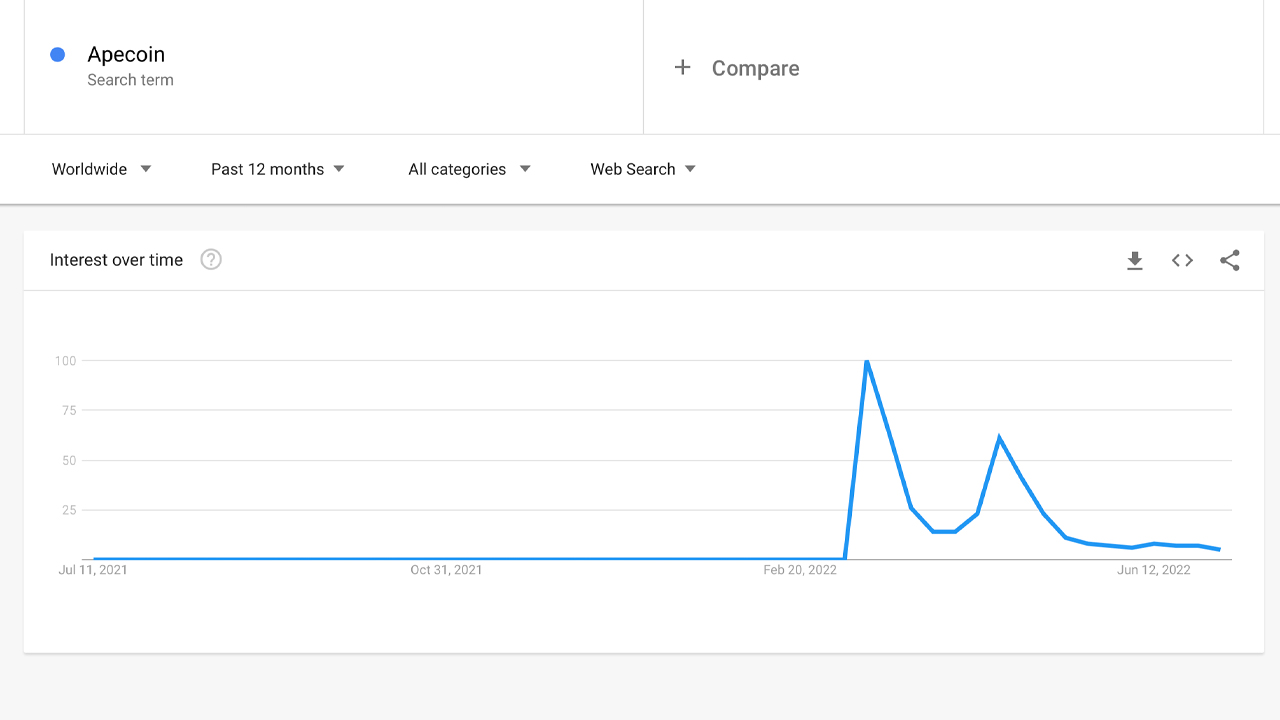
Top 100 Apecoin Holders Control Over 51% of the Supply, APE Lost 81% in 2 Months

Google Trends search queries for the term “apecoin” declined by 95% since the second week of March 2022.

On July 9, 2022, 819 APE transfers were recorded and during the last week, $71.24 million worth of APE was transactions tied to transfers greater than $100K per transaction. Search data further shows that interest in apecoin (APE) has slid a great deal in the last two monts.

Google Trends (GT) data indicates that on the week of March 13th through the 19th, the search term “apecoin” tapped the highest score of 100. This week, the search query “apecoin” has a score of 5, according to worldwide GT metrics on July 10, 2022.


Related Reads

The Value Distribution of Stablecoins

**Summary: The Value Distribution of Stablecoins** The article argues that stablecoins are evolving from mere trading tools into broader channels for dollar access. It divides the stablecoin ecosystem into four layers to analyze how value is distributed: 1. **Issuance Layer:** Mints stablecoins, holds reserve assets, and captures the spread between reserve yield and user costs (e.g., Tether, Circle). This layer currently earns the largest profit margin. 2. **Infrastructure Layer:** Connects stablecoins to the traditional financial system, handling fiat on/off-ramps, banking integration, compliance (KYC/AML), and asset management (e.g., Bridge, BVNK). This is the "unglamorous" but critical work, building the essential bridges between crypto and real-world finance. 3. **Acquiring/Distribution Layer:** Integrates stablecoins into merchant systems, manages payment flows, and provides enterprise financial software (e.g., Stripe, Coinbase). They act as the access point for businesses. 4. **Application Layer:** The end-users and businesses that ultimately use stablecoins for payments, settlements, or as a store of value. They benefit from convenience but have little pricing power. The core thesis is that while the issuance layer currently dominates profits, the often-overlooked **infrastructure layer holds significant long-term potential**. The real challenge and barrier to mass adoption is not the on-chain transfer of stablecoins (which is simple), but the complex "last mile" integration into existing business workflows, banking systems, and regulatory frameworks across different countries. Companies in this layer are currently in a "land grab" phase, investing heavily to build networks, secure bank partnerships, and establish compliance pathways. While their position is currently pressured by the profitable issuers above and distribution platforms below, the article suggests that if stablecoins become a default financial rail for businesses, the infrastructure providers who have done the hard work of integration will ultimately gain strong pricing power and become entrenched, essential players.

marsbit1h ago

The Value Distribution of Stablecoins

marsbit1h ago

The Value Distribution of Stablecoins

The Value Distribution of Stablecoins The article argues that stablecoins are evolving from a mere trading tool into a broad "dollar channel." It analyzes the industry's value chain through four layers: 1. **Issuance Layer (e.g., Tether, Circle):** The top layer that mints stablecoins, holds reserve assets, and captures the thickest interest rate spread. 2. **Infrastructure Layer (e.g., Bridge, BVNK):** Connects stablecoins to the traditional financial system, handling critical but complex "dirty work" like fiat on/off-ramps, banking integration, compliance (KYC/AML), and cross-border settlement. 3. **Acquiring/Distribution Layer (e.g., Stripe, Coinbase):** Embeds stablecoins into merchant systems, manages payment flows, and integrates with enterprise software. 4. **Application Layer:** End-users and businesses that ultimately use stablecoins for payments, settlement, or storing value. The author posits that while the issuance layer currently captures the most profit, the most overlooked and potentially critical layer is infrastructure. The core challenge for stablecoin adoption isn't the on-chain transfer (which is simple), but bridging the gap between blockchain and the real-world financial system. This involves solving practical problems for businesses: fiat conversion, reconciliation, tax handling, and user onboarding. Infrastructure companies are currently in a difficult "land-grab" phase—building networks, securing banking relationships, and achieving compliance country-by-country. They face pressure from both the profitable issuance layer above and distribution platforms below. However, the author suggests this layer is building a crucial moat. Once stablecoins become a default business rail, the infrastructure players who have done the hard work of integration may gain significant, durable value and pricing power.

链捕手1h ago

The Value Distribution of Stablecoins

链捕手1h ago

How to Do Research Well: Deliberately Practice the Real Skills That Matter

No one truly teaches you how to do research. You're often given a desk, a pre-selected problem, and vague instructions to "create something new." Consequently, many people reverse-engineer the job based on visible outputs—papers, posts, announcements—learning only how to *appear* like a researcher rather than how to *become* one. True research capability is built from stacking small, trainable skills, nearly all of which can be developed through deliberate practice. **Pick Your Own Problem:** Most researchers absorb problems from advisors or trends, lacking the underlying reasoning. Choosing a problem you genuinely care about, as John Schulman advises, leads to original work. Develop "taste" like a muscle: predict experiment outcomes, guess paper results from methods, and track which findings remain important over time. **Upgrade Your Inputs:** Relying on shared reading lists (arXiv hot lists, filtered group chats) leads to unoriginal conclusions. Undervalued old literature often holds crucial insights (e.g., MoE, LSTM, backpropagation). Richard Sutton's "The Bitter Lesson" or Claude Shannon's 1952 talk on creative thinking are more predictive than lengthy modern surveys. Breadth matters as much as depth: draw from neuroscience, mechanism design, hardware knowledge, and honest statistics. Read papers directly, especially appendices and limitations sections. **Write Everything Down:** As Paul Graham noted, writing exposes flaws in seemingly mature ideas. Writing is the cheapest defense against self-deception. Following Feynman's principle, Darwin programmatically wrote down facts contradicting his theory to combat memory bias. Maintain a detailed log of hypotheses, setups, predictions, results, and updated understandings. Reviewing past logs fosters essential humility.

marsbit3h ago

How to Do Research Well: Deliberately Practice the Real Skills That Matter

marsbit3h ago

Trading

Spot
Futures

Hot Articles

How to Buy APE

Welcome to HTX.com! We've made purchasing ApeCoin (APE) simple and convenient. Follow our step-by-step guide to embark on your crypto journey.Step 1: Create Your HTX AccountUse your email or phone number to sign up for a free account on HTX. Experience a hassle-free registration journey and unlock all features.Get My AccountStep 2: Go to Buy Crypto and Choose Your Payment MethodCredit/Debit Card: Use your Visa or Mastercard to buy ApeCoin (APE) instantly.Balance: Use funds from your HTX account balance to trade seamlessly.Third Parties: We've added popular payment methods such as Google Pay and Apple Pay to enhance convenience.P2P: Trade directly with other users on HTX.Over-the-Counter (OTC): We offer tailor-made services and competitive exchange rates for traders.Step 3: Store Your ApeCoin (APE)After purchasing your ApeCoin (APE), store it in your HTX account. Alternatively, you can send it elsewhere via blockchain transfer or use it to trade other cryptocurrencies.Step 4: Trade ApeCoin (APE)Easily trade ApeCoin (APE) on HTX's spot market. Simply access your account, select your trading pair, execute your trades, and monitor in real-time. We offer a user-friendly experience for both beginners and seasoned traders.

3.9k Total ViewsPublished 2024.03.29Updated 2026.06.02

How to Buy APE

What is APECOIN

Understanding Asia Pacific Electronic Coin ($APECoin) In an era where the intersection of technology and environmentalism is becoming increasingly critical, cryptocurrencies are making their mark as potential catalysts for change. Among these innovations, Asia Pacific Electronic Coin ($APECoin) stands out as a distinct project designed to support environmental initiatives across the Asia Pacific region. This article delves into the foundation, unique features, and impact of $APECoin within the broader blockchain landscape. What is Asia Pacific Electronic Coin ($APECoin)? Asia Pacific Electronic Coin ($APECoin) is an ERC20 and TRC20 token, brought to fruition in April 2020 after its conceptualization in December 2019. This innovation was born out of a desire to foster eco-friendly practices and support a suite of environmental projects aimed at sustainability and green initiatives. Aims and Objectives $APECoin is not merely a digital currency; it is envisioned as a medium of exchange that enables users to engage in transactions that directly benefit environmental causes. Its ecosystem is designed to facilitate various financial activities while promoting the adoption of eco-friendly practices. The currency aims primarily to: Support Environmental Initiatives: Through every transaction, a portion is allocated to funding sustainable projects aimed at conservation and renewable energy. Promote Eco-Friendly Innovations: Encouraging startups and projects that align with environmental sustainability through the use of its token as a means of value. Create a Sustainable Marketplace: The platform includes an e-marketplace where financial transactions can occur within a framework dedicated to promoting green practices. Creator of Asia Pacific Electronic Coin ($APECoin) While the details regarding the individual creator of $APECoin are not publicly disclosed, the project is significantly backed by the APEC Group, a consortium focused on advocating for environmental initiatives. This backing adds credibility and significance to the project, connecting it to a broader network committed to sustainability and eco-friendly practices. Investors of Asia Pacific Electronic Coin ($APECoin) The investment landscape surrounding $APECoin remains largely undisclosed. Specific names of investment foundations or organizations supporting this cryptocurrency have yet to be revealed. However, what is evident is a growing interest among investors keen on supporting sustainable projects that demonstrate potential for impact in the crypto space. How does Asia Pacific Electronic Coin ($APECoin) work? $APECoin stands out due to its innovative operational model, which leverages blockchain technology and smart contracts. This combination not only ensures transactional efficiency but also enforces adherence to regulatory frameworks, enhancing the security and transparency of transactions. Unique Features of $APECoin Blockchain-Based Operations: By establishing its operations on a blockchain platform, $APECoin ensures that all transactions are immutable and secured through advanced cryptographic techniques. This decentralization underscores the integrity of the token within its ecosystem. Smart Contracts: $APECoin employs smart contracts that facilitate seamless transactions while ensuring compliance with applicable regulations. These automated agreements minimize the possibility of disputes, streamline processes, and contribute to a reliable transaction framework. E-Marketplace: One of the hallmark features of $APECoin is its dedicated e-marketplace. This digital environment serves as a hub for services that endorse eco-friendly practices, providing a platform for exchanges that further the project's green vision. Through these attributes, $APECoin carves a niche for itself within the vast expanse of the cryptocurrency market, effectively marrying the principles of blockchain with environmental stewardship. Timeline of Asia Pacific Electronic Coin ($APECoin) Understanding the trajectory of $APECoin provides insight into its developmental milestones and future aspirations. Here’s a timeline highlighting significant events in the project’s history: December 2019: Conceptualization of Asia Pacific Electronic Coin, initiated with an ambition to drive sustainability through cryptocurrency. April 2020: Official launch of $APECoin, marking its entry into the marketplace as a dedicated token for environmental projects. 2020-2021: Conducting of the Initial Exchange Offering (IEO), enabling users to purchase $APECoin, alongside the registration with various electronic exchange platforms to enhance accessibility. In its relatively short journey, $APECoin has made significant strides in laying the groundwork for a secure and impactful cryptocurrency driven by environmental goals. Conclusion Asia Pacific Electronic Coin ($APECoin) embodies the marriage of technology and environmental responsibility, fostering growth in the crypto ecosystem while championing sustainability. With its unique structure, backing by reputable entities, and vision for a greener future, $APECoin is more than just a cryptocurrency; it is a pioneering project aimed at nurturing responsible innovation in the Asia Pacific region. Through its commitment to financial inclusion and its support of environmental initiatives, it stands as a formidable example of how digital currencies can be leveraged for positive societal impact. As the project continues to evolve, stakeholders within the crypto community and beyond will be eagerly watching how $APECoin shapes the conversation around sustainable practices in the burgeoning world of cryptocurrency.

887 Total ViewsPublished 2024.12.03Updated 2024.12.03

What is APECOIN

Discussions

Welcome to the HTX Community. Here, you can stay informed about the latest platform developments and gain access to professional market insights. Users' opinions on the price of APE (APE) are presented below.

活动图片