Bitcoin Nears $90K – Bitcoin Hyper ($HYPER) Presale Heats Up as Bulls Return

bitcoinistPublished on 2025-11-25Last updated on 2025-11-25

Abstract

Quick Facts: ➡️ Bitcoin’s rebound toward $90K has been underpinned by digital asset treasuries, with institutional-style buyers steadily accumulating $BTC...

Trusted Editorial content, reviewed by leading industry experts and seasoned editors. Ad Disclosure

Quick Facts:

  • ➡️ Bitcoin’s rebound toward $90K has been underpinned by digital asset treasuries, with institutional-style buyers steadily accumulating $BTC and $ETH through volatility.
  • ➡️ As $BTC becomes a core treasury asset, demand rises for infrastructure that makes Bitcoin usable in DeFi, payments, and programmable finance ecosystems.
  • ➡️ Bitcoin Hyper aims to fuse SVM-level performance with Bitcoin settlement, targeting low-latency, low-fee smart contracts that address $BTC’s speed and programmability gaps.
  • ➡️ $HYPER raised over $28.4M in presale with a price of $0.013325 and a projected release by Q1 2026; price predictions suggest a 1,400% ROI by the end of next year.

Bitcoin’s latest bounce has put the market back on offense.

After a sharp pullback that carved out several local lows, $BTC has climbed back toward the $90K zone, erasing much of the recent drawdown and reminding you how quickly sentiment can flip from fear to renewed greed in this cycle.

When treasury desks treat Bitcoin as strategic collateral rather than a trade, every 10% pullback looks less like a crash and more like a rebalancing opportunity. That structural bid is one reason $BTC’s slide stalled where it did, and why the rebound toward $90K has come with less forced liquidations.

For $BTC-centric altcoins, that backdrop is powerful. If more balance sheets are denominated in Bitcoin, demand naturally rises for infrastructure that makes $BTC productive: usable in DeFi, payments, gaming, and beyond.

That’s the lane Bitcoin Hyper ($HYPER) is trying to own – a Bitcoin Layer 2 that bolts Solana-style performance onto Bitcoin’s settlement layer, aiming to turn dormant $BTC into programmable capital.

You can buy $HYPER on the official presale page today.

Why Bitcoin’s Rebound Supercharges The Hyper Race

$BTC’s recovery toward $90K is reinforcing a familiar tension: the asset that dominates crypto’s market cap is still clunky to use.

On-chain transactions can take minutes or even hours to confirm, fee spikes can push simple transfers into double-digit dollar costs, and native programmability is essentially absent on the base layer.

That’s why capital has been rotating into Bitcoin infrastructure. You’ve seen the rise of Lightning for payments, sidechains like Rootstock for EVM-compatible contracts, and newer rollup-style designs experimenting with Bitcoin as a settlement and data-availability layer.

Each tries to solve the same trilemma: keep Bitcoin’s security while adding speed, scale, and a cost-effective profile.

Zooming in, Bitcoin Hyper ($HYPER) positions itself as a modular Bitcoin Layer 2 built around the Solana Virtual Machine (SVM).

The idea is straightforward but ambitious: use Bitcoin L1 purely for settlement and state anchoring, while pushing execution to an SVM-based L2 that can, in theory, process smart contracts faster than Solana’s own mainnet.
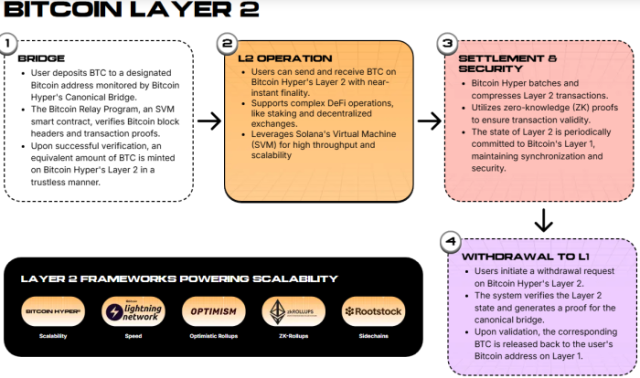
How Hyper’s Layer 2 works.

Instead of trying to cram complex logic onto Bitcoin itself, $HYPER runs a real-time execution environment where Solana-style programs – written in Rust and compatible with modified SPL token standards – execute with extremely low latency and sub-cent fees.

On paper, that architecture targets the three pain points Bitcoin users know well:

  • The Canonical Bridge reduces finality times to seconds
  • The batched transactions bring fees down, keeping the network cheap and eliminating the fee-based priority system
  • Improve scalability, allowing for more and faster transactions, helping Bitcoin grow at scale.

All this without impacting Bitcoin’s native security or brand appeal.

If the proposition makes sense to you, you can buy $HYPER right here.

$HYPER Presale, Predictions, and Release Date

The Bitcoin Hyper ($HYPER) presale has raised over $28.4M, with $HYPER valued at $0.013325 – a material signal that a segment of the market is willing to fund a Bitcoin-centric, SVM-powered experiment while $BTC trades near cycle highs.
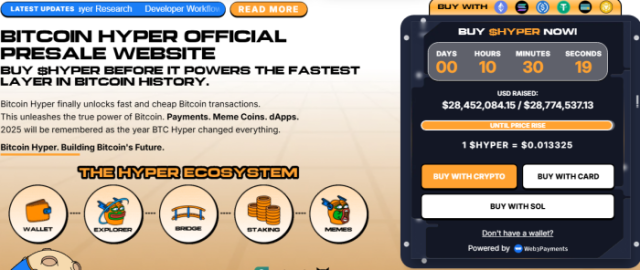
$HYPER’s presale numbers.

For you as a $BTC holder or builder, the potential unlock is straightforward: move wrapped $BTC into Bitcoin Hyper’s Layer 2, tap high-speed payments, access DeFi protocols, or deploy Rust-based dApps without leaving Bitcoin’s security umbrella.

The utility is obvious and feeds into the hype we’re seeing right now, which explains the presale’s impressive performance.

Based on these factors, our price prediction for $HYPER post-launch puts the token at $0.20 by the end of 2026 and $1.50 by 2030. In terms of raw profit, you’re looking at an ROI of 1,400% for a 1-year investment and 11,155% for a 5-year one.

Naturally, these numbers can fluctuate depending on market conditions, but considering Bitcoin Hyper’s utility, our vote is for it to increase over time.

You can read more about what Bitcoin Hyper is right here, or our guide on how to buy $HYPER before visiting the presale page.

As a final heads-up: $HYPER has a projected release window between Q4 2025 and Q1 2026, so there’s not much time left.

Go to the official presale page and buy your $HYPER today.

This isn’t financial advice. DYOR before investing.

Authored by Bogdan Patru, Bitcoinist: https://bitcoinist.com/bitcoin-$90k-market-rebounds-as-bitcoin-hyper-reaches-$28M

Editorial Process for bitcoinist is centered on delivering thoroughly researched, accurate, and unbiased content. We uphold strict sourcing standards, and each page undergoes diligent review by our team of top technology experts and seasoned editors. This process ensures the integrity, relevance, and value of our content for our readers.

As a crypto writer, Bogdan’s responsibilities are split between researching and writing articles and entertaining the team with his humor bordering on the politically incorrect, an aspiring Bill Burr, if you will. Thanks to his 12+ years of writing experience in just as many fields, including tech, cybersecurity, modelling, fitness, crypto, and other topics-that-shall-not-be-named, he's become a genuine asset to the team. While his position as a senior writer at PrivacyAffairs thought him valuable lessons about the power of self-management, his entire writing career was and is an exercise in self-improvement. Now, he's ready to sink his teeth into crypto and teach people how to take control of their own money on the blockchain. With fiat as an eternally devaluing currency, Bitcoin and altcoins seem like the best-fitting alternative for Bogdan. Bogdan’s biggest professional accomplishment, aside from securing a position as a main writer for Bitcoinist, was his 5-year run as a writing manager at Blackwood Productions, where he coordinated a team of four writers. During that time, he learned the value of teamwork and that of creating a working environment that breeds efficiency, positivity, and friendship.

Trending Cryptos

Related Reads

An Eight-Year Investment Takes a Sharp Turn: Why Did Ethereum Suddenly Abandon Poseidon?

On August 13, Ethereum researcher Justin Drake announced a significant shift in Ethereum's Layer-1 cryptographic roadmap: abandoning the SNARK-friendly hash function Poseidon in favor of traditional functions like SHA2 or BLAKE2. This decision ends eight years of research and investment, marking a major revision to the post-quantum security strategy. Poseidon, introduced in 2019, was highly efficient for zkRollups and zkVMs within SNARK circuits. However, its need for prolonged cryptanalysis and the pressing timeline for quantum resistance revealed limitations. Recent breakthroughs in SNARK design, specifically using binary fields, now enable traditional, battle-tested hash functions to perform as efficiently as Poseidon within SNARKs. Benchmarks show modern laptops can now verify over a million traditional hash calls per second. This change is partly driven by accelerated concerns over quantum computing threats. Reports warn that "Cryptographically Relevant Quantum Computers" could break current blockchain signatures like ECDSA by the early 2030s, risking trillions in assets. Ethereum's response focuses on hash-based post-quantum signature schemes, deemed more quantum-resistant than some lattice-based alternatives under pressure from AI cryptanalysis. Ethereum's updated post-quantum roadmap targets a production-ready "leanVM" for signature aggregation by 2027, with full deployment across consensus, execution, and data layers by 2028. The shift to mature hash functions like SHA2 reduces reliance on newer algorithms and aligns with the goal of using widely analyzed cryptographic primitives. Other major blockchains are also preparing. Solana's core teams have independently chosen the NIST-standardized Falcon signature scheme for its compact size. Starknet plans a phased migration, starting with replacing its Pedersen hash with BLAKE2. Ethereum's move signifies a strategic pivot towards proven security foundations for the quantum era.

marsbit44m ago

An Eight-Year Investment Takes a Sharp Turn: Why Did Ethereum Suddenly Abandon Poseidon?

marsbit44m ago

Programmers Worldwide Are Wasting Money on Anthropic! The Company Can't Stand It Anymore

Anthropic recently published guidelines to help developers using Claude Code reduce unnecessary token costs. The key recommendations include: 1) Clear (/clear) conversations after completing a task to avoid carrying irrelevant file reads and command outputs into the next task. 2) Set the model and reasoning effort level at the start of a session, as switching mid-session invalidates the prompt cache, requiring a full-price recalculation of the entire dialog history. 3) Attach files using @ references instead of typing paths manually to avoid extra tool calls and searches that bloat the context. 4) Add quiet flags to verbose commands (e.g., in CLAUDE.md) to minimize lengthy output in the dialog history. 5) Use /compact while the session cache is still warm (before breaks) to compress the dialog at one-tenth the cost. 6) Offload large-output tasks to a sub-agent, which runs in an isolated context and only returns conclusions, preventing intermediate outputs from polluting the main dialog. The article explains token pricing: input tokens (prefill) are processed in parallel, while output tokens (decode) are generated serially, making output tokens five times more expensive. Caching is crucial for savings—if a request's prefix (system prompt, CLAUDE.md, dialog history) matches the previous one byte-for-byte, reading it costs only 10% of the standard input price. However, cache invalidation occurs when changing models, effort levels, fast mode, compressing dialogs, after cache expiration, or when resuming old sessions. Dialog history also grows quadratically (O(n²)) as file contents and command outputs accumulate, increasing costs per round. Proactive context management—like isolating noisy tasks, using /rewind to trim unproductive turns, and task-based session clearing—is becoming an essential skill for cost-effective AI-assisted development.

marsbit2h ago

Programmers Worldwide Are Wasting Money on Anthropic! The Company Can't Stand It Anymore

marsbit2h ago

Pax Silica vs. WAICO: The US Wants to Prohibit Europe from Using Chinese Artificial Intelligence

The United States is preparing to demand that European and other partners abandon Chinese artificial intelligence initiatives, threatening exclusion from the American-led "Pax Silica" coalition, according to a leaked U.S. State Department document. This ultimatum forces signatories of the "AI Opportunity Statement" to choose between the Western technological ecosystem and alternative frameworks, with China not explicitly named but clearly targeted. Pax Silica is a U.S. strategy for AI and semiconductor hegemony, launched in late 2025. Its European presence expanded significantly in mid-2026. Concurrently, China, Russia, and 27 other nations established the World AI Cooperation Organization (WAICO) in July 2026 as an independent intergovernmental platform promoting AI governance based on UN principles. This situation creates a difficult choice, especially for European nations balancing strategic autonomy with dependence on U.S. tech and security. It also pressures Global South countries with pragmatic ties to both Washington and Beijing. The formation of competing blocks risks fragmenting the global tech landscape, forcing companies to split supply chains, increasing costs, and potentially leading to incompatible standards and protocols. The era of open globalization in AI may be ending, replaced by geopolitical confrontation where technological sovereignty trumps economic efficiency. The decisions made will shape the global digital economy for decades.

cryptonews.ru4h ago

Pax Silica vs. WAICO: The US Wants to Prohibit Europe from Using Chinese Artificial Intelligence

cryptonews.ru4h ago

Robert Kiyosaki Shares His Mentor's Predictions About the Emergence of Bitcoin and AI

American entrepreneur and author of "Rich Dad Poor Dad," Robert Kiyosaki, discussed the influence of futurist R. Buckminster Fuller on his worldview, linking Fuller's past technological predictions to the emergence of Bitcoin and the development of artificial intelligence. In an X post, Kiyosaki also reflected on personal purpose, sharing his journey from the music business—where he worked with bands like The Police and Iron Maiden—to creating the "Cashflow" board game and writing his famous book. He described feeling an inner emptiness despite his success, a turning point that came after meeting Fuller, whom he studied with for three summers. Kiyosaki described Fuller as a "friendly genius" who foresaw world-changing developments like Bitcoin and AI. However, the core of his post focused on Fuller's philosophical impact, particularly a quote about belonging to the universe and finding purpose by dedicating one's life to the maximum benefit of others. The entrepreneur remains a vocal advocate for cryptocurrencies. He regularly advises buying Bitcoin during market panics, viewing it and assets like Ethereum, gold, and silver as hedges against traditional financial system failures. Kiyosaki has predicted a major market crash by 2026, seeing it as an opportunity for prepared investors, with long-term price targets including $750,000 for Bitcoin and $95,000 for Ethereum.

cryptonews.ru6h ago

Robert Kiyosaki Shares His Mentor's Predictions About the Emergence of Bitcoin and AI

cryptonews.ru6h ago

Trading

Spot

Hot Articles

What is $BITCOIN

DIGITAL GOLD ($BITCOIN): A Comprehensive Analysis Introduction to DIGITAL GOLD ($BITCOIN) DIGITAL GOLD ($BITCOIN) is a blockchain-based project operating on the Solana network, which aims to combine the characteristics of traditional precious metals with the innovation of decentralized technologies. While it shares a name with Bitcoin, often referred to as “digital gold” due to its perception as a store of value, DIGITAL GOLD is a separate token designed to create a unique ecosystem within the Web3 landscape. Its goal is to position itself as a viable alternative digital asset, although specifics regarding its applications and functionalities are still developing. What is DIGITAL GOLD ($BITCOIN)? DIGITAL GOLD ($BITCOIN) is a cryptocurrency token explicitly designed for use on the Solana blockchain. In contrast to Bitcoin, which provides a widely recognized value storage role, this token appears to focus on broader applications and characteristics. Notable aspects include: Blockchain Infrastructure: The token is built on the Solana blockchain, known for its capacity to handle high-speed and low-cost transactions. Supply Dynamics: DIGITAL GOLD has a maximum supply capped at 100 quadrillion tokens (100P $BITCOIN), although details regarding its circulating supply are currently undisclosed. Utility: While precise functionalities are not explicitly outlined, there are indications that the token could be utilized for various applications, potentially involving decentralized applications (dApps) or asset tokenization strategies. Who is the Creator of DIGITAL GOLD ($BITCOIN)? At present, the identity of the creators and development team behind DIGITAL GOLD ($BITCOIN) remains unknown. This situation is typical among many innovative projects within the blockchain space, particularly those aligning with decentralized finance and meme coin phenomena. While such anonymity may foster a community-driven culture, it intensifies concerns about governance and accountability. Who are the Investors of DIGITAL GOLD ($BITCOIN)? The available information indicates that DIGITAL GOLD ($BITCOIN) does not have any known institutional backers or prominent venture capital investments. The project seems to operate on a peer-to-peer model focused on community support and adoption rather than traditional funding routes. Its activity and liquidity are primarily situated on decentralized exchanges (DEXs), such as PumpSwap, rather than established centralized trading platforms, further highlighting its grassroots approach. How DIGITAL GOLD ($BITCOIN) Works The operational mechanics of DIGITAL GOLD ($BITCOIN) can be elaborated on based on its blockchain design and network attributes: Consensus Mechanism: By leveraging Solana’s unique proof-of-history (PoH) combined with a proof-of-stake (PoS) model, the project ensures efficient transaction validation contributing to the network's high performance. Tokenomics: While specific deflationary mechanisms have not been extensively detailed, the vast maximum token supply implies that it may cater to microtransactions or niche use cases that are still to be defined. Interoperability: There exists the potential for integration with Solana’s broader ecosystem, including various decentralized finance (DeFi) platforms. However, the details regarding specific integrations remain unspecified. Timeline of Key Events Here is a timeline that highlights significant milestones concerning DIGITAL GOLD ($BITCOIN): 2023: The initial deployment of the token occurs on the Solana blockchain, marked by its contract address. 2024: DIGITAL GOLD gains visibility as it becomes available for trading on decentralized exchanges like PumpSwap, allowing users to trade it against SOL. 2025: The project witnesses sporadic trading activity and potential interest in community-led engagements, although no noteworthy partnerships or technical advancements have been documented as of yet. Critical Analysis Strengths Scalability: The underlying Solana infrastructure supports high transaction volumes, which could enhance the utility of $BITCOIN in various transaction scenarios. Accessibility: The potential low trading price per token could attract retail investors, facilitating wider participation due to fractional ownership opportunities. Risks Lack of Transparency: The absence of publicly known backers, developers, or an audit process may yield skepticism regarding the project's sustainability and trustworthiness. Market Volatility: The trading activity is heavily reliant on speculative behavior, which can result in significant price volatility and uncertainty for investors. Conclusion DIGITAL GOLD ($BITCOIN) emerges as an intriguing yet ambiguous project within the rapidly evolving Solana ecosystem. While it attempts to leverage the “digital gold” narrative, its departure from Bitcoin's established role as a store of value underscores the need for a clearer differentiation of its intended utility and governance structure. Future acceptance and adoption will likely depend on addressing the current opacity and defining its operational and economic strategies more explicitly. Note: This report encompasses synthesised information available as of October 2023, and developments may have transpired beyond the research period.

1.9k Total ViewsPublished 2025.05.13Updated 2025.05.13

What is $BITCOIN

Discussions

Welcome to the HTX Community. Here, you can stay informed about the latest platform developments and gain access to professional market insights. Users' opinions on the price of BTC (BTC) are presented below.

活动图片