What is the Ultimate Blue-chip Crypto Asset: BTC, NFTs, or Land?

cryptoslatePublished on 2022-07-07Last updated on 2022-07-07

Abstract

One of the biggest changes to the crypto market today compared to the last bear market is the different types of assets that exist. 

One of the biggest changes to the crypto market today compared to the last bear market is the different types of assets that exist. 

Instead of choosing between Dash, Litecoin, Ethereum, Bitcoin, etc., people can invest in NFTs and plots of digital land in the metaverse.

Common sense indicates that these new, experimental assets are riskier compared to BTC and ETH. While it’s difficult to objectively measure risk, we can use on-chain data to assess price volatility.

With the bear market fully underway, now is the perfect time to compare these assets and see what the ultimate blue-chip assets could be going forward: Crypto, NFTs, or metaverse land. 

Here, we’ll compare three hypothetical investors: Abe, Bob and Cathy. One year ago, each put their money into a different asset class within the crypto space. 

Abe’s portfolio: 50% BTC & 50% ETH. 

Bob’s portfolio: 50% BAYC & 50% CryptoPunks

Cathy’s portfolio: 50% Decentraland Land & 50% Sandbox parcels. 

These comparisons arent’s 1-to-1 (buying 3 Bored Apes at $6,000 each one year ago is a very different move than investing $6,000 in a longstanding “safe” token like ETH.) So, we’ve created 3 “reasonable” portfolios along these 50/50 lines that aren’t exactly the same. To be explained later.

In this article, we’ll track how each of these investors’ portfolio’s performed and explore why some of these investments are more volatile than others. 

Abe’s Token Portfolio

One of the upsides of investing in tokens instead of NFTs is liquidity and divisibility. We are able to put a precise USD dollar value on BTC and ETH on any given day, buy any amount we want, and receive a fair market rate. 

On this day a year ago, June 28, 2021, BTC cost $35,867. For ease of calculation, we’ll round this to the nearest hundred—$35,900. ETH was $2,160—rounded to $2,200. 

Our token investor chose an excellent time to jump in. After the enthusiasm of the Coinbase listing on April 13, 2021, and the Federal Reserve dropping interest rates to 0.25% to stimulate the economy, the market roared. However, it was temporarily sent crashing primarily due to a wave of strict regulations in China, and it was roughly here when Abe aped in.

In hindsight, Abe bought the bottom of the cycle, putting $50,000 into BTC and $50,000 into ETH (getting about 1.39 BTC and 22.7 ETH.)

The insane climb upward continued until November 8, 2021, when Abe’s initial investment was worth $203,767.52. 

But then, speculative enthusiasm for cryptocurrencies started waning as retail and investors cut back on risky assets.

From January to June, the Federal Reserve raised interest rates by 75 basis points in quick succession, the largest margin in 28 years.

In February, the war in Ukraine triggered a downturn in macroeconomic conditions, resulting in a bearish environment for the crypto market.

To top it off, the flash crash of Terra Luna in May looked like the beginning of a series of blockchain industry car wrecks. 

All these events have driven down the price of BTC and ETH—assets which, to the vast majority of the non-crypto public, are stand-ins for the “price of crypto” itself. 
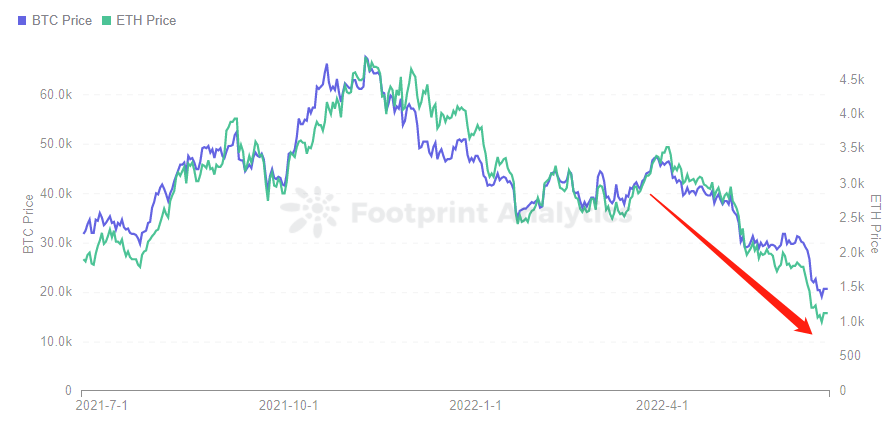
Footprint Analytics - BTC Price & ETH Price

Footprint Analytics – BTC Price & ETH Price

On June 28, 2022, Abe’s 1.39 BTC and 22.7 ETH portfolio was worth $54,197.7, down 45.8%. The drop from the all-time high was 73.4%.

The NFT Portfolio

Although NFTs are not as liquidity as BTC or ETH, they are unique and collectible. And when the market is in a better state, holders can also get a specific dollar value from it.

What did the NFT market look like in June 2021?

  • Germination and construction period: 

In June 2017, CrytoPunks, the world’s first NFT project, was officially born, bringing the NFT concept to a climax. Led by OpenSea, NFT trading has become more convenient and perfect, making NFT application areas gradually expand from games and artworks.

  • Expansion period.

By 2021, Axie Infinity sales were rising rapidly, driving the growth of the NFT market. The same year, BAYC was also established and entered the public eye.

This is the perfect time for Bob to enter the market when NFTs are in their infancy. Because NFT abides by a rule, the sooner its attributes are rarer, the higher the value and the lower the price is more balanced (the NFT trading market is immature, and the transaction frequency is low).

BAYC and CryptoPunks rank among the top NFTs in terms of trading volume in 2021.
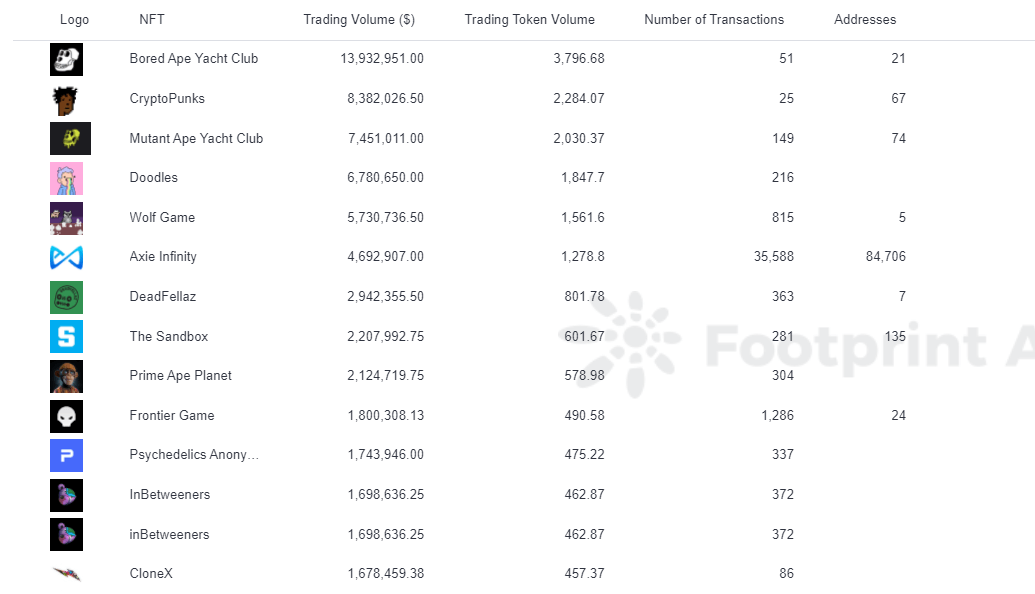
Footprint Analytics - NFT Projects by Trading Volume in 2021

Footprint Analytics – NFT Projects by Trading Volume in 2021

Assuming Bob buys 1 BAYC (3.5713 ETH) and 1 CryptoPunk (28.9191 ETH) on June 28, 2021, at an average price, his initial investment is worth $71,478.88 at that time.

In 2021, world economic development was severely impacted by the epidemic, and fiscal easing in major economies brought inflation and currency devaluation, driving users to crypto markets such as artwork, NFT, and BTC. trading activity in the NFT market continued to increase from August to March 2021.
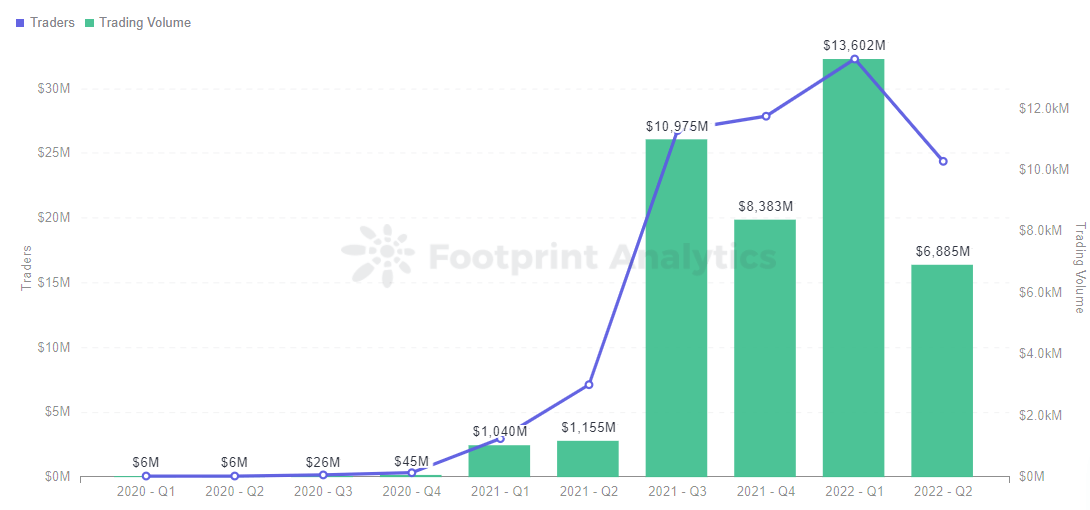
Footprint Analytics - NFT Traders & Trading Volume

Footprint Analytics – NFT Traders & Trading Volume

If Bob had followed ETH and sold it at its peak on November 8 (ETH at $4,826.25), when the average prices of BAYC and CryptoPunk were 43.8835 ETH and 98.5848 ETH, respectively, his portfolio would have been worth $687,587.63, an increase of 861.95%.

The Crypto market crash led to a decline in investor interest in NFT, significantly impacting its overall trading volume and market cap decline. Over the past 90 days, total trading volume has fallen by 63.84% and total market capitalization by 38.07%.
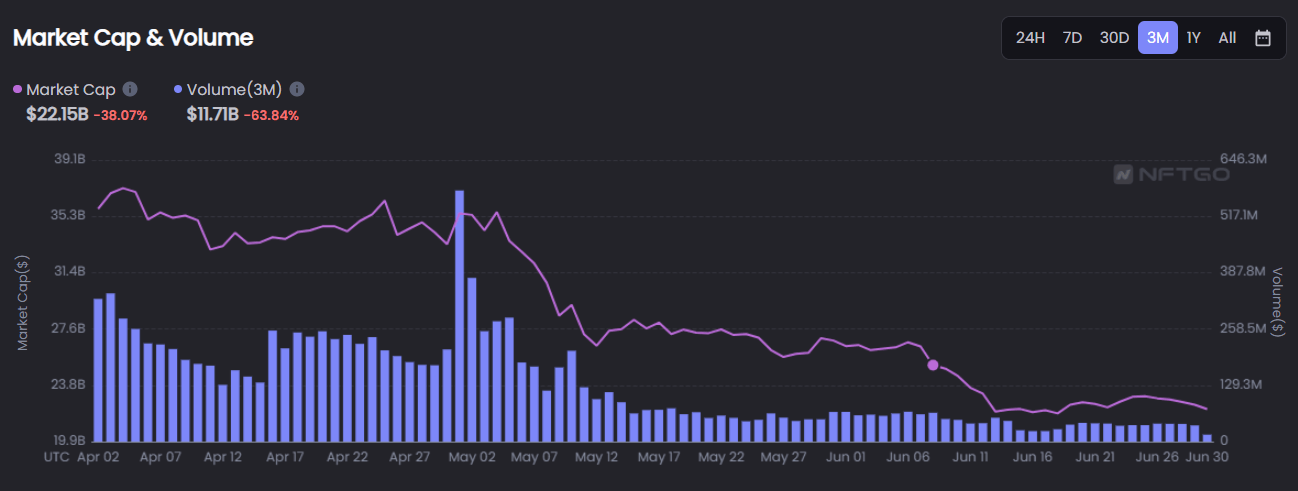
Screenshot Source  - nftgo - Market Cap & Volume

Screenshot Source  – nftgo – Market Cap & Volume

As of June 28, 2022, ETH is trading at $1,144, BAYC at 113.5035 ETH, and CryptoPunk at 77.6991 ETH. Bob’s portfolio is worth $218,735.77, up 206.01% year-over-year. It is down 68.19% from its all-time high.

Clearly, blue-chip NFTs, as of the beginning of summer 2022, aren’t as volatile as many people think compared to the so-called “safe” crypto investments BTC and ETH. 

*Since investing half your portfolio into BAYC NFTs would have been quite insane in June 2021, we’re taking a different approach to 50/50 in this portfolio. Bob bought 1 Punk and 1 Ape. 

The Land Portfolio

By being interested in the metaverse in June 2021, Cathy can be considered an early adopter. At that time, the word “metaverse” had not yet become a household name. 

Facebook’s rebranding to Meta was still four months away. 

Was the metaverse some new version of Second Life? Did you need a VR headset to access it? Almost nobody who wasn’t deep in the crypto rapithole already knew. 

But the rumblings were there. On June 4, Sotheby’s opened a virtual gallery in Decentraland, and the game made waves as the first to break 1 million in a metaverse land sale. 

On June 28, 2021, Cathy became a metaverse landlord. Her purchase was one of 37 NFT sales in Decentraland, which generated $148,500 in total. 

Because all the transactions on the blockchain are on a public ledger, we can actually see and analyze all the LAND sold on this date. 
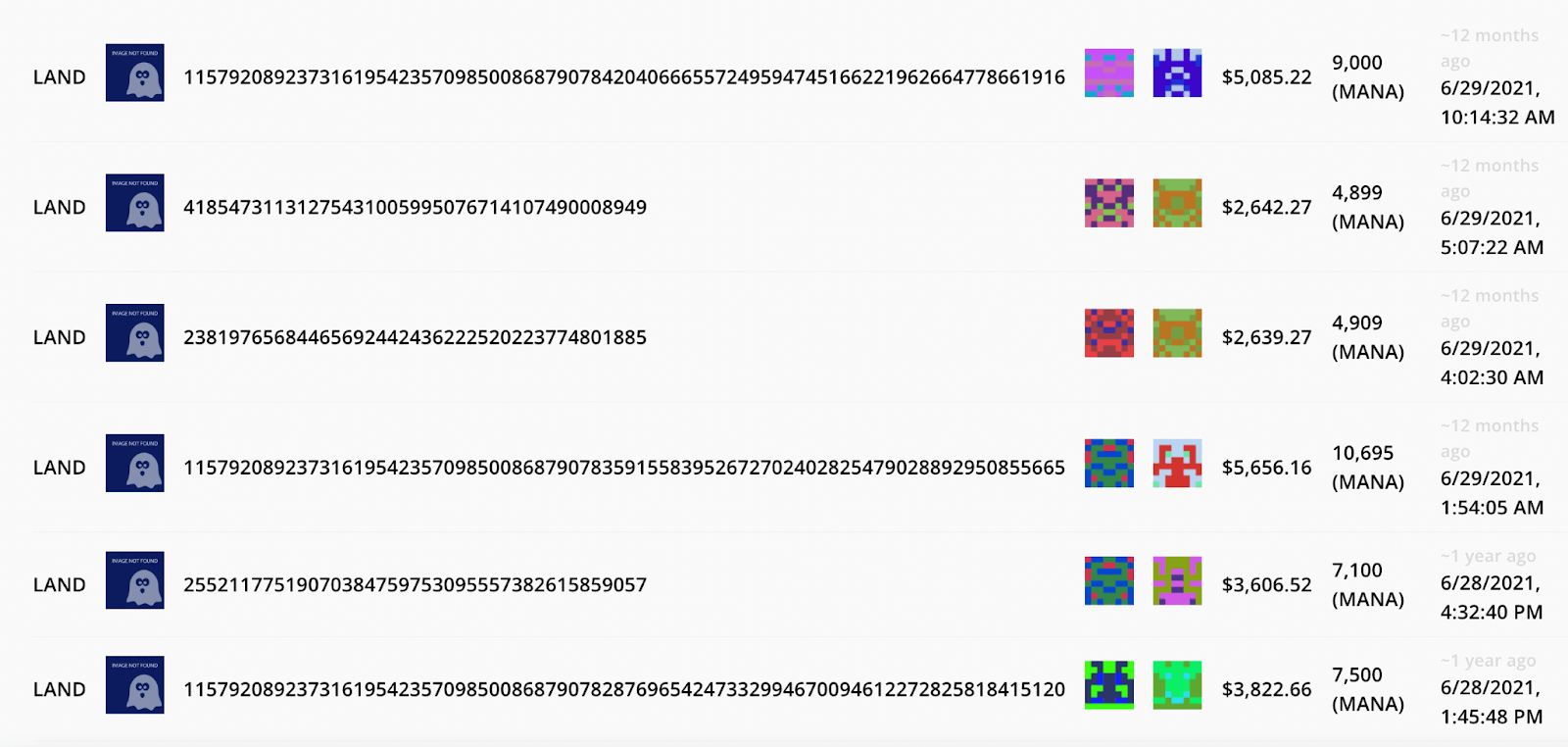
Screenshot Source - nonfungible

Screenshot Source – nonfungible

The average sale price on June 28 was about $4,000, which seems like a reasonable assessment looking at these sales. (I.e., if there were a single sale at an astronomical price, it would make the average a bad yardstick for how much Cathy could have paid.)

So, dipping her toes into the metaverse, Cathy bought one plot of land for $4,000—perhaps this one: 

Screenshot Source - nonfungible

Screenshot Source – nonfungible

She also added a parcel in The Sandbox. At that time, the search term “Sandbox” hardly brought to mind the metaverse title that would take over news headlines in just a few months for the 3842% jump in its token price. 

On June 28, 46 NFTs were sold, bringing in $43,500, an average price of $945. This is a few hundred higher than the median price for the day but is still accurate enough to do a general analysis. 
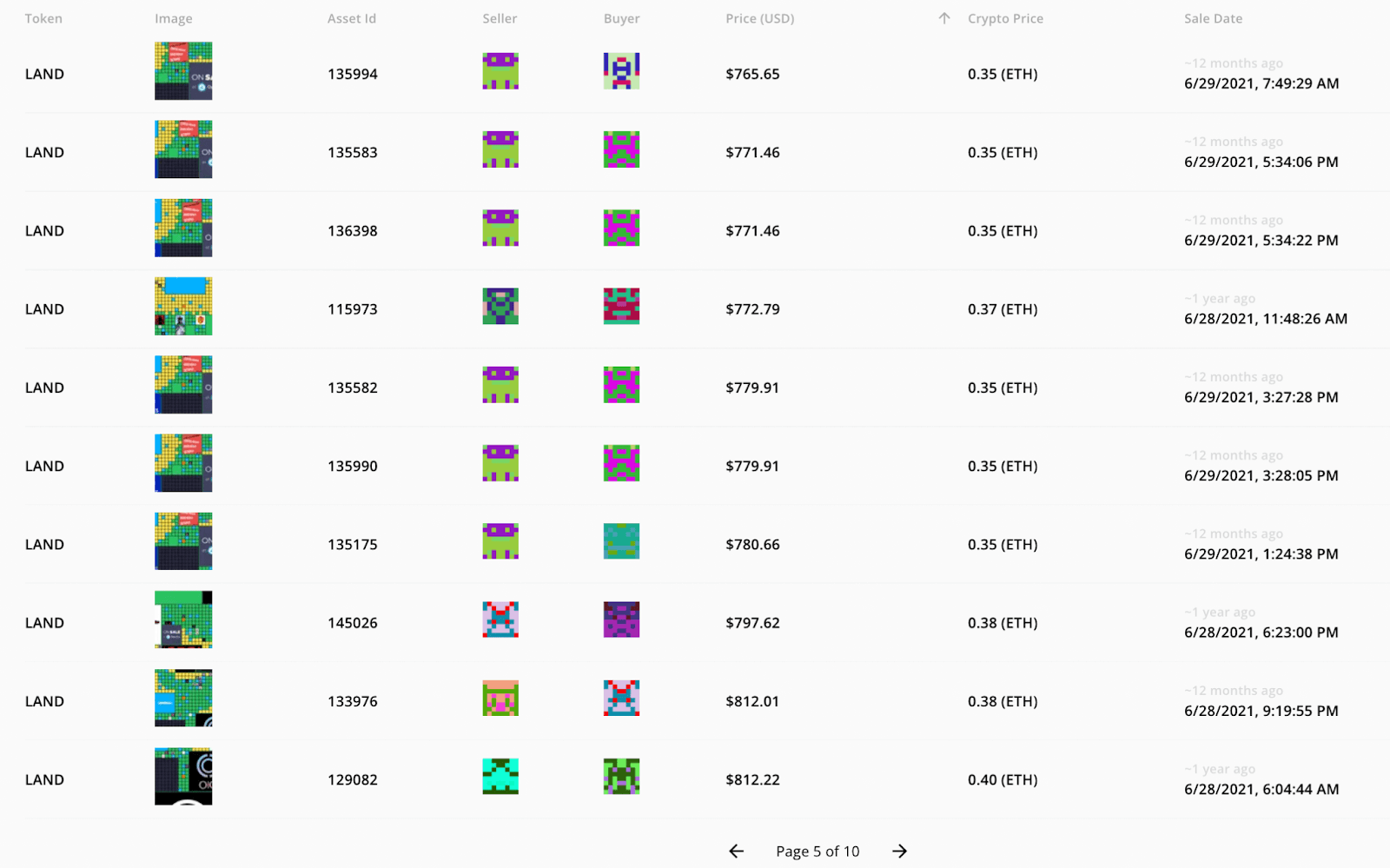
Screenshot Source - nonfungible

Screenshot Source – nonfungible

So, to maintain a nearly 50/50 allocation in the two biggest-name products in the asset category, Cathy bought one plot of Decentraland land at $4,000 and 4 Sandbox lands at $945 each—a total metaverse land portfolio of $7,780. 

Her judgment would prove visionary. By November 8, 2021, when ETH BTC peaked, the average sale price in Decentraland increased by 3.0469 ETH to $14,705. The average price of The Sandbox land skyrocketed to $6,096, a 734.62% percent increase. 

If we’re just going by averages, her 1 Decentraland plot and 4 Sandbox parcels would be worth $39,089. 

If we instead look at the real asset shown above that cost just under $4,000 on June 28, 2021, then it increased by $59,135. It flipped hands for $55,313 on November 15, 2021, the closest sale to the ETH peak.  

Over the next year, the prices of metaverse land declined sharply as the volume in Decentraland and The Sandbox decreased to ATLs by 76.81% and 79.03% respectively. 

On June 28, 2022, Cathy’s portfolio was down by $14,811 from ATH (-62%). A big hit, but still way up from her original investment. Metaverse land is clearly extremely volatile and can still be called a Hail Mary play rather than a safe blue-chip. 

Summary

While the bull market saw enormous gains for NFTs and metaverse land, the on-chain data for top projects indicates that prices are not as volatile as many people believe relative to “safe” assets like BTC and ETH. 

In this article, we created three hypothetical portfolios and found that the safe crypto bet had a steeper fall from ATH (as of June 28) than investments into NFTs and metaverse land. The gains over the bull market would have also been significantly higher for the latter two “riskier” assets. 

While there are several possible explanations for this (e.g., harder for institutions to push down the prices of NFTs and land), this data supports the idea thesis that the top NFTs and metaverse land projects have performed exceptionally well through the entirety of the last year—booms, busts, crashes and all.


Related Reads

The Value Distribution of Stablecoins

**Summary: The Value Distribution of Stablecoins** The article argues that stablecoins are evolving from mere trading tools into broader channels for dollar access. It divides the stablecoin ecosystem into four layers to analyze how value is distributed: 1. **Issuance Layer:** Mints stablecoins, holds reserve assets, and captures the spread between reserve yield and user costs (e.g., Tether, Circle). This layer currently earns the largest profit margin. 2. **Infrastructure Layer:** Connects stablecoins to the traditional financial system, handling fiat on/off-ramps, banking integration, compliance (KYC/AML), and asset management (e.g., Bridge, BVNK). This is the "unglamorous" but critical work, building the essential bridges between crypto and real-world finance. 3. **Acquiring/Distribution Layer:** Integrates stablecoins into merchant systems, manages payment flows, and provides enterprise financial software (e.g., Stripe, Coinbase). They act as the access point for businesses. 4. **Application Layer:** The end-users and businesses that ultimately use stablecoins for payments, settlements, or as a store of value. They benefit from convenience but have little pricing power. The core thesis is that while the issuance layer currently dominates profits, the often-overlooked **infrastructure layer holds significant long-term potential**. The real challenge and barrier to mass adoption is not the on-chain transfer of stablecoins (which is simple), but the complex "last mile" integration into existing business workflows, banking systems, and regulatory frameworks across different countries. Companies in this layer are currently in a "land grab" phase, investing heavily to build networks, secure bank partnerships, and establish compliance pathways. While their position is currently pressured by the profitable issuers above and distribution platforms below, the article suggests that if stablecoins become a default financial rail for businesses, the infrastructure providers who have done the hard work of integration will ultimately gain strong pricing power and become entrenched, essential players.

marsbit6h ago

The Value Distribution of Stablecoins

marsbit6h ago

The Value Distribution of Stablecoins

The Value Distribution of Stablecoins The article argues that stablecoins are evolving from a mere trading tool into a broad "dollar channel." It analyzes the industry's value chain through four layers: 1. **Issuance Layer (e.g., Tether, Circle):** The top layer that mints stablecoins, holds reserve assets, and captures the thickest interest rate spread. 2. **Infrastructure Layer (e.g., Bridge, BVNK):** Connects stablecoins to the traditional financial system, handling critical but complex "dirty work" like fiat on/off-ramps, banking integration, compliance (KYC/AML), and cross-border settlement. 3. **Acquiring/Distribution Layer (e.g., Stripe, Coinbase):** Embeds stablecoins into merchant systems, manages payment flows, and integrates with enterprise software. 4. **Application Layer:** End-users and businesses that ultimately use stablecoins for payments, settlement, or storing value. The author posits that while the issuance layer currently captures the most profit, the most overlooked and potentially critical layer is infrastructure. The core challenge for stablecoin adoption isn't the on-chain transfer (which is simple), but bridging the gap between blockchain and the real-world financial system. This involves solving practical problems for businesses: fiat conversion, reconciliation, tax handling, and user onboarding. Infrastructure companies are currently in a difficult "land-grab" phase—building networks, securing banking relationships, and achieving compliance country-by-country. They face pressure from both the profitable issuance layer above and distribution platforms below. However, the author suggests this layer is building a crucial moat. Once stablecoins become a default business rail, the infrastructure players who have done the hard work of integration may gain significant, durable value and pricing power.

链捕手6h ago

The Value Distribution of Stablecoins

链捕手6h ago

Trading

Spot
Futures

Hot Articles

What is $BITCOIN

DIGITAL GOLD ($BITCOIN): A Comprehensive Analysis Introduction to DIGITAL GOLD ($BITCOIN) DIGITAL GOLD ($BITCOIN) is a blockchain-based project operating on the Solana network, which aims to combine the characteristics of traditional precious metals with the innovation of decentralized technologies. While it shares a name with Bitcoin, often referred to as “digital gold” due to its perception as a store of value, DIGITAL GOLD is a separate token designed to create a unique ecosystem within the Web3 landscape. Its goal is to position itself as a viable alternative digital asset, although specifics regarding its applications and functionalities are still developing. What is DIGITAL GOLD ($BITCOIN)? DIGITAL GOLD ($BITCOIN) is a cryptocurrency token explicitly designed for use on the Solana blockchain. In contrast to Bitcoin, which provides a widely recognized value storage role, this token appears to focus on broader applications and characteristics. Notable aspects include: Blockchain Infrastructure: The token is built on the Solana blockchain, known for its capacity to handle high-speed and low-cost transactions. Supply Dynamics: DIGITAL GOLD has a maximum supply capped at 100 quadrillion tokens (100P $BITCOIN), although details regarding its circulating supply are currently undisclosed. Utility: While precise functionalities are not explicitly outlined, there are indications that the token could be utilized for various applications, potentially involving decentralized applications (dApps) or asset tokenization strategies. Who is the Creator of DIGITAL GOLD ($BITCOIN)? At present, the identity of the creators and development team behind DIGITAL GOLD ($BITCOIN) remains unknown. This situation is typical among many innovative projects within the blockchain space, particularly those aligning with decentralized finance and meme coin phenomena. While such anonymity may foster a community-driven culture, it intensifies concerns about governance and accountability. Who are the Investors of DIGITAL GOLD ($BITCOIN)? The available information indicates that DIGITAL GOLD ($BITCOIN) does not have any known institutional backers or prominent venture capital investments. The project seems to operate on a peer-to-peer model focused on community support and adoption rather than traditional funding routes. Its activity and liquidity are primarily situated on decentralized exchanges (DEXs), such as PumpSwap, rather than established centralized trading platforms, further highlighting its grassroots approach. How DIGITAL GOLD ($BITCOIN) Works The operational mechanics of DIGITAL GOLD ($BITCOIN) can be elaborated on based on its blockchain design and network attributes: Consensus Mechanism: By leveraging Solana’s unique proof-of-history (PoH) combined with a proof-of-stake (PoS) model, the project ensures efficient transaction validation contributing to the network's high performance. Tokenomics: While specific deflationary mechanisms have not been extensively detailed, the vast maximum token supply implies that it may cater to microtransactions or niche use cases that are still to be defined. Interoperability: There exists the potential for integration with Solana’s broader ecosystem, including various decentralized finance (DeFi) platforms. However, the details regarding specific integrations remain unspecified. Timeline of Key Events Here is a timeline that highlights significant milestones concerning DIGITAL GOLD ($BITCOIN): 2023: The initial deployment of the token occurs on the Solana blockchain, marked by its contract address. 2024: DIGITAL GOLD gains visibility as it becomes available for trading on decentralized exchanges like PumpSwap, allowing users to trade it against SOL. 2025: The project witnesses sporadic trading activity and potential interest in community-led engagements, although no noteworthy partnerships or technical advancements have been documented as of yet. Critical Analysis Strengths Scalability: The underlying Solana infrastructure supports high transaction volumes, which could enhance the utility of $BITCOIN in various transaction scenarios. Accessibility: The potential low trading price per token could attract retail investors, facilitating wider participation due to fractional ownership opportunities. Risks Lack of Transparency: The absence of publicly known backers, developers, or an audit process may yield skepticism regarding the project's sustainability and trustworthiness. Market Volatility: The trading activity is heavily reliant on speculative behavior, which can result in significant price volatility and uncertainty for investors. Conclusion DIGITAL GOLD ($BITCOIN) emerges as an intriguing yet ambiguous project within the rapidly evolving Solana ecosystem. While it attempts to leverage the “digital gold” narrative, its departure from Bitcoin's established role as a store of value underscores the need for a clearer differentiation of its intended utility and governance structure. Future acceptance and adoption will likely depend on addressing the current opacity and defining its operational and economic strategies more explicitly. Note: This report encompasses synthesised information available as of October 2023, and developments may have transpired beyond the research period.

366 Total ViewsPublished 2025.05.13Updated 2025.05.13

What is $BITCOIN

Discussions

Welcome to the HTX Community. Here, you can stay informed about the latest platform developments and gain access to professional market insights. Users' opinions on the price of BTC (BTC) are presented below.

活动图片