$30 Billion in Funding Just the Starting Point? Anthropic's Valuation Could Exceed $2 Trillion by 2030

marsbitPublished on 2026-03-31Last updated on 2026-03-31

Abstract

According to an internal investor presentation from Coatue Management, Anthropic is projected to reach a valuation of $1.995 trillion by 2030, potentially rising to $2.413 trillion in 2031. The forecast anticipates $18 billion in revenue by 2026, though with an EBITDA loss of $14 billion, and an annual recurring revenue (ARR) of $30 billion. By 2031, revenue is expected to surge to $200 billion, with $48 billion in EBITDA profit and $224 billion in ARR. In February, Anthropic completed a $30 billion Series G round led by Coatue and GIC, reaching a post-money valuation of $380 billion. However, the company's growth has already exceeded expectations, with ARR nearing $20 billion by March—more than double the $9 billion recorded at the end of 2025. CEO Dario Amodei highlighted the strong performance of Claude Code and enterprise clients, which make up 80% of its customer base. As a key competitor to OpenAI, Anthropic is recognized for its focus on safe and reliable AI, with its Claude models gaining significant traction in coding and enterprise applications. The company has achieved rapid revenue growth, surpassing $10 billion in under three years, fueled by strong demand in generative AI and enterprise digital transformation.

Author: Bright Company
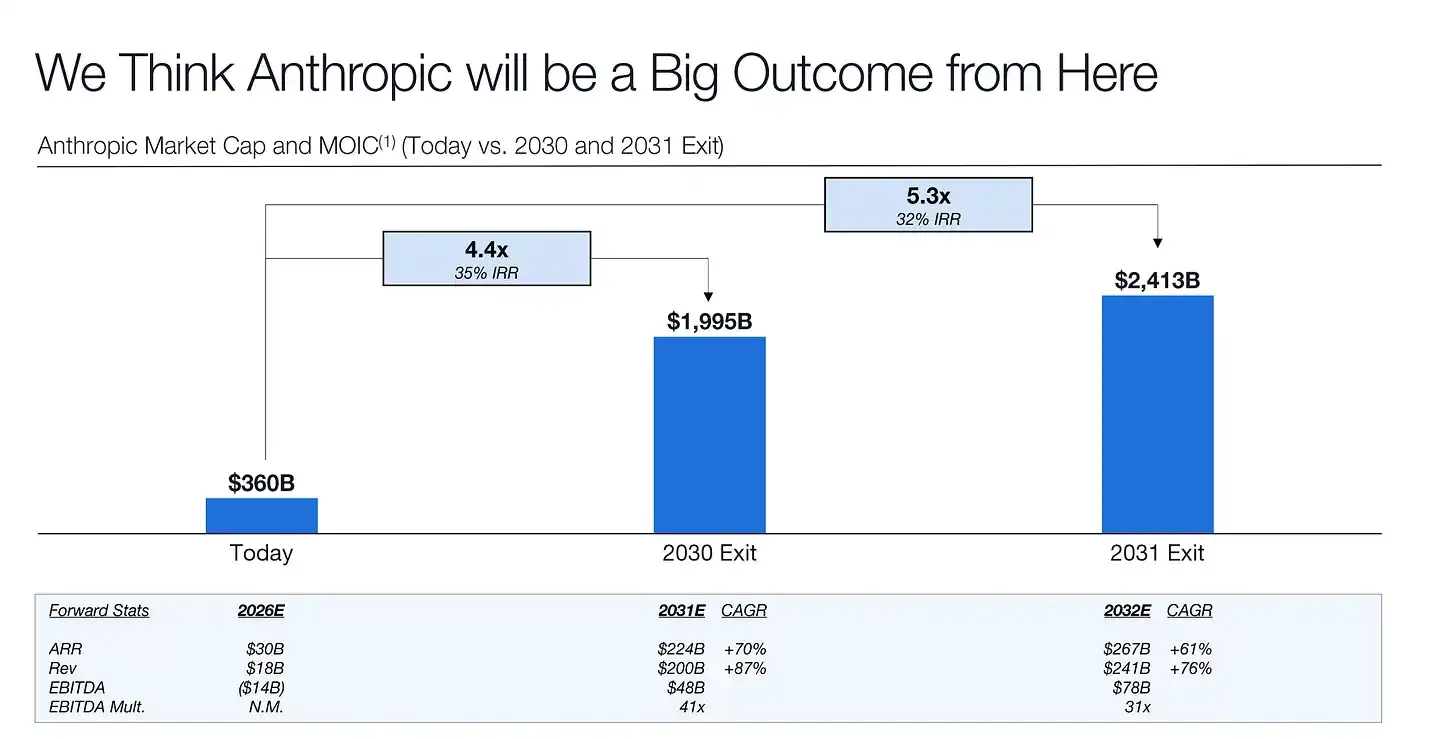
According to the Substack account Newcomer, renowned investment firm Coatue Management predicted in an internal investor presentation from January that Anthropic's valuation would soar to $1.995 trillion by 2030.

Based on the Coatue PPT released by Newcomer, Anthropic is projected to achieve revenue of $18 billion in 2026, but with an EBITDA loss of $14 billion, and its ARR is expected to reach $30 billion by the end of the year.

By 2031, the company's revenue is anticipated to jump to $200 billion, with an EBITDA profit of $48 billion, and ARR further climbing to $224 billion.

Using this as a basis, Coatue applied a 41x forward EBITDA multiple to derive a valuation of $1.995 trillion for 2030, suggesting it could potentially rise to $2.413 trillion in 2031.

In February of this year, Anthropic just completed a new round of financing. Coatue and Singapore's sovereign wealth fund GIC co-led Anthropic's $30 billion Series G funding round, resulting in a post-money valuation of $380 billion. This round of financing is among the largest in the history of the AI field, with participation from other top-tier institutions including D.E. Shaw Ventures and Founders Fund. Coatue founder Philippe Laffont stated at the time that the firm is highly confident in Anthropic's positioning in enterprise AI and Agent Coding.

However, Anthropic's actual growth rate has already partially exceeded Coatue's optimistic expectations. By early March, the company's ARR had approached $20 billion, doubling from $9 billion at the end of 2025, with particularly significant growth in February alone. Anthropic CEO Dario Amodei confirmed at a Morgan Stanley conference that products like Claude Code have made outstanding contributions, with enterprise customers accounting for as much as 80% of the business, and consumption-based billing models further amplifying revenue elasticity.

As a major competitor to OpenAI, Anthropic is known for its "safe and reliable" AI philosophy, and its Claude series of models are rapidly penetrating the coding and enterprise application markets. Since 2025, weekly active users of Claude Code have doubled, and the proportion of code generated by it on GitHub has significantly increased. The company achieved the leap from zero to tens of billions in revenue in less than three years, a growth rate far surpassing that of early cloud computing giants. The generative AI market is in a period of explosion, driven by data centers, computing power demands, and enterprise digital transformation, collectively fueling expectations of trillion-dollar growth.


Related Questions

QWhat is the projected valuation of Anthropic by 2030 according to Coatue Management's internal investor presentation?

ACoatue Management projects that Anthropic's valuation will reach $1.995 trillion by 2030.

QHow much revenue is Anthropic expected to generate in 2026 and 2031 based on Coatue's forecast?

AAnthropic is expected to generate $18 billion in revenue in 2026 and $200 billion in revenue in 2031.

QWhat recent financing round did Anthropic complete, and what was the post-money valuation?

AAnthropic completed a $30 billion Series G financing round in February, led by Coatue and GIC, with a post-money valuation of $380 billion.

QWhich product has been a significant contributor to Anthropic's rapid growth, particularly in enterprise applications?

AClaude Code has been a significant contributor to Anthropic's rapid growth, especially in enterprise applications, with enterprise customers accounting for 80% of its business.

QHow does Anthropic's AI philosophy differentiate it from competitors like OpenAI?

AAnthropic is known for its 'safe and reliable' AI philosophy, differentiating itself by focusing on safety and reliability in its Claude series models, which have gained rapid traction in coding and enterprise applications.

Related Reads

Thanks to Dice Rolls, Bitcoin Keys Are Stored Offline, But Not Everyone Will Do It

The article discusses using dice rolls to generate secure Bitcoin wallet seeds, providing entropy independent of potentially flawed hardware random number generators. It explains that each fair dice roll offers about 2.585 bits of entropy, with around 50 rolls needed for a standard 12-word seed phrase and 99+ recommended for higher security. This method gained attention after a vulnerability was revealed in some Coldcard hardware wallets, where a faulty firmware RNG (dating back to 2021) compromised generated keys. The analysis notes that while a dice-generated main seed was safe from this specific flaw, other Coldcard functions (like creating paper wallets, backup keys, or passwords) could still be vulnerable if they used the defective RNG. The piece argues that while dice-based entropy is technically robust, the manual process is error-prone, tedious, and unrealistic for most new users, who might make mistakes in recording or inputting rolls. It concludes that while manual entropy generation should remain an option for advanced users, the long-term goal is to develop reliable, user-friendly hardware and software that securely generates randomness without requiring specialized knowledge. Coldcard users are advised to check their firmware version and replace any secondary secrets (like paper wallet keys) created with vulnerable devices, while also considering multi-signature setups with devices from different manufacturers for added security.

cryptonews.ru3h ago

Thanks to Dice Rolls, Bitcoin Keys Are Stored Offline, But Not Everyone Will Do It

cryptonews.ru3h ago

Trading

Spot
活动图片




