Cathie Wood Predicts Bitcoin Uptrend: Check Out the Best Presales for 1000x Gains

bitcoinistPublished on 2025-06-09Last updated on 2025-06-09

Abstract

ARK Invest CEO Cathie Wood said she remains bullish on Bitcoin ($BTC), citing its ability to withstand ‘all kinds of...

Trusted Editorial content, reviewed by leading industry experts and seasoned editors. Ad Disclosure

ARK Invest CEO Cathie Wood said she remains bullish on Bitcoin ($BTC), citing its ability to withstand ‘all kinds of turmoil.’ Could some of the best presales be next to hop on the Bitcoin gravy train?

Speaking on Ark Invest’s ‘In the Know’ podcast on YouTube, Wood expressed her gratitude to Donald Trump’s administration for giving regulatory clarity on cryptocurrencies, including Bitcoin.

‘We think the financial services sector is going to reconfigure completely in the next five to ten years, and that of course Bitcoin and now Circle and of course Coinbase as well,’ Wood said.

In April, Ark Invest projected Bitcoin could reach $710K by 2030. That may still be five years away, but there are plenty of reasons to be optimistic, especially with the growing number of institutional investors starting to hoard $BTC, including the US government.

Cathie Wood Bitcoin prediction best presales

When Bitcoin regains momentum and breaks past its current all-time high of $111K, we expect altcoins and even the best crypto presales to ride this wave.

The Best Presales to Surge with Bitcoin

While buying even just 1 $BTC is already out of reach for most, crypto presales let you grab promising new tokens for much less money, and watch them rise with Bitcoin as it climbs to new heights. Here are some of the best-positioned presales to rise with Bitcoin.

1. BTC Bull Token ($BTCBULL) – Bet on Bitcoin’s Continued Rise

The BTC Bull Token ($BTCBULL) presale rallies true Bitcoin believers to support its rally past the $150K mark and beyond. As a $BTCBULL holder, you’ll get the chance to receive free $BTC airdrops when Bitcoin hits $150K and $200K. Plus, you’ll get additional $BTCBULL tokens when $BTC reaches the $250K mark.

You can also watch your $BTCBULL tokens’ value increase thanks to regular token burns when Bitcoin’s value hits $125K, $175K, and $225K. And based on our BTC Bull Token price prediction, exponential gains are possible in the next few years.
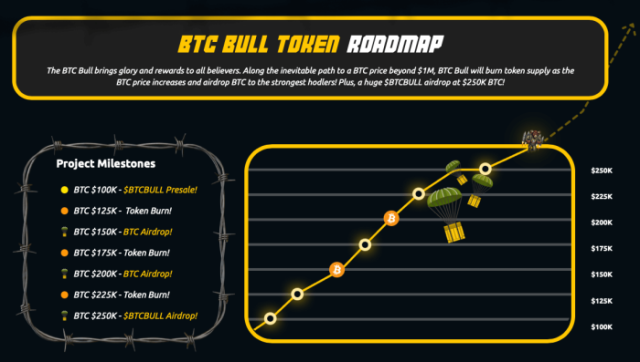
BTC Bull Token Roadmap

Alternatively, you can stake your tokens to earn passive income. The staking rewards are currently at 58% p.a., although this can still change as more investors lock their tokens in the staking pool. To date, over 1.79B $BTCBULL tokens have been staked, accounting for about 8.5% of the total token supply.

To get your hands on $BTCBULL, head on to the BTC Bull Token presale page. Next, connect your crypto wallet (you’ll need to use its partner, Best Wallet to claim your free airdops), enter the number of tokens you want to buy, and pay with your credit/debit card or crypto.

Currently priced at $0.002555, $BTCBULL tokens are at their cheapest until the next price increase in three weeks. So if you want to get them at a discount, it’s best to buy $BTCBULL as soon as you can.  Read more in our What is BTC Bull Token guide.

2. Best Wallet Token ($BEST) – Buy and Store Bitcoin, Altcoins, and Meme Coins in a Secure Crypto Wallet

If you prefer to buy Bitcoin rather than wait for free airdrops, you can consider getting Best Wallet instead. It’s a multi-chain, non-custodial crypto wallet that lets you do everything from buying Bitcoin, altcoins, and meme coins to the newest crypto presales via its Token Launchpad.

To get the most out of the wallet, you can get its native Best Wallet Token ($BEST). As a token holder, you’ll get exclusive perks, like early access to the best new crypto in presale, lower transaction fees, and governance rights, which let you have your say on the project’s direction.
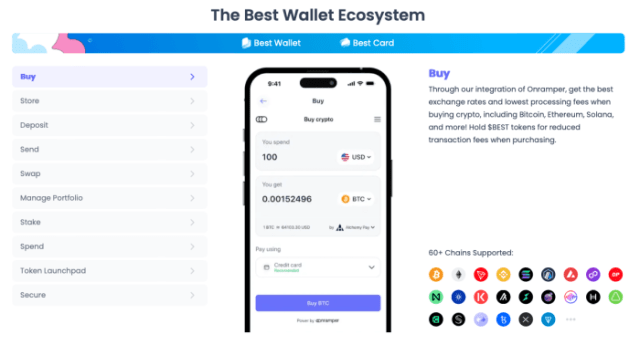
Best Wallet Ecosystem.

You can get your $BEST tokens from the Best Wallet Token presale page or the Best Wallet app. Each token is currently priced at $0.025155, but you only have about a day left before the next price increase. You can check out our Best Wallet Token buying guide for step-by-step instructions on how to purchase tokens.

Of course, you can stake your tokens too. The project offers a generous 107% p.a. staking reward, which will be disbursed over three years. It’s a great way to earn passive income from your investment while supporting Best Wallet’s goal of being one of the top crypto wallets in the market. Read our full Best Wallet review and Best Wallet Price Prediction for more hints.

3. Bitcoin Pepe ($BPEP) – Unlock Your Bitcoin’s Value with the ‘Solana on Bitcoin’ Layer 2

Bitcoin Pepe ($BPEP) is a project that aims to capitalize on the surge in meme coins’ popularity along with Bitcoin’s reputation via a Layer 2 blockchain.

With the project team dubbing it ‘Solana on Bitcoin’, it will introduce the speed, low transaction fees, and the familiar UX of Solana and combine it with Bitcoin’s security.

With its L2, you’ll be able to deploy tokens on Bitcoin via the Bitcoin Pepe platform. As such, you’ll be able to go beyond just holding $BTC and waiting for its value to appreciate and boost its profit potential.

Its $BPEP tokens are currently priced at $0.0396. But with only eight days left in the presale and the upcoming listing on major exchanges, it’s your last chance to get $BPEP at this low price. So, head on out to its presale page as soon as you can.

Beyond Bitcoin: Boost Your Profit Potential with the Best Presales

As more institutions embrace Bitcoin, it’s safe to say that its value can only go up over the long term. While most investors lean towards $BTC and the top altcoins, some of the best crypto presales also offer opportunities for massive gains, including BTC Bull Token ($BTCBULL) and Best Wallet Token ($BEST).

The crypto market is highly volatile, and there’s no real way to predict the future. That’s why you should never forget to do your own research before you invest, and only invest money you can afford to lose. Finally, only use the information in this article for educational purposes and not as investment advice.

Editorial Process for bitcoinist is centered on delivering thoroughly researched, accurate, and unbiased content. We uphold strict sourcing standards, and each page undergoes diligent review by our team of top technology experts and seasoned editors. This process ensures the integrity, relevance, and value of our content for our readers.

Related Reads

Ethereum's Next Decade in the Eyes of Vitalik

"Lean Ethereum" Long-Term Roadmap Unveiled by Vitalik Buterin On July 5, 2026, Vitalik Buterin published the "Lean Ethereum" roadmap, positioning it as Ethereum's third major evolution following the Merge. This multi-year, multi-phase upgrade aims to fundamentally transform Ethereum's core protocol through staged network upgrades extending to 2029. Key goals include achieving 1 gigagas per second L1 throughput (a massive increase from the current ~32 TPS), near-instant finality, and quantum-resistant cryptography. The plan involves transitioning Ethereum's security model from full transaction re-execution by all nodes to native verification via recursive STARK proofs. A major proposed change is replacing the EVM with a proof-friendly architecture like RISC-V or leanISA, though this remains a point of contention, especially with L2s like Arbitrum favoring alternatives like WASM. Other planned upgrades include a restructured state model with a large, cheap "warehouse" storage layer to drastically reduce fees for migrated applications, multi-dimensional gas pricing, and a new focus on making privacy a first-class, native protocol feature. While the roadmap significantly raises Ethereum's long-term technical ceiling, analysts note it does not directly address ETH's mid-term token economics or value capture. The plan's multi-year timeline means near-term price impact will likely depend on observable progress milestones, such as the successful deployment of the upcoming Glamsterdam gas limit increase, growth in L2 activity and blob usage, and trends in L1 fee revenue and ETH burn.

链捕手57m ago

Ethereum's Next Decade in the Eyes of Vitalik

链捕手57m ago

In Just 11 Days, Claude Rewrote Millions of Lines of Code, an Epic AI Engineering Feat Sparks Fury

In just 11 days, Bun's founder Jarred Sumner used Anthropic's Claude AI models to rewrite its million lines of code from Zig to Rust. This move sparked significant controversy, particularly from Zig's creator, Andrew Kelley, who publicly criticized Sumner's engineering practices and the decision to use AI for such a massive rewrite. Bun, a high-performance JavaScript/TypeScript runtime and rival to Node.js, was originally written in Zig. After Anthropic acquired Bun, the team encountered persistent stability and memory safety bugs in the Zig codebase. These issues, combined with Zig's strict policy against LLM-generated code, led to the decision to rewrite in Rust. The rewrite was executed using Claude AI tools at an estimated API cost of $165,000, dramatically reducing the expected time and financial cost. Andrew Kelley's response was scathing. He blamed the original bugs on poor engineering habits, calling Bun's Zig code a collection of "hacks on top of hacks." He expressed relief that Bun was no longer associated with Zig, fearing it would misrepresent the language and attract low-quality, AI-generated contributions. The tech community is divided; some view Kelley's critique as unprofessional, while others see it as a defense of engineering integrity. A major concern about the AI-driven rewrite is the resulting code quality. The translation from Zig left approximately 27,000 lines of unsafe Rust code, raising fears about long-term maintainability and technical debt. The debate centers on whether this project is a milestone in AI-assisted development or a future maintenance nightmare.

marsbit2h ago

In Just 11 Days, Claude Rewrote Millions of Lines of Code, an Epic AI Engineering Feat Sparks Fury

marsbit2h ago

From Auto Finance to Bitcoin to AI Engines: An Analysis of Cango's 'What Not to Do' Strategy

From Auto Finance to Bitcoin and Now AI: Cango's "What Not to Do" Strategy Cango, a Chinese auto finance platform that went public on the NYSE in 2018, is undergoing its third major transformation. After selling its entire auto business in 2024, it pivoted to become a large-scale Bitcoin miner, acquiring 50 exahash of mining rigs from Bitmain. However, its true goal was never Bitcoin, but owning and controlling energy infrastructure. Now, Cango is pivoting again. While most listed Bitcoin miners are leasing power to giant hyperscalers for AI training clusters, Cango is taking the opposite path. It has launched an AI inference subsidiary called EcoHash, focusing not on training but on distributed inference. The company's strategy hinges on the insight that over 70% of mining industry power is controlled by small, independent sites (10-50 MW), which are too small for hyperscalers but ideal for low-latency AI inference. Cango aims to partner with these small operators, providing the AI technology, customers, and financing through its EcoLink software layer, which can distribute workloads across sites for reliability. Cango maintains a hybrid model, running roughly 31.7 EH/s of Bitcoin mining for cash flow while aggressively cleaning its balance sheet—slashing long-term debt by 94.5% to $30.6 million and raising $75 million for its AI venture. Its first AI deployment will be at a 50 MW site in Georgia. The strategy faces skepticism, given the high costs of converting mining sites and the potential for an AI bubble. However, Cango's leadership believes discipline around "what not to do"—avoiding direct competition with hyperscalers in training—positions it to capture the long-tail demand for distributed AI inference power.

Foresight News2h ago

From Auto Finance to Bitcoin to AI Engines: An Analysis of Cango's 'What Not to Do' Strategy

Foresight News2h ago

Strategy's Bitcoin Sales Cap Far Exceeds $1.25 Billion: A Detail the Market Overlooked

The article discusses how MicroStrategy's potential Bitcoin sales go far beyond the announced $1.25 billion "reserve-building capacity." It clarifies a key distinction in the company's "BTC Monetization Program": selling Bitcoin to *build* a new dollar reserve (the $1.25B cap) versus selling to *replenish* the existing USD Reserve after it's used for expenses like preferred share dividends. The recent $216M BTC sale for dividend payments was a "replenishment," leaving the headline $1.25B building quota untouched. The plan actually outlines three potential funding pools from BTC sales: 1) Building the reserve ($1.25B cap), 2) Covering preferred share/ debt costs (no specified cap), and 3) Funding buyback programs (up to $20B). This means the structured sales potential exceeds $30 billion, not including uncapped replenishment sales. The piece argues this marks MicroStrategy's shift from a passive "buy-and-hold" Bitcoin proxy to an actively managed entity using BTC as a balance-sheet tool to manage its complex capital structure (common stock, preferred shares, debt, reserve). This creates new dynamics and potential conflicts, as actions benefiting one part (e.g., selling BTC to pay dividends) may pressure another (e.g., undermining the "never sell" narrative). Investors must now parse the company's specific terminology ("build" vs. "replenish") to understand the true scope of future BTC sales, which is significantly larger than the market initially perceived.

marsbit2h ago

Strategy's Bitcoin Sales Cap Far Exceeds $1.25 Billion: A Detail the Market Overlooked

marsbit2h ago

Trading

Spot
活动图片