Ethereum Price Risks Closing Below 3M Bollinger Bands, Expert Says Think Longer Term

bitcoinistPublished on 2025-03-26Last updated on 2025-03-27

Abstract

Ethereum has been weighed down by persistent downward momentum, and even a near-term rally may not be enough to shift...

Trusted Editorial content, reviewed by leading industry experts and seasoned editors. Ad Disclosure

Ethereum has been weighed down by persistent downward momentum, and even a near-term rally may not be enough to shift the broader trend immediately. As it stands, the ETH price is now at an important technical moment, with crypto analyst Tony “The Bull” Severino warning of a possible close below a significant long-term indicator. 

With just days remaining in the first quarter of 2025, Severino took to the social media platform X to highlight the implications of Ethereum’s position relative to its 3-month Bollinger Band basis, which could spell trouble.

Ethereum Faces A Technical Threat On The Quarterly Timeframe Chart

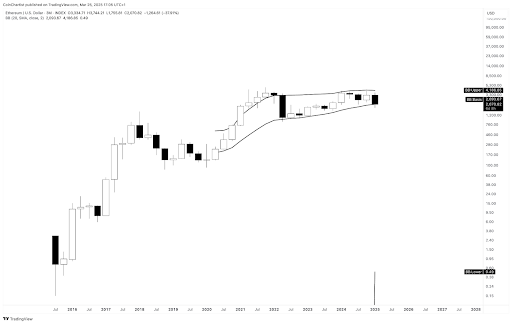
Crypto analyst Tony “The Bull” Severino has sounded the alarm on Ethereum’s quarterly chart. In a recent post on social media platform X, Severino pointed to the 3-month Bollinger Band basis, saying Ethereum’s price is in danger of closing below it. There’s now less than a week remaining in Q1, and the analyst warned, “There are seven days left to save Ethereum from closing below the 3M Bollinger Band basis. If it loses it, look out below.”

The 3M Bollinger Band is a version of the standard Bollinger Bands indicator applied to a 3-month (quarterly) chart. In this case, each candlestick on the chart represents three months of price action, so it covers ETH’s price behavior from a long-term perspective. Speaking of long-term price action, the Ethereum / U.S. Dollar 3-month index shared by Severino shows that the altcoin has been trading within these Bollinger bands since July 2022.
Ethereum
Source: Tony Severino on X

As shown in the price chart below, Ethereum is currently trading close to the lower Bollinger band, which is just around the $2,000 price level. Interestingly, the current candlestick, which only has a few days to close, is highlighted by a lower wick protruding below the lower band. This means the Ethereum price has already broken below the Bollinger Band for a brief period this quarter, but only a close below could quickly seal the deal.

What A Breakdown Below The Band Could Mean For ETH’s Price

If Ethereum does close below the Bollinger Band, it will undoubtedly signal an incoming wave of bearish momentum that might outshine its current lackluster price action. The cryptocurrency might lose the $2,000 psychological price threshold completely and lose many support levels up until $1,500 before any strong rebound. Tony Severino noted that there are only seven days left to save Ethereum from closing below the 3M Bollinger Band and avoid a bearish potential.

In another post on X, the analyst expanded on the implications of ETH’s current structure. Many investors are hoping for a swift rebound and a return to all-time highs, but he cautioned that such an optimistic run might take a long time to manifest.

Any bullish trend in the short term might not be enough to reverse the larger downward trend that has been developing for the past 12 months. A meaningful structural change will require sustained bullish pressure over multiple quarters, not just a short-term bounce.  “Think in terms of quarters, not months, weeks, or days,” he said.

At the time of writing, Ethereum is trading at $2,052.

Ethereum
ETH trading at $2,065 on the 1D chart | Source: ETHUSDT on Tradingview.com
Featured image from iStock, chart from Tradingview.com
Editorial Process for bitcoinist is centered on delivering thoroughly researched, accurate, and unbiased content. We uphold strict sourcing standards, and each page undergoes diligent review by our team of top technology experts and seasoned editors. This process ensures the integrity, relevance, and value of our content for our readers.

Scott Matherson is a leading crypto writer at Bitcoinist, who possesses a sharp analytical mind and a deep understanding of the digital currency landscape. Scott has earned a reputation for delivering thought-provoking and well-researched articles that resonate with both newcomers and seasoned crypto enthusiasts. Outside of his writing, Scott is passionate about promoting crypto literacy and often works to educate the public on the potential of blockchain.

Related Reads

Agentized OS: It's Not About AI, It's About the Foundation

The Agentic OS: Beyond AI, It's About the Foundational Stack In 2026, major operating systems like Android, iOS, HarmonyOS, and Windows are entering the "Agentic" era, integrating proactive AI assistants deeply into the system layer. However, the real competition lies not in the flashy AI features showcased at events, but in the three-layer foundational stack that enables them: the system-level AI Runtime, proprietary/controllable chips, and the on-device/cloud model matrix. The AI Runtime acts as the central scheduler, managing model inference, resource allocation, and exposing capabilities to apps. Controllable chips (e.g., Apple Silicon, Google Tensor, Huawei Kirin) are crucial for deep hardware-software co-optimization, determining the efficiency and experience limits of on-device Agents. The on-device/cloud model matrix provides the "intelligence," with proprietary, chip-optimized small models (like Gemini Nano, Apple's ~3B model) handling daily tasks locally for low latency, privacy, and reliability, while cloud models tackle complex requests. Deep synergy between these three layers enables key Agent differentiators: ultra-low latency and power efficiency, genuine "on-device first" privacy, access to system-level personal context across apps, and reliable performance as a system service even offline. OS vendors with strong integration across this stack (like Apple, Google, and Huawei) build a deeper moat. Beyond this core stack, long-term competitiveness depends on variables like structured App integration (e.g., App Intents/AppFunctions) for reliable multi-step workflows, and robust privacy frameworks that build user trust. This shift towards Agentic OS extends beyond phones and PCs to IoT, cars, and XR glasses via existing multi-device ecosystems. The race is won not in a keynote, but through generations of meticulously co-developed chips, models, and system software.

marsbit20m ago

Agentized OS: It's Not About AI, It's About the Foundation

marsbit20m ago

Why Sam Altman's 'Water and Electricity Theory' Sparks Copyright Controversy

OpenAI CEO Sam Altman's recent statement that "intelligence will become a utility like electricity or water" has sparked significant controversy, primarily around copyright issues and the nature of AI development. While positioning AI as a utility serves as a compelling narrative for infrastructure investors, critics argue the analogy is flawed in three key areas. First, there's a fundamental "property gap." Traditional utilities like water and power create new, physical infrastructure from scratch. In contrast, major AI models are trained by reorganizing vast amounts of existing human-created content—books, articles, code, etc.—often scraped from the web without explicit permission or compensation to creators. This "free acquisition, paid resale" model is seen by many as ethically problematic. Second, there's a "pricing gap." True public utilities are typically regulated to ensure universal service with non-discriminatory, cost-plus pricing. AI's token-based pricing, however, involves significant price discrimination (e.g., output tokens costing much more than input tokens) and is designed for revenue maximization, not equitable access. Third, a "governance gap" exists. Utilities operate under public oversight, while AI pricing and development are currently controlled by a few private companies. Furthermore, the industry's own shift toward buying licensed training data (e.g., deals with Reddit or news publishers) undermines its previous legal reliance on "fair use" for freely scraped data. In conclusion, while AI is indeed becoming a foundational technology, calling it a public utility remains contentious. The title requires not just scale and a pay-per-use model, but also credible solutions for data provenance, equitable pricing, and public governance.

marsbit36m ago

Why Sam Altman's 'Water and Electricity Theory' Sparks Copyright Controversy

marsbit36m ago

From ZEC's Surge to Vitalik's Support: Will the Privacy Narrative Resurface?

From ZEC's surge to Vitalik's endorsement, is privacy making a comeback? The recent rally in ZEC has refocused attention on the crypto privacy sector. This resurgence stems from a growing market realization: while blockchain transparency builds trust, full exposure of user balances, trading strategies, and risk positions can become a vulnerability, especially for large traders and institutions on platforms like Hyperliquid. The privacy landscape has evolved beyond classic anonymity coins like ZEC, XMR, and DASH. It now encompasses privacy infrastructure projects such as Railgun (bringing privacy to DeFi) and Aztec (a privacy-focused L2), as well as newer entrants like Genius Terminal, SilentSwap, and 0xBow that emphasize transaction privacy while attempting to balance compliance. Industry trends confirm privacy is becoming integrated, not a niche feature. Perp DEX Aster has introduced a "Shield Mode," and Vitalik has discussed the need for native privacy at the Ethereum protocol level, including proposals like EIP-8182 for standardized private transfers. In conclusion, this revival is more than a simple sector rotation. It reflects a critical reassessment of transparency's limits. As on-chain finance matures, the challenge is finding a sustainable balance between necessary transparency for trust and essential privacy for protecting assets and strategies, making privacy a potential cornerstone of next-generation infrastructure.

marsbit46m ago

From ZEC's Surge to Vitalik's Support: Will the Privacy Narrative Resurface?

marsbit46m ago

Trading

Spot
Futures

Hot Articles

Discussions

Welcome to the HTX Community. Here, you can stay informed about the latest platform developments and gain access to professional market insights. Users' opinions on the price of ETH (ETH) are presented below.

活动图片