25% Of Institutions Plan To Add XRP In 2026: Coinbase Survey

bitcoinistPublished on 2026-03-27Last updated on 2026-03-27

Abstract

According to a Coinbase and EY-Parthenon survey of 351 institutional decision-makers, 25% plan to add XRP to their portfolios in 2026, highlighting a broader shift into altcoins beyond just Bitcoin and Ethereum. The survey, conducted in January 2026, reveals that 73% of institutions intend to increase their digital asset allocations, with 74% expecting crypto prices to rise. While Bitcoin and Ethereum remain dominant, other assets like Solana, Chainlink, and XRP are gaining traction. The data also shows a trend toward larger portfolio allocations, with regulated vehicles like ETFs being the preferred access method. Key drivers for increased adoption include greater regulatory clarity and improved institutional infrastructure. At the time of reporting, XRP traded at $1.37.

Institutional crypto portfolios are broadening beyond Bitcoin and Ethereum, with Coinbase and EY-Parthenon survey data showing that 25% of respondents plan to add XRP to their allocations in 2026. The same report shows the share of firms holding any non-BTC, non-ETH crypto rising from 51% to 56%, pointing to a wider institutional shift into selected altcoins rather than a simple two-asset market.

The findings come from a January 2026 survey of 351 global institutional decision-makers, 96% of whom represent firms with more than $1 billion in AUM. The respondent base was 60% US, 20% Europe including the UK, and 20% rest of world, spanning asset managers, hedge funds, private banks, venture funds, asset owners, and family offices. Across that group, 73% said they plan to increase digital asset allocations in 2026, while 74% expect crypto prices to rise over the next 12 months.

XRP Among Top 2026 Picks

Bitcoin and Ethereum still dominate institutional positioning, but the diversification trend is clear in the report’s breakdown of current and planned allocations. Bitcoin appears in 94% of current institutional crypto allocations and 91% of 2026 plans, while Ethereum rises from 86% to 90%. Outside the two largest assets, Solana moves from 36% to 38%, Chainlink from 20% to 26%, XRP from 18% to 25%, Binance Coin from 12% to 15%, Cardano from 4% to 5%, Tron from 3% to 4%, and Bitcoin Cash from 3% to 6%. Dogecoin remains marginal at 2% both currently and in 2026 plans.

The XRP figure matters in part because it sits inside a broader expansion in institutional sizing. Among firms already invested in digital assets, the share allocating more than 5% of AUM to the category is expected to rise from 18% to 29% by the end of 2026. The 6% to 10% allocation bucket climbs from 11% to 19%, and the 11% to 20% bucket from 3% to 7%. At the same time, access remains heavily tilted toward regulated wrappers: 66% of digital asset investors now get exposure through spot ETFs or ETPs, 81% prefer spot exposure via a registered vehicle, and net spot crypto ownership via ETF, ETP or direct holdings rose from 76% in January 2025 to 79% in January 2026.

That combination of broader asset selection and tighter portfolio construction runs throughout the report. Among those planning to increase holdings, 65% cited greater regulatory clarity and confidence in compliance frameworks as a key driver, 51% pointed to wider availability of digital assets in regulated vehicles, and 46% to better institutional-grade infrastructure across custody, settlement, and risk.

Smaller firms were the most aggressive, with 77% of the $1 billion to $50 billion AUM group planning to significantly increase or increase holdings, versus 69% for firms in the $51 billion to $500 billion range and 64% for the $501 billion to $1 trillion cohort.

Even so, institutions are not approaching the market with looser standards. The survey found that 49% said recent volatility had strengthened their emphasis on risk management, liquidity, and position sizing, while 22% said volatility caused them to slow down, delay, or keep allocations conservative. Regulation remains both catalyst and constraint: 78% said market structure is the area most in need of clarity, and 66% still cited regulatory uncertainty as a primary concern when investing in digital assets.

At press time, XRP traded at $1.37.
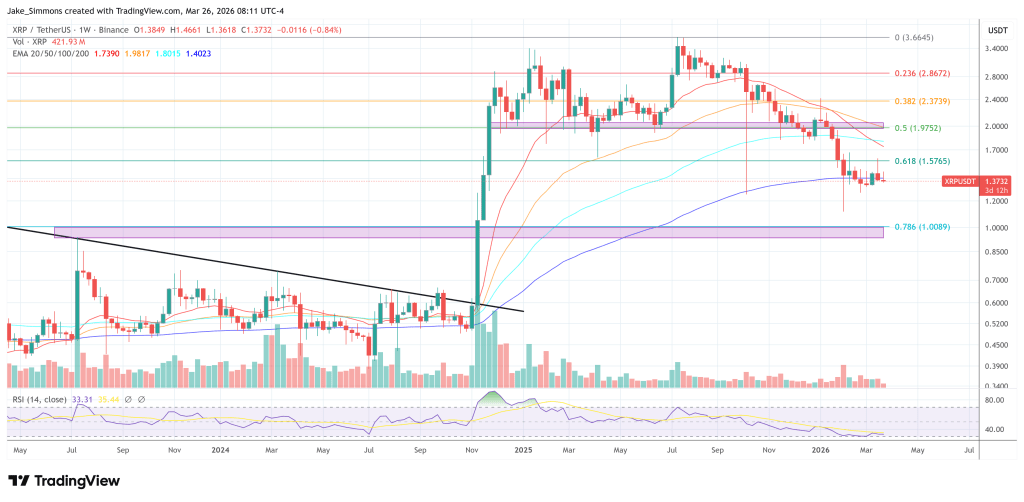
XRP must rise above the 0.618 Fib, 1-week chart | Source: XRPUSDT on TradingView.com

Related Questions

QWhat percentage of institutional decision-makers surveyed plan to add XRP to their crypto allocations in 2026?

A25% of the institutional decision-makers surveyed plan to add XRP to their crypto allocations in 2026.

QAccording to the survey, what is the primary driver for 65% of institutions planning to increase their digital asset holdings?

AThe primary driver for 65% of institutions is greater regulatory clarity and increased confidence in compliance frameworks.

QWhat was the reported price of XRP at the time the article was published?

AXRP was trading at $1.37 at press time.

QHow did the share of firms holding non-Bitcoin, non-Ethereum crypto change according to the survey?

AThe share of firms holding any non-Bitcoin, non-Ethereum crypto rose from 51% to 56%.

QWhich size group of firms (by AUM) was the most aggressive in planning to increase their crypto holdings?

AFirms with $1 billion to $50 billion in AUM were the most aggressive, with 77% planning to significantly increase or increase their holdings.

Related Reads

Trading

Spot
Futures

Hot Articles

What is XRP 2.0

XRP 2.0: A New Frontier in the Cryptocurrency Landscape Introduction to XRP 2.0 In the ever-evolving realm of cryptocurrency, new projects continuously emerge, vying for attention and adoption. One such promising initiative is XRP 2.0, a novel cryptocurrency project designed to leverage advanced blockchain technology and robust encryption methodologies. While the name draws parallels with Ripple’s XRP, it’s crucial to note that XRP 2.0 operates independently, focusing on enhancing transaction security, privacy, and scalability. As the digital financial landscape increasingly embraces decentralized solutions, XRP 2.0 aims to contribute meaningfully to web3 and the overall expansion of crypto projects. What is XRP 2.0? At its core, XRP 2.0 is a cryptocurrency project that aims to create a secure and decentralized digital currency ecosystem. Its foundational technology integrates sophisticated blockchain principles with cutting-edge encryption techniques. The overarching goal of XRP 2.0 is to establish itself as a reliable and efficient platform enabling swift transaction execution while prioritizing enhanced privacy protections for its users. The project is promoted as a solution to many limitations faced by existing cryptocurrencies, proposing a system that can handle a higher volume of transactions with improved speed and privacy. This versatility positions XRP 2.0 as a significant contender in a marketplace riddled with various digital currencies. Who is the Creator of XRP 2.0? The identity of the creator behind XRP 2.0 has been flagged as ‘Wilbur.’ However, comprehensive details regarding Wilbur or their associated entity remain elusive. The anonymity of many cryptocurrency creators is not an uncommon phenomenon in the industry, often designed to maintain a degree of privacy and security. Who are the Investors of XRP 2.0? As of now, specific information related to the investment foundations or organizations supporting XRP 2.0 is not publicly available. In the cryptocurrency sector, the backing by reputed investors can significantly influence a project's credibility and success, yet the transparency regarding the financial supporters of XRP 2.0 has not been established. How Does XRP 2.0 Work? XRP 2.0 stands out by employing a combination of blockchain technology and advanced encryption algorithms that ensures secure and decentralized transactions. Its innovative structure includes unique features designed to foster user engagement and broaden functionalities beyond conventional cryptocurrency transactions. Among these features, XRP 2.0 incorporates AI-powered capabilities, such as text-to-image and text-to-speech functionalities. These additions are designed to enhance the interactive experience for users, promoting broader applicability across various sectors. By bridging technological advancements with user-centered design, XRP 2.0 aims to capture the attention of a diverse range of individuals and enterprises looking to integrate cryptocurrency solutions into their operational frameworks. Timeline of XRP 2.0 Understanding XRP 2.0 requires examining the milestones that have defined its journey thus far: July 23, 2023: XRP 2.0 is introduced as a novel cryptocurrency project, aiming to revolutionize secure and decentralized transaction capabilities in the blockchain domain. September 8, 2023: The launching of another project, XRP20, occurs, marking the emergence of an ERC-20 token on the Ethereum blockchain that remains unrelated to XRP 2.0. November 13, 2023: The XRP Ledger undergoes a significant update with the release of rippled server software version 2.0.0. It is essential to note that this development is disconnected from the XRP 2.0 cryptocurrency project. Key Points About XRP 2.0 To distill the essence of XRP 2.0, several critical factors emerge: Unique Features: The inclusion of features like AI-powered text-to-image and text-to-speech further diversifies the potential applications of XRP 2.0. Blockchain Technology: The framework utilizes advanced blockchain mechanisms and encryption protocols, ensuring a secure and decentralized environment for transactions. Scalability and Privacy: XRP 2.0 prioritizes enhanced privacy protections in transaction processes and the scalability necessary to accommodate a growing user base. No Affiliation with Ripple: Importantly, despite its name, XRP 2.0 does not have any allegiance or collaboration with Ripple’s XRP, distinguishing its operational framework and objectives within the cryptocurrency ecosystem. Conclusion XRP 2.0 represents an ambitious venture into the cryptocurrency sphere, aiming to offer a combination of security, privacy, and efficiency in digital transactions. By integrating sophisticated technologies and user-friendly features, the project sets out to broaden the horizons of what cryptocurrency can achieve in today's digital economy. While the anonymity of its creator and lack of disclosed investors might raise questions for some, XRP 2.0's focus on advanced functionalities and decentralisation enhances its appeal amidst an increasingly crowded crypto market. As the cryptocurrency landscape continues to evolve, XRP 2.0 may yet emerge as a pivotal player in the expansion of secure and scalable blockchain solutions.

941 Total ViewsPublished 2024.04.01Updated 2024.12.03

What is XRP 2.0

Discussions

Welcome to the HTX Community. Here, you can stay informed about the latest platform developments and gain access to professional market insights. Users' opinions on the price of XRP (XRP) are presented below.

活动图片















