如果特朗普真的宣布比特币作为战略储备资产,会有什么影响?

深潮Published on 2024-07-26Last updated on 2024-07-26

如若成真,地位媲美货真价实的黄金。

撰文:Kaori

上周末,一则特朗普将要在比特币 2024 大会上宣布将 BTC 作为美国战略储备资产的传闻广泛传播,伴随着比特币快速回到 68,000 美元,大盘情绪也因此高涨了不少。所有人都在期待这位「加密总统」能在本周末的比特币大会上再疯一把。

什么是国家战略储备资产

国家战略储备资产是指一个国家为应对经济不确定性、外部冲击或其他紧急情况而持有的资产。这些资产通常包括传统避险资产黄金、以美元、欧元、日元为代表的外汇储备、由国际货币基金组织(IMF)分配的储备资产特别提款权 (SDR),以及包括政府债券、外币计价的存款和其他流动性较强的资产。

储备资产的构成和管理对于一个国家的经济稳定以及与 IMF 等国际金融机构的关系起着至关重要的作用。

同为比特币大会参会者的 Satoshi Action Fund 联创 Dennis Porter 在社交媒体上发文称,比特币在成为美国战略储备资产这一事件最可能出现的方向是成为美国财政部的外汇稳定基金(ESF)。

ESF 基金是根据 1934 年《黄金储备法》设立的美国财政部运营的专项基金,其主要目标是稳定美元的价值。ESF 为财政部提供了进行货币和黄金操作以影响汇率并促进外汇市场稳定的工具。而如今,比特币在美国普遍被视为一种外币。

10x Research 研究员 Markus 分析称,美国政府目前持有约 212,847 枚比特币,价值约 150 亿美元,相比之下,其黄金储备总量约为 2.615 亿金衡盎司,价值约 6000 亿美元。如果比特币持有量增加一倍(150 亿美元),几乎相当于年初至今的比特币现货 ETF 净流入资金(160 亿美元),从信号效应来看,这无疑会更具影响力。

7 月 25 日,支持加密货币的怀俄明州共和党参议员 Cynthia Lummis 正计划在比特币大会上宣布比特币战略储备立法。虽然该法案的具体内容尚不清楚,但据一位看过初稿的人士称,该法案的目的是指示美联储购买比特币并将其作为储备资产持有,就像美国央行持有黄金和外币一样,以帮助管理美国货币体系并保持美元价值稳定。
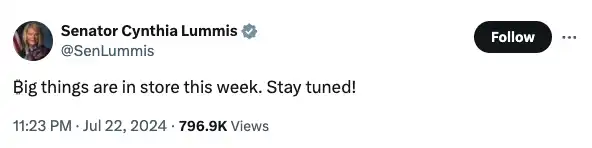
Lummis 在她的 X 账户上暗示一项重大公告:「本周有大事要发生,敬请期待」

资产经理 Bryan Courchesne 最近也在 CNBC 上讨论比特币在未来特朗普政府领导下成为美国政府战略储备资产的潜力。据这位资产管理人称,采用比特币作为储备资产会很困难,但并非不可能。Courchesne 指出,美国司法部持有 20 万比特币,这使得美国政府成为比特币的最大持有者,仅次于匿名创造者中本聪 (Satoshi Nakamoto)。司法部可以简单地将比特币转移到美国财政部,为财政部开始长期积累和持有这种稀缺资产铺平道路。

如果特朗普届时在大会上真的宣布未来将会把比特币作为国家战略储备资产,对比特币乃至加密行业将会产生何种影响?

如若成真,地位媲美货真价实的黄金

首当其冲的便是价格影响,由于美国作为全球最大的经济体之一,其政策变化对全球金融市场有着巨大的影响力。比特币成为战略储备资产的消息会引发市场的强烈反应,投资者对比特币的需求会急剧增加,从而推高其价格。

这还将大大提升其主流认可度,其他国家和机构或许会跟随美国脚步,将比特币纳入他们的储备资产中,从而进一步巩固比特币在全球金融体系中的地位。而随着更多国家和机构将比特币作为储备资产,其性质决定了其持有者倾向于长期持有,比特币市场的波动性可能会有所降低。

但在此之前,我们需要意识到,一种资产要想成为一个国家的战略储备资产并不是由某一个人说了算。就算特朗普真的当选新一届总统,也无法仅靠他一人就让比特币成为战略储备资产。这一过程将涉及政策制定者、经济学家和金融专家的广泛审议,还需要国会的批准并与美联储和财政部协调。

当这一切尘埃落定之时,为了保护和管理其战略储备资产,美国可能会制定和实施更加明确和严格的加密货币监管政策。这些政策可能会对整个加密货币市场产生深远影响,促使其他国家也加强对加密货币的监管。

随着比特币的重要性增加,相关的基础设施和技术也会得到进一步发展。这包括更加安全的储存解决方案、更加高效的交易系统以及更加完善的法律和监管框架。

比特币作为战略储备资产的角色可能会改变现有金融市场的结构。「数字黄金」的称号将使传统资产(如黄金和国债)在储备资产中的地位受到挑战,投资组合的多样性和风险管理策略也会发生变化。

不管最后结果如何,加密行业已经毋庸置疑通过政治进入了更加主流的社会视野。

Related Reads

Summary of Kevin Warsh's Past Remarks: How Will This Prospective 'New Head' Upend the Fed?

Kevin Warsh, nominated by President Trump to replace Fed Chair Powell, is poised to introduce sweeping reforms at the Federal Reserve. His agenda includes structural changes, advocating for lower policy rates, a fundamentally new approach to inflation, a significantly smaller balance sheet, safeguarding Fed independence, narrowing the Fed’s mandate, improving coordination with the Treasury, and reducing communication “noise” from policymakers. Warsh has criticized current monetary policy as “broken” and called for “fundamental regime change,” arguing that continuity is meaningless when the Fed has lost credibility. He believes interest rates should be lower and that a smaller balance sheet would help achieve that, describing the current one as “multiple trillions of dollars larger than necessary.” On inflation, he attributes its rise to cognitive errors at the Fed—including overreliance on flawed models, neglect of money supply, and blaming external factors rather than excessive government spending. He also suggests AI could lead to a structural decline in prices. He strongly defends Fed independence as its “most important asset” and warns against mission creep, which he says risks its core objectives and increases political vulnerability. He proposes closer coordination with the Treasury to align balance sheet and debt issuance plans, clarifying expectations for markets. Regarding communication, Warsh supports transparency but criticizes the current “cacophony of voices” and “forward guidance” that creates ambiguity. He has urged Fed officials to speak less frequently to avoid market confusion.

marsbit10m ago

Summary of Kevin Warsh's Past Remarks: How Will This Prospective 'New Head' Upend the Fed?

marsbit10m ago

Arbitrum Pretends to Be the Hacker, 'Steals' Back the Money Lost by KelpDAO

Title: Arbitrum Poses as Hacker to Recover Stolen Funds from KelpDAO Last week, KelpDAO suffered a hack resulting in nearly $300 million in losses, marking the largest DeFi security incident this year. Approximately 30,765 ETH (worth over $70 million) remained on an Arbitrum address controlled by the attacker. In an unprecedented move, Arbitrum’s Security Council utilized its emergency authority to upgrade the Inbox bridge contract, adding a function that allowed them to impersonate the hacker’s address and initiate a transfer without access to its private key. The council’s action, approved by 9 of its 12 members, moved the stolen ETH to a frozen address in a single transaction before reverting the contract to its original state. The operation was coordinated with law enforcement, which attributed the attack to North Korea’s Lazarus Group. Community reactions are divided: some praise the recovery of funds, while others question the centralization of power, as the council can upgrade core contracts without governance votes. However, such emergency mechanisms are common among major L2s. Despite the partial recovery, over $292 million was stolen in total, with more than $100 million in bad debt on Aave and remaining funds scattered across other chains. The incident highlights escalating security challenges in DeFi, with state-sponsored hackers employing advanced tactics and L2s responding with elevated countermeasures.

marsbit20m ago

Arbitrum Pretends to Be the Hacker, 'Steals' Back the Money Lost by KelpDAO

marsbit20m ago

iQiyi Is Too Impatient

The article "iQiyi Is Too Impatient" discusses the controversy surrounding the Chinese streaming platform IQiyi's recent announcement of an "AI Actor Library" during its 2026 World Conference. IQiyi claimed over 100 actors, including well-known names like Zhang Ruoyun and Yu Hewei, had joined the initiative. CEO Gong Yu suggested AI could enable actors to "star in 14 dramas a year instead of 4" and that "live-action filming might become a world cultural heritage." The announcement quickly sparked backlash. Multiple actors named in the list issued urgent statements denying they had signed any AI-related authorization agreements. This forced IQiyi to clarify that inclusion in the library only indicated a willingness to *consider* AI projects, with separate negotiations required for any specific role. The incident, which trended on social media with hashtags like "IQiyi is crazy," is presented as a sign of the company's growing desperation. Facing intense competition from short-video platforms like Douyin and Kuaishou, as well as Bilibili and Xiaohongshu, IQiyi's financial performance has weakened, with revenues declining for two consecutive years. The author argues that IQiyi is "too impatient" to tell a compelling AI story to reassure the market, especially as it pursues a listing on the Hong Kong stock exchange. The piece concludes by outlining three key "AI questions" IQiyi must answer: defining its role as a tool provider versus a content creator, balancing the "coldness" of AI with the human element audiences desire, and properly managing the interests of platforms, actors, and viewers. The core dilemma is that while AI can reduce costs and increase efficiency, it risks creating homogenized, formulaic content and devaluing human performers.

marsbit1h ago

iQiyi Is Too Impatient

marsbit1h ago

Trading

Spot
Futures

Hot Articles

What is $BITCOIN

DIGITAL GOLD ($BITCOIN): A Comprehensive Analysis Introduction to DIGITAL GOLD ($BITCOIN) DIGITAL GOLD ($BITCOIN) is a blockchain-based project operating on the Solana network, which aims to combine the characteristics of traditional precious metals with the innovation of decentralized technologies. While it shares a name with Bitcoin, often referred to as “digital gold” due to its perception as a store of value, DIGITAL GOLD is a separate token designed to create a unique ecosystem within the Web3 landscape. Its goal is to position itself as a viable alternative digital asset, although specifics regarding its applications and functionalities are still developing. What is DIGITAL GOLD ($BITCOIN)? DIGITAL GOLD ($BITCOIN) is a cryptocurrency token explicitly designed for use on the Solana blockchain. In contrast to Bitcoin, which provides a widely recognized value storage role, this token appears to focus on broader applications and characteristics. Notable aspects include: Blockchain Infrastructure: The token is built on the Solana blockchain, known for its capacity to handle high-speed and low-cost transactions. Supply Dynamics: DIGITAL GOLD has a maximum supply capped at 100 quadrillion tokens (100P $BITCOIN), although details regarding its circulating supply are currently undisclosed. Utility: While precise functionalities are not explicitly outlined, there are indications that the token could be utilized for various applications, potentially involving decentralized applications (dApps) or asset tokenization strategies. Who is the Creator of DIGITAL GOLD ($BITCOIN)? At present, the identity of the creators and development team behind DIGITAL GOLD ($BITCOIN) remains unknown. This situation is typical among many innovative projects within the blockchain space, particularly those aligning with decentralized finance and meme coin phenomena. While such anonymity may foster a community-driven culture, it intensifies concerns about governance and accountability. Who are the Investors of DIGITAL GOLD ($BITCOIN)? The available information indicates that DIGITAL GOLD ($BITCOIN) does not have any known institutional backers or prominent venture capital investments. The project seems to operate on a peer-to-peer model focused on community support and adoption rather than traditional funding routes. Its activity and liquidity are primarily situated on decentralized exchanges (DEXs), such as PumpSwap, rather than established centralized trading platforms, further highlighting its grassroots approach. How DIGITAL GOLD ($BITCOIN) Works The operational mechanics of DIGITAL GOLD ($BITCOIN) can be elaborated on based on its blockchain design and network attributes: Consensus Mechanism: By leveraging Solana’s unique proof-of-history (PoH) combined with a proof-of-stake (PoS) model, the project ensures efficient transaction validation contributing to the network's high performance. Tokenomics: While specific deflationary mechanisms have not been extensively detailed, the vast maximum token supply implies that it may cater to microtransactions or niche use cases that are still to be defined. Interoperability: There exists the potential for integration with Solana’s broader ecosystem, including various decentralized finance (DeFi) platforms. However, the details regarding specific integrations remain unspecified. Timeline of Key Events Here is a timeline that highlights significant milestones concerning DIGITAL GOLD ($BITCOIN): 2023: The initial deployment of the token occurs on the Solana blockchain, marked by its contract address. 2024: DIGITAL GOLD gains visibility as it becomes available for trading on decentralized exchanges like PumpSwap, allowing users to trade it against SOL. 2025: The project witnesses sporadic trading activity and potential interest in community-led engagements, although no noteworthy partnerships or technical advancements have been documented as of yet. Critical Analysis Strengths Scalability: The underlying Solana infrastructure supports high transaction volumes, which could enhance the utility of $BITCOIN in various transaction scenarios. Accessibility: The potential low trading price per token could attract retail investors, facilitating wider participation due to fractional ownership opportunities. Risks Lack of Transparency: The absence of publicly known backers, developers, or an audit process may yield skepticism regarding the project's sustainability and trustworthiness. Market Volatility: The trading activity is heavily reliant on speculative behavior, which can result in significant price volatility and uncertainty for investors. Conclusion DIGITAL GOLD ($BITCOIN) emerges as an intriguing yet ambiguous project within the rapidly evolving Solana ecosystem. While it attempts to leverage the “digital gold” narrative, its departure from Bitcoin's established role as a store of value underscores the need for a clearer differentiation of its intended utility and governance structure. Future acceptance and adoption will likely depend on addressing the current opacity and defining its operational and economic strategies more explicitly. Note: This report encompasses synthesised information available as of October 2023, and developments may have transpired beyond the research period.

363 Total ViewsPublished 2025.05.13Updated 2025.05.13

What is $BITCOIN

Discussions

Welcome to the HTX Community. Here, you can stay informed about the latest platform developments and gain access to professional market insights. Users' opinions on the price of BTC (BTC) are presented below.

活动图片