2 Days, 20x: A Quick Look at the Automated Market Making Mechanism of the New Gem Snowball

深潮Published on 2025-12-22Last updated on 2025-12-22

Abstract

Snowball, a new meme token launched on pump.fun on December 18, gained significant traction in the English-speaking crypto community by introducing an automated market-making mechanism designed to create a self-sustaining "snowball effect." Unlike typical meme coins where creators take a fee (usually 0.5%-1%) from each transaction, Snowball redirects 100% of this fee to an on-chain bot. This bot uses accumulated funds to buy back tokens, add liquidity to the pool, and burn a small portion of tokens periodically. The goal is to create continuous buy pressure and improve trading depth, theoretically allowing the token to grow organically through increased trading activity. Within four days, Snowball reached a $10 million market cap with over 7,000 holders and relatively decentralized ownership. However, the mechanism relies heavily on sustained trading volume to fuel the buyback bot. In a cold market with low on-chain activity, this "flywheel" could reverse if new buyers diminish. While the structure reduces developer exit risk, it doesn’t eliminate other meme coin dangers like large holder dumps or narrative fatigue. Similar projects like FIREBALL are emerging, indicating interest in "mechanism-driven memes," but past examples like OlympusDAO and Safemoon show that mechanisms alone don’t guarantee long-term value. Snowball remains primarily a meme experiment—interesting, but high-risk.

The crypto market in December is as cold as the weather.

On-chain transactions have been dormant for a long time, and new narratives are hard to come by. Just look at the drama and gossip in the Chinese CT (Crypto Twitter) space these past few days, and you'll know hardly anyone is playing in this market anymore.

But the English-speaking community has been discussing something new.

A meme coin called Snowball launched on pump.fun on December 18th. In four days, its market cap surged to $10 million and is still hitting new highs; yet it's barely mentioned in Chinese circles.
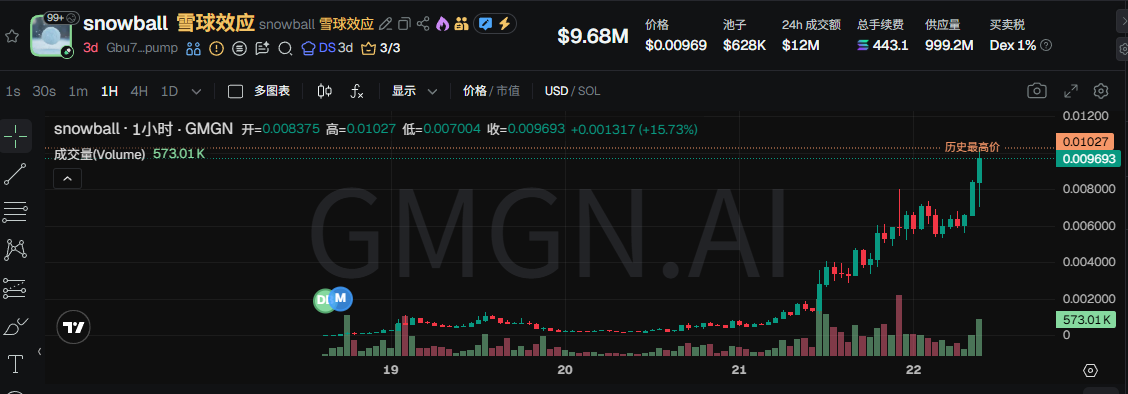
In the current environment, devoid of new narratives and where even memes are considered unplayable, this is one of the few things that catches the eye and shows some localized wealth effect.

And the name Snowball itself tells the story it wants to convey:

A mechanism that allows the token to "roll and grow larger by itself."

Turning Transaction Fees into Buy Pressure, Rolling the Snowball for Market Making

To understand what Snowball is doing, you first need to know how tokens on pump.fun typically make money.

On pump.fun, anyone can create a token in minutes. The token creator can set a "creator fee," essentially taking a cut of every transaction into their own wallet, usually between 0.5% and 1%.

This money could theoretically be used for community building or marketing, but in practice, most Devs choose to: accumulate enough and then run.

This is part of the typical life cycle of a shitcoin. Launch, pump, harvest fees, rug. Investors aren't betting on the token itself, but on the developer's conscience.

Snowball's approach is to not take this creator fee money.

To be precise, 100% of the creator fees do not go into anyone's wallet but are automatically transferred to an on-chain market-making bot.

This bot performs three actions at regular intervals:

First, it uses the accumulated funds to buy tokens on the market, creating buy-side support;

Second, it adds the bought tokens and the corresponding SOL to the liquidity pool, improving trading depth;

Third, it burns 0.1% of the tokens with each operation, creating deflation.
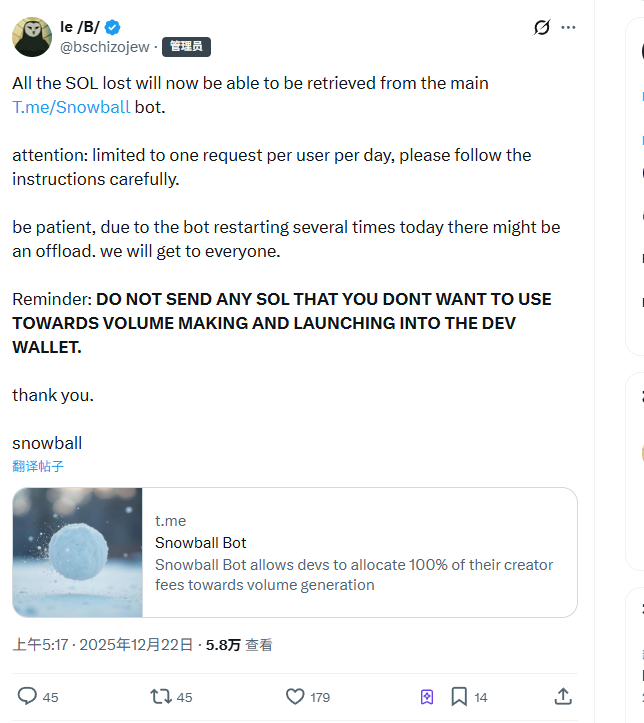
Additionally, the percentage taken as the creator fee is not fixed; it fluctuates between 0.05% and 0.95% based on market cap.

It takes a higher percentage when the market cap is low, allowing the bot to accumulate ammunition faster; it reduces the fee when the market cap is high, decreasing transaction friction.

In one sentence, the logic of this mechanism is: every time you trade, a portion of the money automatically becomes buy pressure and liquidity, instead of going into the developer's pocket.

Therefore, it's easy to understand this snowball effect:

Transactions generate fees → Fees become buy pressure → Buy pressure pushes the price up → Higher price attracts more transactions → More fees... theoretically, it can roll on its own.

On-Chain Data Situation

Now that we've covered the mechanism, let's look at the on-chain data.

Snowball launched on December 18th, so it's been four days now. Its market cap grew from zero to $10 million, with a 24-hour trading volume exceeding $11 million.

For a shitcoin on pump.fun, these results mean it's already one of the longer-lasting ones in the current environment.

In terms of token distribution, there are currently 7,270 holder addresses. The top ten holders combined hold about 20% of the total supply, with the largest single holder holding 4.65%.
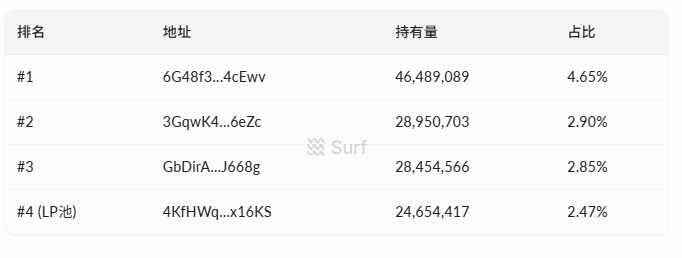
(Data source: surf.ai)

There's no address holding 20-30% of the supply; the distribution is relatively decentralized.

Regarding trading data, there have been over 58,000 cumulative transactions since launch, with 33,000 buys and 24,000 sells. The total buy volume is $4.4 million, and sell volume is $4.3 million, resulting in a net inflow of about $100,000. Buying and selling are basically balanced, with no one-sided selling pressure.

The liquidity pool holds about $380,000, half in tokens and half in SOL. For a market cap of this size, the depth isn't very thick, and large orders would still experience significant slippage.

Another notable point is that Bybit Alpha announced listing the token less than 96 hours after launch, which to some extent confirms the short-term hype.

Perpetual Motion Meets a Cold Market

Looking around, you can see the English community's discussion about Snowball mainly focuses on the mechanism itself. Supporters' logic is straightforward:

This is the first meme coin that locks 100% of the creator fees into the protocol; developers can't take the money and run, making it structurally safer than other shitcoins, at least.

The Dev is also playing into this narrative. The developer wallet, market-making bot wallet, and transaction logs are all public, emphasizing "verifiable on-chain."

@bschizojew labels himself as "on-chain schizophrenia, 4chan special forces, first-generation meme coin veteran," radiating a self-deprecating degen vibe that really appeals to the crypto-native community.

But a safe mechanism and making money are two different things.

The snowball effect relies on the premise that there is sufficient trading volume to continuously generate fees to feed the bot for buybacks. More trades mean more ammunition for the bot, stronger buy pressure, higher prices, attracting more people to trade...

This is the ideal state for any meme coin's so-called buyback flywheel to spin up in a bull market.

The problem is, the flywheel needs external momentum to start.

What is the current crypto market environment? On-chain activity is sluggish, overall meme coin hype is down, and there's simply less capital willing to chase shitcoins. In this context, if new buy pressure doesn't keep up and trading volume shrinks, the fees the bot receives will become less and less, buyback strength weakens, price support falters, and trading willingness declines further.

The flywheel can spin forward, but it can also spin in reverse.

A more realistic problem is that the mechanism solves only one risk point—"developers taking money and running"—but meme coins face far more risks than that.

Whales dumping, insufficient liquidity, narratives going out of style—if any of these happen, 100% fee buybacks can only do so much.

Everyone is tired of being rugged. As one Chinese crypto brother aptly summarized:

Play if you want, but don't get in over your head.

More Than One Snowball Rolling

Snowball isn't the only project telling this automated market-making story.

Within the pump.fun ecosystem, a token called FIREBALL is doing something similar: automatic buybacks and burns, packaged as a protocol other tokens can plug into. But its market cap is much smaller than Snowball's.
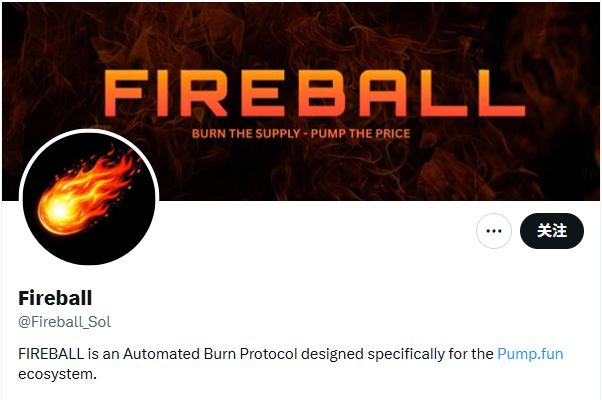
This shows the market is currently responsive to the direction of "mechanism-based meme coins."

The traditional玩法 (playbook) of shilling, pumping, and community hype is finding it harder to attract capital. Using mechanism design to tell a "structurally safe" story might be one of meme coins' latest tricks.

That said, artificially creating a specific mechanism isn't a new玩法 (play) either.

OlympusDAO's (3,3) in 2021 was the most classic case, packaging a staking mechanism with game theory, telling the story "if everyone holds, we all profit together." It reached a peak market cap of several billion dollars. The ending, as everyone knows, was a death spiral, dropping over 90%.

Even earlier, there was Safemoon's玩法 of "taxing every transaction and distributing it to holders," also a narrative of mechanism innovation, which ended with the SEC suing and the founders charged with fraud.

A mechanism can be a great narrative hook, capable of gathering capital and attention in the short term, but the mechanism itself does not create value.

When external capital stops flowing in, even the most精巧 (ingenious) flywheel will stop.

Finally, let's recap what this little gem is actually doing:

Turning the meme coin's creator fees into an "automated market-making bot." The mechanism itself isn't complicated, and the problem it solves is very clear: preventing developers from directly taking the money and running.

Developers not being able to rug doesn't mean you'll make money.

If after reading this you find the mechanism interesting and want to participate, remember one thing: it is first and foremost a meme coin, and only secondly an experiment with a new mechanism.


Trending Cryptos

Related Questions

QWhat is the core mechanism that makes Snowball different from typical meme coins on pump.fun?

ASnowball's core mechanism is that 100% of the creator fees from each transaction are automatically sent to an on-chain market-making bot instead of going to the developer's wallet. This bot uses the accumulated funds to buy back tokens, add liquidity to the pool, and burn a small portion of tokens, creating a self-sustaining 'snowball effect' of buying pressure and liquidity growth.

QHow does the 'snowball effect' theoretically work in this token's economic model?

AThe 'snowball effect' works through a feedback loop: transactions generate fees → fees are used by the bot to buy tokens and add liquidity → buying pressure pushes the price higher → higher prices attract more traders and transactions → which generates more fees for the bot to continue the cycle.

QWhat are some of the risks or limitations of Snowball's automatic market-making mechanism?

AThe mechanism relies on sustained trading volume to generate fees for the bot. If new buyers dry up and trading volume decreases, the bot's buying power weakens, potentially leading to a downward spiral. It also doesn't protect against other risks like large holders dumping, liquidity issues, or narrative fatigue.

QHow does the creator fee percentage in Snowball adjust, and why?

AThe creator fee percentage in Snowball fluctuates between 0.05% and 0.95% based on market capitalization. It charges a higher percentage when the market cap is low to allow the bot to accumulate funds faster, and a lower percentage when the market cap is high to reduce transaction friction for traders.

QWhat precedent exists in crypto for 'mechanism-driven' tokens like Snowball, and what were their outcomes?

APrecedents include OlympusDAO's (3,3) staking mechanism, which collapsed after reaching a multi-billion dollar valuation, and Safemoon's transaction tax redistribution model, which ended with fraud charges from the SEC. These show that while mechanisms can drive short-term hype, they don't create inherent value and often fail when external capital stops flowing in.

Related Reads

From South Korea to the United States: Blue-Collar Jobs Are Becoming Increasingly Popular, Thanks to AI

AI is reshaping the labor market's value proposition. The traditional four-year college degree is losing its appeal as a guaranteed career path, while skilled blue-collar trades like electricians, welders, and plumbers are experiencing historic demand and wage premiums. This shift is driven by dual pressures: AI's displacement of certain white-collar roles and a booming need for physical infrastructure and data center construction. Data confirms the trend. In the U.S., vocational school revenue surged, and a significant portion of recent layoffs are AI-related. Surveys show a majority of Gen Z adults plan to pursue blue-collar work, citing better job security against AI automation. Vocational education interest has exploded recently. Experts cite a psychological shift as younger generations seek tangible, AI-resistant careers and avoid high student debt. In many cases, salaries for skilled trades now match or exceed those requiring a bachelor's degree. In South Korea, semiconductor vocational high schools boast near-total employment, with graduates securing high-paying roles at companies like Samsung. The shortage is structural, exacerbated by a retiring baby boomer workforce and massive infrastructure projects. Companies like JPMorgan Chase, Meta, and Lowe's are investing heavily in training programs. However, overcoming historical stigma and a "perception gap" around trade careers remains a key challenge to closing the talent gap.

marsbit3m ago

From South Korea to the United States: Blue-Collar Jobs Are Becoming Increasingly Popular, Thanks to AI

marsbit3m ago

Qualcomm: AI Hype Subsides, When Will Smartphones Emerge from the Gloom?

Qualcomm reported its Q3 FY2026 results (ending June 2026), with revenue of $9.95B, down 4% YoY but above expectations. Gross margin declined to 53.1%, pressured by rising costs across manufacturing and memory. Key business segments showed mixed performance: Handset revenue fell 19.6% YoY to $5.09B, dragged by an 11% decline in non-Apple Android shipments and weaker high-end mix. Conversely, Automotive revenue surged 61% to $1.59B, and IoT grew 9% to $1.83B. Core operating profit dropped 41% YoY due to margin compression and higher expenses. Management's Q4 FY2026 guidance projects revenue of $9.7B-$10.5B, in line with consensus, but Non-GAAP EPS guidance of $2.05-$2.25 fell short of expectations. Amidst persistent weakness in its core handset market, Qualcomm is pursuing growth in AI, focusing on Edge AI (smartphones, PCs, automotive) and Data Center AI. Its data center strategy includes four pillars: AI accelerators (e.g., AI200), commercial CPUs (Dragonfly C1000), custom silicon, and connectivity solutions. While these initiatives initially boosted its stock, concerns over AI capital expenditure sustainability have since erased those gains. The company targets $5B in data center revenue for FY2027 and $15B for FY2029. The report concludes that with the traditional handset business still under pressure, the data center opportunity is currently viewed as a longer-term option, and a more conservative valuation based on core operations may be warranted until AI contributions materialize.

marsbit8m ago

Qualcomm: AI Hype Subsides, When Will Smartphones Emerge from the Gloom?

marsbit8m ago

From TPU to Self-Evolving Agents: How Jeff Dean Predicts the Next Step in AI

At the 2026 YC Startup School, Jeff Dean outlined his vision for AI's next phase, shifting focus from simply scaling models to building intelligent, autonomous systems. He believes AI's progress is no longer just about creating smarter models, but about integrating them into systems capable of long-term, iterative work, automated experimentation, and continuous learning. This evolution moves the competition from "who has the bigger model" to "who can best organize intelligence." Dean suggests AI capabilities are now comparable to a junior engineer, enabling the automation of complex workflows. However, the true challenge and opportunity lie in managing these AI "workers" at scale. He emphasizes the importance of **context engineering**—structuring tools, memory, and feedback loops—over raw model power. For startups, this means building deep expertise in niche domains where general models currently fail (near 0-1% success rates), leveraging proprietary data, specialized tools, and domain-specific evaluators. A recurring theme is re-examining fundamental constraints. Dean's past work, like moving Google's search index to memory or creating the TPU, stemmed from questioning outdated assumptions about hardware and cost. He sees similar inflection points today, particularly in **specialized inference hardware** to drastically reduce latency and energy consumption for real-time Agent operation. Notably, he points out that in modern AI systems, the dominant cost is often not computation but **data movement**. Reliable, long-running Agents require robust system design, borrowing concepts from distributed computing like checkpointing, state management, and parallel exploration to handle failures and maintain progress over days or weeks. As AI automates execution, the scarcest human skills will shift to **defining clear specifications**, **judging what problems are worth solving** (taste), and designing effective feedback loops. Ultimately, Dean's framework prioritizes understanding the problem deeply, identifying the true bottlenecks, and systematically building closed-loop systems where AI can not only perform tasks but also improve AI itself.

marsbit8m ago

From TPU to Self-Evolving Agents: How Jeff Dean Predicts the Next Step in AI

marsbit8m ago

Trading

Spot

Hot Articles

Learn Quick Buy Tokens

HTX Quick Buy/Sell is a form of transaction between fiat money and cryptos, where you don't have to manually choose a buyer or seller.

4.3k Total ViewsPublished 2023.08.15Updated 2024.02.18

Learn Quick Buy Tokens

How to Buy QUICK

Welcome to HTX.com! We've made purchasing Quickswap (QUICK) simple and convenient. Follow our step-by-step guide to embark on your crypto journey.Step 1: Create Your HTX AccountUse your email or phone number to sign up for a free account on HTX. Experience a hassle-free registration journey and unlock all features.Get My AccountStep 2: Go to Buy Crypto and Choose Your Payment MethodCredit/Debit Card: Use your Visa or Mastercard to buy Quickswap (QUICK) instantly.Balance: Use funds from your HTX account balance to trade seamlessly.Third Parties: We've added popular payment methods such as Google Pay and Apple Pay to enhance convenience.P2P: Trade directly with other users on HTX.Over-the-Counter (OTC): We offer tailor-made services and competitive exchange rates for traders.Step 3: Store Your Quickswap (QUICK)After purchasing your Quickswap (QUICK), store it in your HTX account. Alternatively, you can send it elsewhere via blockchain transfer or use it to trade other cryptocurrencies.Step 4: Trade Quickswap (QUICK)Easily trade Quickswap (QUICK) on HTX's spot market. Simply access your account, select your trading pair, execute your trades, and monitor in real-time. We offer a user-friendly experience for both beginners and seasoned traders.

4.1k Total ViewsPublished 2024.03.29Updated 2026.06.02

How to Buy QUICK

Discussions

Welcome to the HTX Community. Here, you can stay informed about the latest platform developments and gain access to professional market insights. Users' opinions on the price of QUICK (QUICK) are presented below.

活动图片












