Ethereum Bulls Take Breather, This Scenario Could Trigger A Correction

newsbtcPublished on 2023-04-17Last updated on 2023-04-17

Abstract

Ethereum price extended its increase above the $2,000 resistance against the US Dollar. ETH is slowly moving lower and might decline if it breaks the $2,075 support.

Ethereum price extended its increase above the $2,000 resistance against the US Dollar. ETH is slowly moving lower and might decline if it breaks the $2,075 support.

Ethereum started a strong increase above the $2,000 and $2,050 resistance levels.

The price is trading above $2,000 and the 100-hourly Simple Moving Average.

There is a major bullish trend line forming with support near $2,090 on the hourly chart of ETH/USD.

The pair could start a downside correction below the $2,075 support zone.

Ethereum Price Faces Resistance

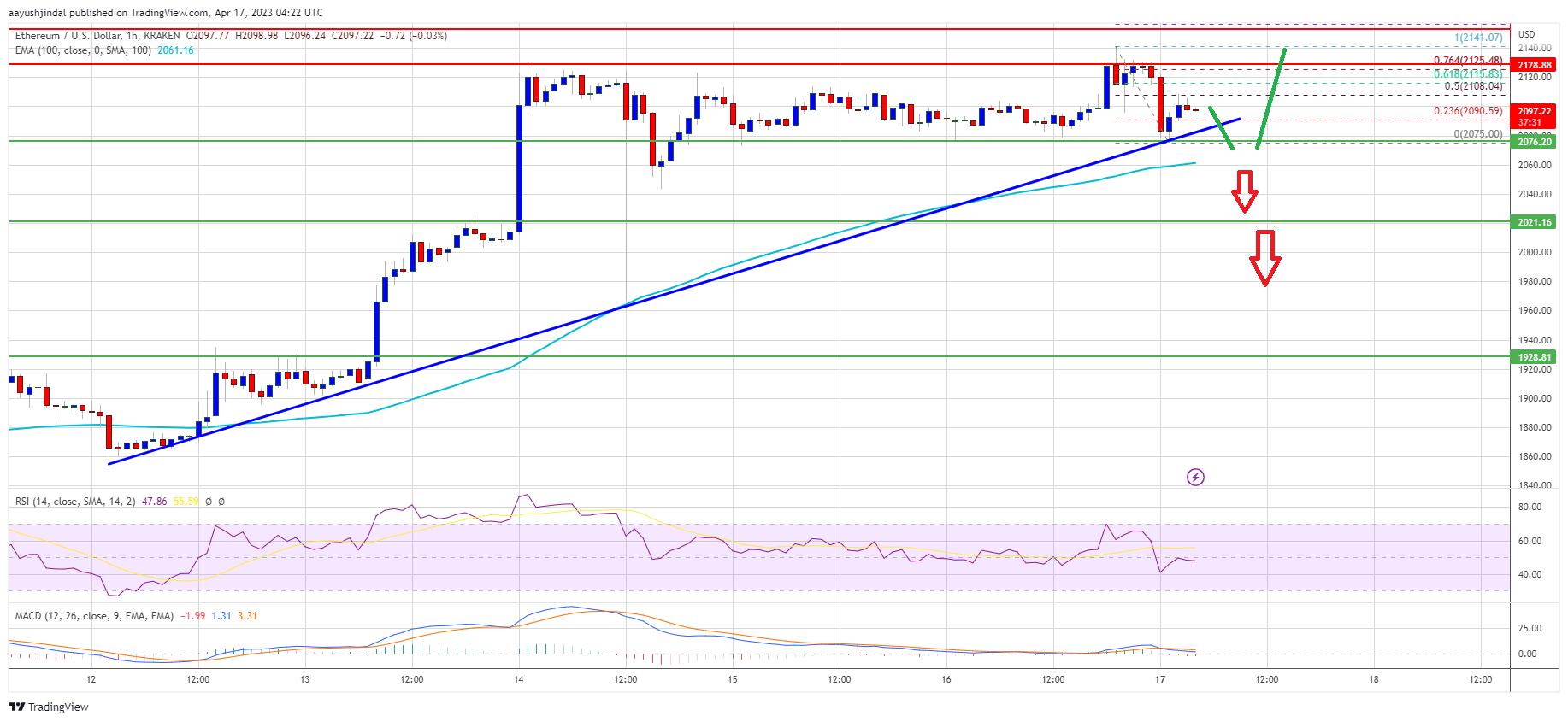
Ethereum’s price gained pace after there was a clear move above the $2,000 resistance zone. ETH even climbed above the $2,080 resistance zone before the bears appeared near the $2,120 zone.

A high was formed near the $2,141 level before the price started a downside correction, similar to Bitcoin. There was a move below the $2,100 level but the downsides were limited. A low is formed near $2,075 and the price is now consolidating gains.

Ether price trading above $2,000 and the 100-hourly Simple Moving Average. There is also a major bullish trend line forming with support near $2,090 on the hourly chart of ETH/USD. Immediate resistance is near the $2,110 zone. It is near the 50% Fib retracement level of the downward move from the $2,141 swing high to the $2,075 low.

The next major resistance is near the $2,125 zone or the 76.4% Fib retracement level of the downward move from the $2,141 swing high to the $2,075 low.

A close above the $2,125 resistance zone could start another strong increase. In the stated case, the bulls might aim for a move toward the $2,200 resistance. Any more gains could set the pace for a test of the $2,320 resistance.

Downside Break in ETH?

If Ethereum fails to clear the $2,125 resistance, it could start a downside correction. Initial support on the downside is near the $2,090 level and trend line.

The next major support is near the $2,075 zone, below which ether price might decline toward the $2,020 level. The main support is now forming near the $1,925 and $1,920 levels.

Technical Indicators

Hourly MACD – The MACD for ETH/USD is now losing momentum in the bullish zone.

Hourly RSI – The RSI for ETH/USD is just below the 50 level.

Major Support Level – $2,075

Major Resistance Level – $2,125

Related Reads

6 Questions to Understand the Business Trends of AI

The AI industry has entered its "summer" phase, according to a six-dimensional scoring framework assessing its development cycle. Each dimension—narrative vs. delivery, system connectivity, delivery capability, ROI rationalization, common industry trends, and capital environment—scores 1 point, totaling 6 points. This places the industry firmly in summer (5-7 points), characterized by a coexistence of grand promises and tangible deliverables, with increasing pressure to demonstrate value and profitability. Key signals mark this shift. ByteDance's Doubao launched paid subscriptions, while OpenAI introduced an advertising platform. These moves are driven by dual forces: immense cost pressures from scaling user bases and massive compute requirements, and the maturation of commercial opportunities. Major players like Anthropic report explosive growth, highlighting AI's transition into core productivity infrastructure. For businesses, the path forward involves three strategic steps. First, identify a small, high-impact use case to quickly demonstrate a closed-loop value proposition, such as automating customer service or content generation. Second, systematically replicate successful pilots across the organization by standardizing processes, building shared AI capabilities, and aligning talent, incentives, and leadership. Finally, move beyond simply adding AI to existing workflows and undertake systemic reconstruction—redesigning processes for parallel AI-human collaboration, implementing real-time dashboards, and establishing automated trigger chains. The era where storytelling alone secured funding is over. The focus has shifted to delivering measurable efficiency gains, cost savings, and new revenue streams, as evidenced by real-world implementations in companies like Semir, Anta, and Midea. Success now depends on starting with a focused proof point, scaling it organization-wide, and ultimately allowing AI to redefine operational paradigms.

marsbit5h ago

6 Questions to Understand the Business Trends of AI

marsbit5h ago

US Government Lifts Ban on Crypto Perpetual Contracts for the First Time: What Does It Mean for the Market?

The U.S. Commodity Futures Trading Commission (CFTC) has issued guidance permitting 24/7 trading and clearing for crypto asset derivatives, effectively opening the U.S. market to crypto perpetual contracts for the first time. This move ends the previous ban and allows American individuals and institutions to trade these instruments around the clock. Direct beneficiaries include Kalshi, which received approval to list a Bitcoin perpetual contract; Coinbase, now the first CFTC-regulated futures commission merchant for U.S. clients to access global crypto derivatives; and CME, which will transition its Bitcoin futures and options to 24/7 trading. The CFTC emphasized this is a specific allowance for crypto assets, noting that traditional commodities like agriculture may not be suitable for non-stop trading. It also requires platforms to undergo case-by-case reviews for compliance and risk management. Industry leaders like Michael Saylor and Brian Armstrong praised the decision for integrating Bitcoin into capital markets and granting U.S. users access to a major global market segment. However, consumer advocacy group Better Markets criticized the CFTC for allegedly neglecting investor protection and favoring the industry it regulates. Other platforms like Kraken have announced plans to launch regulated perpetual futures for the U.S. market. The policy shift is expected to redirect significant liquidity and institutional participation to the newly accessible U.S. crypto derivatives landscape.

Odaily星球日报16h ago

US Government Lifts Ban on Crypto Perpetual Contracts for the First Time: What Does It Mean for the Market?

Odaily星球日报16h ago

Trading

Spot
Futures

Hot Articles

What is $BITCOIN

DIGITAL GOLD ($BITCOIN): A Comprehensive Analysis Introduction to DIGITAL GOLD ($BITCOIN) DIGITAL GOLD ($BITCOIN) is a blockchain-based project operating on the Solana network, which aims to combine the characteristics of traditional precious metals with the innovation of decentralized technologies. While it shares a name with Bitcoin, often referred to as “digital gold” due to its perception as a store of value, DIGITAL GOLD is a separate token designed to create a unique ecosystem within the Web3 landscape. Its goal is to position itself as a viable alternative digital asset, although specifics regarding its applications and functionalities are still developing. What is DIGITAL GOLD ($BITCOIN)? DIGITAL GOLD ($BITCOIN) is a cryptocurrency token explicitly designed for use on the Solana blockchain. In contrast to Bitcoin, which provides a widely recognized value storage role, this token appears to focus on broader applications and characteristics. Notable aspects include: Blockchain Infrastructure: The token is built on the Solana blockchain, known for its capacity to handle high-speed and low-cost transactions. Supply Dynamics: DIGITAL GOLD has a maximum supply capped at 100 quadrillion tokens (100P $BITCOIN), although details regarding its circulating supply are currently undisclosed. Utility: While precise functionalities are not explicitly outlined, there are indications that the token could be utilized for various applications, potentially involving decentralized applications (dApps) or asset tokenization strategies. Who is the Creator of DIGITAL GOLD ($BITCOIN)? At present, the identity of the creators and development team behind DIGITAL GOLD ($BITCOIN) remains unknown. This situation is typical among many innovative projects within the blockchain space, particularly those aligning with decentralized finance and meme coin phenomena. While such anonymity may foster a community-driven culture, it intensifies concerns about governance and accountability. Who are the Investors of DIGITAL GOLD ($BITCOIN)? The available information indicates that DIGITAL GOLD ($BITCOIN) does not have any known institutional backers or prominent venture capital investments. The project seems to operate on a peer-to-peer model focused on community support and adoption rather than traditional funding routes. Its activity and liquidity are primarily situated on decentralized exchanges (DEXs), such as PumpSwap, rather than established centralized trading platforms, further highlighting its grassroots approach. How DIGITAL GOLD ($BITCOIN) Works The operational mechanics of DIGITAL GOLD ($BITCOIN) can be elaborated on based on its blockchain design and network attributes: Consensus Mechanism: By leveraging Solana’s unique proof-of-history (PoH) combined with a proof-of-stake (PoS) model, the project ensures efficient transaction validation contributing to the network's high performance. Tokenomics: While specific deflationary mechanisms have not been extensively detailed, the vast maximum token supply implies that it may cater to microtransactions or niche use cases that are still to be defined. Interoperability: There exists the potential for integration with Solana’s broader ecosystem, including various decentralized finance (DeFi) platforms. However, the details regarding specific integrations remain unspecified. Timeline of Key Events Here is a timeline that highlights significant milestones concerning DIGITAL GOLD ($BITCOIN): 2023: The initial deployment of the token occurs on the Solana blockchain, marked by its contract address. 2024: DIGITAL GOLD gains visibility as it becomes available for trading on decentralized exchanges like PumpSwap, allowing users to trade it against SOL. 2025: The project witnesses sporadic trading activity and potential interest in community-led engagements, although no noteworthy partnerships or technical advancements have been documented as of yet. Critical Analysis Strengths Scalability: The underlying Solana infrastructure supports high transaction volumes, which could enhance the utility of $BITCOIN in various transaction scenarios. Accessibility: The potential low trading price per token could attract retail investors, facilitating wider participation due to fractional ownership opportunities. Risks Lack of Transparency: The absence of publicly known backers, developers, or an audit process may yield skepticism regarding the project's sustainability and trustworthiness. Market Volatility: The trading activity is heavily reliant on speculative behavior, which can result in significant price volatility and uncertainty for investors. Conclusion DIGITAL GOLD ($BITCOIN) emerges as an intriguing yet ambiguous project within the rapidly evolving Solana ecosystem. While it attempts to leverage the “digital gold” narrative, its departure from Bitcoin's established role as a store of value underscores the need for a clearer differentiation of its intended utility and governance structure. Future acceptance and adoption will likely depend on addressing the current opacity and defining its operational and economic strategies more explicitly. Note: This report encompasses synthesised information available as of October 2023, and developments may have transpired beyond the research period.

363 Total ViewsPublished 2025.05.13Updated 2025.05.13

What is $BITCOIN

Discussions

Welcome to the HTX Community. Here, you can stay informed about the latest platform developments and gain access to professional market insights. Users' opinions on the price of BTC (BTC) are presented below.

活动图片