1-Minute Breakdown of Quantitative Models: High Rollers Hunt Down Trading Bots

marsbitPublished on 2026-01-21Last updated on 2026-01-21

Abstract

In the emerging prediction markets, a mysterious trader known as a4385 executed a sophisticated attack against quantitative trading bots, netting $280,000 in 48 hours. These markets allow users to bet on short-term price movements of assets like XRP—for example, predicting whether the price will rise or fall within 15 minutes. Quant algorithms typically profit by exploiting散户情绪 and market inefficiencies with毫秒级 precision. On January 17, 2026, a4385 placed a "rise" bet in an XRP market when the price was below the starting price and the probability of success was only 36%. In the final minute before settlement, a4385 executed large market buy orders, artificially pumping XRP’s price just above the starting threshold at the exact moment of settlement—ensuring his bet paid out. The strategy relied on shallow order book depth (due to weekend trading and XRP’s lower liquidity), allowing a4385 to move the market with relatively modest volume (~$569,000 in the final minute. Each operation cost about $6,200 in fees, but yielded returns as high as $40,218 per round. To hedge against post-settlement price drops, a4385 held short positions of equivalent size, ensuring overall portfolio stability. This required significant capital—over a million dollars—highlighting that this was not luck or a散户 victory, but a calculated exploit of market structure, liquidity conditions, and quantitative model behavior.

In today's stock market, where quantitative trading is all the rage, most people see these cold, algorithmic bots as Wall Street's ruthless harvesting machines, constantly siphoning off the hard-earned money of retail investors through emotional misjudgments or information asymmetry at millisecond speeds.

However, in a nascent market over the past 48 hours, the near-perfect profit curves of several top quantitative bots collectively snapped, while a mysterious account named a4385 raked in $280,000 from the chaos.

This market is called the prediction market, and it is here that a trader known as a4385 showcased a meticulously orchestrated hunt targeting quantitative bots.

Financial "Heads or Tails": The Arbitrage Paradise for Quantitative Models

Everyone understands heads or tails, and prediction markets have a similar game.

For example, if you bet on "up" in "Will the price of gold rise or fall tomorrow?" and the price indeed rises tomorrow, then regardless of the magnitude of the increase, your "up" position will be settled for profit according to the odds at the time of betting, where the odds themselves correspond to the probability of the event occurring. Conversely, if the price falls, no matter how much it drops, your position will be wiped to zero.

"XRP up or down in 15 minutes" is a typical representative of the many markets in prediction markets. Each 15-minute market opens with a starting price; 15 minutes later, if XRP's price is above the starting price, traders who wagered on "up" profit, and vice versa for those who bet on "down".
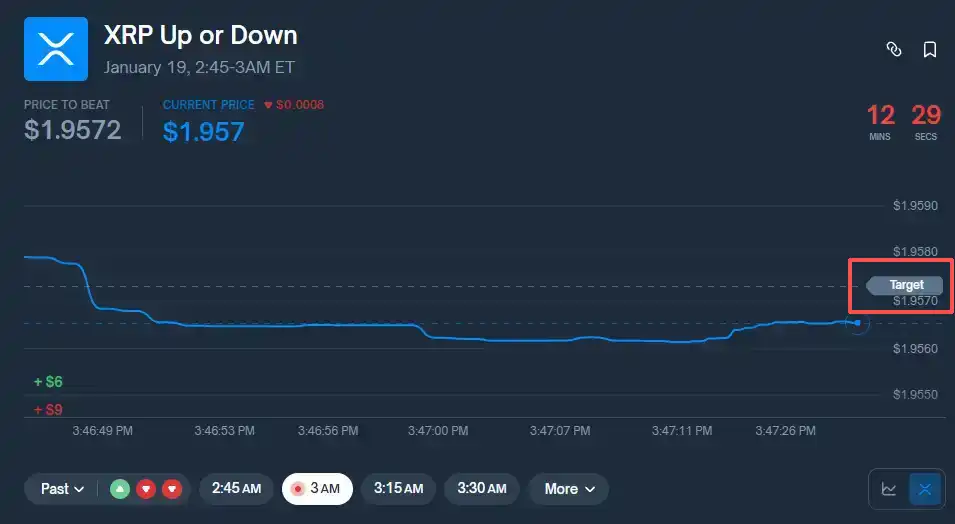
This real-time mechanism makes this particular market a paradise for quantitative bots: algorithms use sophisticated statistical models to capture pricing deviations caused by retail investor emotions, information delays, remaining time, and other factors, perfectly蚕食ing steady profits through automated trading.
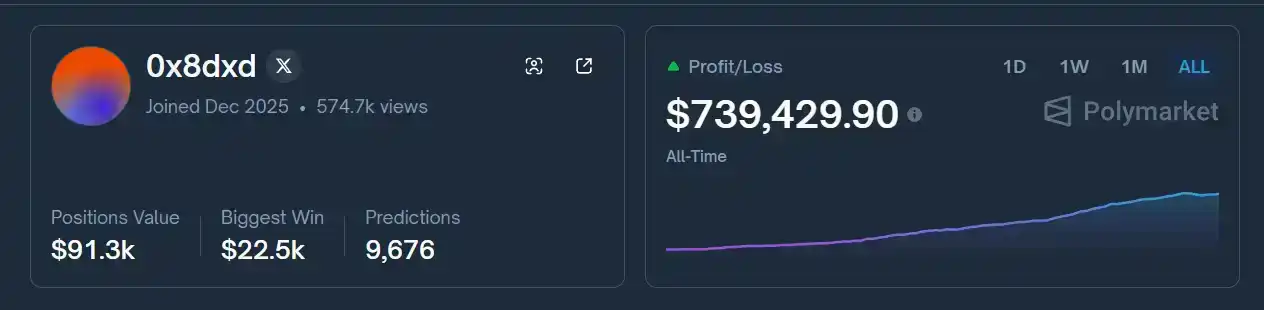
XRP Soars Right at Settlement, "Lucky Big Spender" Doubles Their Money

On the afternoon of January 17, 2026, a4385 bet on "up" in the "XRP up or down in 15 minutes" market.

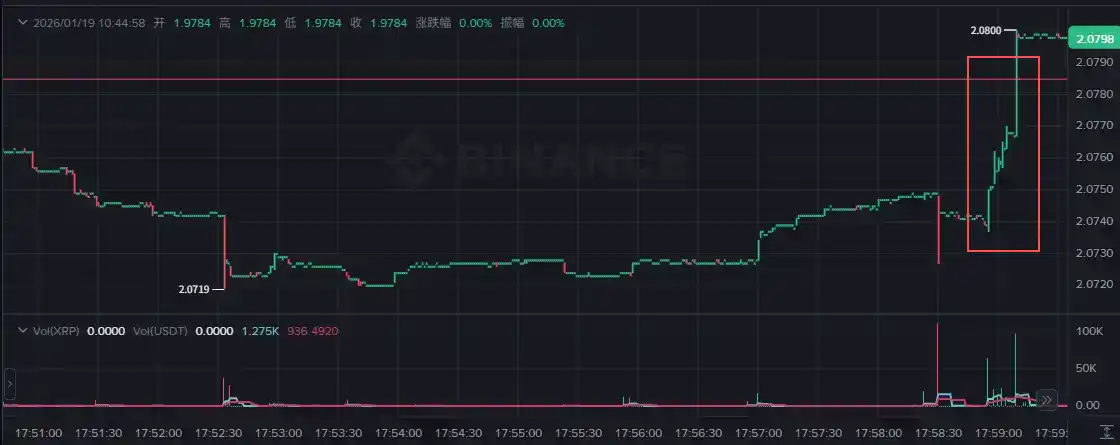
The starting price for XRP in this market was $2.0784, and as late as 17:58:54 (66 seconds remaining until settlement), XRP's price was still hovering around $2.0737, with a corresponding probability of rising of only 36%—market consensus suggested it would be difficult for XRP to rise above the starting price in the mere minute remaining.

But in the next minute, XRP suddenly began a sustained climb, and the market settlement price was fixed at $2.0817—just clearing the starting price.

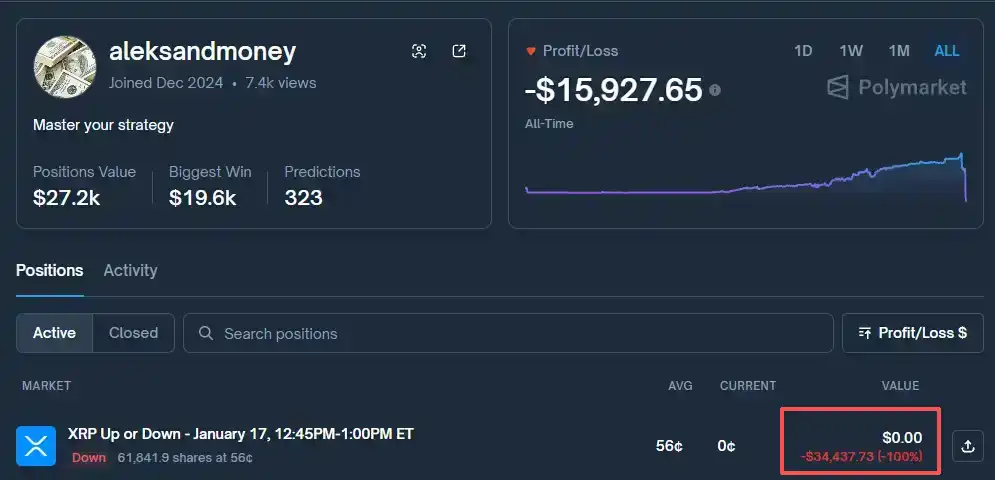
This meant a4385's position, from entry to settlement, realized huge profits, while quantitative bots, like the one in the chart below, spewed out all their historical profits, and even suffered additional losses, just from this single market.
Meticulous Manipulation Behind Repeated "Luck"

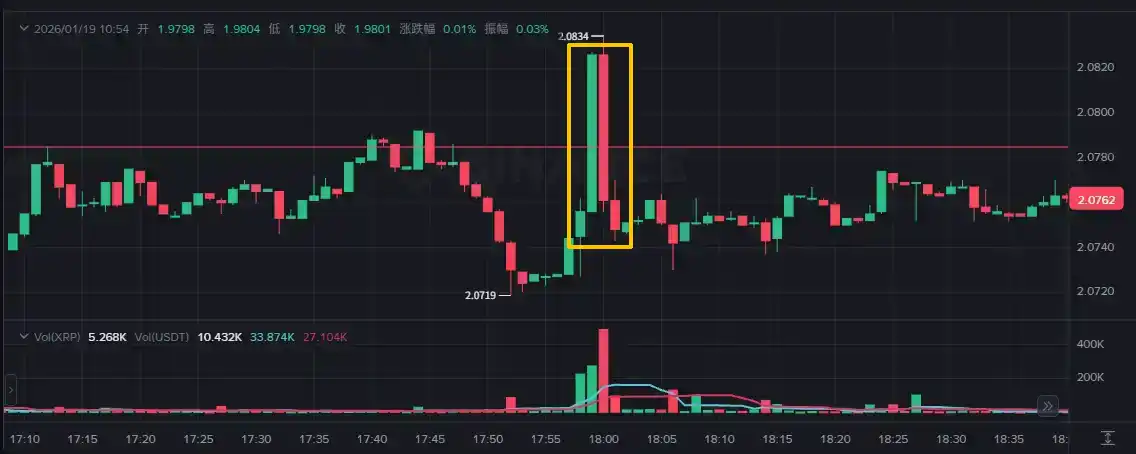
After this market settled, people discovered that a4385 subsequently replicated this "incredible luck" several more times: in multiple markets, about one minute before settlement, the XRP price suddenly spiked, only to quickly fall back the very second after settlement.

This led to suspicions that his "luck" might not be coincidental but rather a precise snipe targeting quantitative bots.

In theory, a4385 could first bet on "up" when the real-time XRP price is below the starting price, then, in the minute before settlement, place large market orders to buy XRP, artificially pushing the price up to ensure it exceeds the starting price at settlement, thus locking in profits.

At this point, all previously seemingly insignificant details become crucial: the 17th was a weekend, meaning the order book depth provided by market makers for XRP was insufficient to buffer large, short-term trades.

Choosing XRP, a less popular asset compared to Bitcoin, further ensured shallower order book depth, guaranteeing the manipulator could move the price with less capital in a short time.

This gave a4385 a perfect, brief window for manipulation:
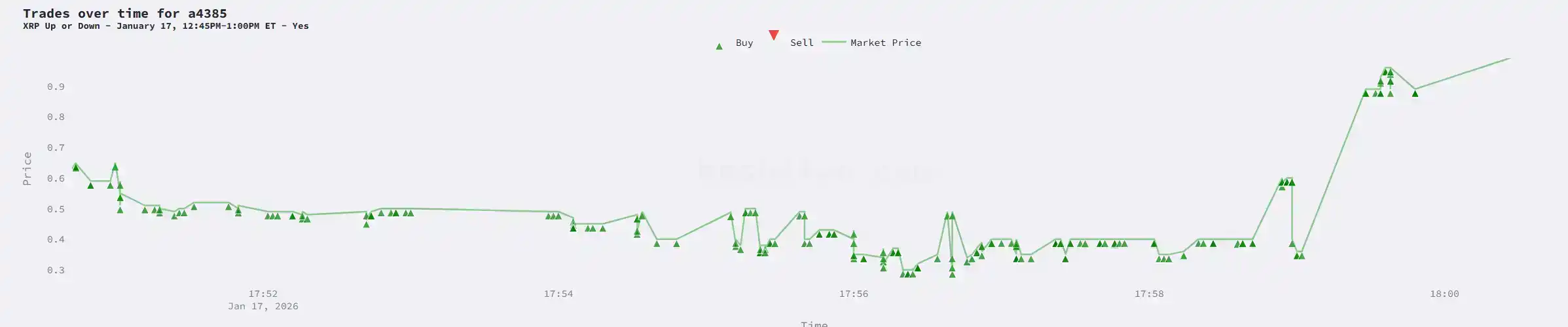
If we assume all market buy orders at 17:59 came from a4385, then based on the trading volume of $569,000 in that one-minute candle, with an exchange fee of 0.32%, the total cost for buying and subsequently selling would be approximately $6,200.

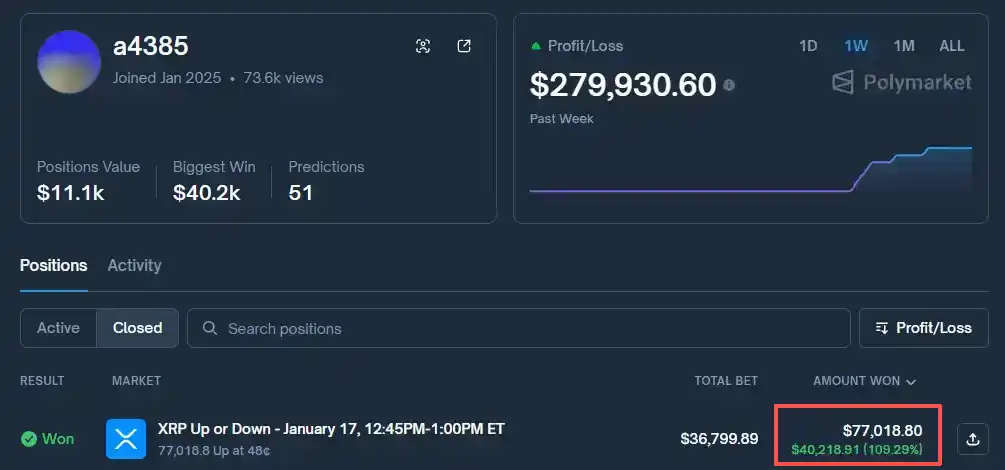
His profit from betting "up" in this market was $40,218. By repeatedly replicating this strategy, he made nearly $300,000 within 48 hours.
While marveling at a4385's seemingly money-printing operation, we must also account for the costs behind this seemingly "retail revenge"热血 story.

Buying to pump the price not only incurs thousands in fee磨损 but also leads to massive losses when selling off after settlement due to the price falling back.

Therefore, while pumping, he also needs to hold an equivalent 1x short position. Only then can his total asset value remain stable, no matter how violently the spot XRP price in his hands fluctuates.

This means, besides bearing the fee磨损, he requires over a million dollars in liquid capital to ensure the feasibility of this strategy.

So, this is not a gambler's game of luck, nor is it a狂欢 for the average retail investor.

Behind the legendary stories of casino-like huge profits, perhaps the one laughing last is never luck itself, but the inevitable outcome of precisely calculated capital, structure, and rules.


Related Questions

QWhat is the core strategy used by the mysterious account a4385 to profit from quantitative trading bots in the prediction market?

AThe account a4385 executed a strategy where they placed a bet on 'up' in the 'XRP 15-minute up or down' market when the real-time price was below the starting price. Then, in the final minute before settlement, they used large market buy orders to artificially pump the price of XRP above the starting price, ensuring their bet would win. They simultaneously held a corresponding short position to hedge against price fluctuations in their purchased XRP, making the outcome a calculated result rather than a gamble.

QWhy was the XRP market specifically chosen for this strategy against quantitative models?

AXRP was chosen because it is a less popular asset compared to Bitcoin, resulting in a shallower order book depth. This meant that a large market order could move its price significantly with less capital, especially on a weekend when market maker liquidity was lower, creating a perfect window for a short-term price manipulation.

QWhat was the estimated cost and profit for a4385 in a single market operation described in the article?

AFor a single market operation, the estimated cost based on the trading volume and a 0.32% exchange fee was approximately $6,200. The profit from the successful 'up' bet in that market was $40,218.

QWhat crucial risk management technique did a4385 employ to protect against losses from the price volatility of the XRP they bought to pump the price?

ATo hedge against the volatility and potential loss from the XRP they purchased, a4385 held an equivalent 1x short position. This ensured that their overall asset value remained stable regardless of the price movement of the spot XRP after the settlement.

QAccording to the article, what does the success of a4385's strategy ultimately depend on, beyond mere chance?

AThe success ultimately depended on precise calculations of market structure and rules, a deep understanding of quantitative model behaviors, and, most importantly, access to over a million dollars in liquid capital to fund the large trades and hedging positions required for the strategy.

Related Reads

Why Do You Always Lose Money on Polymarket? Because You're Betting on News, While the Pros Read the Rules

Why do you always lose money on Polymarket? Because you bet on news, while the pros study the rules. This article explains how top traders ("che tou") profit by meticulously analyzing market rules, not just predicting events. Polymarket, a prediction market platform, often sees disputes over event outcomes due to ambiguous rule wording. For instance, a market asking "Who will be the leader of Venezuela by the end of 2026?" was misinterpreted by many who bet on Delcy Rodríguez, assuming she held power. However, the rules specified "officially holds" as the formally appointed, sworn-in individual. Since Nicolás Maduro was still recognized as president officially, he won the market—even being in prison. To resolve such disputes, Polymarket uses a decentralized arbitration system via UMA protocol. The process involves: 1. Proposal: Anyone can propose a market outcome by staking 750 USDC, earning 5 USDC if unchallenged. 2. Dispute: A 2-hour window allows challenges with a 750 USDC stake; successful challengers earn 250 USDC. 3. Discussion: A 48-hour period on UMA Discord for evidence and debate. 4. Voting: UMA token holders vote in two 24-hour phases (blind then public). Outcomes require >65% consensus and 5M tokens voted; otherwise, four re-votes occur before Polymarket intervention. 5. Settlement: Results are final and automatic. Unlike traditional courts, Polymarket’s system lacks separation between arbitrators and stakeholders—voters often hold market positions, creating conflicts of interest. This leads to herd mentality in discussions and non-transparent outcomes without explanatory rulings, preventing precedent formation. Thus, success on Polymarket hinges on deep rule interpretation, not just event prediction, exploiting gaps between reality and contractual wording.

marsbit2h ago

Why Do You Always Lose Money on Polymarket? Because You're Betting on News, While the Pros Read the Rules

marsbit2h ago

DeepSeek Funding: Liang Wenfeng's 'Realist' Pivot

DeepSeek, a leading Chinese AI company, has initiated its first external funding round, aiming to raise at least $300 million at a valuation of no less than $10 billion. This move marks a significant shift from its founder Liang Wenfeng’s previous idealistic stance of rejecting external capital to maintain independence. Despite strong financial backing from its parent company, quantitative trading firm幻方量化 (Huanfang Quant), which provided an estimated $700 million in revenue in 2025 alone, DeepSeek faces mounting challenges. Key issues include a 15-month gap in major model updates, delays in its flagship V4 release, and the loss of several core researchers to competitors offering significantly higher compensation. The company is also undergoing a strategic pivot by migrating its infrastructure from NVIDIA’s CUDA to Huawei’s Ascend platform, a move aligned with China’s push for technological self-reliance amid U.S. export controls. However, DeepSeek lags behind rivals like智谱AI and MiniMax—both now publicly listed—in areas such as product ecosystem, multimodal capabilities, and commercialization. The funding round, though relatively small in scale, is seen as a way to establish a market-validated valuation anchor, making employee stock options more competitive and facilitating talent retention. It also signals DeepSeek’s transition from a pure research-oriented organization to a commercially-driven player in the global AI ecosystem.

marsbit3h ago

DeepSeek Funding: Liang Wenfeng's 'Realist' Pivot

marsbit3h ago

Trading

Spot
Futures

Hot Articles

How to Buy PEOPLE

Welcome to HTX.com! We've made purchasing ConstitutionDAO (PEOPLE) simple and convenient. Follow our step-by-step guide to embark on your crypto journey.Step 1: Create Your HTX AccountUse your email or phone number to sign up for a free account on HTX. Experience a hassle-free registration journey and unlock all features.Get My AccountStep 2: Go to Buy Crypto and Choose Your Payment MethodCredit/Debit Card: Use your Visa or Mastercard to buy ConstitutionDAO (PEOPLE) instantly.Balance: Use funds from your HTX account balance to trade seamlessly.Third Parties: We've added popular payment methods such as Google Pay and Apple Pay to enhance convenience.P2P: Trade directly with other users on HTX.Over-the-Counter (OTC): We offer tailor-made services and competitive exchange rates for traders.Step 3: Store Your ConstitutionDAO (PEOPLE)After purchasing your ConstitutionDAO (PEOPLE), store it in your HTX account. Alternatively, you can send it elsewhere via blockchain transfer or use it to trade other cryptocurrencies.Step 4: Trade ConstitutionDAO (PEOPLE)Easily trade ConstitutionDAO (PEOPLE) on HTX's spot market. Simply access your account, select your trading pair, execute your trades, and monitor in real-time. We offer a user-friendly experience for both beginners and seasoned traders.

6.2k Total ViewsPublished 2024.03.29Updated 2025.03.21

How to Buy PEOPLE

Discussions

Welcome to the HTX Community. Here, you can stay informed about the latest platform developments and gain access to professional market insights. Users' opinions on the price of PEOPLE (PEOPLE) are presented below.

活动图片