BitMine adds 7,430 ETH, spends $86M on share buybacks – Why?

ambcryptoPublished on 2026-07-21Last updated on 2026-07-21

Abstract

BitMine significantly slowed its Ethereum accumulation last week, purchasing only 7,430 ETH—its smallest weekly buy since May. The company instead prioritized shareholder returns, spending approximately $86 million to repurchase 5.5 million common shares. BitMine's ETH treasury remains substantial at 5.78 million ETH (4.8% of circulating supply), nearing its long-term goal of 5%. The company has already staked 85% of its holdings and projects up to $290 million in annual staking revenue. Meanwhile, Michael Saylor's MicroStrategy continues its Bitcoin-focused treasury strategy despite recent sales.

Bitmine drastically reduced the amount of Ethereum [ETH] it was accumulating last week, buying just 7,430 ETH—its lowest weekly purchase since May. This action was taken to prioritize the returns to shareholders.

For perspective, the company spent roughly $13 million on new ETH purchases. However, instead of aggressively growing its ETH treasury, it spent about $86 million repurchasing 5.5 million common shares at an average price of $15.62.

With 5,777,468 ETH, or 4.8% of Ethereum’s total circulating supply, Bitmine’s treasury is still massive despite the slower buying pace. In fact, it is also very close to its long-term objective of owning 5% of all ETH.

Remarking on the same, Thomas “Tom” Lee, Chairman of Bitmine, said,

We view the purchase of our common shares as accretive to shareholder value.

Bitmine’s goals achieved so far

With this pace, Bitmine is just 0.2 percentage points short of its declared objective of “Alchemy of 5%.”

That said, Bitmine has almost reached this milestone in just 12 months since introducing its Ethereum treasury strategy in June 2025.

As for staking, Bitmine has already staked 4.92 million ETH, or about 85% of its holdings, through its institutional-grade MAVAN (Made in America Validator Network) platform.

Additionally, the company is projecting $247 million in staking revenue annually at current staking yields of 2.67%, which could increase to about $290 million once its whole ETH treasury is staked.

This occurs as the price of ETH was trading at $1,929.35 at the time of writing, following a 7.44% increase over the previous week.

Will Strategy’s weakening BTC strategy impact Bitmine?

While this happens in the Ethereum space, Michael Saylor’s Strategy is making headlines, creating countless hubbubs in the crypto space. Needless to say, in the case of Strategy, every dollar raised went toward buying more Bitcoin [BTC].

Each rally served to support the model. Additionally, the corporate treasury continued to grow, which seemed to justify the dilution of shareholders. But now the financial force that started the unrelenting accumulation is asking more of the treasury that it was created to expand.

Yet, despite all the strain, Strategy still has 843,775 BTC (approximately $55.8 billion). This stack of Bitcoin follows this year’s sales of 3620 BTC and the addition of 171,278 BTC.
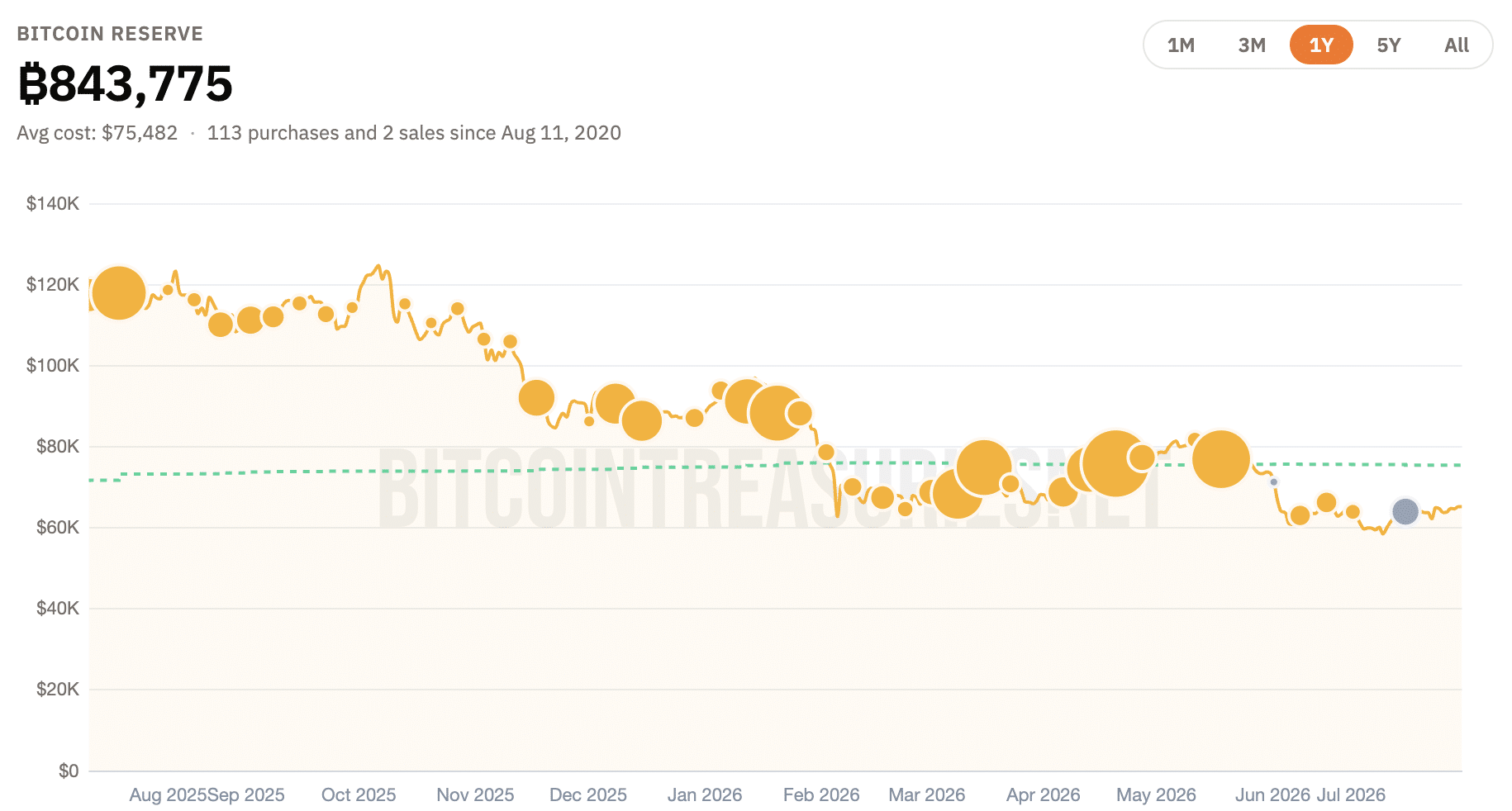
Source: BitcoinTreasuries.NET

Final Summary

  • Instead of expanding its ETH treasury, Bitmine spent about $86 million repurchasing 5.5 million common shares.
  • This happens while ETH’s price surged by 7.44% in the past week.

Trending Cryptos

Related Questions

QWhy did BitMine reduce its weekly Ethereum (ETH) purchase to its lowest level since May?

ABitMine drastically reduced its weekly ETH purchase to 7,430 ETH in order to prioritize returns to shareholders by allocating more funds to share buybacks instead of aggressively growing its ETH treasury.

QHow much did BitMine spend on share buybacks and how many shares were repurchased?

ABitMine spent about $86 million to repurchase 5.5 million of its common shares at an average price of $15.62.

QWhat are the details of BitMine's Ethereum holdings and its long-term objective?

ABitMine currently holds 5,777,468 ETH, which is 4.8% of Ethereum's total circulating supply. Its long-term objective, known as the 'Alchemy of 5%', is to own 5% of all ETH, putting it just 0.2 percentage points short of this goal.

QWhat is BitMine's projected annual staking revenue from its ETH holdings?

ABitMine projects $247 million in annual staking revenue at current yields of 2.67%. This could increase to about $290 million once its entire ETH treasury is staked. Currently, it has staked 4.92 million ETH (85% of its holdings) via its MAVAN platform.

QHow does the article contrast BitMine's current strategy with that of Michael Saylor's MicroStrategy?

AWhile BitMine recently prioritized share buybacks over aggressive ETH accumulation, MicroStrategy's model has historically used every dollar raised to buy more Bitcoin (BTC), with corporate treasury growth justifying shareholder dilution. The article notes MicroStrategy still holds a massive 843,775 BTC despite recent financial strain.

Related Reads

The Verdict in Choi Tae-won's Divorce Case: Revealing the Inheritance Undercurrent Behind SK Hynix's Trillion-Won Empire

SK Group Chairman Chey Tae-won's high-profile divorce case, involving a record 1.38 trillion won settlement, has drawn attention to the succession plans for Korea's second-largest conglomerate, especially its crown jewel, SK hynix. Unlike traditional chaebol scripts centered on the eldest son, Chey's three children from his marriage to former President Roh Tae-woo's daughter, Roh Soh-yeong, are carving distinct, non-traditional paths. Eldest daughter Chey Yun-jung (b. 1989) is seen as the most evident successor. With a scientific and consulting background, she holds executive roles at SK bioscience and SK Inc.'s growth support department, focusing on future strategy and biopharma. Her marriage is to an AI infrastructure entrepreneur, not a traditional business alliance. Second daughter Chey Min-jung (b. 1991) took a unique route, voluntarily serving as a South Korean naval officer, including an anti-piracy deployment. She later worked on policy and strategy for SK hynix in Washington D.C. before co-founding an AI-driven healthcare startup. She married a former U.S. Marine Corps officer, connecting her to U.S. defense and policy circles—networks crucial for a global semiconductor giant. The only son, Chey In-geun (b. 1995), who studied physics like his father, worked briefly at SK E&S before joining McKinsey. Despite fitting the traditional "heir" profile as the eldest son, he remains silent and holds no public position or shares in SK, suggesting the old succession playbook is obsolete. As SK hynix's valuation soars, becoming a geopolitical asset in the AI era, the heirs' legitimacy is no longer automatic. They must prove themselves in fields like AI biotech, global policy, and strategic consulting. Their marriages also reflect new elite networks in tech and defense, not old political alliances. Their inheritance is the complex challenge of navigating a globalized, tech-driven world, not just a corporate throne.

marsbitYesterday 09:06

The Verdict in Choi Tae-won's Divorce Case: Revealing the Inheritance Undercurrent Behind SK Hynix's Trillion-Won Empire

marsbitYesterday 09:06

From OpenSea to OpenRouter: Is Alex Atallah Repeating His 'Exit at the Peak' Playbook?

From OpenSea to OpenRouter: Is Alex Atallah Repeating His "Exit at the Peak" Playbook? According to the Wall Street Journal, payments giant Stripe is in talks to acquire the AI model aggregation platform OpenRouter in a potential deal valuing the company near $100 billion. This would mark founder Alex Atallah's second creation of a company reaching a $100 billion valuation, following his co-founding of NFT marketplace OpenSea. OpenRouter, founded just over three years ago, has grown rapidly by acting as a unified gateway for developers to access over 400 AI models. It currently has about 10 million users and processes over 200 trillion tokens monthly. While the platform's annualized revenue is around $50 million, its valuation has skyrocketed from $1.3 billion in March 2026. The potential acquisition by Stripe, a company OpenRouter's founder once likened it to, represents a major expansion into AI infrastructure for the payments leader. This move echoes Atallah's previous timing with OpenSea, where he departed before the NFT market's significant downturn. For OpenRouter, selling now may be strategic. Despite its scale, its business model—charging a 5-5.5% fee on AI inference calls—faces pressure from competition, open-source models, and potential price wars among model providers, limiting its profitability narrative for an IPO. A key asset for potential acquirers like Stripe is OpenRouter's vast repository of real-world AI usage data, which offers unique insights into model performance and developer preferences that are difficult to replicate. Whether this potential deal signifies a new valuation benchmark for AI infrastructure or another market peak signal remains to be seen.

链捕手Yesterday 08:42

From OpenSea to OpenRouter: Is Alex Atallah Repeating His 'Exit at the Peak' Playbook?

链捕手Yesterday 08:42

Trading

Spot

Hot Articles

Discussions

Welcome to the HTX Community. Here, you can stay informed about the latest platform developments and gain access to professional market insights. Users' opinions on the price of ETH (ETH) are presented below.

活动图片