GPT-5.6's IQ Breaks 130 Genius Threshold for the First Time, Outsmarting 99% of Humans

marsbitPublished on 2026-07-16Last updated on 2026-07-16

Abstract

GPT-5.6 has reportedly achieved an IQ score of 136 on Tracking AI's proprietary offline test, surpassing the human "genius" threshold of 130 for the first time. This places it above an estimated 99% of humans in this specific metric. The test is designed to prevent memorization by using a private question bank. Multiple GPT-5.6 variants, including the vision model, consistently scored 136, leading competitors like Claude-5 Fable (130). User anecdotes suggest practical superiority over rivals in real-world coding and problem-solving tasks, such as building a physics simulation or a customer service app from a single prompt. While some speculate this approaches AGI for most users, the article notes IQ tests only measure a narrow slice of cognitive ability like pattern recognition. The significance lies in GPT-5.6's apparent ability to translate high test scores into effective task performance on novel, real-world problems.

Today, 99% of the global human population is actually outperformed by an AI in terms of IQ.

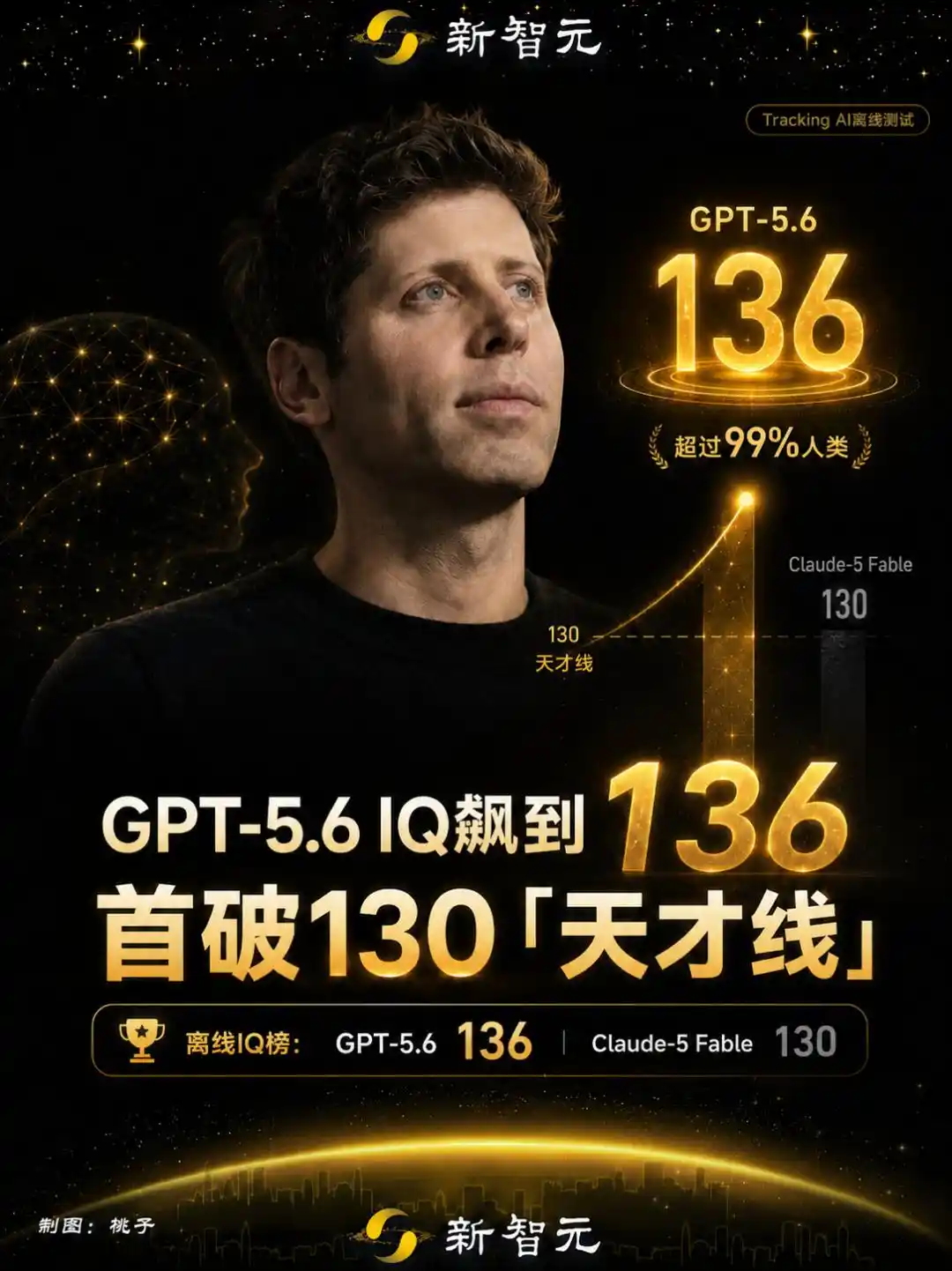
In Tracking AI's latest offline IQ test, multiple versions of the GPT-5.6 "full suite" soared to a score of 136.
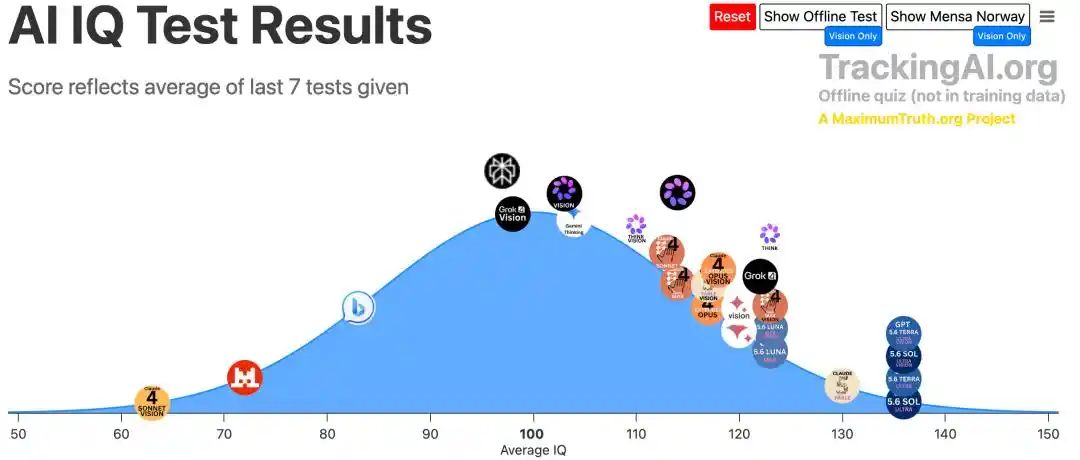
This is the first time an LLM has pushed its IQ beyond the 130 mark.

In the distribution of human intelligence, 130 is the starting line for "genius," a level only about 1% of the global population can reach.

In other words, GPT-5.6 is smarter than 99% of humans.
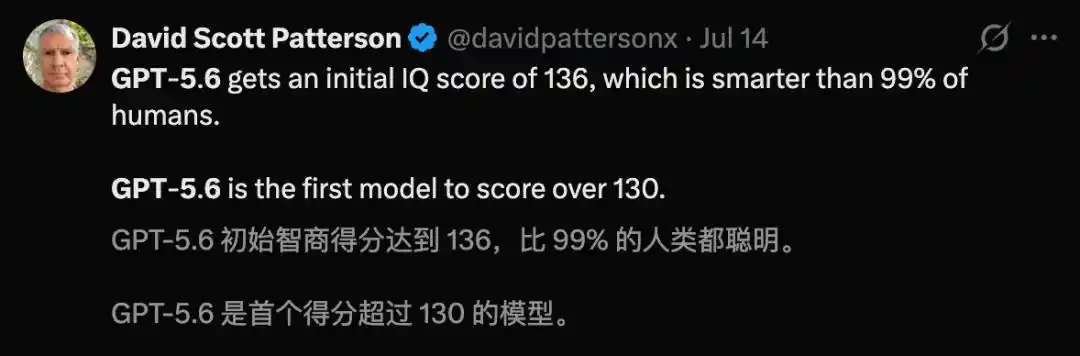
GPT-5.6 Racks Up 136 Points, IQ Breaks "Genius Line" for the First Time

How credible is this "IQ"?

In fact, Tracking AI uses two sets of questions.

One is a public Mensa Norway-style test, available online for anyone to take, which models have already scored over 140 on.

The other is its own curated "offline question bank." It's not public, prevents leaks, and is specifically designed to block the loophole of "models memorizing answers in advance."

The 136 points GPT-5.6 achieved this time was on this most difficult, anti-cheating offline test.
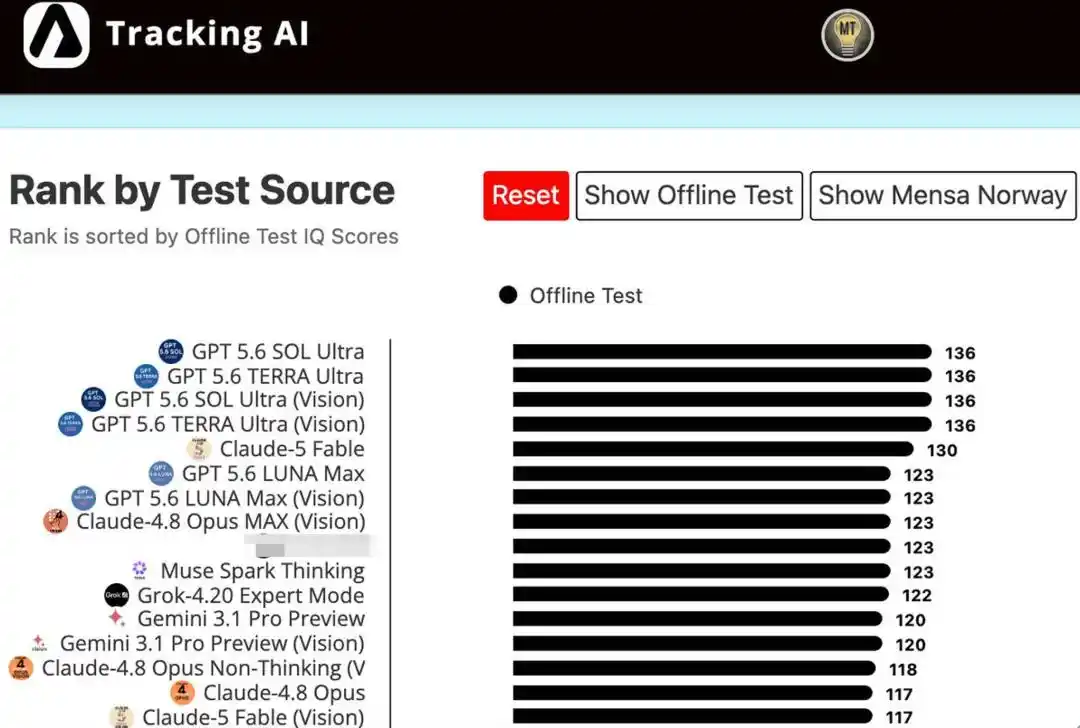
On this offline leaderboard, the various variants of GPT-5.6 (including the vision version) collectively surged to 136 points, leaving all competitors far behind.

Close behind is Claude-5 Fable, with 130 points.

Further down, names like GPT-5.6 LUNA Max and Claude-4.8 Opus are still hovering between 117 and 123 points.

It's important to note that this 130-point threshold had never been crossed before.

Over the past year, wave after wave of models, from o3 to various flagship models, surged forward, all getting stuck at the 130-point door, with none truly stepping into the "genius range."

GPT-5.6 is the first to kick that door open.

And it didn't achieve this score alone; the entire SOL, TERRA family collectively soared to 136, with even the vision version keeping pace.

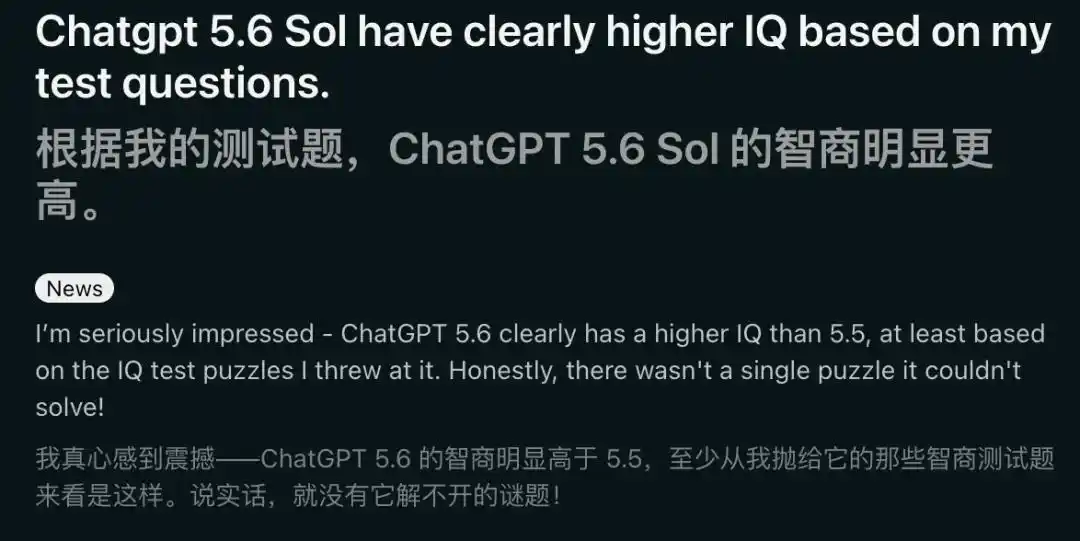
On Reddit, a developer conducted a hands-on test and concluded that GPT-5.6's intelligence feels significantly higher than GPT-5.5's.
In the following test questions, GPT-5.6 achieved outstanding results in the shortest possible time.
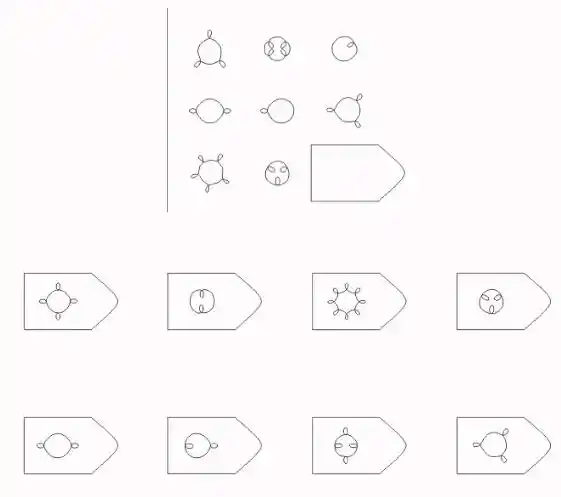
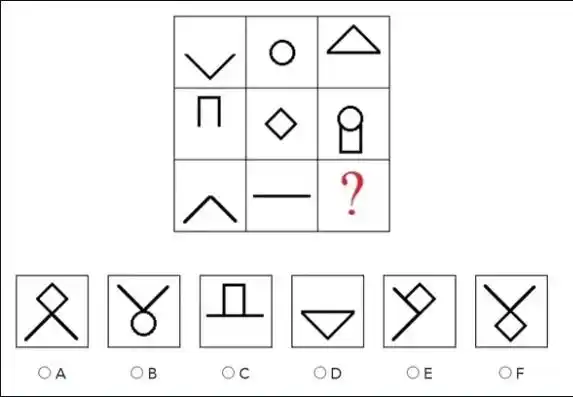
One test score might not be convincing enough, so what does GPT-5.6 look like when taken out of the exam room and put to real work?

More Than Just a Score: Putting GPT-5.6 to Work

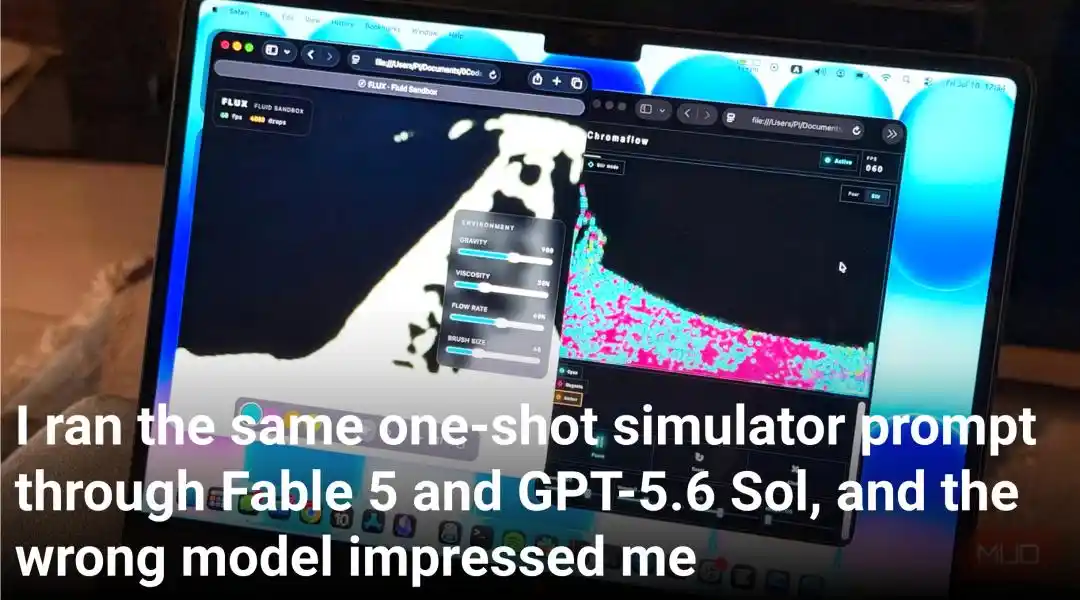
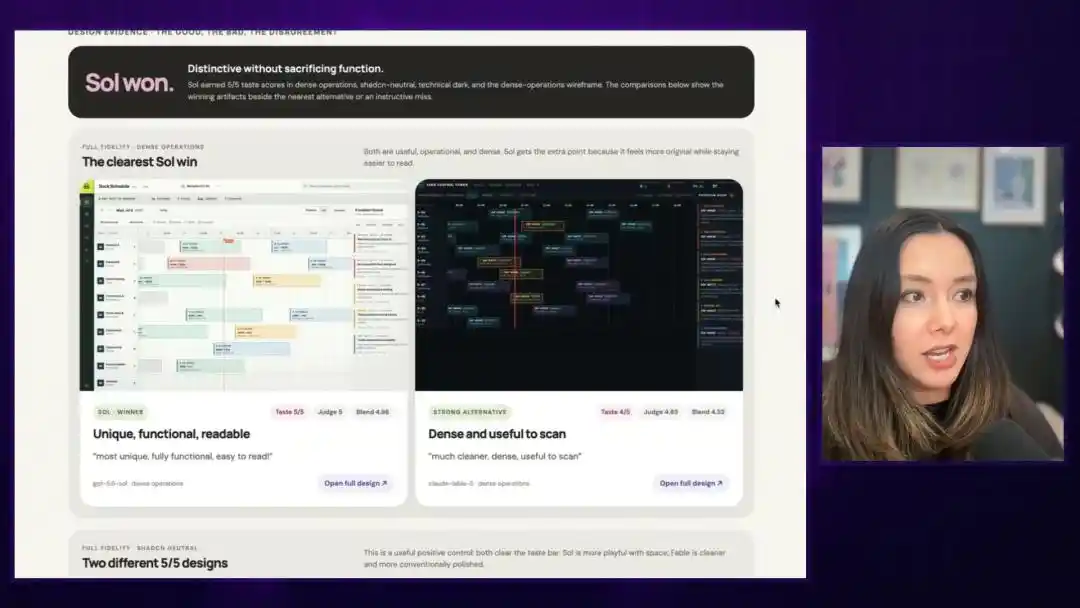
Developer Amir Bohlooli fed the same physics simulation prompt to both Fable 5 and GPT-5.6 Sol, expecting to be crushed by Fable, but ended up being amazed by GPT.

It chose particle fluid simulation, with physics progressing in real-time rather than blindly running fixed calculations per frame, cramming CSS, interface, and rendering all into a single HTML file, and automatically hosting it as a shareable webpage. In short, a finished product.
Similarly, Ramanpal Singh used a single prompt to create a RAG-based customer service ticketing system.

Four roles, an admin backend, embeddable components, and it can automatically categorize complaints, recognize sentiment, and draft replies.

It built 5 such apps in one go, at a cost that was only a fraction of what Fable 5 would require.

The most vivid story is from Claire Vo.

A few days ago, she was stuck on a bug, thinking her own code was broken. After switching to GPT-5.6 Sol, she just threw out the line, "I just don't believe I can't fix this."

Sol fixed it in one attempt and even managed to get it running on other models.

Her assessment hit the nail on the head: Fable gets bogged down in technical absolute precision, becoming its own trap, while Sol's pragmatic approach gets the job done.
It has to be said, there's an entire real-world project between an AI that can solve test problems and an AI that can save the day.

Does This Count as AGI?

Some netizens have said, "For 99% of people, this is already AGI."

Looking at it calmly, this 136 score was achieved on a specific offline / Mensa Norway-style test by Tracking AI.

What it measures is mainly "standardized cognition" like abstract pattern recognition and logical reasoning.

The problem is: IQ tests were never designed for large models.

A Mensa exam paper can't measure a model's factual reliability, its tool-calling ability, or how dependable it is in real professional scenarios.
It only slices off one thin layer of "intelligence" and tells you how bright that slice is.

However, hands-on testing by users provides the other half of the answer: GPT-5.6 seems to be slowly merging the two capabilities of "solving test problems" and "getting things done."

The questions in standardized tests are ones models have likely seen thousands of times in their training data; the real test of skill is with those new problems they've never encountered and have no answers to copy from.

Whoever can hold steady there truly deserves the word "intelligence."

References:

https://x.com/davidpattersonx/status/2077049232490672458

https://trackingai.org/

This article is from the WeChat public account "新智元" (New AI Era), author: ASI Revelation

Trending Cryptos

Related Questions

QAccording to the article, what was the significant achievement of GPT-5.6 in the Tracking AI offline IQ test?

AGPT-5.6 achieved a score of 136 on the private, offline IQ test, which is the first time a large language model has crossed the 130-point 'genius' threshold.

QHow does the article describe the difference between the two sets of IQ tests used by Tracking AI?

ATracking AI uses two sets of tests: a publicly available Mensa Norway-style test that models have already scored highly on, and a private, offline question bank designed to prevent models from having seen the questions before, which is considered more difficult and cheat-proof.

QWhat practical examples are given in the article to demonstrate GPT-5.6's capabilities beyond test scores?

AThe article provides examples where GPT-5.6 successfully created a particle fluid simulation HTML file, built a RAG-based customer service ticket system with multiple features, and efficiently debugged a coding problem that other models failed to solve.

QWhat caution does the article mention about interpreting the IQ score of GPT-5.6?

AThe article cautions that the IQ test only measures a specific slice of intelligence, like abstract pattern recognition and logical reasoning, and does not assess a model's factual reliability, tool-use ability, or performance in real-world professional scenarios.

QWhat was a key distinction made between Claude-5 Fable and GPT-5.6 Sol in their approach to solving problems, according to developer feedback cited in the article?

AAccording to developer feedback, Claude-5 Fable was described as being overly focused on technical perfection, which could hinder practical problem-solving, while GPT-5.6 Sol was praised for its pragmatic approach that successfully got the job done.

Related Reads

The Verdict in Choi Tae-won's Divorce Case: Revealing the Inheritance Undercurrent Behind SK Hynix's Trillion-Won Empire

SK Group Chairman Chey Tae-won's high-profile divorce case, involving a record 1.38 trillion won settlement, has drawn attention to the succession plans for Korea's second-largest conglomerate, especially its crown jewel, SK hynix. Unlike traditional chaebol scripts centered on the eldest son, Chey's three children from his marriage to former President Roh Tae-woo's daughter, Roh Soh-yeong, are carving distinct, non-traditional paths. Eldest daughter Chey Yun-jung (b. 1989) is seen as the most evident successor. With a scientific and consulting background, she holds executive roles at SK bioscience and SK Inc.'s growth support department, focusing on future strategy and biopharma. Her marriage is to an AI infrastructure entrepreneur, not a traditional business alliance. Second daughter Chey Min-jung (b. 1991) took a unique route, voluntarily serving as a South Korean naval officer, including an anti-piracy deployment. She later worked on policy and strategy for SK hynix in Washington D.C. before co-founding an AI-driven healthcare startup. She married a former U.S. Marine Corps officer, connecting her to U.S. defense and policy circles—networks crucial for a global semiconductor giant. The only son, Chey In-geun (b. 1995), who studied physics like his father, worked briefly at SK E&S before joining McKinsey. Despite fitting the traditional "heir" profile as the eldest son, he remains silent and holds no public position or shares in SK, suggesting the old succession playbook is obsolete. As SK hynix's valuation soars, becoming a geopolitical asset in the AI era, the heirs' legitimacy is no longer automatic. They must prove themselves in fields like AI biotech, global policy, and strategic consulting. Their marriages also reflect new elite networks in tech and defense, not old political alliances. Their inheritance is the complex challenge of navigating a globalized, tech-driven world, not just a corporate throne.

marsbitYesterday 09:06

The Verdict in Choi Tae-won's Divorce Case: Revealing the Inheritance Undercurrent Behind SK Hynix's Trillion-Won Empire

marsbitYesterday 09:06

From OpenSea to OpenRouter: Is Alex Atallah Repeating His 'Exit at the Peak' Playbook?

From OpenSea to OpenRouter: Is Alex Atallah Repeating His "Exit at the Peak" Playbook? According to the Wall Street Journal, payments giant Stripe is in talks to acquire the AI model aggregation platform OpenRouter in a potential deal valuing the company near $100 billion. This would mark founder Alex Atallah's second creation of a company reaching a $100 billion valuation, following his co-founding of NFT marketplace OpenSea. OpenRouter, founded just over three years ago, has grown rapidly by acting as a unified gateway for developers to access over 400 AI models. It currently has about 10 million users and processes over 200 trillion tokens monthly. While the platform's annualized revenue is around $50 million, its valuation has skyrocketed from $1.3 billion in March 2026. The potential acquisition by Stripe, a company OpenRouter's founder once likened it to, represents a major expansion into AI infrastructure for the payments leader. This move echoes Atallah's previous timing with OpenSea, where he departed before the NFT market's significant downturn. For OpenRouter, selling now may be strategic. Despite its scale, its business model—charging a 5-5.5% fee on AI inference calls—faces pressure from competition, open-source models, and potential price wars among model providers, limiting its profitability narrative for an IPO. A key asset for potential acquirers like Stripe is OpenRouter's vast repository of real-world AI usage data, which offers unique insights into model performance and developer preferences that are difficult to replicate. Whether this potential deal signifies a new valuation benchmark for AI infrastructure or another market peak signal remains to be seen.

链捕手Yesterday 08:42

From OpenSea to OpenRouter: Is Alex Atallah Repeating His 'Exit at the Peak' Playbook?

链捕手Yesterday 08:42

Trading

Spot

Hot Articles

Discussions

Welcome to the HTX Community. Here, you can stay informed about the latest platform developments and gain access to professional market insights. Users' opinions on the price of S (S) are presented below.

活动图片