Robinhood Chain flips Hyperliquid – 2 metrics show speculative interest

ambcryptoPublished on 2026-07-11Last updated on 2026-07-11

Abstract

Robinhood Chain, a new Ethereum Layer 2, has rapidly become a major hub for speculative trading, surpassing Hyperliquid and BNB Chain in daily DEX volume. Its volume skyrocketed from under $10 million to a record $600 million, driven largely by viral memecoins like CashCat and a public bet by Robinhood's CEO. This surge has positioned it as the fourth-largest chain for such activity. However, the memecoin frenzy has reignited a broader debate about the value of L2s to Ethereum. Critics, including Bankless's David Hoffman, argue L2s operate as largely independent chains that do not economically benefit ETH. Uniswap CEO Hayden Adams countered that ETH-denominated trading pairs could increase ETH burns. The debate centers on whether L2 growth, while scaling Ethereum, ultimately undermines ETH's value by reducing transaction fees burned on the mainnet.

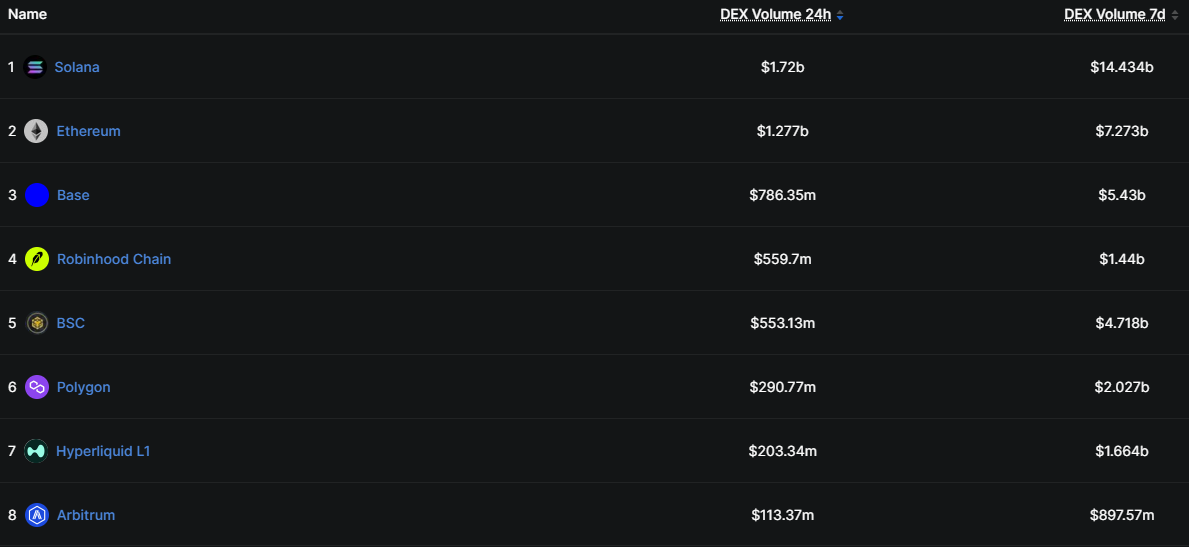
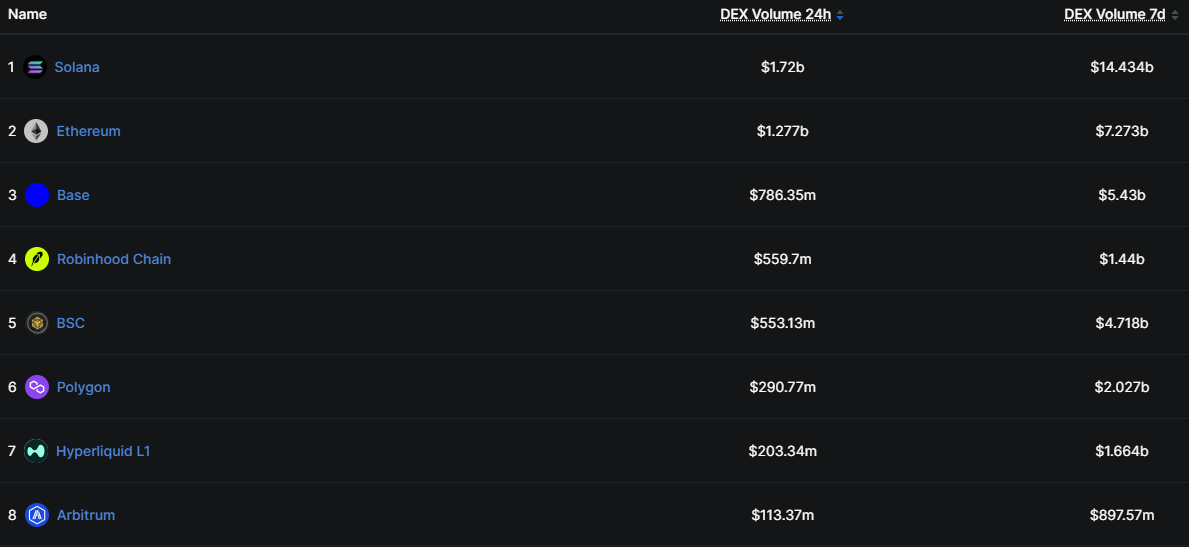
The new Ethereum Layer 2 (L2) Robinhood Chain has surpassed Hyperliquid and BNB Chain in speculative interest.

A week ago, Robinhood’s DEX volume (which tracks trading volume and broader speculative interest) was less than $10M.

As of writing, the daily DEX volume has hit a record level of $600M, making it the fourth dominant chain in speculative activity.

In the past two days, it has effectively surpassed BNB Chain and Hyperliquid on this front thanks to Robinhood’s CEO’s memecoin bet.
Source: DeFiLlama

As Robinhood Chain-based memecoins like CashCat [CASHCAT] went viral and posted massive gains, the FOMO attracted users and capital inflows.

Robinhood’s memecoin frenzy sparks L2 debate

If the memecoin mania persists, it could surpass Base in DEX volume to become the third-largest place for speculative trading.

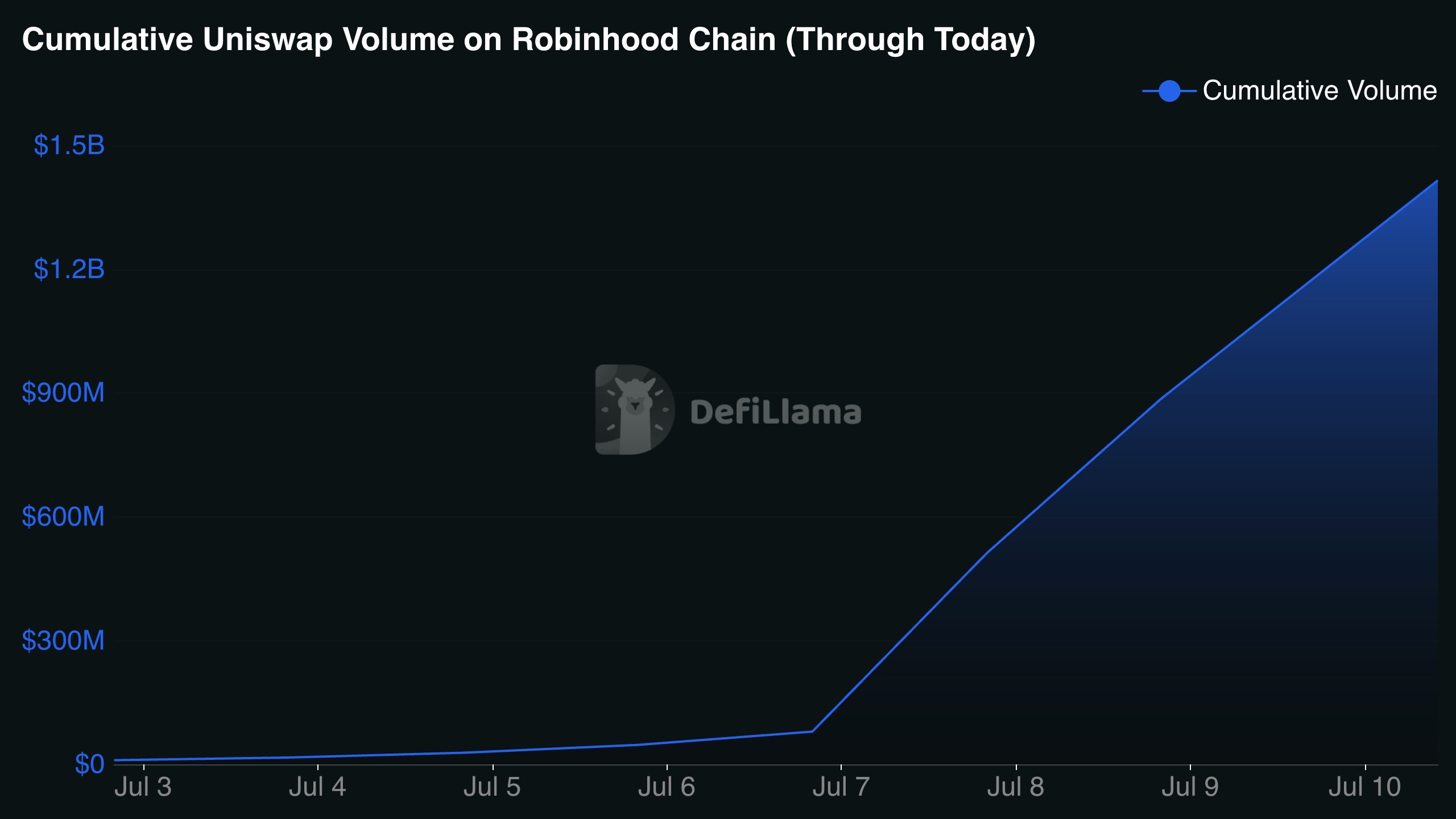
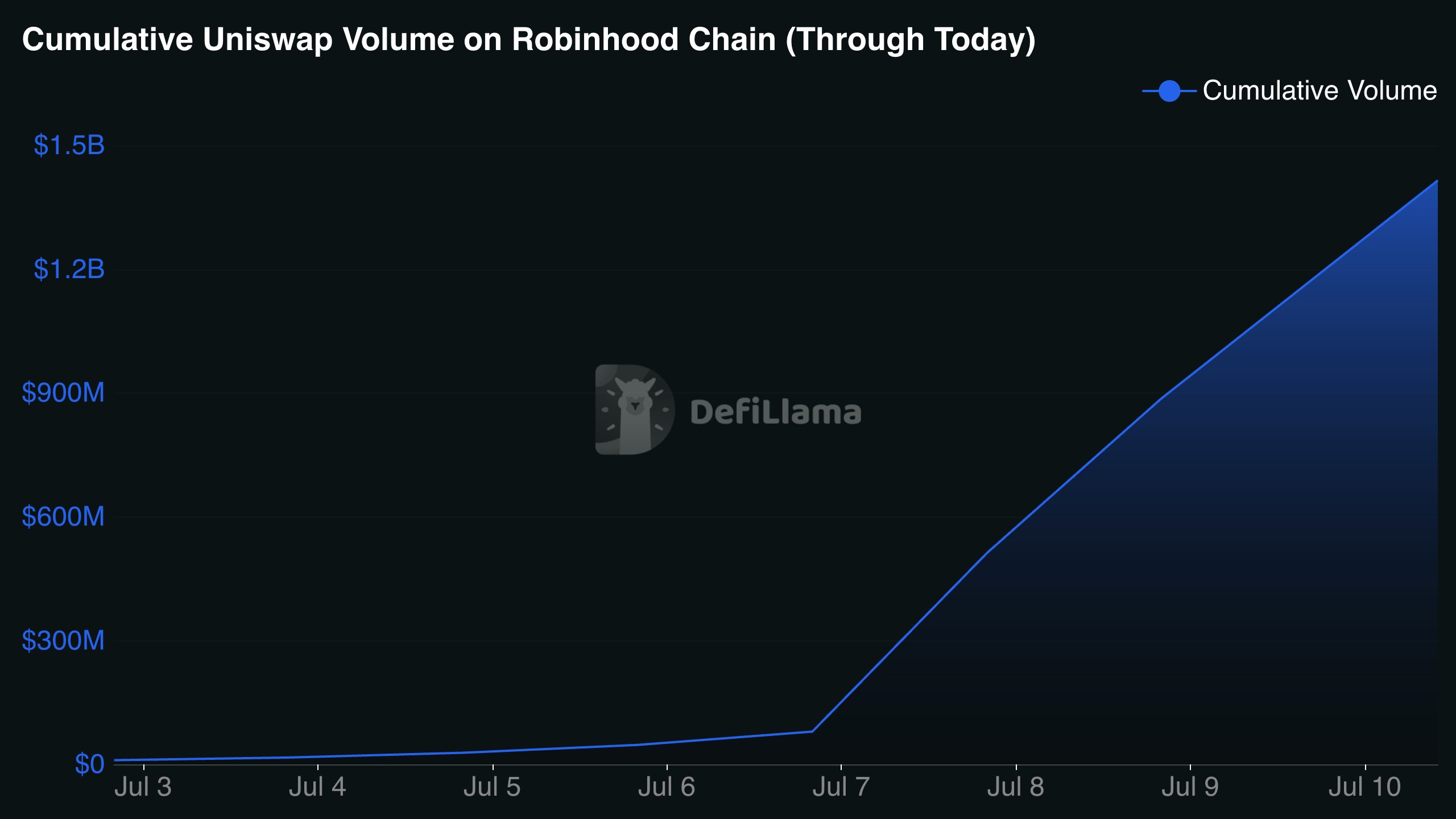
Worth pointing out that Uniswap crossed $1B in volume on Robinhood Chain since launch, further underscoring how crazy the memecoin mania is on the new L2.
Source: DeFiLlama

But critics have been opposing the memecoin push. Most questioned the need for another Ethereum Layer 2 (L2) if its use case is risky memecoin speculation. The debate has since evolved to whether L2 growth benefits ETH’s value.

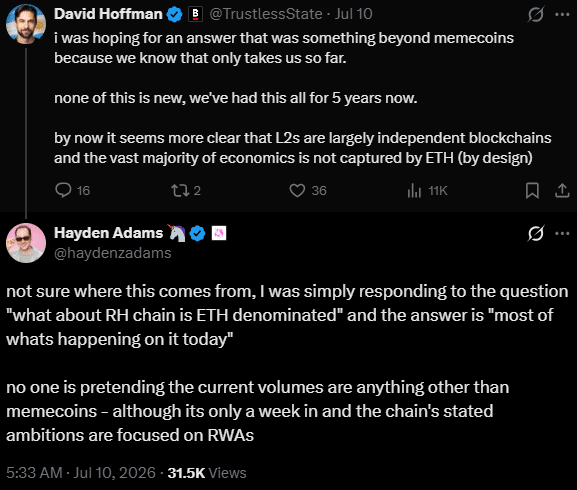
For Bankless’ David Hoffman, L2s aren’t helpful to ETH.

By now it seems more clear that L2s are largely independent blockchains and the vast majority of economics is not captured by ETH (by design).

Uniswap CEO Hayden Adam countered that most of the pairs on the chain are denominated in ETH and will eventually help burn more ETH, especially if the RWA narrative picks up momentum.
Source: X

Do Layer 2s actually help Ethereum?

The L2 roadmap has been under heavy criticism. With corporate chains such as Stripe’s Tempo, SWIFT, and more, the criticism has deepened.

For lawyer Gabriel Shapiro, the entire roadmap was ‘poorly executed’ to benefit ETH value.

The roadmap was just very poorly executed so that it’s mostly negative to ETH & leaves the L2s with too much optionality to become L1s, no real lock-in.

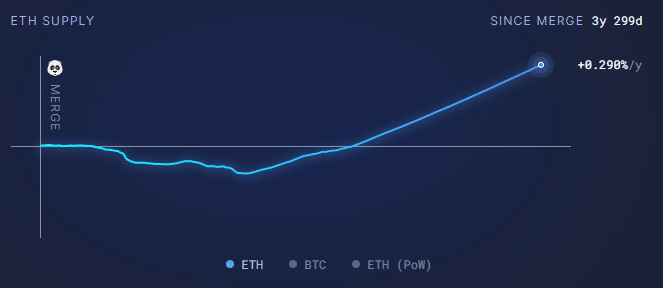
Ethereum’s best shot at scaling was through L2s, and recent upgrades have made them cheaper and attracted more traffic.

But this has also reduced the number of ETH burned, making the asset inflationary and denting its ‘store of value’ narrative.
Source: Ultrasoundmoney

Whether the renewed L2 debate will drag ETH’s market sentiment and price remains to be seen. As of writing, Ethereum [ETH] traded at $1.8K, a key inflection point that could trigger the next leg of price recovery or another pullback.


Final Summary

  • Robinhood L2 has become the fourth largest on-chain place for speculative trading, flipping BNB Chain and Hyperliquid
  • Amid the hype, Ethereum L2s are under scrutiny again for being non-beneficial to ETH’s value

Trending Cryptos

Related Questions

QWhat recent achievement did Robinhood Chain accomplish according to the article?

ARobinhood Chain has become the fourth largest on-chain platform for speculative trading, surpassing BNB Chain and Hyperliquid in daily DEX volume, which reached a record $600 million.

QWhat is the primary driver behind the surge in speculative activity on Robinhood Chain?

AThe surge is primarily driven by a memecoin frenzy, particularly following a memecoin bet by Robinhood's CEO, which led to viral memecoins like CashCat [CASHCAT] posting massive gains and attracting significant user interest and capital inflows.

QWhat criticism is highlighted regarding Ethereum Layer 2s (L2s) in the article?

AThe main criticism is that L2s are largely independent blockchains and their economic activity does not significantly benefit Ethereum (ETH) by capturing value for it. Critics argue this design has made L2s potentially negative for ETH's value, reducing the amount of ETH burned and making the asset inflationary.

QWhat does Uniswap CEO Hayden Adams argue about L2s and Ethereum?

AHayden Adams counters the criticism by arguing that since most trading pairs on L2s are denominated in ETH, the increased activity will eventually help burn more ETH. He believes this will be especially beneficial if the Real World Asset (RWA) narrative gains momentum.

QAccording to the article, what is a key concern about Ethereum's current price level?

AAs of the article's writing, Ethereum is trading at $1.8K, which is identified as a key inflection point that could determine whether the price begins its next recovery phase or experiences another pullback.

Related Reads

The Verdict in Choi Tae-won's Divorce Case: Revealing the Inheritance Undercurrent Behind SK Hynix's Trillion-Won Empire

SK Group Chairman Chey Tae-won's high-profile divorce case, involving a record 1.38 trillion won settlement, has drawn attention to the succession plans for Korea's second-largest conglomerate, especially its crown jewel, SK hynix. Unlike traditional chaebol scripts centered on the eldest son, Chey's three children from his marriage to former President Roh Tae-woo's daughter, Roh Soh-yeong, are carving distinct, non-traditional paths. Eldest daughter Chey Yun-jung (b. 1989) is seen as the most evident successor. With a scientific and consulting background, she holds executive roles at SK bioscience and SK Inc.'s growth support department, focusing on future strategy and biopharma. Her marriage is to an AI infrastructure entrepreneur, not a traditional business alliance. Second daughter Chey Min-jung (b. 1991) took a unique route, voluntarily serving as a South Korean naval officer, including an anti-piracy deployment. She later worked on policy and strategy for SK hynix in Washington D.C. before co-founding an AI-driven healthcare startup. She married a former U.S. Marine Corps officer, connecting her to U.S. defense and policy circles—networks crucial for a global semiconductor giant. The only son, Chey In-geun (b. 1995), who studied physics like his father, worked briefly at SK E&S before joining McKinsey. Despite fitting the traditional "heir" profile as the eldest son, he remains silent and holds no public position or shares in SK, suggesting the old succession playbook is obsolete. As SK hynix's valuation soars, becoming a geopolitical asset in the AI era, the heirs' legitimacy is no longer automatic. They must prove themselves in fields like AI biotech, global policy, and strategic consulting. Their marriages also reflect new elite networks in tech and defense, not old political alliances. Their inheritance is the complex challenge of navigating a globalized, tech-driven world, not just a corporate throne.

marsbitYesterday 09:06

The Verdict in Choi Tae-won's Divorce Case: Revealing the Inheritance Undercurrent Behind SK Hynix's Trillion-Won Empire

marsbitYesterday 09:06

From OpenSea to OpenRouter: Is Alex Atallah Repeating His 'Exit at the Peak' Playbook?

From OpenSea to OpenRouter: Is Alex Atallah Repeating His "Exit at the Peak" Playbook? According to the Wall Street Journal, payments giant Stripe is in talks to acquire the AI model aggregation platform OpenRouter in a potential deal valuing the company near $100 billion. This would mark founder Alex Atallah's second creation of a company reaching a $100 billion valuation, following his co-founding of NFT marketplace OpenSea. OpenRouter, founded just over three years ago, has grown rapidly by acting as a unified gateway for developers to access over 400 AI models. It currently has about 10 million users and processes over 200 trillion tokens monthly. While the platform's annualized revenue is around $50 million, its valuation has skyrocketed from $1.3 billion in March 2026. The potential acquisition by Stripe, a company OpenRouter's founder once likened it to, represents a major expansion into AI infrastructure for the payments leader. This move echoes Atallah's previous timing with OpenSea, where he departed before the NFT market's significant downturn. For OpenRouter, selling now may be strategic. Despite its scale, its business model—charging a 5-5.5% fee on AI inference calls—faces pressure from competition, open-source models, and potential price wars among model providers, limiting its profitability narrative for an IPO. A key asset for potential acquirers like Stripe is OpenRouter's vast repository of real-world AI usage data, which offers unique insights into model performance and developer preferences that are difficult to replicate. Whether this potential deal signifies a new valuation benchmark for AI infrastructure or another market peak signal remains to be seen.

链捕手Yesterday 08:42

From OpenSea to OpenRouter: Is Alex Atallah Repeating His 'Exit at the Peak' Playbook?

链捕手Yesterday 08:42

Trading

Spot

Hot Articles

Discussions

Welcome to the HTX Community. Here, you can stay informed about the latest platform developments and gain access to professional market insights. Users' opinions on the price of LAYER (LAYER) are presented below.

活动图片