Musk Targets AI Infrastructure Again: Tesla Set to Sell 'Compute Building Blocks'

marsbitPublished on 2026-06-22Last updated on 2026-06-22

Abstract

Tesla has filed a trademark for "Megapod," a modular AI data center hardware system, signaling a potential move into AI infrastructure. The system, as described in the filing, would integrate computer servers, AI processing hardware, networking equipment, power distribution, and cooling into a single, plug-and-play unit. This follows Tesla's existing "mega" product line like the Megapack energy storage system. The move comes less than a year after Tesla disbanded its in-house Dojo supercomputer team, shifting away from custom AI chip development. Analysts suggest Megapod is likely not a direct challenge to NVIDIA's dominant GPU-based systems, but rather targets the supporting infrastructure layer—power, cooling, and rapid deployment—where Tesla's energy business has expertise. The company's Megapack batteries are already being purchased by AI firms like xAI to manage the intense power demands of data centers. While still an early-stage trademark with no product details, Megapod hints at Tesla's broader strategy to commercialize modular AI infrastructure. It aligns with trends seen in Elon Musk's other ventures, such as SpaceX's lucrative contracts to lease GPU compute capacity. The potential market addresses critical bottlenecks in AI expansion: electricity, thermal management, and deployment speed.

Tesla has set its sights on the AI infrastructure business.

Recently, Tesla filed a trademark application named "Megapod" with the United States Patent and Trademark Office (USPTO), planning to sell modular AI data center hardware.
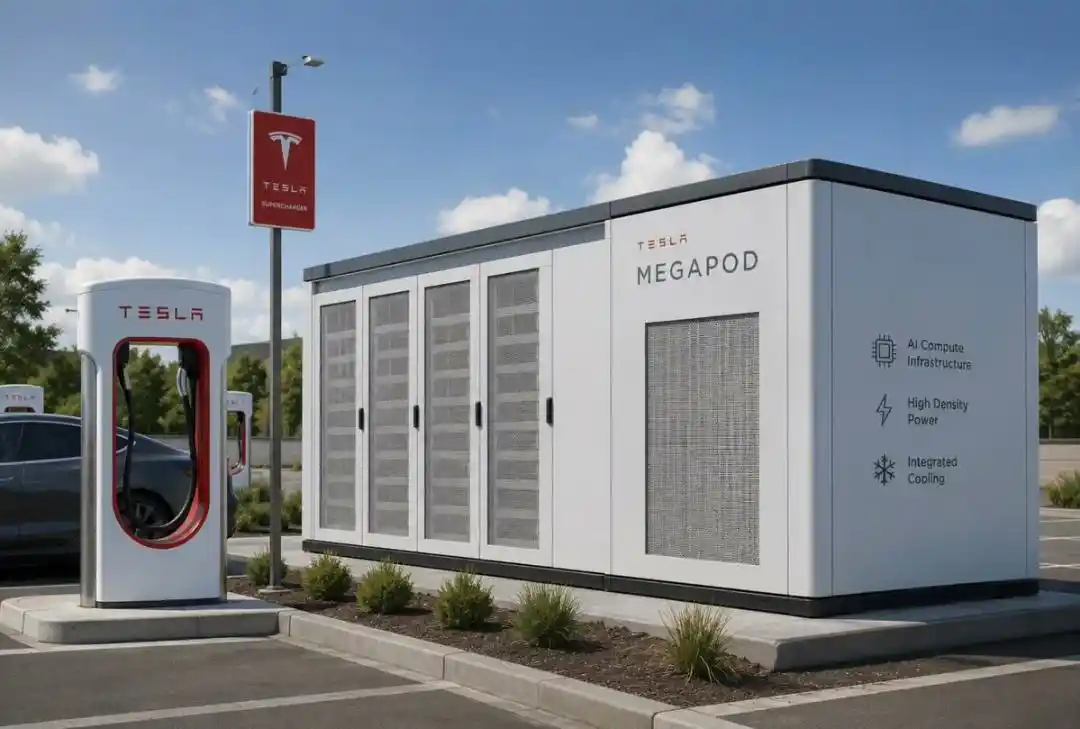
According to the trademark description, this is a modular data center hardware system for AI computing, including computer servers, AI data processing hardware, network equipment, power distribution units, and cooling systems.

However, just under a year ago, Tesla had disbanded its Dojo team, shutting down its only in-house AI training supercomputer.

After bidding farewell to Dojo, they are now registering a new trademark for AI data centers.

Hmm? Is Tesla just changing its approach to continue pursuing computing power?

What is Megapod?

Currently, confirmed information comes from the trademark application.

The trademark name Tesla submitted is MEGAPOD, with application serial number 99893717 and a filing date of June 18, 2026.
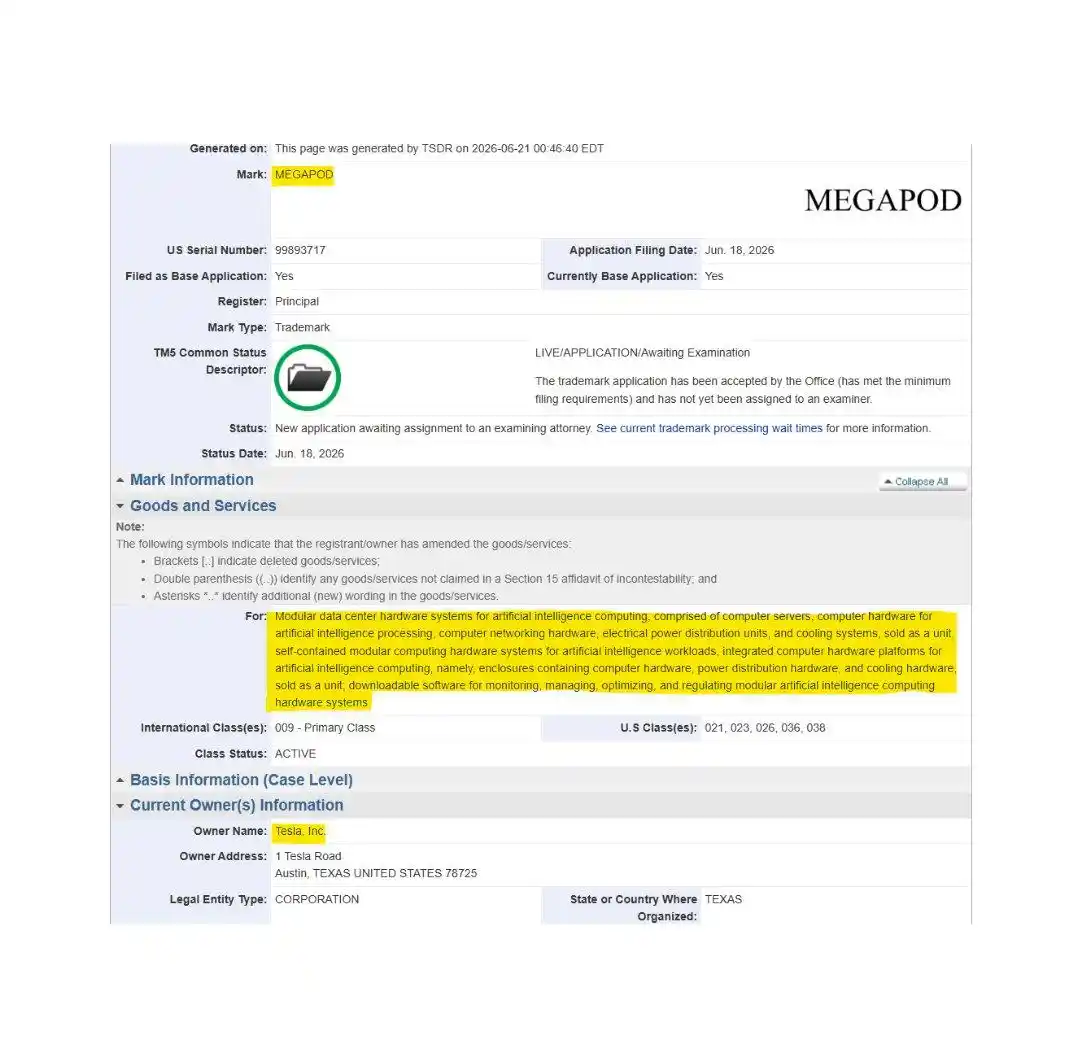
In terms of type, this is a standard character trademark, meaning they are securing the name "MEGAPOD" first. The filing basis is intent-to-use, indicating "an intention to use" the mark, but the product has not yet officially launched.

The description in the trademark application is quite specific. It states that Megapod covers:

Modular data center hardware systems for artificial intelligence computing, comprising computer servers, computer hardware for artificial intelligence data processing, network equipment, power distribution units, and cooling systems.

It also includes "self-contained modular AI computing hardware systems" and "downloadable software for monitoring, managing, and optimizing the aforementioned systems."

In simple terms, Megapod sounds like a plug-and-play AI data center module.

It packs servers, network equipment, power supplies, and cooling systems into a single rack. Just haul it to a site, plug it in, and it's ready to run AI training and inference.

This is also where it shares a lineage with Tesla's existing Megapack and Megablock.

Megapack sells large-scale energy storage batteries, while Megablock is an even larger, more modular energy storage system.

Megapod, on the other hand, seems to apply this "modularity" concept from power systems to AI compute systems.

Some netizens have therefore directly called it: Tesla has quietly revealed a massive AI infrastructure play.
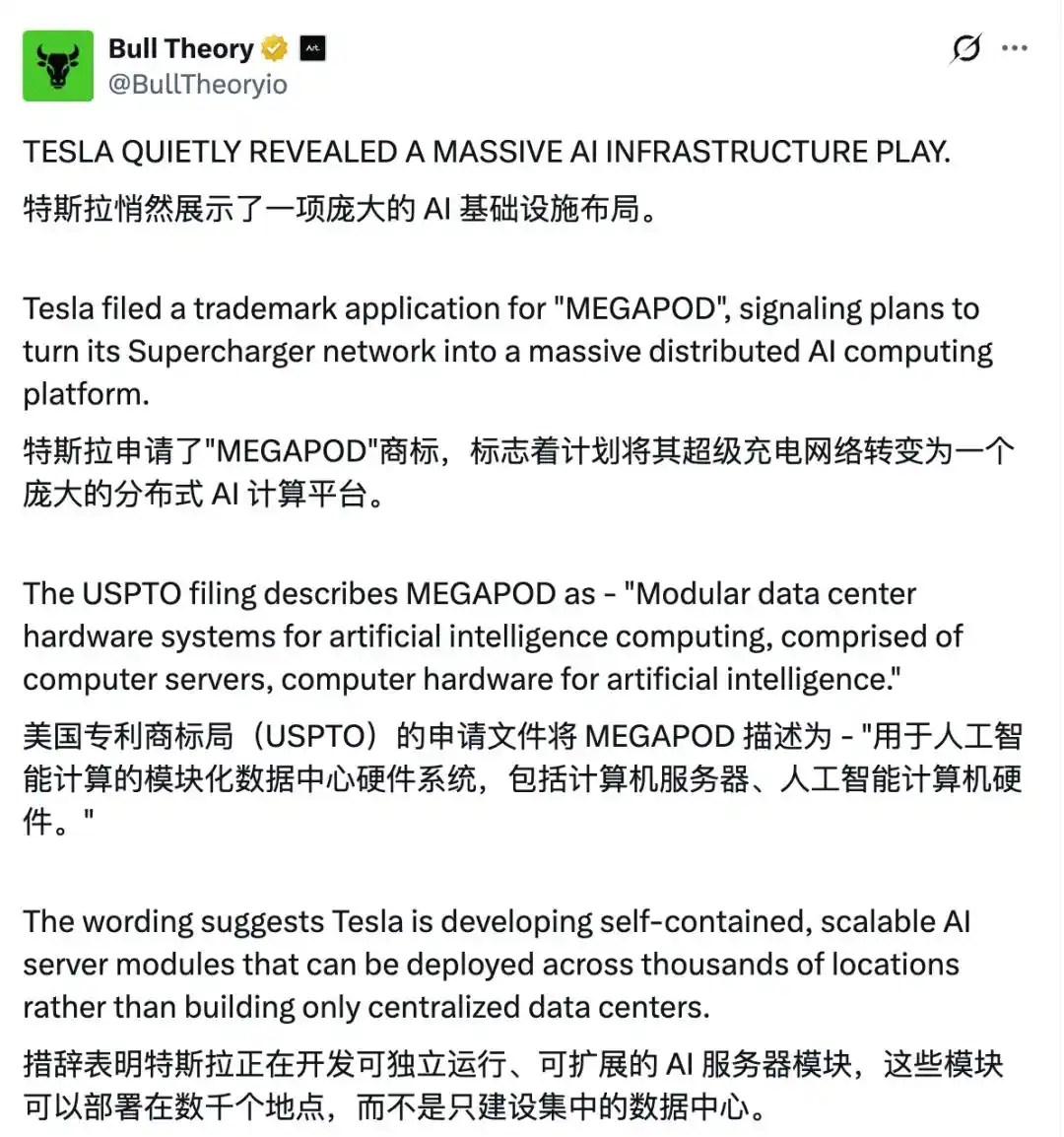
Others have speculated further, linking it to Musk's previous mentions of "using idle electricity to run AI." There's even conjecture that Tesla might connect its Supercharger network, battery storage, and AI compute nodes in the future to form a distributed AI infrastructure.

However, for now, Megapod is just a trademark application. There are no prototypes, specifications, prices, or delivery timelines.

Therefore, there's still a long way to go before Megapod becomes a real product.

Yet, the trademark itself indicates that Tesla is already seriously considering turning AI infrastructure into a marketable hardware category.

Is Tesla Trying to Steal Nvidia's Business?

At first glance, Megapod easily brings Nvidia to mind.

After all, the most expensive and critical components in AI data centers today are Nvidia's full-rack compute systems.

Take the GB200 NVL72, for example, which has already become a de facto standard for high-end AI data centers.

It integrates GPUs, CPUs, high-speed interconnects, liquid cooling, and networking into a single rack. Customers buy it and deploy it directly for large model training and inference. Currently, global cloud providers, AI companies, and sovereign AI projects largely revolve around this ecosystem.

In other words, in the business of "modular AI compute," Nvidia is already the absolute core player.

So, is Tesla's Megapod coming to snatch Nvidia's lunch?

In the short term, not necessarily.

Because Tesla itself is also a Nvidia customer. Tesla needs vast numbers of GPUs to train its FSD, robotics, and in-vehicle AI models; Musk's xAI is also procuring Nvidia chips on a large scale to build training clusters.

Moreover, Tesla's history with in-house AI chips has been quite bumpy.

Tesla once heavily bet on the Dojo supercomputer, hoping to use its self-developed D1 training chips to support FSD model training.

At the 2021 AI Day, Tesla officially showcased Dojo and the D1 chip, with the rationale being to accelerate autonomous driving model iteration through a self-developed training system.
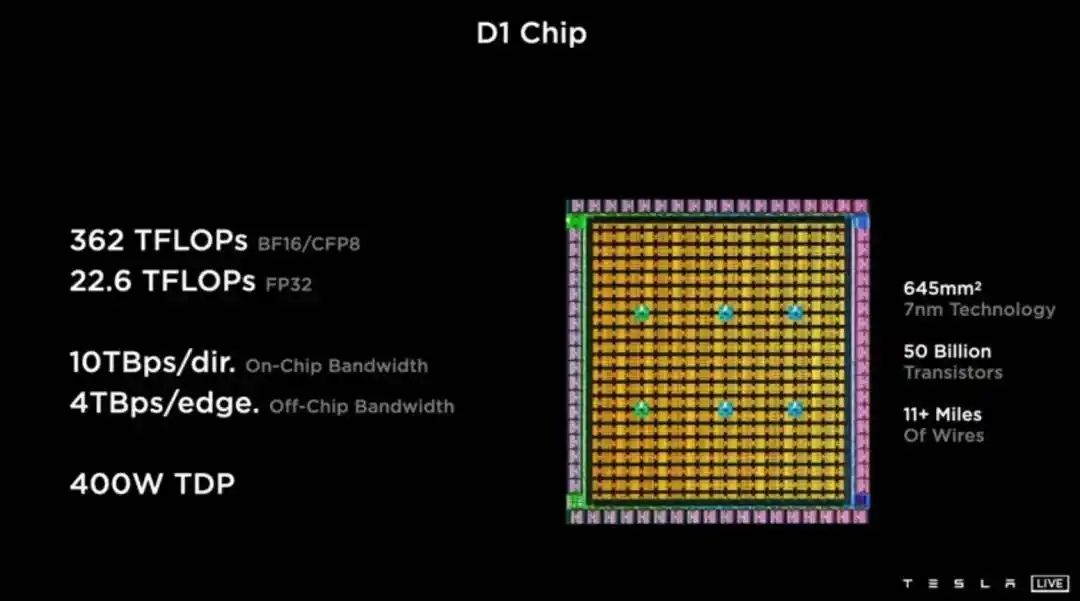
But by 2025, the Dojo team was disbanded, its lead departed, some members moved to AI chip startups, and the remaining personnel were transferred to other Tesla data center and computing projects.

Musk later stated that the company should not spread its resources thin by expanding two different AI chip designs, and that the focus would shift to AI5/AI6, relying more on external compute ecosystems like Nvidia and AMD.

From this perspective, Tesla's new move likely isn't about stealing Nvidia's GPU business, but rather targeting another layer of the AI data center business: power, energy storage, cooling, power distribution, and modular deployment.

This is also a current pain point for AI data centers. Large model training and inference are consuming electricity voraciously. New AI data centers aren't just short on GPUs; they also lack grid access, transformer capacity, cooling systems, and rapidly deployable infrastructure.

Many projects can't start running even after the chips arrive, often stalled by power supply, heat dissipation, construction timelines, and grid connection approvals.

And these problems happen to fall closer to the capabilities of Tesla's energy business.

Tesla's Truly Profitable AI Business Might Be Batteries

Over the past few years, when Tesla talks about AI, the outside world has focused most on FSD, Optimus, and Dojo.

But from a business perspective, the most direct connection between Tesla and AI data centers might actually be the Megapack.
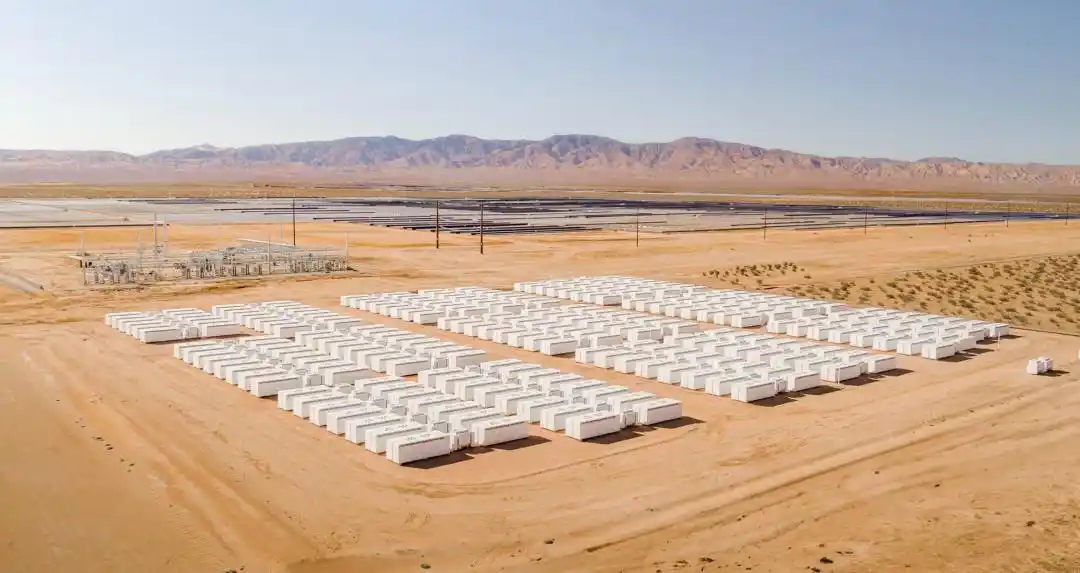
Megapack is Tesla's large-scale energy storage battery product, targeting grids, power stations, commercial and industrial sectors, and large infrastructure projects.

After an AI data center connects to the grid, it creates very sharp fluctuations in power consumption. Especially during large-scale GPU cluster training, loads can spike or drop rapidly, placing high demands on grid stability.

This is where energy storage systems can act as a buffer.

They charge when grid power is abundant and discharge when AI cluster loads increase; they can also help smooth out shocks caused by power fluctuations during training tasks.

This is the real entry point for Tesla's energy business into AI data centers.

Documents have previously shown that xAI purchased approximately $1 billion worth of Tesla Megapacks cumulatively from 2024 to April 2026, with a single-month purchase of $269 million in April 2026 alone.

This indicates that a major spending area for AI infrastructure is no longer just chips and servers. The power system itself is becoming part of the AI race.

Judging by the names, from Megapack to Megablock to Megapod, there's clear continuity.

A proper "mega trilogy".
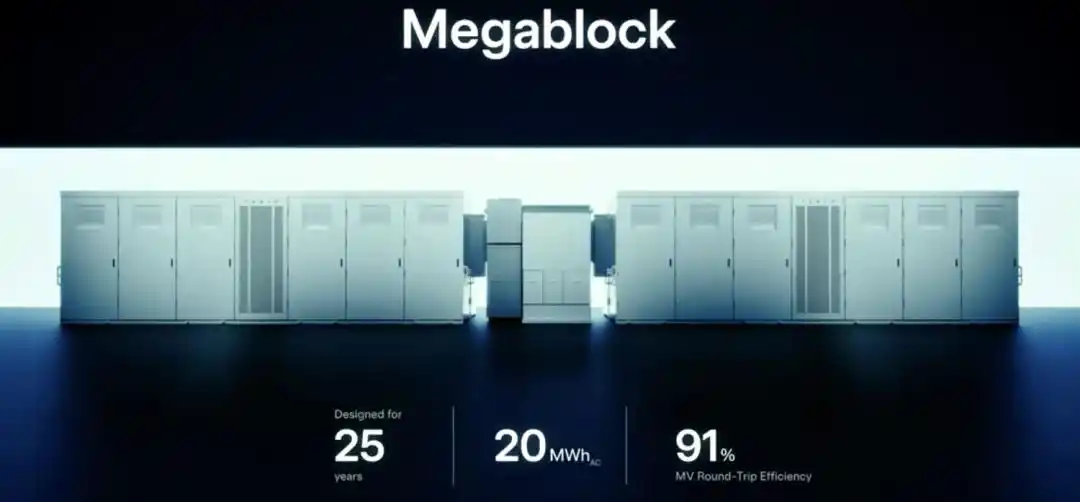
Megapack solves energy storage; Megablock solves larger-scale, faster-deploying power modules.

If Megapod materializes, it could further bundle servers, networking, power, cooling, and software management into an integrated infrastructure product for AI customers.

However, AI data center hardware is an extremely complex market, already populated by established players like Nvidia, Dell, Supermicro, Vertiv, Schneider, Eaton, and others.

From GPU racks to server integration, liquid cooling systems, power distribution, and UPS, each layer has high engineering barriers and long customer qualification cycles.

Tesla's strengths lie in modular manufacturing, battery storage, power control, and AI demand within Musk's ecosystem.

But its weaknesses are also evident: limited experience in enterprise data center delivery, an unstable in-house AI chip roadmap, and it remains unknown whether customers are willing to entrust critical AI infrastructure to Tesla.

However, Musk has already tasted the sweet success from SpaceX's massive compute contracts.
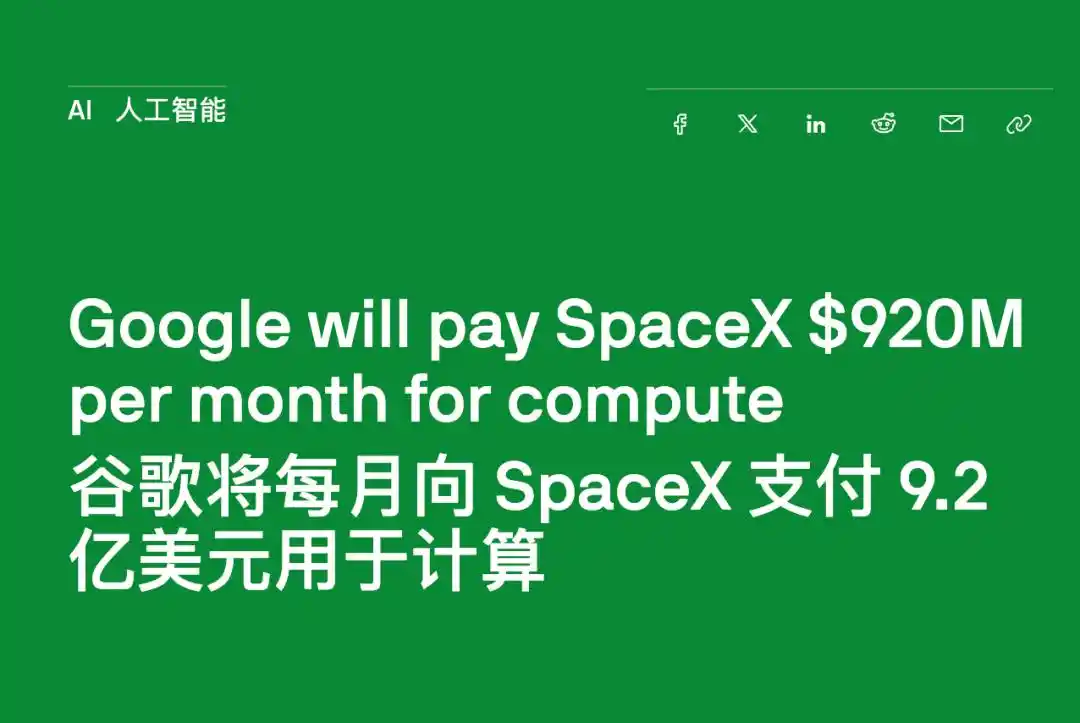
According to reports, Google will pay SpaceX $920 million per month to lease approximately 110,000 Nvidia GPUs along with related CPUs, memory, and other components, for a period of three years.

Prior to this, Anthropic also signed a contract to lease all the compute capacity at SpaceX's Colossus data center for $1.25 billion per month.

Combined, these two contracts mean SpaceX can rake in around $2.17 billion per month just from "renting out compute power."

What? A rocket-building company earning over $2 billion a month just from renting out idle GPUs???

When it comes to being a landlord on this scale, no one does it quite like Musk.

This also makes Megapod even more intriguing:

On one side, SpaceX is turning AI compute into a rentable asset, while on the other, Tesla is using the "mega trilogy" to penetrate power, energy storage, cooling, and modular deployment.

One can imagine that Megapod might not become "Tesla's version of Nvidia."

But when every AI company is short on power, cooling, and deployment speed, this business might just be more tangible than telling autonomous driving stories~

References:

[1]https://electrek.co/2026/06/21/tesla-megapod-ai-data-center-hardware/

[2]https://x.com/BullTheoryio/status/2068569421971436011

[3]https://techcrunch.com/2026/06/05/google-will-pay-spacex-920m-per-month-for-compute/

This article is from the WeChat public account "QbitAI," author: Ting Yu

Related Questions

QWhat is 'Megapod' according to Tesla's recent trademark application, and what is its intended purpose?

AAccording to Tesla's trademark application, 'Megapod' is a modular data center hardware system for AI computing. Its purpose is to provide an integrated system that includes computer servers, AI data processing hardware, networking equipment, power distribution units, and cooling systems, designed to be a plug-and-play AI compute module.

QWhy is it significant that Tesla filed for the 'Megapod' trademark shortly after disbanding its Dojo supercomputer team?

AIt is significant because it shows a strategic shift in Tesla's AI compute approach. After disbanding its in-house Dojo AI training supercomputer project, this move suggests Tesla is pivoting from developing its own AI chips to focusing on modular, infrastructure-level hardware solutions for AI data centers.

QWhat are the key pain points in modern AI data centers that Tesla's 'Megapod' might address?

AModern AI data centers face key pain points beyond just compute power, including lack of power grid access, insufficient electrical capacity, complex cooling requirements, and long construction/deployment cycles. Tesla's 'Megapod' concept aims to address these by offering a pre-integrated, modular system that combines power, cooling, and compute for faster deployment.

QHow does Tesla's potential move into AI data center hardware relate to its existing energy products, and what is the 'mega trilogy'?

ATesla's move relates directly to its energy products through a product family philosophy. The 'mega trilogy' refers to Megapack (large-scale energy storage batteries), Megablock (larger, more modular energy storage systems), and the proposed Megapod (modular AI data center hardware). This shows Tesla applying its modular system expertise from energy storage to AI infrastructure.

QWhy might Tesla's 'Megapod' not be seen as a direct competitor to NVIDIA's AI data center offerings?

ATesla's 'Megapod' might not be a direct NVIDIA competitor because Tesla itself is a major NVIDIA customer for GPUs. The article suggests Megapod is less about competing in AI chips and more about leveraging Tesla's strengths in modular manufacturing, battery storage, and power management to address the power, cooling, and deployment infrastructure layers of AI data centers.

Related Reads

Dialogue with KK, Founder of Hash Global: Do VCs Still Invest in Blockchain Games Now? What Kind of Projects Can Still Get Funding?

**Title: Dialogue with KK, Founder of Hash Global: Do VCs Still Invest in Blockchain Games? What Kind of Projects Can Still Get Funding?** **Summary:** KK, partner at Hash Global, discussed the evolving landscape of Web3 investment and blockchain games in a recent interview. He noted that the industry has moved past its initial hype phase into a more sober "second half," where VCs now prioritize core questions: Is the game actually fun? Does it have real users? Can it generate revenue? Key insights include: * **Web3 Investment Evolution:** The sector is increasingly adopting traditional investment logic, focusing on business models, value capture, and tangible worth over pure narrative. * **Blockchain Game Fundamentals:** The paramount criterion for any game is being genuinely fun and engaging. Web3 elements (like asset issuance and value distribution) should enhance an already solid product, not be a substitute for poor gameplay. Play-to-Earn is seen as a potential final stage, not a starting point. * **Current Investment Thesis:** Hash Global remains active in gaming, favoring projects with low barriers to entry, strong social/competitive elements, and the ability to generate real revenue (e.g., through ads, skins) like traditional Web2 games before scaling. Essential criteria are: 1) A fun core loop understandable without Web3 knowledge, 2) Web3 mechanisms that genuinely improve asset distribution and community participation, and 3) A capable, long-term-focused team with proven product-building experience. * **Team Focus:** The firm concentrates on investing in Chinese teams, leveraging cultural familiarity and judgment. * **Web3 Application Outlook:** Large-scale adoption may be accelerated by AI in areas with significant pain points in distribution (e.g., creator economy) or in "Non-Financial RWA" sectors like entertainment/culture. * **BNB Ecosystem:** Hash Global is bullish on BNB, viewing its ecosystem as significantly undervalued, with real users and global capital access. * **Investor Advice:** In the current bear market, KK expresses respect for new institutional investors entering Web3, as it indicates deep research rather than hype-chasing. A key lesson is managing pace—maintaining optimism tempered with realism to ensure longevity.

marsbit8m ago

Dialogue with KK, Founder of Hash Global: Do VCs Still Invest in Blockchain Games Now? What Kind of Projects Can Still Get Funding?

marsbit8m ago

A New Player Enters at Third Place, Rothera Disrupts the Prediction Market Landscape

"Rothera Skyrockets to Third in Prediction Market Rankings, Disrupting Industry Landscape" Rothera, Robinhood's newly launched prediction market platform, has rapidly climbed to become the third-largest player in the sector by trading volume, trailing only giants Kalshi and Polymarket. Its growth is attributed not to attracting new users, but to migrating existing Robinhood user orders away from partner Kalshi. Previously, Robinhood served as a major distribution channel for Kalshi, accounting for an estimated 25%-35% of its volume. With the launch of Rothera, Robinhood now internally executes events like World Cup contracts, capturing revenue that was previously shared with Kalshi. Data shows Rothera's weekly trading volume surged from $21.9 million to $559 million within weeks, reaching nearly one-fifth of Polymarket's volume. Analysts estimate Robinhood's prediction market business could generate around $10 billion in annual revenue at this pace, potentially surpassing its historical crypto revenue peak. In response, Kalshi is reportedly exploring new distribution channels by engaging with investment banks for a potential IPO, requiring them to integrate their systems with Kalshi to access institutional clients. This shift highlights a new competitive focus in prediction markets: controlling user access and distribution channels rather than just product offerings.

marsbit16m ago

A New Player Enters at Third Place, Rothera Disrupts the Prediction Market Landscape

marsbit16m ago

Commerce Ministry's Latest Export Controls Target 10 US Companies: Three Market-Moving Threads Explained

China's Ministry of Commerce placed 10 U.S. entities, including MP Materials, USA Rare Earth, Red Cat Holdings, and Teal Drones, on an export control list, banning the export of dual-use items. This move is seen as part of an ongoing countermeasure in the rare earth sector. The analysis suggests the primary impact is on U.S. companies within the **military, drone, and rare earth** sectors, aiming to restrict their access to critical Chinese materials and technology. For the Chinese market, the event is interpreted as reinforcing the **strategic value and pricing power** of domestic rare earth suppliers. However, the potential stock market reactions are nuanced: 1. **Chinese Rare Earth Upstream:** Companies like Northern Rare Earth are near yearly highs, indicating this event's "beneficiary" logic is largely priced in. It may confirm the trend but is unlikely to be a new major catalyst. 2. **Chinese Rare Earth Mid/Downstream & Drones:** Sectors like magnetic materials (e.g., Da Di Bear, Zhenghai Magnetic) and military drones (e.g., China Aerospace) are relatively undervalued. While the drone listing highlights sectoral competition, it doesn't directly translate to new orders for Chinese firms. 3. **Impact on Listed U.S. Companies:** The effect on stocks like MP Materials is ambiguous. While Chinese restrictions pose a challenge, these companies are also core to U.S. supply chain security efforts and may receive increased government support, potentially offsetting negative impacts. Their pre-announcement stock prices did not indicate panic selling. In summary, the export controls strengthen China's position in the global rare earth supply chain but have uneven effects across related stock market segments, with upstream Chinese gains likely priced in and downstream/drone sectors receiving more indirect, sentiment-driven attention. The outcome for the targeted U.S. stocks depends on the balance between restriction impacts and potential compensatory U.S. policy support.

marsbit26m ago

Commerce Ministry's Latest Export Controls Target 10 US Companies: Three Market-Moving Threads Explained

marsbit26m ago

Trading

Spot
Futures
活动图片