[Key interpretation] There are still 167000 BTC flowing out of the whale account, and ENS and QNT are accelerating

HuobiPublished on 2022-10-14Last updated on 2022-10-17

Abstract

BTC Whale's holding of currency is still divergent, and the price trend is subject to the expectation of the Federal Reserve's interest rate increase, so the adjustment is still continuing.

1. BTC rebounded slightly

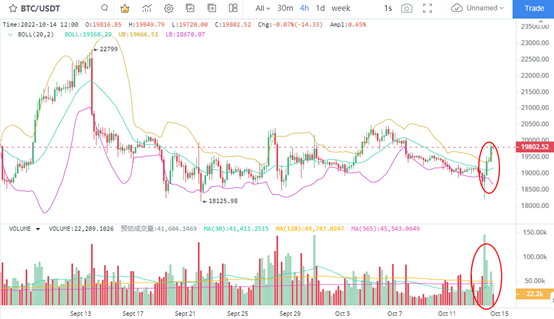
BTC's 4-hour K chart shows that the price is in a short-term rebound state. After the BTC hit the minimum of 18190 dollars during the continuous decline, a technical rebound occurred soon. The rebound speed is very fast. BTC has returned to more than 19000 dollars, and it is currently operating around 19802 dollars. This shows that although BTC has a weak trend, it still operates within the range. The limited volume of BTC in the rebound stage also indicates that the possibility of market strength is not very high.
2. BTC is still issuing coins

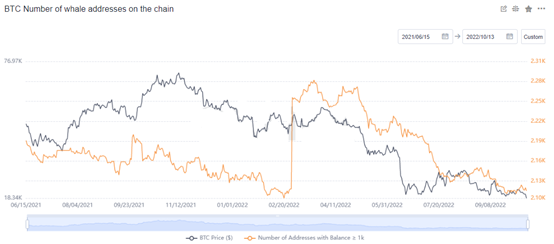
From the perspective of the main players' coin holding direction, the number of addresses of whale accounts has not changed much recently, and they are still operating at a low level after continuous decline. The data on October 13 showed that the number of megawhales remained at 2115, the lowest since March 21. On March 21, there were 2282 addresses of the whale with more than 1000 BTCs, which is still reduced by 167 to 167000 BTCs. Therefore, BTC is currently in the low adjustment stage, and the main force has not yet shown signs of increasing its shareholding.

On the news side, the US inflation rate, according to the data released by the US Department of Labor on October 13, the US consumer price index (CPI) in September this year increased by 8.2% year-on-year, 0.4% higher than that in August, higher than the expectations of US economists. The core inflation rate in the United States reached the highest growth rate in 40 years. The sharp rise of inflation rate shows that the five interest rate hikes by the Federal Reserve this year have little effect on easing inflation pressure. Therefore, the expectation of interest rate increase is still strong, the expectation of US dollar rise and BTC callback still exists, and the current rebound of BTC may not last too long.
3. ETH Bollinger Line starts to expand

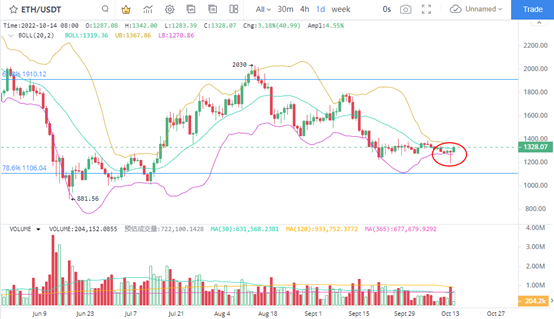
In terms of the daily K line, ETH prices and BTC rebounded at the bottom simultaneously, and prices completed a reverse pattern in the short term. During the bottoming period, ETH reached the lowest level of $1190. After the turnover rebounded in a short time, the turnover rate of ETH was limited. Prices are still fluctuating in the range. It is expected that ETH has a high upward space, but the price recovery needs the support of the overall market strength. In particular, the successful bottoming of BTC can further promote the ETH price.
4. ENS Strong Breakthrough

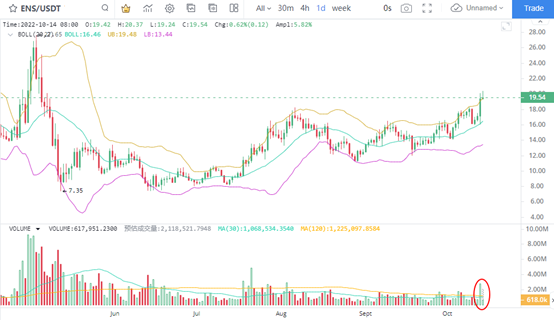
The price of ENS increased to 18.2 ¥ within 24 hours, which was the currency with the highest increase among the top 100 currencies with market value. In terms of trading volume, the trading volume corresponding to ENS's daily K line was effectively enlarged, more than 5 times that of the previous day, so the daily K line closed up 23.8%. In fact, during the period when the price was in a clear recovery state, the cumulative increase of ENS since the bottom reached in June reached 135%. It is expected that the price can still challenge the previous high of $27, so holding the currency can continue to gain gains.
5. QNT is steadily rising

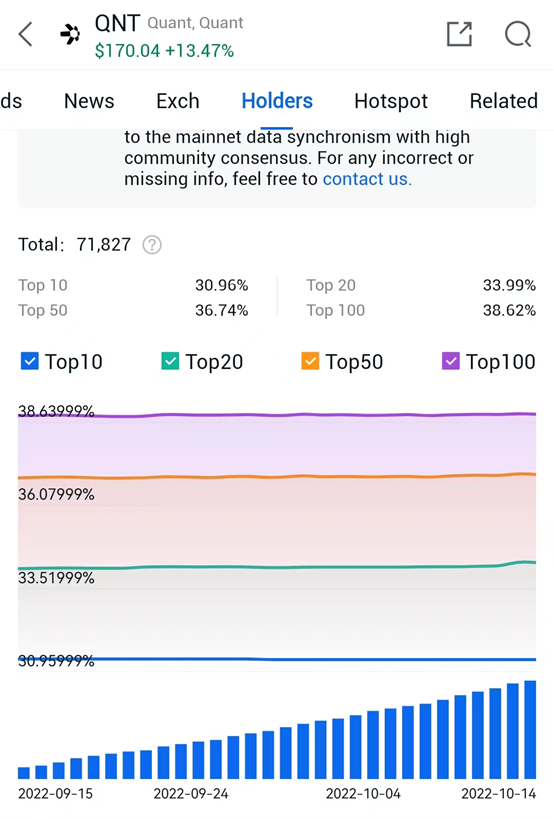
QNT's recent seven day increase has expanded to 23%, and prices remain strong. From the perspective of the number of coins held, the main players within the first 100 coins held did not show signs of continuous position reduction, indicating that the price rising trend of QNT may continue. Although the price rebounded from $40 to a maximum of $171, with a cumulative increase of 327%, it is still the stage of accelerated growth of QNT.

Related Reads

Report Interpretation: J.P. Morgan Details Micron's Pre-Earnings Sentiment, Current Hardware Sector Dynamics

Morgan Stanley analyst Joshua Meyers' report (June 21, 2026) highlights key trends in the hardware and semiconductor sector ahead of Micron's earnings. The core takeaways are: 1. **Micron & Memory:** Memory remains a high-conviction long theme, driven by strong AI demand and rising ASPs. However, investor focus is shifting to the sustainability of Micron's >80% gross margins and the specifics of potential new long-term supply agreements (SCAs). 2. **Hardware Supply Chain:** AI-related demand for servers, networking, and storage remains robust, but company performance is diverging. Celestica (CLS) shows improved margin confidence, Western Digital and Seagate benefit from pricing, Fabrinet (FN) sees predictable AI optics growth, and Teradyne (TER) anticipates a new Google customer. 3. **AI Capex & WFE Forecasts:** JPMorgan increased its Wafer Fab Equipment (WFE) market growth forecasts to 28% in 2026 and 29% in 2027. AI infrastructure financing is evolving, with higher project-level debt reducing constraints on capex expansion. The report signals that while the AI-driven hardware cycle is strong, the market is entering a phase focused on execution verification (e.g., Micron's SCA details, Fabrinet's ramp with Amazon) and valuation sustainability. Key near-term signals include Micron's guidance, Arista Networks' outlook, and the pace of demand normalization post potential tariff-related pull-ins.

marsbit2h ago

Report Interpretation: J.P. Morgan Details Micron's Pre-Earnings Sentiment, Current Hardware Sector Dynamics

marsbit2h ago

Research Report Analysis: The Fed's New Chair's Debut – New Leader, But Same Script?

Report Analysis: Federal Reserve's New Chair Debut – A New Captain, But the Same Script? Morgan Stanley's chief global economist Seth B. Carpenter analyzes the first FOMC meeting under new Fed Chair Kevin Warsh in a June 21 report. Warsh deliberately avoided providing forward guidance on interest rates, aligning with his philosophy. However, market expectations for a rate hike this year were reinforced. Key signals lie elsewhere: inflation may fall more than expected, and quantitative tightening (QT) could be more aggressive than anticipated. The FOMC's "dot plot" suggests only one rate hike in 2026. Carpenter argues that if inflation undershoots forecasts, the logic for even a single hike weakens, especially as projections indicate potential rate cuts in 2027. On QT, Warsh's stance is clear. Carpenter notes that measures like halving the Treasury's account balance could shrink the Fed's balance sheet by around $500 billion with minimal market impact. Combined with adjustments to reserve interest and liquidity rules, the ultimate QT scale may exceed expectations, though its market effect might be less disruptive unless the Fed actively sells Mortgage-Backed Securities (MBS). While Warsh initiated a review of the Fed's policy framework, the 2% inflation target remains intact for now. The report concludes that the market may be overestimating the significance of reduced forward guidance and the near-term rate hike risk, while potentially underestimating the scope and manageable nature of the coming balance sheet reduction. The key debates will hinge on upcoming core PCE data, the specifics of the QT path, and the framework review's findings.

marsbit2h ago

Research Report Analysis: The Fed's New Chair's Debut – New Leader, But Same Script?

marsbit2h ago

Critical Game Week: BTC Retracement Confirmation vs. HYPE Support Battle | Guest Analysis

This weekly analysis outlines a critical juncture for BTC and HYPE markets, focusing on key price level confirmations. **BTC Analysis:** BTC is at a pivotal point after a five-wave rally from the June 5th low of $59,100. The price has broken below a short-term rising channel's lower boundary, with the current move seen as a pullback to test this breakdown. Failure to reclaim this level could lead to a retest of the $59,000-$60,000 support zone. The core scenario hinges on this channel retest outcome. * **Key Levels:** Resistance at $64,500-$65,000 (channel boundary) and $69,500-$70,500. Support at $59,000-$60,000 and $55,000. * **Strategy:** A core bearish stance is maintained (20% short from last week), with short-term plans for tactical trades. Three detailed contingency plans (A/B/C) are provided for short positions on resistance tests or breakdowns, emphasizing strict stop-loss discipline. **HYPE Analysis:** HYPE shows strong momentum but is currently in a corrective phase after hitting a new high of $76.94. The price is retesting the crucial $64-$66 support area. * **Key Levels:** Resistance near $77 and $80-$82. Support at $64-$66 and $52-$54. * **Strategy:** The short-term approach is "buy on dips, avoid chasing rallies." A long position is considered only if clear stabilization signals appear at the $64-$66 or deeper $52-$54 support zones, with tight risk controls. **General Risk Management:** A standardized trailing stop-loss protocol is emphasized: set initial stop, breakeven at +1% profit, then trail stops upward to lock in gains. *Disclaimer: All analysis is presented as a personal trading framework, not investment advice. Market conditions are complex and require dynamic adjustment.*

marsbit3h ago

Critical Game Week: BTC Retracement Confirmation vs. HYPE Support Battle | Guest Analysis

marsbit3h ago

Research Report Interpretation: Citi Attends AWS Summit, Bullish on Cloud Business Acceleration but Data Governance Remains Key Variable

Citi analyst Tyler Radke's team attended the AWS New York Summit (June 17-18), engaging with over 10 clients and partners. In a June 19 report, they highlighted the summit's focus on scaling agent AI for enterprise deployment. Citi maintains a "Buy" rating on Amazon, forecasting AWS revenue growth to accelerate to 37% in FY27 from 30% in FY26, noting this estimate may be conservative. Key takeaways: 1. **AWS Strategy Shift:** AWS is moving from proof-of-concepts to scalable deployment. New offerings like AWS Context (building enterprise knowledge graphs), Amazon Quick (cross-application AI assistant), and security tool Continuum address core enterprise pain points for AI adoption. 2. **Data Infrastructure Beneficiaries:** Data infrastructure companies like Snowflake, Elastic, Oracle, and ClickHouse are seen as direct beneficiaries of scaling AI workloads, as evidenced by strong growth and use cases presented. 3. **Critical Role of Data Governance:** As AI agents scale from hundreds to thousands, effective data governance becomes the key variable for deploying AI in core business processes. AWS Context represents AWS's strategic extension from providing compute/models to offering a data governance infrastructure layer. The report emphasizes that without solving data governance, AI will remain confined to pilot projects. The investment thesis focuses on AWS revenue acceleration and data infrastructure vendors' growth, while monitoring signals like AWS's quarterly revenue growth, Bedrock AgentCore task volume, and pricing impacts on companies like Elastic.

marsbit3h ago

Research Report Interpretation: Citi Attends AWS Summit, Bullish on Cloud Business Acceleration but Data Governance Remains Key Variable

marsbit3h ago

Trading

Spot
Futures
活动图片