Author: Oluwapelumi Adejumo
Compiled by: Saoirse, Foresight News
As Ethereum's native token ETH enters a mid-term downtrend, overall market sentiment has significantly weakened. Data from blockchain analytics platform Santiment shows that discussions about ETH surged across networks in May, but the prevailing sentiment was overwhelmingly negative, with investors widely concerned about further price declines.
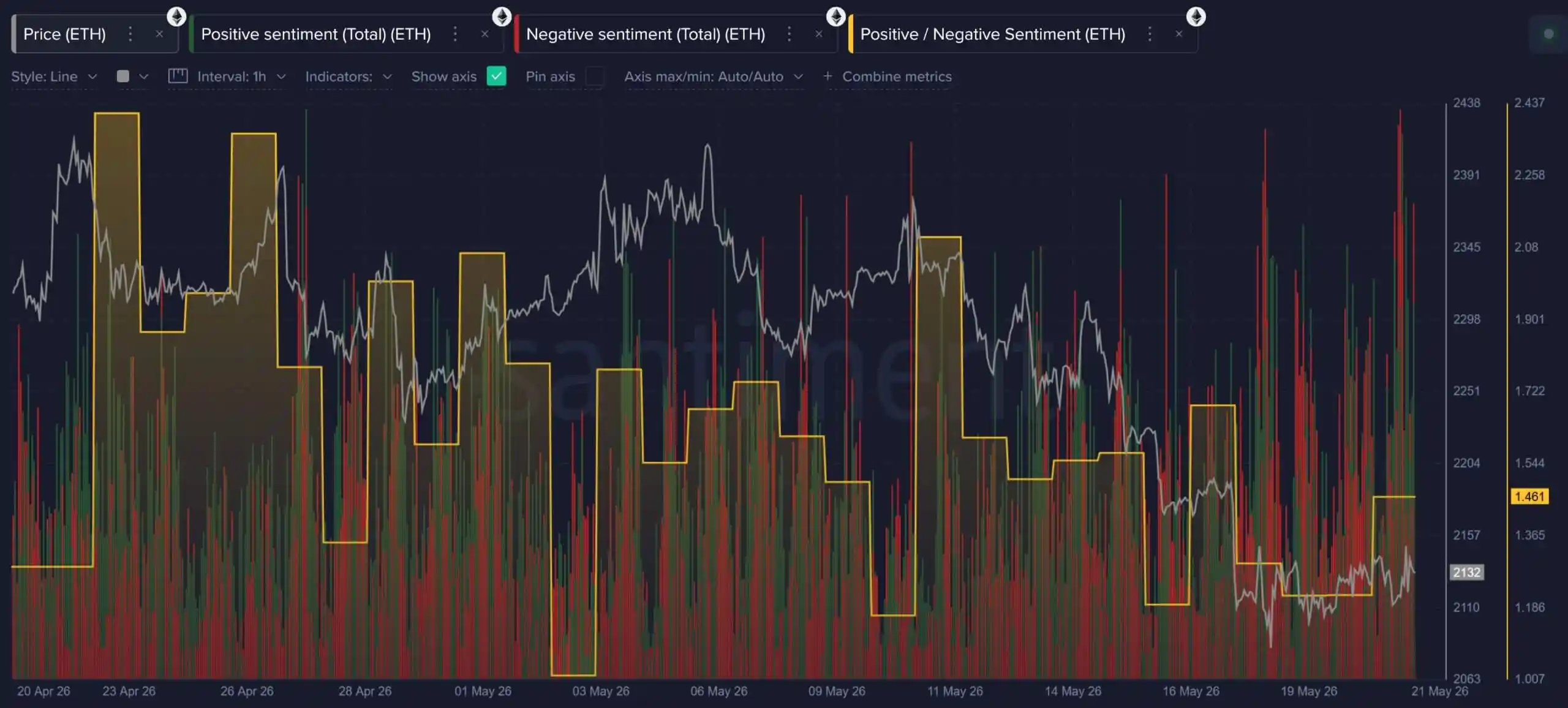
Ethereum Market Sentiment (Source: Santiment)
Analysts indicate that multiple bearish factors have converged, collectively dragging down the market: weak spot price performance, continuous outflows from ETFs, the departure of key personnel from the Ethereum Foundation, public questioning from veteran community supporters, and the growing competitiveness of peer public chains such as Hyperliquid, Zcash, and Solana.
Data from CryptoQuant also confirms a significant cooling in institutional investment interest. Currently, ETH price is approaching the critical $2,000 support level, with both spot market and fundamental indicators showing clear signs of weakness.
Ethereum's performance relative to the broader market appears particularly sluggish. The ETH/Bitcoin exchange rate has fallen to around 0.02758, hitting a ten-month low, indicating that Ethereum has significantly underperformed Bitcoin in this cycle. Spot investors continue to reduce their holdings, market liquidity keeps shrinking, and major institutions have largely ceased buying.
Persistent Spot Selling, Ethereum Lacks Effective Buying Support
Over the past two quarters, institutional holdings have consistently decreased. In October 2025, institutional holdings once exceeded 7 million ETH but have now retreated to around 5.5 million. During the prolonged price correction, large investment institutions have been scaling back their core positions.
The regulated ETF market is also under pressure. Current Ethereum ETF assets under management are approximately $12.14 billion, a 23% decrease from the peak in January. Data from SoSoValue shows severe market performance in May, with ETFs experiencing net outflows for two consecutive weeks, totaling around $470 million in cumulative outflows, marking one of the most concentrated periods of capital flight this year.
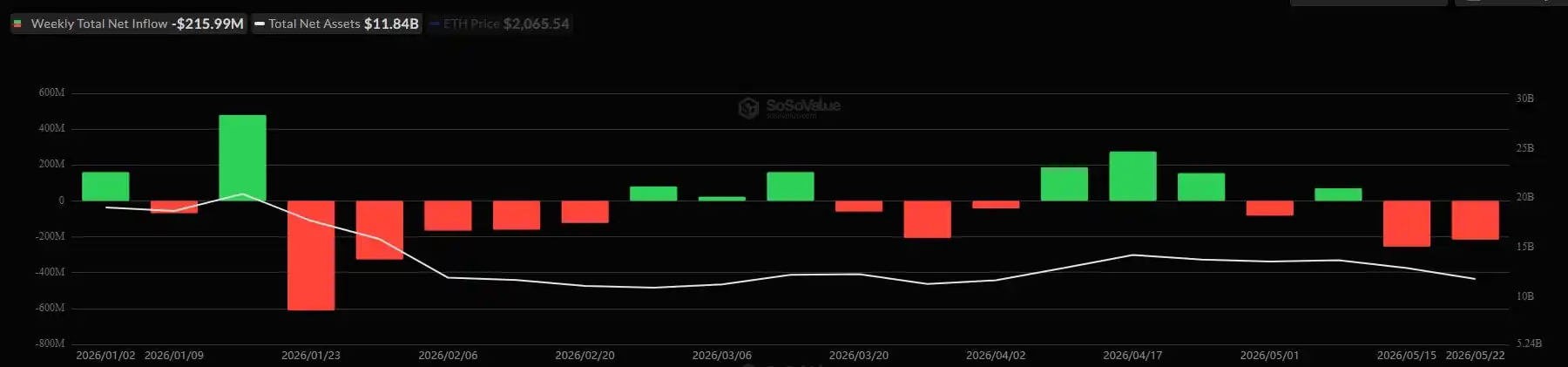
Weekly Ethereum ETF Fund Outflows (Source: SoSoValue)
The Coinbase Premium Index has remained in negative territory throughout, reflecting a lack of spot buying interest among U.S. institutional investors. As institutional holdings decrease, ETH market liquidity has tightened in tandem. Since February 2026, daily average institutional trading volume has continued to decline, falling well below the one-year average. Recent daily trading volume has only ranged between $17 million and $42 million.
Market bottom-fishing willingness has faded, and spot market activity is sluggish. Any negative news could easily trigger sharp price volatility.
Derivatives Market Hedging Heats Up, Contract Longs Remain Determined
As spot market selling pressure intensifies, the derivatives market shows significant divergence regarding future trends. Industry opinions are split on whether ETH is entering a long-term downtrend or is about to bottom out and rebound.
Professional traders are actively buying put options to hedge risks, while the perpetual contract market still retains substantial long positions, reflecting starkly opposing views. Block Scholes data shows that the seven-day ETH 25-delta risk reversal skew is close to -7%, indicating traders are willing to pay a premium for put options to hedge against downside risk.
Data from Deribit exchange shows that the total open interest for put options with strike prices of $2,000 and $2,100 exceeds $380 million, making these two price levels the core battleground for short-term institutional speculation.
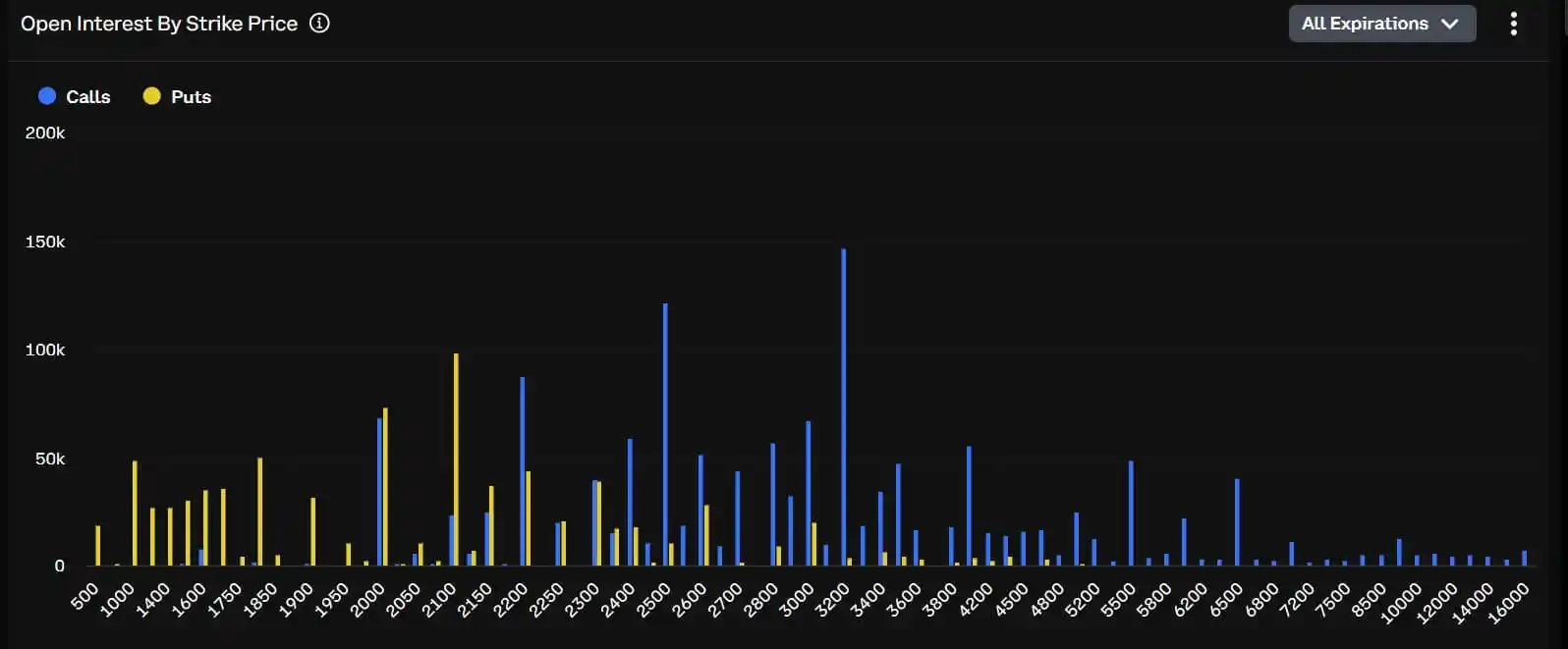
Ethereum Options Trader Positions (Source: Deribit)
Market Interpretation: The large-scale deployment of put options suggests a widespread market expectation of continued weakness. The price has already broken below the $2,100 support level, and market risk appetite keeps declining. In the absence of spot capital to absorb selling pressure, the market can only rely on hedging operations to mitigate risks.
Signals from the perpetual contract market are more complex. According to CryptoQuant statistics, Ethereum's funding rate has remained stable in positive territory, reaching 0.0082 on May 21st. Even as market capitalization, institutional holdings, and spot trading volume decline across the board, speculative bullish sentiment has not completely dissipated.
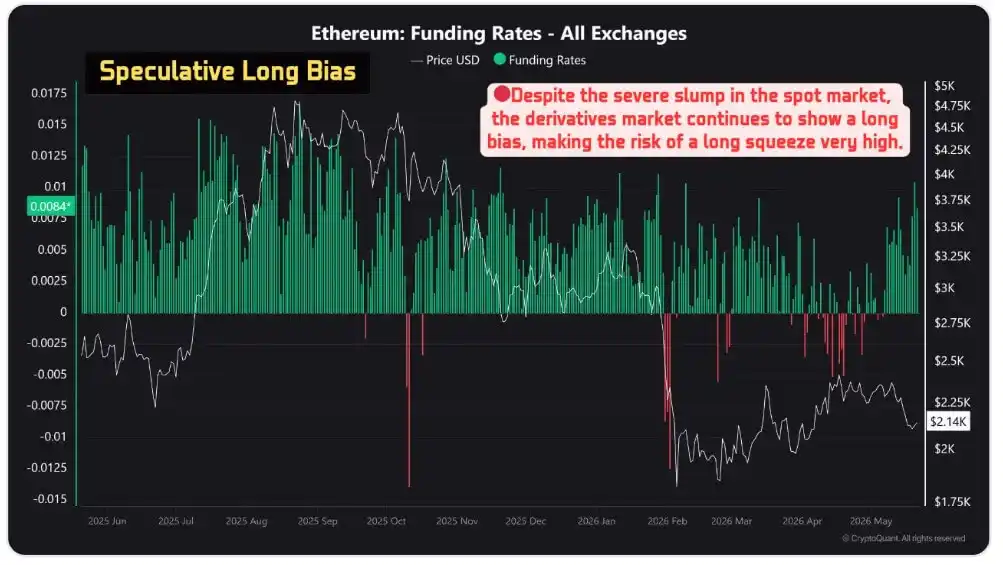
Ethereum Funding Rate (Source: CryptoQuant)
The opposing long and short stances introduce significant uncertainty into the price action. If spot buying suddenly recovers, it is likely to trigger a short squeeze and rebound. Conversely, if the price breaks below the critical $2,000 support level, the massive open interest could trigger a cascade of liquidations, exacerbating market volatility.
Key Talent Departures, Ethereum's Value Debate Intensifies
Amid the poor price performance, the Swiss non-profit Ethereum Foundation, responsible for Ethereum's underlying R&D, is undergoing large-scale senior personnel changes.
Senior R&D personnel Carl Beek and Julian Ma have formally resigned, triggering internal personnel turbulence. Carl Beek, with seven years of experience, was primarily responsible for Beacon Chain design. Julian Ma led the development of the lab oversight incentive framework.
Since February, at least nine senior personnel have left or stepped back from core roles at the Foundation. In May alone, five individuals departed, including former Co-Executive Director Tomasz Stańczak, Board Co-Chair Josh Stark, protocol R&D contributor Trent Van Epps, protocol team lead Barnabé Monnot, and Tim Beiko. Senior researcher Alex Stokes has also begun a three-month leave. The reduction in core technical team members during a market downturn has created a leadership vacuum.
Industry analysis suggests the trigger for this personnel change was a foundational document released by the Foundation in mid-March. This 38-page document established the CROPS principles: Censorship Resistance, Open Source, Privacy, and Security.
The document clearly defines the Foundation's role as an ecosystem guardian, not a commercial operator. Its core duty is to maintain network neutrality, not to pursue goals like raising token prices, boosting investor returns, or advancing commercial expansion.
Now, as other public chains continue to capture market share, the Foundation's adherence to a neutral development philosophy is increasingly difficult for the market to accept. Tommy Shaughnessy, co-founder of venture firm Delphi Ventures, stated that the negative impact of this talent drain far exceeds surface appearances. With reform-minded members gone, internal voices questioning the current development direction are unlikely to emerge again.
Calls for Reform Grow Louder, Neutral Development Model Faces Severe Test
Many departing core members believe the Foundation has been insufficiently proactive in commercialization and have called for adjustments to the governance structure. Prominent researcher Dankrad Feist, who left the Foundation last year to join a new public chain project, publicly proposed forming a new, independent institution to ensure the network's economic competitiveness.
He suggested the new institution should have initial capital of at least $1 billion, partially sourced from network staking rewards. This institution would be directly accountable to token holders, with the core mission of expanding ETH's commercial application scenarios and driving token market capitalization growth.
Dankrad Feist pointed out that the Ethereum Foundation currently holds less than 0.1% of the total circulating supply, cannot access underlying staking rewards or on-chain transaction fees, and the entire ecosystem lacks a professional body actively promoting the token in capital markets.
Ryan Sean Adams, co-founder of media outlet Bankless, expressed agreement with this view. He argued that Ethereum's development cannot rely solely on the Foundation. The ecosystem needs well-funded, competitive professional institutions focused on improving capital efficiency, communicating development value externally, and implementing commercial projects—tasks that fall outside the Foundation's mandate.
These reform proposals do not call for abolishing the original Foundation but advocate for a dual-agency collaborative model: one side remains true to its original purpose, safeguarding the underlying network's neutrality and building public infrastructure; the other focuses on token promotion and competing for institutional capital resources.
Bullish investors, however, believe the market is over-interpreting short-term volatility, viewing the personnel changes as a normal generational transition. Investor Ryan Berckmans stated that talent flow is a normal phenomenon for team renewal. Ethereum has successfully navigated regulatory storms and management changes in the past, completed major technical upgrades like The Merge and blobs transactions, and its on-chain application assets remain industry-leading. Global enterprises continue to deploy stablecoins and asset tokenization businesses, which can still support long-term network development.
Major institutional holders also maintain an optimistic outlook. Thomas Lee, Chairman of BitMine, the public company with the largest ETH holdings, believes the current market panic is just a normal correction within the cycle. The company holds 5.2 million ETH, with assets worth over $10 billion in staking.
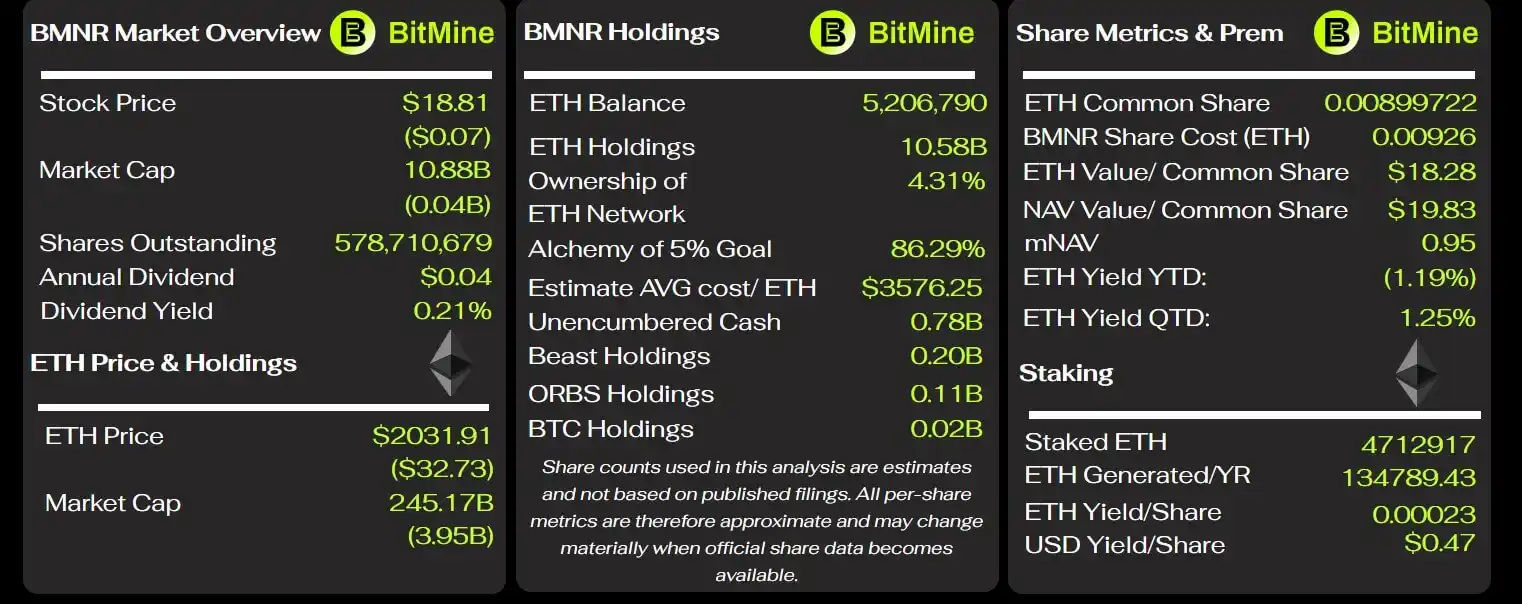
BitMine Key Metrics (Source: BitMine Tracker)
Thomas Lee stated that blockchain serves as the underlying infrastructure for AI commercial systems and institutional financial settlements. With its mature security system, ample market liquidity, and broad institutional recognition, Ethereum still possesses irreplaceable industry advantages.
Shaking Off Negative Sentiment, How Can Ethereum Regain Its Upward Trajectory?
Industry insiders believe Ethereum's future trajectory depends on whether its technical roadmap and commercial moats can translate into an attractive investment thesis. Analysis from investment firm Galaxy Digital suggests that to stem the tide of capital outflows, Ethereum must steadily execute its various operational plans.
The short-term priority is to successfully launch the Glamsterdam upgrade, steadily advance subsequent Hegotá version iterations, clarify internal authority and responsibility divisions within the Foundation, and concentrate resources on core commercial sectors. Key focus areas include high-value decentralized finance (DeFi), institutional asset issuance, real-world asset tokenization, stablecoin settlement, and privacy financial infrastructure. Ethereum's neutrality and security capabilities will become core advantages in these sectors.
Simultaneously, Ethereum needs to accelerate its layout in the next wave of industry hotspots, including public chain scaling technology, on-chain privacy protection, post-quantum security, and AI-native economic systems. Relevant technical frameworks are already included in the open-source R&D roadmap. The current biggest challenge is coordinating synergistic development between commercial entities and institutional resources.
The Foundation's charter clearly outlines principles for underlying technology R&D but does not specify a token value growth logic or establish dedicated operational entities to address competitor challenges.
This price decline is no longer merely a simple market correction; it is a profound test: Can a decentralized system rationally allocate commercial functions and complete institutional division of labor adjustments while maintaining operational stability?
If the ecosystem can leverage this personnel transition to streamline authority and responsibility, transforming technical plans into clear investment value, this downturn may become an opportunity for governance model optimization. Conversely, if adjustments cannot be made, persistently weak spot market performance, frequent talent departures, and shifting competitive landscapes will lead the market to question whether Ethereum's network strength can no longer support stable token value.