On the Eve of the Tech IPO Boom, Polymarket Joins Forces with NASDAQ to Seize 'Valuation Authority'

marsbitPublished on 2026-05-20Last updated on 2026-05-20

Abstract

At the dawn of a major tech IPO wave, prediction market platform Polymarket is forming an exclusive partnership with Nasdaq Private Market (NPM) to launch contracts predicting the valuations of pre-IPO giants like OpenAI, Anthropic, and SpaceX. This move aims to capture the "valuation adjudication right" in the booming but opaque private market, where accurate valuation data is scarce for retail investors. Facing stiff competition from rival Kalshi, which holds an 89% US market share and full regulatory approval, Polymarket's deal with NPM is a strategic counterattack. NPM provides crucial, real-time secondary market transaction data from employee stock sales to settle the new prediction contracts. In return, Polymarket's market-generated probability data becomes a valuable "institutional signal" for NPM's clients. This follows Polymarket's broader strategy of monetizing its prediction data through partnerships with giants like ICE (Intercontinental Exchange) and Dow Jones, integrating its signals into mainstream financial data feeds and media. The Nasdaq deal specifically targets the lucrative and high-profile arena of pre-IPO tech valuations, potentially raising the entry barrier for competitors in this niche.

In this wave of tech IPO frenzy, everyone wants to 'get on board,' including Polymarket.

The soonest SpaceX could list on Nasdaq is in 23 days, an IPO poised to break all records in human IPO history.

OpenAI's last round valuation was $5 trillion, Anthropic is rumored to be worth $4 trillion, and SpaceX $17.5 trillion. Globally, there are 1,600 unicorn companies with a cumulative valuation of $5 trillion. The returns from this sector have historically been available only to institutions and accredited investors. Directly buying shares in these companies requires a six-figure minimum, a one-year lock-up period, accredited investor certification, and a network of connections. Ordinary people have no access.

Furthermore, private companies are not obligated to disclose their valuations. Funding round valuations are lagging, secondary market quotes are scattered, and the actual transaction prices of employee stock are highly sensitive internal information. This, precisely, is the perfect entry point for prediction markets.

On May 19th, just before this critical timing, Polymarket announced an exclusive partnership with NASDAQ, launching a batch of prediction contracts targeting the market valuations of pre-IPO companies. Users can bet on whether OpenAI's valuation will break through $10 trillion by year-end, whether Anthropic will reach $11 trillion by December 31st, and if SpaceX can touch $15 trillion before June 30th. NASDAQ, as the data source, is responsible for the final settlement of the contracts.

Polymarket previously had a market on OpenAI's closing market cap on its first day. Bloomberg reported that it accumulated $1.6 million in trading volume since last September. On Kalshi, existing IPO contracts are even more concentrated: Cerebras Systems' probability of an IPO before 2027 is priced at 95%, Kraken at 83%, Databricks at 70%, Discord at 70%. OpenAI and Anthropic also have contracts.
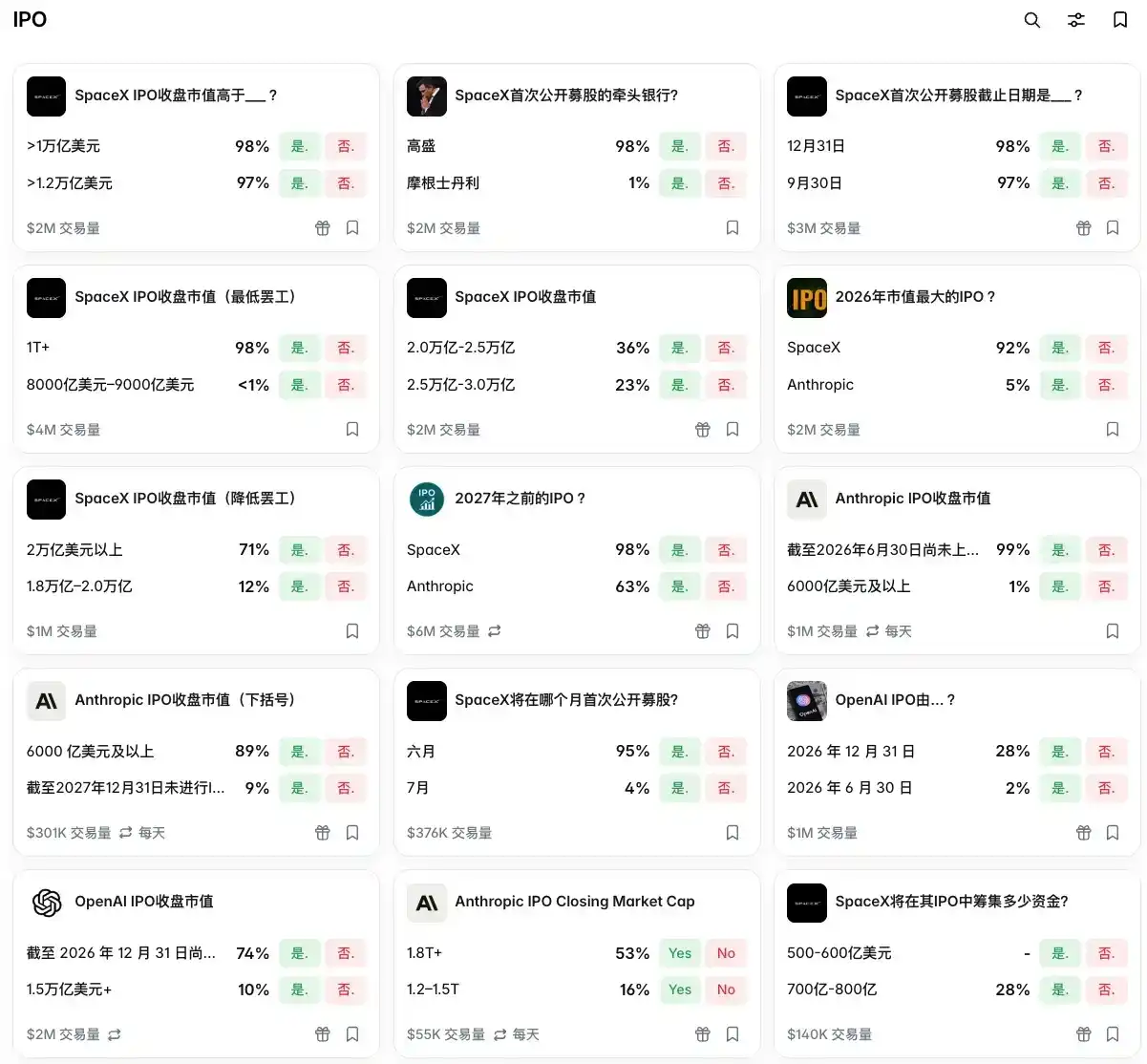
Both competing platforms are placing significant emphasis on this wave of pre-IPO frenzy.

Polymarket's Comeback Fight

Over the past eight months, Polymarket has been surpassed by Kalshi on nearly every visible metric.

In April, Kalshi's monthly trading volume was $14.8 billion, a 13% increase month-over-month. Polymarket's global volume plus the US App volume totaled $10.2 billion, a month-over-month decline of 8.9%. Active traders dropped from 733,000 in March to 643,000 in April, a 12% decrease. In valuation, Kalshi's latest round is $22 billion, while Polymarket is reportedly in talks for $15 billion.

A Bank of America report in April noted that among US-based prediction markets, Kalshi has captured approximately 89% of the market share.

Kalshi's journey over the past few years has been smoother than Polymarket's. In 2020, the CFTC granted it a Designated Contract Market (DCM) license, the first in the US and still the only one specifically issued to an event contract platform. This means Kalshi can accept USD, issue 1099 tax forms, integrate SDKs with platforms like Robinhood, and have its probability data cited by CNN and CNBC. In February of this year, Kalshi was selected by TIME for its TIME100 Most Influential Companies list, and its App Store ranking once approached that of ChatGPT.

Polymarket, fined $1.4 million by the CFTC in 2022, withdrew from the US market. It wasn't until July 2025 that the CFTC and the Department of Justice concluded a new round of investigations against it, allowing it to acquire a compliant trading license through the acquisition of QCEX.

However, Polymarket's partnership with NASDAQ this time is likely a signal of a counteroffensive.

The specific partner for Polymarket is Nasdaq Private Market (referred to as NPM), a company incubated by NASDAQ that specializes in serving private companies. Its main businesses are two-fold:

First, organizing secondary market liquidity programs for employee stock. Employees of companies like OpenAI, SpaceX, and Anthropic hold a large number of options or restricted stock units. Since the companies are not public, they cannot sell on the open market. NPM helps companies organize tender offers, allowing employees to sell their shares to approved external investors. NPM itself has disclosed facilitating nearly $80 billion in such transactions, covering over 1,000 company-sponsored liquidity programs and serving more than 200,000 employee shareholders.

Second, building a valuation database for private companies. NPM daily sees the transaction prices of employee stock for companies like OpenAI, Anthropic, and SpaceX on the secondary market. This data was previously sold only to institutional clients for a hefty annual fee.

The key step in this partnership is NPM's agreement to, for the first time, provide these valuation data to Polymarket for use.

Rodolfo Sanchez, NPM's Data Vice President, made a crucial statement in the press release: "The data flows in both directions." NPM provides data to Polymarket for contract settlement, while Polymarket's contract price curves become, in turn, "institutional signals" available to NPM's clients. Institutional clients buying NPM data also receive a probability curve priced in real-time by hundreds of thousands of retail traders.

Selling Data, Seizing Authority, Capturing Retail

This is not Polymarket's first time selling its data.

In October 2025, ICE announced an investment of up to $2 billion at an $8 billion pre-money valuation. The significance of this deal wasn't just the valuation, but the terms. ICE secured global exclusive distribution rights for Polymarket's data. The sales channels of the parent company of NYSE began selling Polymarket's probability data to global institutional clients.

In January 2026, an exclusive partnership with Dow Jones. Polymarket's prediction data was integrated into The Wall Street Journal, Barron's, MarketWatch, and Investor's Business Daily. The financial media matrix under News Corp began embedding Polymarket's probability signals as standard modules in their layouts, similar to the Dow Jones Index or VIX.

In February 2026, ICE formally launched the 'Polymarket Signals and Sentiment' product. Real-time quotes from thousands of contracts on Polymarket were standardized into structured data streams and distributed to institutional clients via the ICE Consolidated Feed, flowing through the same pipeline as NYSE stock data, bond prices, and corporate announcements. ICE President Ben Jackson mentioned this product alongside Reddit and Dow Jones in the Q1 earnings call, calling it one of the three pillars of ICE's alternative data services.

And this new partnership is about seizing the authority to determine valuations in this year's hottest private market.

We speculate Kalshi won't sit idle; its next move will likely involve partnering with a private market data provider to implement a similar structure. However, mainstream private data providers like Forge and PitchBook have smaller scales and cover fewer companies compared to NPM. NPM has already been exclusively secured by Polymarket. The cost for Kalshi to enter this track will be higher.

Trending Cryptos

Related Questions

QWhat is the key collaboration between Polymarket and Nasdaq, and what specific data is being shared?

APolymarket has launched an exclusive collaboration with Nasdaq, specifically its incubated company Nasdaq Private Market (NPM). The key aspect of this partnership is that NPM is providing its private company valuation database to Polymarket for use in settling prediction contracts. This database contains real-time transaction data on employee stock sales from pre-IPO companies like OpenAI, Anthropic, and SpaceX. In return, Polymarket's prediction market price curves serve as a 'crowd-sourced signal' for NPM's institutional clients.

QAccording to the article, how does Polymarket's current position compare to its competitor Kalshi in the US prediction market?

AAccording to the article, Kalshi currently holds a dominant position in the US prediction market. A Bank of America report cited in the article states that Kalshi has captured approximately 89% of the US market share. Key metrics for April show Kalshi with a monthly trading volume of $14.8 billion, compared to Polymarket's combined global and US app volume of $10.2 billion. Furthermore, Kalshi is reported to have a higher valuation and possesses a crucial regulatory advantage with its CFTC-issued Designated Contract Market (DCM) license.

QWhat are the two main business functions of Nasdaq Private Market (NPM) mentioned in the article?

ANasdaq Private Market (NPM) primarily serves two key functions for private companies: 1) Facilitating secondary market liquidity programs for employee shares. It organizes tender offers that allow employees of companies like OpenAI and SpaceX to sell their stock options or restricted shares to approved external investors. 2) Building a valuation database for private companies. NPM collects data on the transaction prices of employee stock sales, creating a valuable proprietary dataset on private company valuations.

QWhat previous steps has Polymarket taken to commercialize its prediction market data prior to the Nasdaq deal?

APrior to the Nasdaq collaboration, Polymarket had already taken significant steps to commercialize its data. In October 2025, Intercontinental Exchange (ICE) invested in Polymarket and secured the global exclusive distribution rights for its data. In January 2026, Polymarket entered an exclusive partnership with Dow Jones, integrating its prediction data into major financial publications like The Wall Street Journal. In February 2026, ICE formally launched the 'Polymarket Signals and Sentiment' product, streaming structured prediction data to institutional clients alongside traditional market data feeds.

QWhy is the pre-IPO company valuation market considered a significant opportunity for prediction markets like Polymarket?

AThe pre-IPO valuation market is a significant opportunity because it addresses a major information gap. Private companies are not obligated to disclose their valuations, and data from funding rounds is often lagging or incomplete. Secondary market quotes are fragmented, and internal transaction prices for employee stock are highly sensitive. This lack of transparent, real-time valuation data creates an ideal environment for prediction markets to aggregate crowd-sourced beliefs about a company's worth, providing an alternative signal that is otherwise inaccessible to the general public.

Related Reads

The Computing Power Dilemma in the Sino-US AI Rivalry

The Sino-US AI rivalry faces a fundamental bottleneck: the widening compute power gap. While Chinese AI chip companies have seen investment surges, their current focus remains largely on the less demanding inference market. The real challenge lies in the high-end training chip sector, crucial for developing cutting-edge large language models (LLMs), where Nvidia holds a near-monopoly. The compute disparity is stark. US tech giants like Meta, Google, and xAI command massive GPU clusters, enabling them to train trillion-parameter models rapidly. Estimates suggest US data center count and total compute capacity significantly outstrip China's. This "brute force" advantage allows for faster model iteration and exploration of larger parameter scales, with top US models reportedly leading their Chinese counterparts by 8 to 15 months. Chinese alternatives, such as Huawei's Ascend and others from companies like Moore Thread and Biren, are emerging. They show promise in inference and some training scenarios, closing the performance gap with mid-range Nvidia products. However, the core hurdle extends beyond raw chip performance to the entrenched software ecosystem, exemplified by Nvidia's CUDA platform. The path forward involves "walking on two legs": navigating import restrictions while heavily investing in the domestic chip industry. Though still in a catch-up phase, China's vast market, talent pool, and capital are fostering progress. The ultimate test is whether Chinese firms can build a competitive hardware-software ecosystem to power the next generation of AI.

marsbit9m ago

The Computing Power Dilemma in the Sino-US AI Rivalry

marsbit9m ago

He Kaiming's Team's New Work: After Deleting VAE and Private Data, Text-to-Image Generation Becomes Even Stronger

KaiMing He's team introduces **MiniT2I**, a minimalist text-to-image (T2I) model that challenges the complexity of mainstream approaches. It eliminates components commonly considered essential: the VAE encoder-decoder, AdaLN conditioning mechanisms, auxiliary losses, private training data, and post-training alignment stages like RL/DPO. Instead, it uses a pure flow-matching objective trained directly on RGB pixels. The model employs a simplified **MM-JiT** Transformer architecture. It removes AdaLN blocks for conditioning and instead prepends two lightweight text adapter blocks to a standard pre-norm Transformer, allowing frozen T5 text features to adapt to the denoiser. Training follows a two-stage, LLM-like paradigm using only public datasets: pre-training on LLaVA-recaptioned CC12M for coverage, followed by fine-tuning on ~120k high-quality image-text pairs. With just 258M parameters (B/16), MiniT2I achieves competitive scores (0.87 on GenEval, 84.2 on DPG-Bench), outperforming larger pixel-space models. Scaling to 912M parameters (L/16) yields results comparable to SD3-Medium (~2B parameters) in style, composition, and imagination, though it lags in text rendering and named entities due to public data limitations. Key advantages include lower computational cost (~570 GFLOPs vs. ~1379 for latent models) and architectural simplicity. Acknowledged limitations include patch boundary artifacts in pixel space, side effects of high CFG scales, resolution ceilings for sequences longer than 1024 tokens, and the aforementioned data bottlenecks. The work demonstrates that high-performance T2I generation is possible with a radically simplified, publicly reproducible baseline.

marsbit14m ago

He Kaiming's Team's New Work: After Deleting VAE and Private Data, Text-to-Image Generation Becomes Even Stronger

marsbit14m ago

The Insurance Industry Faces Its Biggest Competitor: Are Prediction Markets the "Barbarians at the Gate"?

The insurance industry, long a stable "ballast" in the economy, may face a significant challenge from the rise of prediction markets, which are beginning to function as a new form of risk hedging and insurance. Platforms like Kalshi and Polymarket are demonstrating their utility in areas traditionally dominated by insurers. Examples include Kalshi's partnership with sports insurance broker Game Point Capital to offer more cost-effective hedging for NBA team performance bonuses, and Polymarket's collaboration with real estate platform Parcl, allowing users to hedge against housing price fluctuations in major US cities. A New York bar also used Kalshi to hedge a marketing promotion tied to an NBA game outcome, highlighting prediction markets' potential for small business risk management. These markets offer advantages over traditional insurance and sports betting in transparency, liquidity, and flexibility. They allow information monetization across a wider range of events, act as neutral platforms rather than direct counterparties, and provide clearer pricing. A historical precedent is the "Mattress Mack" marketing campaigns, which used sports betting for large-scale customer refunds, but prediction markets offer a more systematic and accessible model. Experts like SIG CEO Jeff Yass see their potential for efficient, parameter-based risk sharing, such as for weather-related property damage. However, challenges remain, including liquidity issues, unclear regulatory boundaries, and potential manipulation of event outcomes. Despite these hurdles, prediction markets represent a growing competitive force for both traditional gambling platforms and segments of the insurance industry.

marsbit15m ago

The Insurance Industry Faces Its Biggest Competitor: Are Prediction Markets the "Barbarians at the Gate"?

marsbit15m ago

Insurance Industry Faces Its Biggest Competitor: Are Prediction Markets the 'Barbarians at the Gate'?

"Insurance Industry Faces New Rival: Are Prediction Markets the 'Barbarians at the Gate'?" Prediction markets, exemplified by platforms like Kalshi and Polymarket, are emerging as potential disruptors to the traditional insurance industry by offering alternative risk-hedging mechanisms. These markets allow users to bet on specific event outcomes, effectively creating a form of customizable, on-demand insurance. Key examples highlight this shift. In sports, Kalshi partnered with insurance broker Game Point Capital to provide NBA teams with more affordable options to hedge performance bonuses compared to traditional insurers. In real estate, Polymarket's collaboration with Parcl lets users speculate on city-specific housing price indices, allowing homeowners to hedge against price drops or buyers against price increases. Furthermore, businesses like a New York bar have used Kalshi to hedge marketing promotions (e.g., offering free drinks if a team wins), framing the transaction explicitly as placing a "hedge." The article argues prediction markets offer advantages over traditional insurance and even sports betting in transparency, liquidity, and flexibility. They provide a wider range of event coverage, act as neutral platforms rather than counterparties, and offer clearer pricing. The piece cites historical precedents like large "refund promotion" hedges by businesses using sportsbooks but notes prediction markets modernize the concept. However, challenges remain for widespread adoption as an insurance alternative, including limited liquidity in some markets, unclear regulatory status, and potential vulnerabilities in event resolution mechanisms. Despite these hurdles, prediction markets are positioning themselves as new tools for risk management, directly challenging certain segments of the conventional insurance landscape.

Odaily星球日报21m ago

Insurance Industry Faces Its Biggest Competitor: Are Prediction Markets the 'Barbarians at the Gate'?

Odaily星球日报21m ago

Trading

Spot
Futures

Hot Articles

How to Buy POL

Welcome to HTX.com! We've made purchasing Polygon Ecosystem Token (POL) simple and convenient. Follow our step-by-step guide to embark on your crypto journey.Step 1: Create Your HTX AccountUse your email or phone number to sign up for a free account on HTX. Experience a hassle-free registration journey and unlock all features.Get My AccountStep 2: Go to Buy Crypto and Choose Your Payment MethodCredit/Debit Card: Use your Visa or Mastercard to buy Polygon Ecosystem Token (POL) instantly.Balance: Use funds from your HTX account balance to trade seamlessly.Third Parties: We've added popular payment methods such as Google Pay and Apple Pay to enhance convenience.P2P: Trade directly with other users on HTX.Over-the-Counter (OTC): We offer tailor-made services and competitive exchange rates for traders.Step 3: Store Your Polygon Ecosystem Token (POL)After purchasing your Polygon Ecosystem Token (POL), store it in your HTX account. Alternatively, you can send it elsewhere via blockchain transfer or use it to trade other cryptocurrencies.Step 4: Trade Polygon Ecosystem Token (POL)Easily trade Polygon Ecosystem Token (POL) on HTX's spot market. Simply access your account, select your trading pair, execute your trades, and monitor in real-time. We offer a user-friendly experience for both beginners and seasoned traders.

3.6k Total ViewsPublished 2024.09.12Updated 2026.06.02

How to Buy POL

Discussions

Welcome to the HTX Community. Here, you can stay informed about the latest platform developments and gain access to professional market insights. Users' opinions on the price of POL (POL) are presented below.

活动图片