On the Eve of the Tech IPO Boom, Polymarket Joins Forces with NASDAQ to Seize 'Valuation Authority'

marsbit發佈於 2026-05-20更新於 2026-05-20

文章摘要

At the dawn of a major tech IPO wave, prediction market platform Polymarket is forming an exclusive partnership with Nasdaq Private Market (NPM) to launch contracts predicting the valuations of pre-IPO giants like OpenAI, Anthropic, and SpaceX. This move aims to capture the "valuation adjudication right" in the booming but opaque private market, where accurate valuation data is scarce for retail investors. Facing stiff competition from rival Kalshi, which holds an 89% US market share and full regulatory approval, Polymarket's deal with NPM is a strategic counterattack. NPM provides crucial, real-time secondary market transaction data from employee stock sales to settle the new prediction contracts. In return, Polymarket's market-generated probability data becomes a valuable "institutional signal" for NPM's clients. This follows Polymarket's broader strategy of monetizing its prediction data through partnerships with giants like ICE (Intercontinental Exchange) and Dow Jones, integrating its signals into mainstream financial data feeds and media. The Nasdaq deal specifically targets the lucrative and high-profile arena of pre-IPO tech valuations, potentially raising the entry barrier for competitors in this niche.

In this wave of tech IPO frenzy, everyone wants to 'get on board,' including Polymarket.

The soonest SpaceX could list on Nasdaq is in 23 days, an IPO poised to break all records in human IPO history.

OpenAI's last round valuation was $5 trillion, Anthropic is rumored to be worth $4 trillion, and SpaceX $17.5 trillion. Globally, there are 1,600 unicorn companies with a cumulative valuation of $5 trillion. The returns from this sector have historically been available only to institutions and accredited investors. Directly buying shares in these companies requires a six-figure minimum, a one-year lock-up period, accredited investor certification, and a network of connections. Ordinary people have no access.

Furthermore, private companies are not obligated to disclose their valuations. Funding round valuations are lagging, secondary market quotes are scattered, and the actual transaction prices of employee stock are highly sensitive internal information. This, precisely, is the perfect entry point for prediction markets.

On May 19th, just before this critical timing, Polymarket announced an exclusive partnership with NASDAQ, launching a batch of prediction contracts targeting the market valuations of pre-IPO companies. Users can bet on whether OpenAI's valuation will break through $10 trillion by year-end, whether Anthropic will reach $11 trillion by December 31st, and if SpaceX can touch $15 trillion before June 30th. NASDAQ, as the data source, is responsible for the final settlement of the contracts.

Polymarket previously had a market on OpenAI's closing market cap on its first day. Bloomberg reported that it accumulated $1.6 million in trading volume since last September. On Kalshi, existing IPO contracts are even more concentrated: Cerebras Systems' probability of an IPO before 2027 is priced at 95%, Kraken at 83%, Databricks at 70%, Discord at 70%. OpenAI and Anthropic also have contracts.
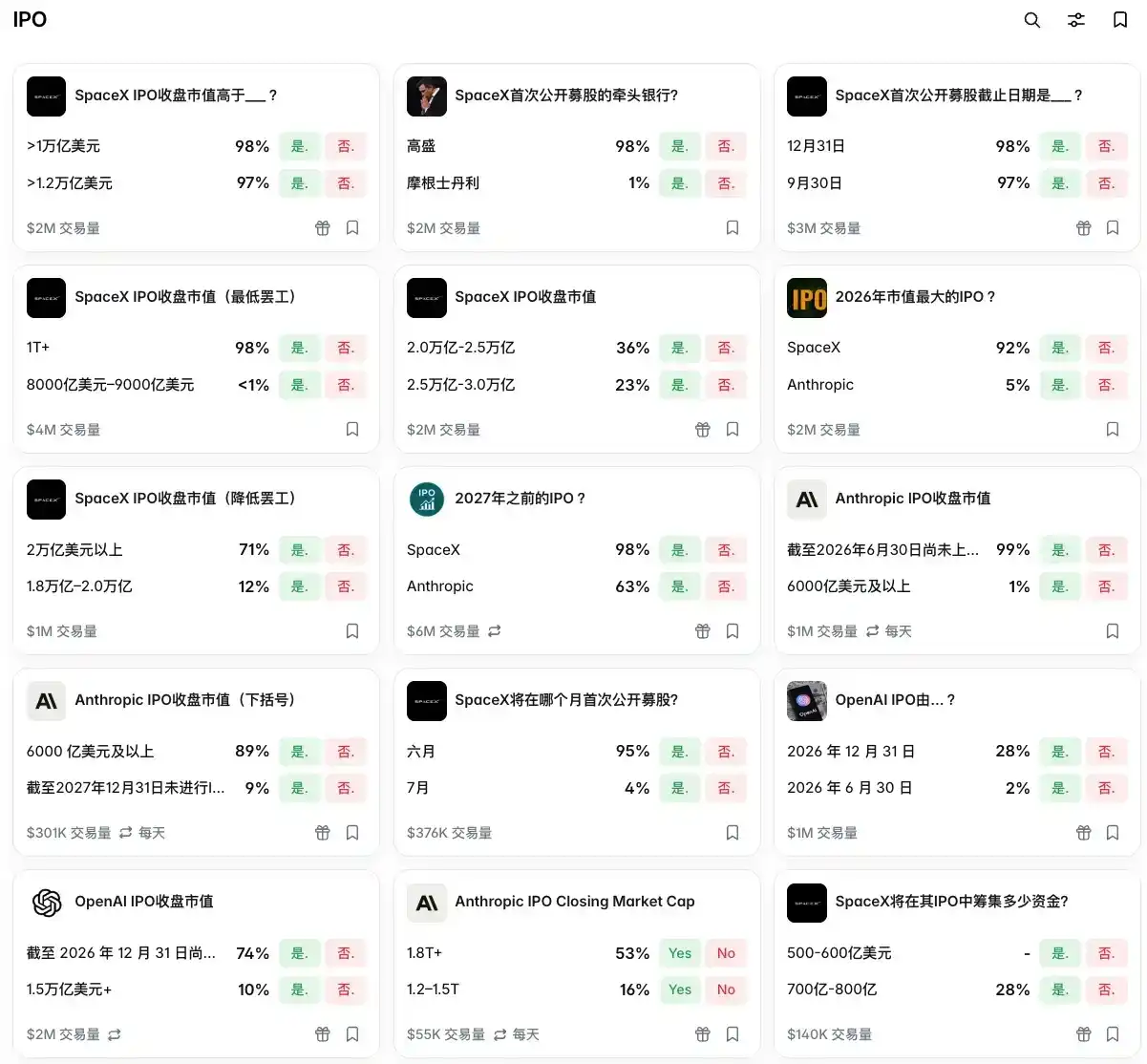
Both competing platforms are placing significant emphasis on this wave of pre-IPO frenzy.

Polymarket's Comeback Fight

Over the past eight months, Polymarket has been surpassed by Kalshi on nearly every visible metric.

In April, Kalshi's monthly trading volume was $14.8 billion, a 13% increase month-over-month. Polymarket's global volume plus the US App volume totaled $10.2 billion, a month-over-month decline of 8.9%. Active traders dropped from 733,000 in March to 643,000 in April, a 12% decrease. In valuation, Kalshi's latest round is $22 billion, while Polymarket is reportedly in talks for $15 billion.

A Bank of America report in April noted that among US-based prediction markets, Kalshi has captured approximately 89% of the market share.

Kalshi's journey over the past few years has been smoother than Polymarket's. In 2020, the CFTC granted it a Designated Contract Market (DCM) license, the first in the US and still the only one specifically issued to an event contract platform. This means Kalshi can accept USD, issue 1099 tax forms, integrate SDKs with platforms like Robinhood, and have its probability data cited by CNN and CNBC. In February of this year, Kalshi was selected by TIME for its TIME100 Most Influential Companies list, and its App Store ranking once approached that of ChatGPT.

Polymarket, fined $1.4 million by the CFTC in 2022, withdrew from the US market. It wasn't until July 2025 that the CFTC and the Department of Justice concluded a new round of investigations against it, allowing it to acquire a compliant trading license through the acquisition of QCEX.

However, Polymarket's partnership with NASDAQ this time is likely a signal of a counteroffensive.

The specific partner for Polymarket is Nasdaq Private Market (referred to as NPM), a company incubated by NASDAQ that specializes in serving private companies. Its main businesses are two-fold:

First, organizing secondary market liquidity programs for employee stock. Employees of companies like OpenAI, SpaceX, and Anthropic hold a large number of options or restricted stock units. Since the companies are not public, they cannot sell on the open market. NPM helps companies organize tender offers, allowing employees to sell their shares to approved external investors. NPM itself has disclosed facilitating nearly $80 billion in such transactions, covering over 1,000 company-sponsored liquidity programs and serving more than 200,000 employee shareholders.

Second, building a valuation database for private companies. NPM daily sees the transaction prices of employee stock for companies like OpenAI, Anthropic, and SpaceX on the secondary market. This data was previously sold only to institutional clients for a hefty annual fee.

The key step in this partnership is NPM's agreement to, for the first time, provide these valuation data to Polymarket for use.

Rodolfo Sanchez, NPM's Data Vice President, made a crucial statement in the press release: "The data flows in both directions." NPM provides data to Polymarket for contract settlement, while Polymarket's contract price curves become, in turn, "institutional signals" available to NPM's clients. Institutional clients buying NPM data also receive a probability curve priced in real-time by hundreds of thousands of retail traders.

Selling Data, Seizing Authority, Capturing Retail

This is not Polymarket's first time selling its data.

In October 2025, ICE announced an investment of up to $2 billion at an $8 billion pre-money valuation. The significance of this deal wasn't just the valuation, but the terms. ICE secured global exclusive distribution rights for Polymarket's data. The sales channels of the parent company of NYSE began selling Polymarket's probability data to global institutional clients.

In January 2026, an exclusive partnership with Dow Jones. Polymarket's prediction data was integrated into The Wall Street Journal, Barron's, MarketWatch, and Investor's Business Daily. The financial media matrix under News Corp began embedding Polymarket's probability signals as standard modules in their layouts, similar to the Dow Jones Index or VIX.

In February 2026, ICE formally launched the 'Polymarket Signals and Sentiment' product. Real-time quotes from thousands of contracts on Polymarket were standardized into structured data streams and distributed to institutional clients via the ICE Consolidated Feed, flowing through the same pipeline as NYSE stock data, bond prices, and corporate announcements. ICE President Ben Jackson mentioned this product alongside Reddit and Dow Jones in the Q1 earnings call, calling it one of the three pillars of ICE's alternative data services.

And this new partnership is about seizing the authority to determine valuations in this year's hottest private market.

We speculate Kalshi won't sit idle; its next move will likely involve partnering with a private market data provider to implement a similar structure. However, mainstream private data providers like Forge and PitchBook have smaller scales and cover fewer companies compared to NPM. NPM has already been exclusively secured by Polymarket. The cost for Kalshi to enter this track will be higher.


相關問答

QWhat is the key collaboration between Polymarket and Nasdaq, and what specific data is being shared?

APolymarket has launched an exclusive collaboration with Nasdaq, specifically its incubated company Nasdaq Private Market (NPM). The key aspect of this partnership is that NPM is providing its private company valuation database to Polymarket for use in settling prediction contracts. This database contains real-time transaction data on employee stock sales from pre-IPO companies like OpenAI, Anthropic, and SpaceX. In return, Polymarket's prediction market price curves serve as a 'crowd-sourced signal' for NPM's institutional clients.

QAccording to the article, how does Polymarket's current position compare to its competitor Kalshi in the US prediction market?

AAccording to the article, Kalshi currently holds a dominant position in the US prediction market. A Bank of America report cited in the article states that Kalshi has captured approximately 89% of the US market share. Key metrics for April show Kalshi with a monthly trading volume of $14.8 billion, compared to Polymarket's combined global and US app volume of $10.2 billion. Furthermore, Kalshi is reported to have a higher valuation and possesses a crucial regulatory advantage with its CFTC-issued Designated Contract Market (DCM) license.

QWhat are the two main business functions of Nasdaq Private Market (NPM) mentioned in the article?

ANasdaq Private Market (NPM) primarily serves two key functions for private companies: 1) Facilitating secondary market liquidity programs for employee shares. It organizes tender offers that allow employees of companies like OpenAI and SpaceX to sell their stock options or restricted shares to approved external investors. 2) Building a valuation database for private companies. NPM collects data on the transaction prices of employee stock sales, creating a valuable proprietary dataset on private company valuations.

QWhat previous steps has Polymarket taken to commercialize its prediction market data prior to the Nasdaq deal?

APrior to the Nasdaq collaboration, Polymarket had already taken significant steps to commercialize its data. In October 2025, Intercontinental Exchange (ICE) invested in Polymarket and secured the global exclusive distribution rights for its data. In January 2026, Polymarket entered an exclusive partnership with Dow Jones, integrating its prediction data into major financial publications like The Wall Street Journal. In February 2026, ICE formally launched the 'Polymarket Signals and Sentiment' product, streaming structured prediction data to institutional clients alongside traditional market data feeds.

QWhy is the pre-IPO company valuation market considered a significant opportunity for prediction markets like Polymarket?

AThe pre-IPO valuation market is a significant opportunity because it addresses a major information gap. Private companies are not obligated to disclose their valuations, and data from funding rounds is often lagging or incomplete. Secondary market quotes are fragmented, and internal transaction prices for employee stock are highly sensitive. This lack of transparent, real-time valuation data creates an ideal environment for prediction markets to aggregate crowd-sourced beliefs about a company's worth, providing an alternative signal that is otherwise inaccessible to the general public.

你可能也喜歡

OpenAI的Hyperliquid盘前定价生意,为何只撑了半年?

文章讨论了在Hyperliquid平台上两家从事“盘前定价”业务的团队:Trade.xyz和Ventuals的不同命运。 Trade.xyz团队匿名,却成为平台上最大的盘前合约市场,成功抓住了SpaceX上市前的交易机会。其策略聪明之处在于,选择像SpaceX这样上市日期和发行价都已确定的标的,最终价格能与现实市场“锚定”,风险相对可控。 而获得顶级风投Paradigm支持的Ventuals,手握OpenAI和Anthropic这类更稀缺但无明确上市计划的标的,反而在运营九个月后关停。其失败关键在于定价机制存在缺陷:合约价格一半依赖外部非公开的老股报价,另一半则参考其自身价格的均线,形成了一个自我强化的循环。这导致价格长期虚高,缺乏真实市场流动性的支撑和纠错,最终失去市场认可。 Ventuals关停时,其定出的OpenAI(1341.80美元)和Anthropic(1618.90美元)的最终价,甚至被部分内部人士作为估值参考,凸显了未上市公司对流动定价的强烈需求,也暴露了这类定价的脆弱性。 文章指出,为未上市明星公司提供实时交易价格正成为一门热门生意,Coinbase等大机构也已入场。但Ventuals的案例表明,这门生意的核心挑战在于,缺乏一个公开、有效、能持续纠错的市场机制来形成真正公允的价格。在标的公司真正上市前,任何定价都可能面临“悬空”的风险。

marsbit6 分鐘前

OpenAI的Hyperliquid盘前定价生意,为何只撑了半年?

marsbit6 分鐘前

日活冲到行业第二的3-4倍,腾讯WorkBuddy撕开了办公Agent的哪条裂缝?

2026年上半年,腾讯推出的办公智能体(Agent)产品WorkBuddy日活跃用户已达行业第二名产品的3到4倍,其高速增长的核心在于成功吸引了大量非技术岗位用户(如HR、运营、行政)。这与OpenAI同期披露的Codex趋势相似(非开发者增速是开发者的3倍以上),但二者路径截然不同。 WorkBuddy并非预设产品,其前身是代码助手CodeBuddy。转折点在于腾讯内部非技术员工自发用它处理研究、报告等非编码任务。团队洞察到“产物才是目的”,于2026年1月快速推出极简版WorkBuddy,公测前已有超2000名内部非技术员工每日使用。 其成功源于三个关键设计决策: 1. **用自然语言替代技术概念**:用户无需理解Agent、prompt等术语,直接以日常语言下达任务。 2. **预封装场景模板**:内置超20种Skills技能包(如数据处理、竞品调研),开箱即用,无需自建流程。 3. **深度原生集成生态**:深度“住进”腾讯文档、微信等国内高频办公软件,成为现有工作流的一部分,而非独立工具。 这些设计拆除了认知、场景和环境三重门槛。相比之下,Codex和Claude Code从命令行/IDE出发,面向开发者,非技术用户需跨越安装、配置和理解交互逻辑的障碍。尽管OpenAI和Anthropic已开始推出角色插件或简化界面(如Claude Cowork)向非技术用户转向,但交互范式和生态集成的重构需要时间,这为WorkBuddy创造了约半年的领先窗口。 数据显示,WorkBuddy在2026年3月公测后增速迅猛(环比达831%),PC端月访问量领先第二名2.6倍。其定价(个人版起价39元/月)也低于海外同类产品(20美元/月起),在国内市场触及面更广。 WorkBuddy代表“场景封装”路线,追求用户使用路径最短;海外产品则侧重“底层能力”,追求功能最强。当前,WorkBuddy已发布企业版以巩固优势,但面对海外巨头在底层模型能力和快速追赶,其先发优势将面临长期考验。核心差异在于:用户无需懂技术,只需知道自己要什么。

marsbit15 分鐘前

日活冲到行业第二的3-4倍,腾讯WorkBuddy撕开了办公Agent的哪条裂缝?

marsbit15 分鐘前

比特币矿场变AI数据中心:Sangha的“卖身”抉择

2025年12月,Spencer Marr在美国德州为名为Genesis的比特币矿场剪彩。这座规模19.9兆瓦的矿场采用“表后直供”模式,直接从相邻的太阳能农场获取低价电力,实现了低至约32美元/兆瓦时的运营成本,使其在比特币行情下行时仍能盈利。 然而,通电仅半年后的2026年6月,Marr的公司Sangha便通过投行放出消息,考虑出售、合资或引入战略伙伴。其根本原因并非经营不善,而是AI算力需求爆发带来了新的估值逻辑。对于亟需电力与数据中心资源的AI公司而言,Genesis这样一个已通电、有扩容潜力(规划至110.4兆瓦)且电力接入手续齐全的站点,价值远超过其作为矿场的本身。 Sangha的商业模式是项目制,通过设立特殊目的载体(SPV)吸引投资。如今,他们计划在估值高点出售这份“电力资产”,这比自行扩建为AI数据中心更为划算。其推介重点也已从比特币挖矿转向AI计算、高性能计算等多元场景。 这一转变并非个例,Core Scientific等上市矿企也已纷纷转向AI/HPC业务。Sangha的案例凸显了一个趋势:在AI的巨大需求下,拥有稳定、低价电力资源的比特币矿场基础设施,正成为被争抢的稀缺资产。矿工们面临的抉择是:是坚守挖矿,还是将阵地拱手让给AI,换取丰厚的资本回报。

marsbit46 分鐘前

比特币矿场变AI数据中心:Sangha的“卖身”抉择

marsbit46 分鐘前

交易

現貨
合約

熱門文章

如何購買POL

歡迎來到HTX.com!在這裡,購買Polygon Ecosystem Token (POL)變得簡單而便捷。跟隨我們的逐步指南,放心開始您的加密貨幣之旅。第一步:創建您的HTX帳戶使用您的 Email、手機號碼在HTX註冊一個免費帳戶。體驗無憂的註冊過程並解鎖所有平台功能。立即註冊第二步:前往買幣頁面,選擇您的支付方式信用卡/金融卡購買:使用您的Visa或Mastercard即時購買Polygon Ecosystem Token (POL)。餘額購買:使用您HTX帳戶餘額中的資金進行無縫交易。第三方購買:探索諸如Google Pay或Apple Pay等流行支付方式以增加便利性。C2C購買:在HTX平台上直接與其他用戶交易。HTX 場外交易 (OTC) 購買:為大量交易者提供個性化服務和競爭性匯率。第三步:存儲您的Polygon Ecosystem Token (POL)購買Polygon Ecosystem Token (POL)後,將其存儲在您的HTX帳戶中。您也可以透過區塊鏈轉帳將其發送到其他地址或者用於交易其他加密貨幣。第四步:交易Polygon Ecosystem Token (POL)在HTX的現貨市場輕鬆交易Polygon Ecosystem Token (POL)。前往您的帳戶,選擇交易對,執行交易,並即時監控。HTX為初學者和經驗豐富的交易者提供了友好的用戶體驗。

565 人學過發佈於 2024.12.11更新於 2026.06.02

如何購買POL

相關討論

歡迎來到 HTX 社群。在這裡,您可以了解最新的平台發展動態並獲得專業的市場意見。 以下是用戶對 POL (POL)幣價的意見。

活动图片












