Telegram Takes Direct Control of TON, Social Traffic Rewrites the Public Chain Narrative

marsbitPublished on 2026-05-11Last updated on 2026-05-11

Abstract

Telegram founder Pavel Durov announced that Telegram will replace the TON Foundation as the core driver and largest validator of The Open Network (TON). Key initiatives include a sixfold reduction in transaction fees, performance upgrades, and improved developer tools within the next few weeks. This marks a strategic shift from Telegram merely providing user access to deeply integrating TON into its platform's core infrastructure. The goal is to transform Telegram's massive social traffic into sustainable on-chain activity. While viral mini-apps like Notcoin have demonstrated Telegram's ability to drive user adoption, TON aims to support frequent, low-value transactions inherent to social platforms—such as tipping, in-app payments, and game rewards. Ultra-low fees and sub-second finality (0.6 seconds) are crucial to making blockchain interactions seamless and nearly invisible within the Telegram user experience. However, Telegram's increased central role raises questions about network decentralization. Durov argues that Telegram's participation will attract more large validators, thereby enhancing decentralization. TON also offers high annual staking rewards (18.8%), aiming to retain capital within its ecosystem. The fundamental challenge for TON is no longer leveraging Telegram's user base, but becoming an indispensable, seamless infrastructure layer for Telegram's everyday applications—moving from an adjacent chain to an embedded utility.

Author | Asher(@Asher_ 0210)
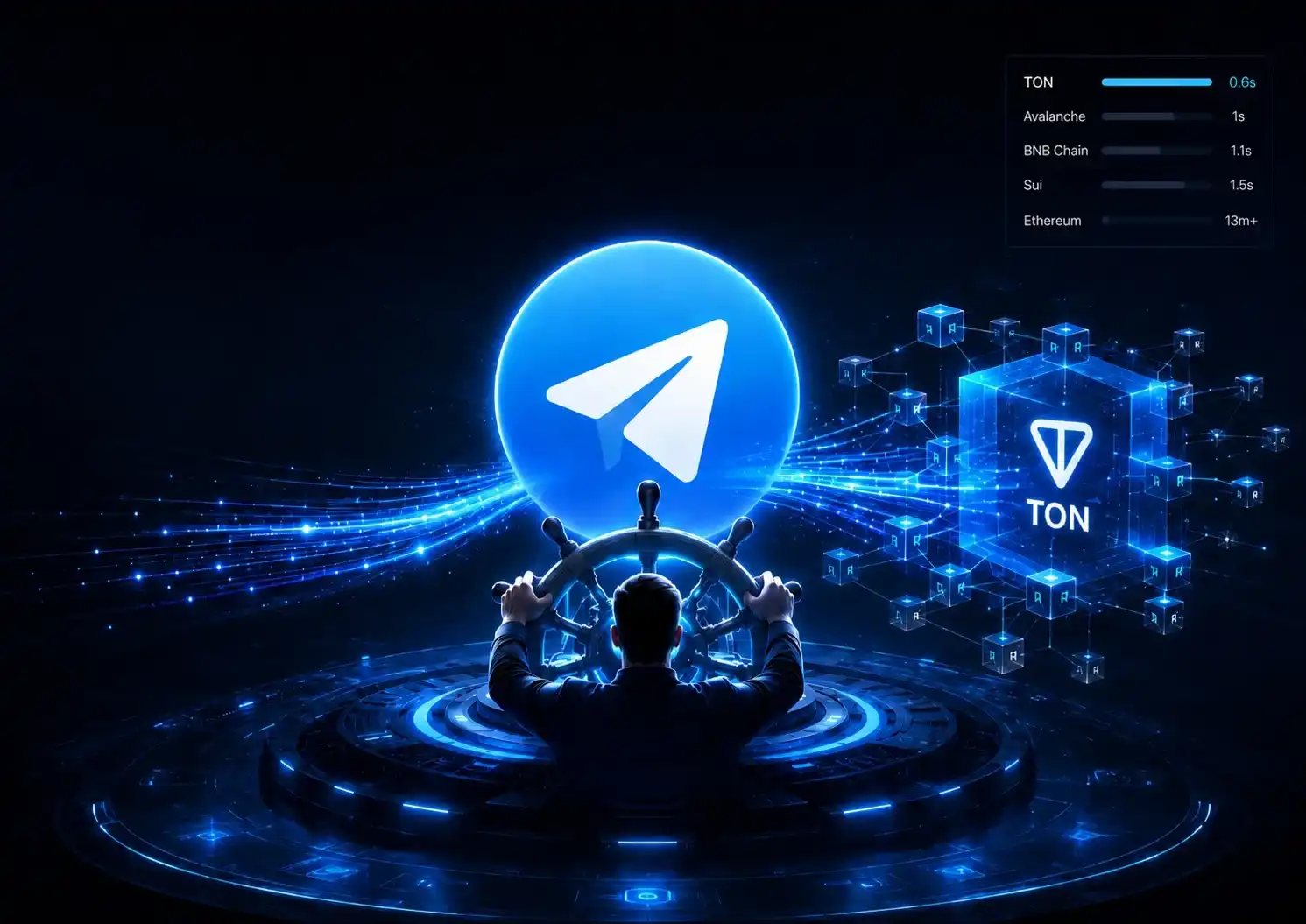
On May 4th, Telegram founder Pavel Durov announced on platform X that TON network transaction fees have been reduced by 6 times, nearing zero. More crucially, he stated that Telegram will replace the TON Foundation, becoming the new core driving force of the TON network and its largest validator. TON's focus will now shift to technological advantages, including a new ton.org, new developer tools, and performance upgrades, with a timeframe of the next 2 to 3 weeks.
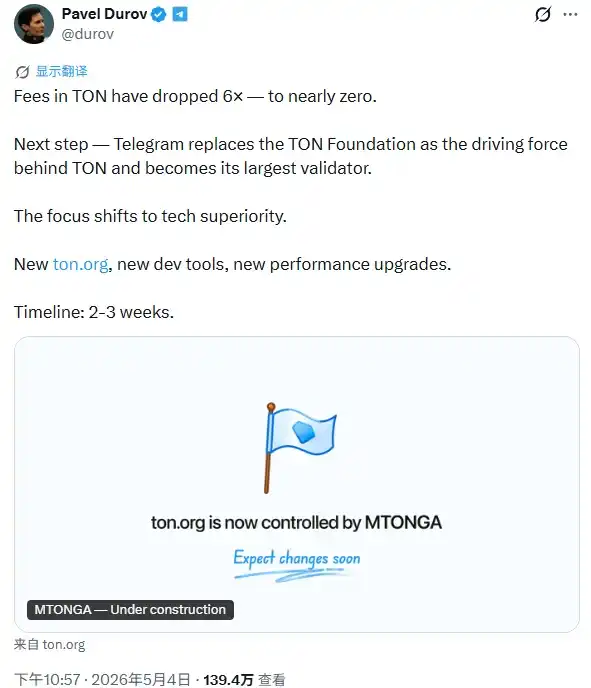
Telegram Founder: TON Fees Reduced by 6x, Telegram to Become Largest Validator

In the past, the relationship between TON and Telegram was more like a strong binding with weak leadership. Telegram provided the gateway, while the Foundation and community were responsible for advancement, with a layer of distance always between them. But this time, Telegram isn't just continuing to bring users to TON; it's beginning to enter more foundational positions such as validator, technical roadmap, and development tools. TON is no longer just a chain adjacent to the Telegram ecosystem but is being reintegrated into Telegram's product system.

TON Doesn't Lack a Gateway; It Lacks Turning the Gateway into Use Cases

Past market discussions about TON often revolved around Telegram's user scale. But for a public chain, having a gateway doesn't equal having an ecosystem, and having user reach doesn't equal having long-term usage. TON's unique aspect is its inherent attachment to a high-frequency social platform, where Mini Apps, wallets, channels, bots, games, and payments already exist within Telegram. This allows TON to avoid having to find users from scratch like most Layer1s. However, if these scenarios cannot solidify into sustained on-chain interactions, Telegram's traffic can only bring waves of short-term hype.

Projects like Notcoin and Dogs have proven that Telegram can quickly generate viral spreads. Simple gameplay combined with social relationship chains can indeed attract a large number of users into crypto applications in a short time. But such explosions come and go quickly. TG mini-games and airdrops can bring attention but can hardly alone sustain a long-term ecosystem.

Therefore, the fee reduction, speed increase, developer tools, and validator role emphasized by Pavel Durov this time point not to a single technological upgrade, but to TON addressing its most critical missing link—transforming Telegram's gateway into sustainable use cases. Only when fees are low enough, confirmation speeds are fast enough, and developer integration is simple enough can scenarios like channel tipping, Mini Apps tasks, game rewards, creator revenue, ad revenue sharing, bot calls, and group micropayments potentially evolve from product features into on-chain activities.

TON no longer needs to repeat the story of "backed by Telegram." What it truly needs to prove is whether the high-frequency behaviors within Telegram can be effectively borne by TON.

Fee Reduction and Speed Increase Aim to Enable Smaller, Higher-Frequency Transactions

The fee reduction by TON this time shouldn't be understood merely as cost optimization typical of public chains. Viewed within the context of Telegram, it actually solves the problem of whether small-amount, high-frequency interactions can become viable.

Most potential on-chain behaviors within Telegram are not large transfers but more fragmented daily operations. Individual transaction amounts are low, but occurrence frequency is high. If users have to perceive fees, wait for confirmations, and repeatedly handle wallet interactions with every button click, these scenarios can hardly truly take off.

Therefore, fee reduction and speed increase must be considered together. Fees approaching zero lower the usage barrier; reducing finality time to 0.6 seconds lowers the perception of waiting. For Telegram, the chain shouldn't become an extra layer perceived by users but should be hidden as much as possible behind product actions like sending messages, clicking buttons, and viewing balance changes.
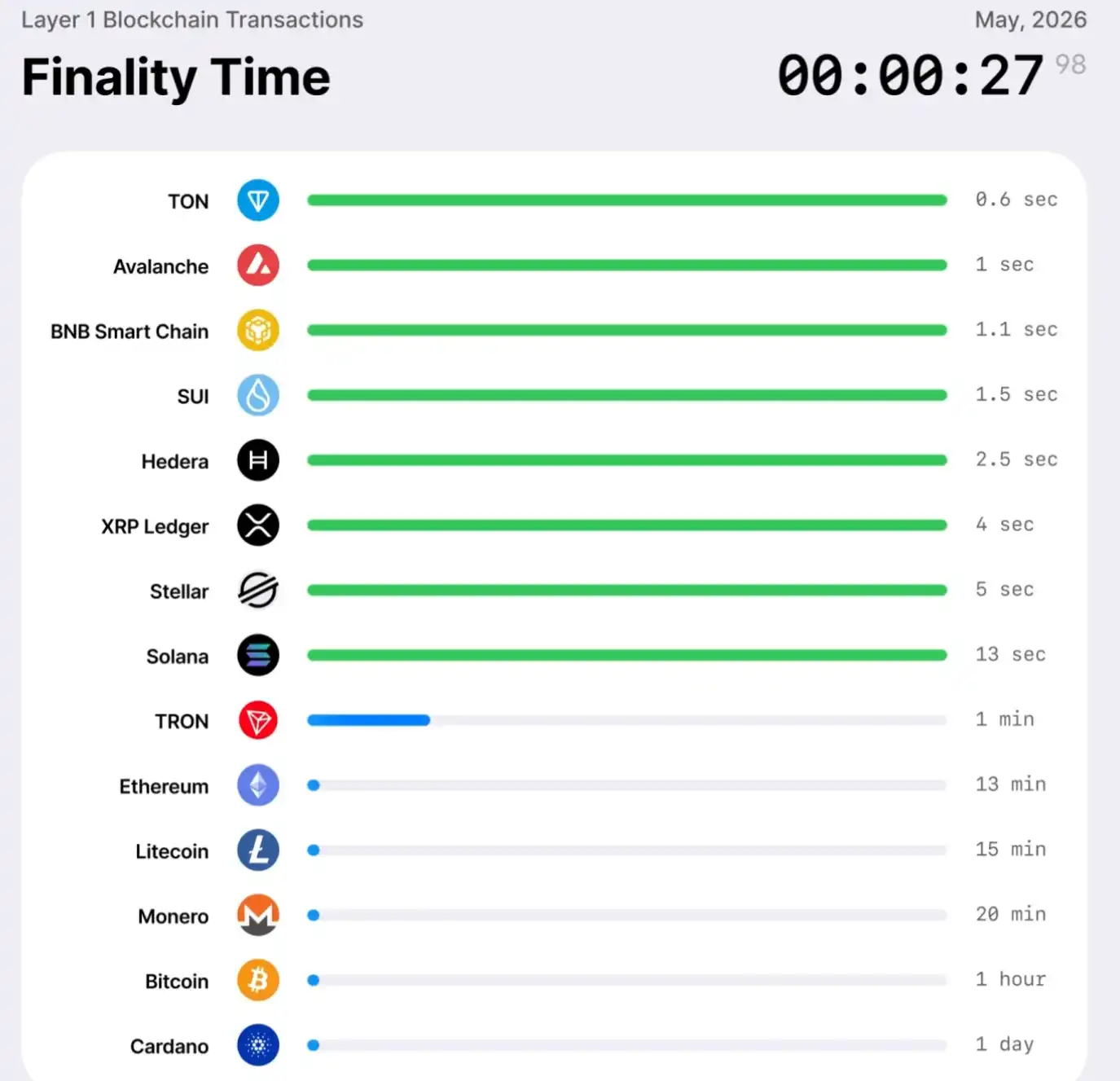
Comparison of "Finality Time" Among Mainstream Public Chains

This also distinguishes TON from many other Layer1s. Its goal isn't solely to make DeFi trades faster or transfers cheaper; it aims to embed the chain into Telegram's daily use. Only when cost, waiting time, and wallet operations are minimized enough can TON potentially evolve from a Telegram-related public chain into the underlying network directly invoked by Telegram's application layer.

From Gateway to Validator, Telegram Begins Penetrating TON's Core

Telegram becoming TON's largest validator is the most significant step in this change. It means Telegram is no longer just providing TON with a gateway and brand endorsement but is entering the network's security and operational mechanisms. Previously, TON was driven by the Foundation and community, which offered greater openness but a relatively decentralized pace. Now, with Telegram directly involved, its products, wallet, Mini Apps, payments, and developer tools have the opportunity to be realigned.

Efficiency may increase, but controversy will also grow. Telegram replacing the TON Foundation as the main driving force and becoming the largest validator will inevitably lead to renewed external discussions about TON's centralization risks. In response, Pavel Durov stated that Telegram's participation would attract more large-scale participants into the validator pool, thereby enhancing decentralization. This logic is not without merit, but the final judgment will depend on results, not statements.

The truly important aspects going forward are whether the validator structure can become more diverse, whether governance information is sufficiently transparent, whether the Foundation and community retain independent space, and whether ecosystem projects can continue developing without relying on Telegram's will.

Therefore, Telegram's return is not a simple positive but a trade-off. For TON to enter the mainstream application layer, it needs Telegram's strong execution capabilities; but the more prominent Telegram's role, the more TON needs to prove it is not merely an internal settlement chain serving Telegram.

High Staking Rewards Retain More Tokens for TON

Pavel Durov subsequently emphasized that TON ranks first in annual staking rewards among the top 50 cryptocurrencies by market cap, with a high rate of 18.8%. Compared to fee reduction and speed increase, high staking rewards are more likely to mobilize capital sentiment and provide TON with another layer of holding rationale in the market's eyes.
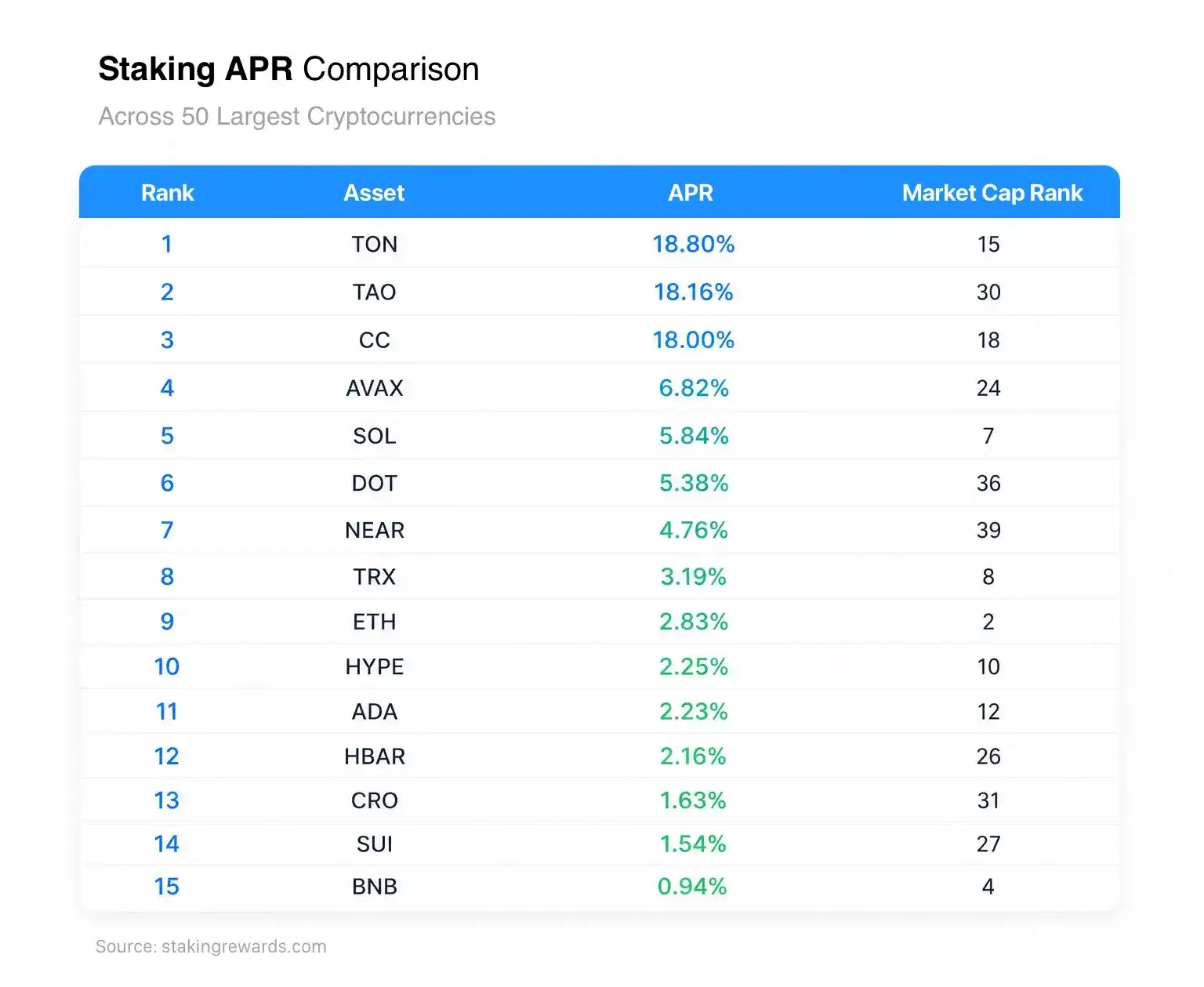
TON Annual Staking Rewards Rank First Among Top 50 Cryptocurrencies

This also makes TON's narrative somewhat more complete. It's not just relying on Telegram's user gateway to attract attention or improving experience through technical upgrades; it's also using staking rewards to keep capital within its ecosystem. The simultaneous presence of gateway, performance, validators, and rewards makes this change more substantial than a single positive factor.

Of course, high yield itself is not the end goal; it's more like buying TON a longer observation period. As long as subsequent developer tools and performance upgrades are delivered, and more capital is locked into the network, a positive feedback loop with real usage may form. For TON, the value of staking rewards isn't just about increasing holding returns but making the market willing to continue waiting for it to truly convert Telegram's gateway advantage.

TON's Return to Telegram Is Not the Finish Line, But a Tougher Challenge

The key for TON going forward is not to continue leveraging Telegram for traffic, but to truly become part of Telegram's application ecosystem. If Telegram's chat, payments, applications, creator economy, and automated interactions are gradually undertaken by TON, then TON's competitors will not just be other Layer1s, but all networks attempting to become the next-generation application infrastructure.

TON isn't just repeating the social traffic story; it's beginning to attempt to turn social traffic into on-chain order. The gateway is just the beginning; usage is the answer. Telegram can push TON to the forefront, but whether it stays there ultimately depends on whether TON can become the layer of infrastructure that operates behind user perception, within the functioning of applications.

If the past TON was still proving how close it is to Telegram, now it must prove how deeply integrated it can be within Telegram's daily use. True mainstream adoption isn't about making users aware they are using a chain, but about making the chain part of the application experience.

TON's opportunity lies here, and so does its pressure.

Related Questions

QAccording to the article, what is the new role that Telegram will assume in the TON network, as announced by Pavel Durov?

ATelegram will become the new core driver of the TON network, replacing the TON Foundation. It will also become the network's largest validator.

QWhat is identified as the key challenge TON needs to overcome, beyond just having access to Telegram's large user base?

ATON needs to transform its access and user reach into sustainable, long-term usage scenarios. It must convert Telegram's high-frequency social interactions into persistent on-chain activities.

QWhy are the reductions in transaction fees and improvements in speed particularly important for TON within the Telegram context?

ALow fees (approaching zero) and fast finality (0.6 seconds) are crucial to enable the small, frequent, and fragmented transactions typical of Telegram's daily use cases. They lower the barrier and reduce user friction, allowing the blockchain to operate seamlessly in the background of the app experience.

QWhat potential downside or concern is raised regarding Telegram becoming the core driver and largest validator of TON?

AThe move raises concerns about increased centralization risk and questions regarding the future independence of the TON Foundation and community projects. It represents a trade-off between stronger execution from Telegram and the need for TON to maintain network decentralization.

QHow does the article frame the high annual staking reward offered by TON, and what purpose does it serve?

AThe high staking reward (18.8% annually, ranked first among top 50 cryptocurrencies) is seen as a mechanism to attract and lock in capital within the TON ecosystem. It provides an additional incentive for holding TON and buys time for the network to realize its potential in converting Telegram's user base into active usage.

Related Reads

Vitalik's Algorithmic Stablecoin Vision: Interpreting the Mechanism and Challenges from an Options Perspective

Vitalik Buterin's recent algorithmic stablecoin proposal envisions using an option-like mechanism to create a stablecoin without the liquidation risks inherent in traditional collateralized debt position (CDP) models. The design splits one unit of ETH into two components: a 'stable' leg (P) that maintains value up to a certain strike price, and an 'upside' leg (N) that captures any appreciation above that price. Together, they always sum to one ETH, eliminating the need for debt or liquidation mechanisms. From an options perspective, the stable leg essentially functions as a synthetic, covered call position. However, significant challenges exist. For the stable asset to maintain its peg, it must continuously roll deep in-the-money call options, leading to potential rollover slippage, predictable trading paths vulnerable to front-running, and liquidity issues. Crucially, the system's scalability depends on a constant demand for the upside leg—a form of leveraged ETH long position without funding rates or liquidation risk. It's unclear if such persistent, specific demand will materialize from speculators or market makers who have simpler alternatives like perpetual swaps. The author, drawing from experience with Rysk, argues that DeFi options have struggled as standalone trading products due to complexity and fragmented liquidity. Their potential lies instead as foundational infrastructure underpinning more complex financial primitives like stablecoins, structured yields, or index products—transforming from a direct product into a core pricing and risk distribution engine for the next generation of on-chain finance.

marsbit1h ago

Vitalik's Algorithmic Stablecoin Vision: Interpreting the Mechanism and Challenges from an Options Perspective

marsbit1h ago

GPT-5.6 Countdown: Abandon the Illusion of a Single API, Computational Iteration Can't Outpace a Single Page of Compliance

In mid-June, three seemingly independent industry events—the compliance-driven throttling of Fable 5, the open-sourcing of GLM-5.2, and the leaked release timeline for GPT-5.6—are pushing the global AI industry toward a watershed moment. These shifts signal a fundamental restructuring of the industry's underlying logic. First, **"usability" has substantially overtaken "advanced capabilities"** as the primary weight, pushing the global large language model (LLM) supply chain into a "dual-track" phase of controlled closed-source and local open-source coexistence. Second, **the competitive moats of closed-source giants are shifting**. Their technical focus is moving from "language intelligence" toward "spatial intelligence (world models)"—a domain heavily reliant on computing power. Third, faced with常态化 transnational compliance risks, **a "model-agnostic" decoupled design has become a survival necessity for application-layer developers to maintain business continuity.** The article details how Anthropic's Fable 5, despite its advanced engineering feats, was restricted for non-U.S. citizens within 72 hours of launch, highlighting how geopolitical compliance can instantly limit even the most advanced models. In response, the open-source camp, exemplified by Zhipu AI's MIT-licensed GLM-5.2, is gaining market share by offering stable performance improvements and significant cost advantages (up to 70% savings for enterprises), while achieving full adaptation with domestic semiconductor platforms. Meanwhile, closed-source leaders like OpenAI are pivoting. The anticipated GPT-5.6 reportedly shifts focus from language to spatial intelligence and world models, aiming to rebuild a generational gap in areas like 3D understanding, simulation, and industrial design that demand immense compute. The core conclusion is that the LLM supply chain's logic has changed. Enterprises must now evaluate infrastructure based on a composite of technical performance and policy compliance. For developers, complete reliance on a single closed-source API poses unacceptable risk. Implementing a truly model-agnostic architecture—enabling swift switches to compliant, locally deployable open-source alternatives—is no longer just good practice but a fundamental baseline for business continuity.

marsbit3h ago

GPT-5.6 Countdown: Abandon the Illusion of a Single API, Computational Iteration Can't Outpace a Single Page of Compliance

marsbit3h ago

Is the 'Token Subsidy War' Among AI Giants Almost Over?

The article discusses the ongoing "token subsidy war" among AI giants like OpenAI and Anthropic, questioning whether it's nearing its end. It reveals that current AI subscription prices are heavily subsidized, with some plans offering tokens at up to 70 times the actual cost to attract and retain heavy users, especially developers and enterprises. This strategy mirrors past internet-era subsidy battles, but with a key difference: AI tokens lack "lock-in" effects. Unlike ride-hailing or food delivery apps, users can easily switch between AI providers as APIs become standardized, making it difficult for companies to raise prices post-subsidy. The piece highlights a structural asymmetry in the competition. Giants like Google, with massive advertising revenue, can afford to subsidize tokens indefinitely, akin to using "tokens as a weapon." In contrast, venture-backed companies like OpenAI and Anthropic face pressure to become profitable, especially as they approach IPO. The article cites Google Ventures founder Bill Maris, who suggests Google could slash token prices by 80%, putting immense pressure on competitors. Two potential endgames are presented: the "internet service" model (subsidize, monopolize, then raise prices) and the "utility" model (tokens become a standardized, low-margin commodity like electricity). Given the low switching costs, the latter seems more likely. The competition may not have a single winner but could instead accelerate AI's evolution into a foundational, infrastructure-level technology, akin to a public utility. For now, users continue to benefit from heavily subsidized token costs.

marsbit4h ago

Is the 'Token Subsidy War' Among AI Giants Almost Over?

marsbit4h ago

Trading

Spot
Futures
活动图片