Lazy Man's Financial Management Restart|Ethereal Earns 27% APR While Farming Points; Huma Opens New 28% APY God Pool (January 6th)

Odaily星球日报Published on 2026-01-06Last updated on 2026-01-06

Abstract

Odaily Planet Daily has restarted its "Lazy Man's Cryptocurrency Guide" series, focusing on relatively low-risk stablecoin yield opportunities. The article highlights several current strategies across centralized exchanges (CEXs) and decentralized platforms. On CEXs, Binance offers a 20.06% APR on USD1 deposits (up to $50k) until January 24, while OKX provides up to 10% APR on USDG holdings. For on-chain opportunities, Ethereal allows users to hedge positions from other perpetual DEXs while earning up to 27.2% APR on USDe collateral, plus potential airdrops. Huma Prime offers a fixed-term pool with up to 28% APR for 6-month lockups, though it's currently full. Kamino enables leveraged farming with PRIME/CASH, achieving up to 23.45% APY. Lastly, Pendle's sNUSD LP pool offers up to 18.41% APY with additional积分 multipliers. The author advises prioritizing CEX options for simplicity and lower risk, noting that on-chain strategies involve higher fees and are better suited for larger capital.

Original | Odaily Planet Daily(@OdailyChina)

Author|Azuma(@azuma_eth)

Early last year, considering readers' increasing demand for stablecoin financial management opportunities, Odaily Planet Daily launched the column "A More Suitable Lazy Man's U-based Financial Management Guide," aiming to cover relatively low-risk yield strategies in the market primarily involving stablecoins (and their derivative tokens), helping users who wish to gradually amplify their capital scale through U-based financial management to find relatively ideal interest-earning opportunities.

This series was updated 29 times in total, introducing nearly a hundred yield windows with relatively high returns during different periods. In addition to pure U-based returns, the attached points and additional rewards also captured "big airdrops" such as Plasma, Ethena, Huma, Avantis, Falcon, etc.

However, the sudden black swan event on October 11 led to a sharp contraction of on-field liquidity. Coupled with the occurrence of several security incidents in succession, we judged at that time that the risk transmission of on-chain DeFi had not yet ended, so we suspended the update of this column. Recently, market sentiment and liquidity have shown obvious signs of recovery, so we decided to restart this column.

Simplest Strategy: Deposit Activities on Major CEXs

Currently, the simplest financial management opportunities are obviously the deposit activities launched by major CEXs.

First is the hottest Binance USDⓈ deposit activity, with an APR of 20.06%, a limit of 50,000 USDⓈ. The activity will last until 7:59 on January 24th, leaving about half a month of the yield window. Although USDⓈ currently has a slight premium compared to USDT (and is expected to have a certain discount after the activity ends), the returns are enough to cover the wear and tear.

In addition, the OKX Pay account's USDG holding interest-earning activity also has a maximum annualized yield of 10%, but the quota is relatively small, only 10,000 USDG; the annualized yield for the excess part will drop to 5%.

I recall that other exchanges also have similar deposit activities (such as Huobi's 20% annualized U current earn coin), but I haven't participated personally yet. You can consider them according to your own usage.

On-chain Strategy One: Ethereal Hedging Orders, Maximum APR Up to 27%

When there is still quota space on the CEX side, I personally suggest giving priority to CEX activities. First, because the incentive intensity of current CEX activities is already attractive enough; second, it can also reduce unnecessary protocol risks and path wear and tear.

If you really consider on-chain opportunities, it is recommended to use the strategy of amplifying margin returns through hedging orders on the decentralized contract exchange Ethereal (https://app.ethereal.trade/trade/BTCUSD).

Lighter's TGE reignited the interactive enthusiasm for the Perp DEX track. My current operation method is to open orders on popular Perp DEXs like Variational to earn points, while simultaneously opening reverse orders on Ethereal in a completely mirrored way for hedging. The reason for doing this is that while Ethereal gives the抵押资产 USDe a basic APR of 5.13%, it also amplifies the yield based on the user's order situation (APR can reach up to 27.2%,收益来自交易费分成), and additionally gives points rewards corresponding to future airdrops.
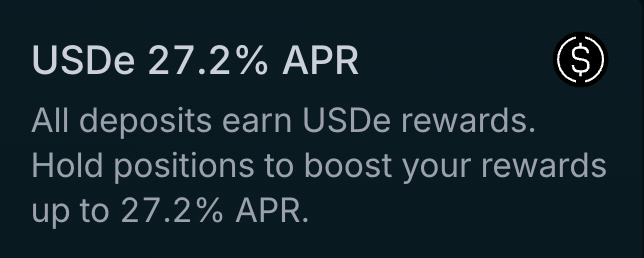
Everyone has different judgments about the future competitive landscape of Perp DEXs, but whether you are mainly farming points on Variational, Backpack, Nado, or StandX, it is currently recommended to use Ethereal as the number one hedging option, using the实实在在的抵押资产收益 to slow down or even cover the wear and tear.

It should be noted that using Ethereal temporarily requires an invitation code to unlock all functions (easy to get in DC), and then you need to bridge USDe from Ethereum to the Ethereal chain (can use StarGate) for deposit and use it as a gas token. There will be certain wear and tear on the path, so it is not recommended to operate with too small an amount.

On-chain Strategy Two: Huma Prime Waiting for Increased Quota, Maximum Annualized 28%

This is a pool that requires setting a small alarm clock.

PayFi leader Huma launched a new pool called Huma Prime yesterday. Actually, to put it bluntly, it is a revolving loan pool for PST. If locked for 6 months, the maximum annualized yield can reach 28% (22.6% without badge加成). The收益 is composed of basic收益, revolving loan收益, plus HUMA incentives.
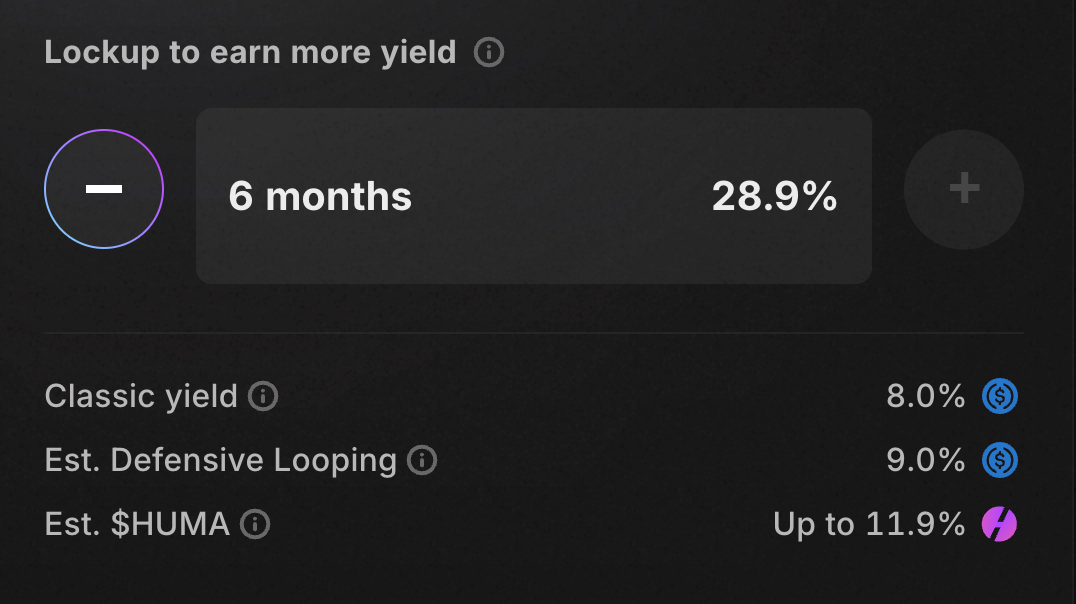
The first 12 hours after the launch of this pool were not open to the public, only supporting OG and Vanguard badge holders to deposit. However, it was filled up only 3 hours after opening, so new users暂时 have no chance to deposit and can only wait for the official quota increase to participate.

It needs to be emphasized first that Huma Prime is different from the previous Classic and Maxi pools. The LP positions have no secondary market, so it is impossible to exit early. Users can only redeem at the Huma official window after the lock-up period ends.

On-chain Strategy Three: Kamino PRIME/CASH Revolving Loan, Maximum Annualized 23.45%

Users who can accept Huma Prime are generally not too resistant to revolving loans. If you don't want to wait for the quota, you can consider the PRIME/CASH revolving loan on Kamino. The Multiply function can build positions with one click by selecting the leverage multiplier, up to 8 times, corresponding to an APY of about 23.45%.

In terms of asset risk, PRIME is a yield stablecoin issued by Hastra, Figure, and Provenance, with抵押资产 being real-world Home Equity Line of Credit (HELOC). CASH is a stablecoin issued by Phantom.

This pool has been open for over a month now, and the historical yield backtest is relatively stable. It is recommended to assess the risk and return situation yourself before participating.

On-chain Strategy Four: Pendle Neutrl(sNUSD) LP, Maximum Annualized 18.41%

Neutrl is a project I personally like very much and have introduced many times before. Simply put, it is a more aggressive version of Ethena, but the hedging asset is changed from mainstream tokens to altcoins acquired at a discount OTC — the main investor is the largest OTC trading platform STIX, giving it a certain uniqueness in model.
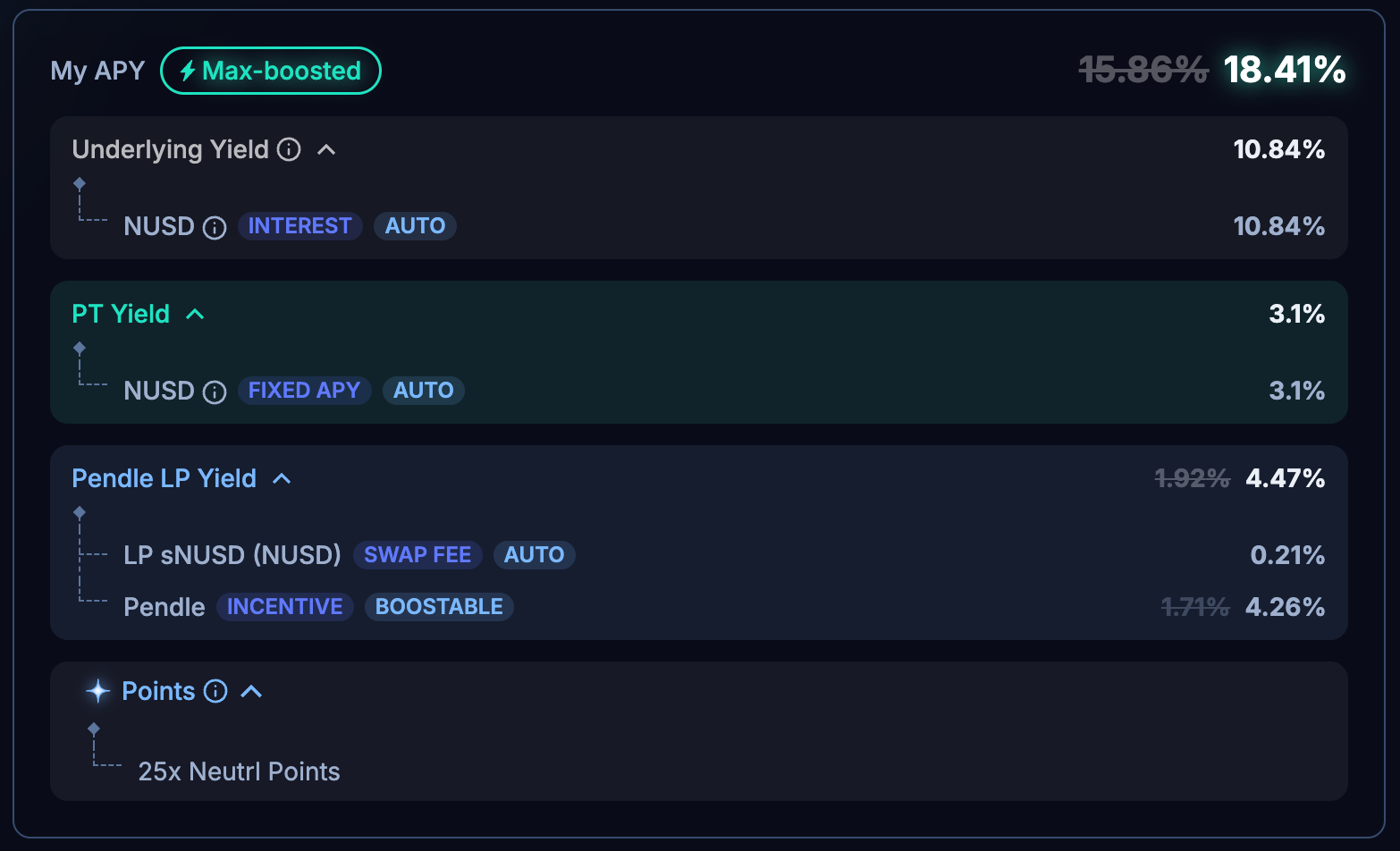
Compared to static deposits (holding NUSD) or staking (holding sNUSD), the most efficient way to participate now is to form an sNUSD LP on Pendle. With sufficient PENDLE staking, the maximum annualized yield can reach 18.41%, the basic annualized yield is 13.97%, plus 25x Neutrl points to capture airdrop opportunities.

Since the pool is on the Ethereum mainnet, there will be certain wear and tear when entering and exiting the path, so it is not recommended to participate with small amounts.


Trending Cryptos

Related Questions

QWhat is the highest APR offered by the Binance USD1 deposit activity mentioned in the article, and what is the deposit limit?

AThe Binance USD1 deposit activity offers an APR of 20.06% with a deposit limit of 50,000 USD1.

QHow can users achieve a maximum APR of 27% on the decentralized exchange Ethereal, and what is required to unlock all its features?

AUsers can achieve a maximum APR of 27% on Ethereal by using a hedging strategy, which involves opening positions to earn trading fee shares. An invitation code is required to unlock all features of the platform.

QWhat is the highest annual yield offered by the new Huma Prime pool, and what is the lock-up period for achieving this yield?

AThe Huma Prime pool offers a maximum annual yield of 28% with a lock-up period of 6 months.

QWhich strategy on Kamino allows users to achieve an APY of up to 23.45% using leverage, and what assets are involved?

AThe Kamino PRIME/CASH loop strategy allows users to achieve an APY of up to 23.45% by using leverage of up to 8x. The assets involved are PRIME, a yield stablecoin backed by real-world home equity lines of credit (HELOC), and CASH, a stablecoin issued by Phantom.

QWhat is the maximum APY achievable by providing liquidity for sNUSD on Pendle, and what additional incentive is offered besides the yield?

AThe maximum APY achievable by providing liquidity for sNUSD on Pendle is 18.41%, and users also earn 25x Neutrl points to capture potential airdrop opportunities.

Related Reads

GPT-5.6 Countdown: Abandon the Illusion of a Single API, Computational Iteration Can't Outpace a Single Page of Compliance

In mid-June, three seemingly independent industry events—the compliance-driven throttling of Fable 5, the open-sourcing of GLM-5.2, and the leaked release timeline for GPT-5.6—are pushing the global AI industry toward a watershed moment. These shifts signal a fundamental restructuring of the industry's underlying logic. First, **"usability" has substantially overtaken "advanced capabilities"** as the primary weight, pushing the global large language model (LLM) supply chain into a "dual-track" phase of controlled closed-source and local open-source coexistence. Second, **the competitive moats of closed-source giants are shifting**. Their technical focus is moving from "language intelligence" toward "spatial intelligence (world models)"—a domain heavily reliant on computing power. Third, faced with常态化 transnational compliance risks, **a "model-agnostic" decoupled design has become a survival necessity for application-layer developers to maintain business continuity.** The article details how Anthropic's Fable 5, despite its advanced engineering feats, was restricted for non-U.S. citizens within 72 hours of launch, highlighting how geopolitical compliance can instantly limit even the most advanced models. In response, the open-source camp, exemplified by Zhipu AI's MIT-licensed GLM-5.2, is gaining market share by offering stable performance improvements and significant cost advantages (up to 70% savings for enterprises), while achieving full adaptation with domestic semiconductor platforms. Meanwhile, closed-source leaders like OpenAI are pivoting. The anticipated GPT-5.6 reportedly shifts focus from language to spatial intelligence and world models, aiming to rebuild a generational gap in areas like 3D understanding, simulation, and industrial design that demand immense compute. The core conclusion is that the LLM supply chain's logic has changed. Enterprises must now evaluate infrastructure based on a composite of technical performance and policy compliance. For developers, complete reliance on a single closed-source API poses unacceptable risk. Implementing a truly model-agnostic architecture—enabling swift switches to compliant, locally deployable open-source alternatives—is no longer just good practice but a fundamental baseline for business continuity.

marsbit56m ago

GPT-5.6 Countdown: Abandon the Illusion of a Single API, Computational Iteration Can't Outpace a Single Page of Compliance

marsbit56m ago

Is the 'Token Subsidy War' Among AI Giants Almost Over?

The article discusses the ongoing "token subsidy war" among AI giants like OpenAI and Anthropic, questioning whether it's nearing its end. It reveals that current AI subscription prices are heavily subsidized, with some plans offering tokens at up to 70 times the actual cost to attract and retain heavy users, especially developers and enterprises. This strategy mirrors past internet-era subsidy battles, but with a key difference: AI tokens lack "lock-in" effects. Unlike ride-hailing or food delivery apps, users can easily switch between AI providers as APIs become standardized, making it difficult for companies to raise prices post-subsidy. The piece highlights a structural asymmetry in the competition. Giants like Google, with massive advertising revenue, can afford to subsidize tokens indefinitely, akin to using "tokens as a weapon." In contrast, venture-backed companies like OpenAI and Anthropic face pressure to become profitable, especially as they approach IPO. The article cites Google Ventures founder Bill Maris, who suggests Google could slash token prices by 80%, putting immense pressure on competitors. Two potential endgames are presented: the "internet service" model (subsidize, monopolize, then raise prices) and the "utility" model (tokens become a standardized, low-margin commodity like electricity). Given the low switching costs, the latter seems more likely. The competition may not have a single winner but could instead accelerate AI's evolution into a foundational, infrastructure-level technology, akin to a public utility. For now, users continue to benefit from heavily subsidized token costs.

marsbit1h ago

Is the 'Token Subsidy War' Among AI Giants Almost Over?

marsbit1h ago

Beyond the Stadium: The Profitable Games Surrounding the World Cup

"Beyond the Pitch: The Profit Game Around the World Cup" The FIFA World Cup transcends being a sporting spectacle, evolving into a massive global arena for speculation and profit-seeking. The 2026 tournament has amplified this dynamic, creating a multi-layered ecosystem of financial opportunism alongside the football. **Prediction markets** have surged into the mainstream. Platforms like Polymarket and Kalshi saw trading volumes for World Cup contracts soar, attracting new users with their financial trading model and high-profile, chain-based wealth stories that overshadow traditional sports betting in terms of growth and narrative. However, **traditional sportsbooks** remain the dominant force, leveraging established user habits, legal markets, and comprehensive product offerings to handle the vast majority of speculative wagers, with projections suggesting record-breaking betting volumes. Capital markets also react. **"Concept stocks"** in countries like South Korea and Japan experience volatile price swings based on team performance and anticipated fan spending on items like chicken, beer, and viewing parties, effectively becoming a stock market reflecting fan sentiment. The **ticket resale market** has become a sophisticated arena for arbitrage. Prices fluctuate wildly based on team draws and star power, with sellers sometimes listing tickets they don't yet own in a practice akin to short-selling, while FIFA's own "Right to Buy" tokens add another layer of speculative trading. **Collectibles and merchandise** offer another avenue. Panini sticker albums, with their inherent scarcity and nostalgic value, can become high-value collectibles. Limited-edition or locally themed jerseys command significant premiums on secondary markets, and even counterfeit vendors profit from fans' desire for affordable match-day identity. The **cryptocurrency** space has seen a frenzy of speculative, unauthorized World Cup-themed meme coins on chains like Solana. These tokens, often exploiting team names and player imagery, experience extreme pump-and-dump cycles, creating stories of massive gains for a few early entrants and steep losses for many others. Finally, an entire industry thrives on **providing information and tools** to other speculators. Developers create platforms like SeatSidekick to track ticket inventory and prices, while paid Telegram groups and subscriptions sell betting tips and predictions, monetizing the widespread desire for an informational edge. In essence, the World Cup has become a compressed, global laboratory for speculation. While the games determine champions on the field, a parallel, complex network of financial transactions—spanning prediction contracts, bets, stocks, tickets, collectibles, crypto, and information services—settles its own scores in the global market.

marsbit1h ago

Beyond the Stadium: The Profitable Games Surrounding the World Cup

marsbit1h ago

How Does Codex Use a Computer? Three Entry Points and Permission Boundaries

This article explains the three primary methods for Codex to interact with a computer, each with distinct use cases, permission boundaries, and trust levels. **1. Computer Use:** This offers the broadest access, allowing Codex to visually control and interact with the graphical user interface of authorized macOS/Windows apps, system settings, and even iOS simulators. It's ideal for tasks lacking APIs or structured tools, such as operating legacy software or multi-app workflows. However, it's the slowest method and has the widest permission scope, requiring careful supervision for sensitive actions. **2. Chrome Extension:** This grants Codex access to the user's logged-in Chrome browser state, including cookies, profiles, and open tabs. It's best for tasks requiring user identity across websites like Gmail, LinkedIn, Salesforce, or internal dashboards. Its key advantage is multi-tab control for complex workflows. While more powerful for browser-based tasks than Computer Use, it carries higher sensitivity as actions are performed under the user's identity. **3. In-App Browser:** This is a browser isolated within the Codex thread, separate from the user's personal browsing data. It excels in web development and debugging scenarios—previewing local servers, testing responsive layouts, or annotating designs directly on the page. Its isolation is a strength for development but a limitation for tasks requiring login sessions. The core principle is to choose the narrowest, safest, and most structured interface for the task. Use plugins or MCPs first, resort to visual control (Computer Use) only for GUI-dependent tasks, employ the Chrome extension for identity-reliant browser work, and prefer the In-App Browser for isolated development. **Appshots** are clarified as a fourth, complementary tool for *inputting* context—capturing a screenshot of a window to point Codex to something—rather than a method for Codex to *act*. Together, this layered approach highlights a key to AI agent productization: not granting unlimited permissions, but constraining them within clear boundaries for specific tasks while preserving user oversight.

marsbit3h ago

How Does Codex Use a Computer? Three Entry Points and Permission Boundaries

marsbit3h ago

Trading

Spot
Futures

Hot Articles

How to Buy APR

Welcome to HTX.com! We've made purchasing aPriori (APR) simple and convenient. Follow our step-by-step guide to embark on your crypto journey.Step 1: Create Your HTX AccountUse your email or phone number to sign up for a free account on HTX. Experience a hassle-free registration journey and unlock all features.Get My AccountStep 2: Go to Buy Crypto and Choose Your Payment MethodCredit/Debit Card: Use your Visa or Mastercard to buy aPriori (APR) instantly.Balance: Use funds from your HTX account balance to trade seamlessly.Third Parties: We've added popular payment methods such as Google Pay and Apple Pay to enhance convenience.P2P: Trade directly with other users on HTX.Over-the-Counter (OTC): We offer tailor-made services and competitive exchange rates for traders.Step 3: Store Your aPriori (APR)After purchasing your aPriori (APR), store it in your HTX account. Alternatively, you can send it elsewhere via blockchain transfer or use it to trade other cryptocurrencies.Step 4: Trade aPriori (APR)Easily trade aPriori (APR) on HTX's spot market. Simply access your account, select your trading pair, execute your trades, and monitor in real-time. We offer a user-friendly experience for both beginners and seasoned traders.

4.1k Total ViewsPublished 2025.10.27Updated 2026.06.02

How to Buy APR

Discussions

Welcome to the HTX Community. Here, you can stay informed about the latest platform developments and gain access to professional market insights. Users' opinions on the price of APR (APR) are presented below.

活动图片