Dual Governance 101: Explainer

项目方LDO(Lido)Published on 2025-06-03Last updated on 2025-11-10

Introducing Dual Governance: Giving stETH Holders a Voice


There is an inherent tension in DAO-run systems: those who shape the protocol’s design are not necessarily those who shoulder the outcomes firsthand. The DAO holds upgrade rights, while stETH holders bear the execution risk. Because upgrades are inevitable as Ethereum evolves, this tension only grows.


Dual Governance addresses these concerns by enabling stETH holders to express discontent and exit the protocol if confronted with controversial LDO-governance decisions.


At its core, Dual Governance represents a dynamic timelock: the more exit signals stETH holders submit, the longer LDO-governance motions are delayed.


This achieves two aims at once:

  1. Makes contention visible and measurable.
  2. Gives stakers the option to exit safely, avoiding unfavorable protocol changes.

Here is how it works, why it matters, and the key parameters that make it effective.


The Core Idea: The Right to Exit & Balanced Power

  1. Right to Exit Safely: stETH holders can withdraw their stake if they oppose governance decisions, preventing forced changes to their crypto-assets.
  2. Balance of Interests: No single group (LDO holders, node operators, or stakers) can unilaterally push harmful changes on stakers. Each has a voice, and strong disagreements trigger a built-in pause for negotiation or exit.


Why It’s Needed: The Risk of Governance Attack

Ethereum’s validator-exit queue can delay withdrawals for weeks or months during congestion. In that window, a hostile majority of LDO tokens could force smart-contract upgrades, eject node operators, or reassign user-withdrawal addresses.


Dual Governance mitigates such extreme scenarios by allowing stETH holders to voice disagreement and by blocking protocol governance for the time needed to exit.


This makes large-scale takeovers costly and impractical, enhancing the protection of Lido participants and, indirectly, Ethereum itself.


How Dual Governance Works

Dual Governance adds a “sentiment gauge” that lets stETH holders delay LDO-governance execution when opposition rises.


Ultimately, the contention is either mediated or—if an active governance attack targets protocol users—stakes can be withdrawn safely through the rage-quit gate.


The more stETH that signals disagreement, the longer the execution delay. Once opposition reaches a major threshold (10 % of TVL), governance cannot execute any change until the opposing stakers withdraw their tokens.


Key Scenarios: When Dual Governance Matters

Scenario 1: Voicing Opposition and De-escalation


  • LDO holders propose removing a node operator, unaware of critical reasons to keep them.
  • stETH holders signal a veto, triggering a temporary pause.
  • LDO holders reconsider and cancel the proposal.
  • Governance continues as usual without harming user trust.


Scenario 2: Reacting to Takeover—Guaranteed Exit

  • A large LDO-holding entity proposes a smart-contract change that jeopardizes user tokens.
  • Enough stETH holders lock tokens in the veto-signalling contract, delaying execution.
  • stETH holders exit if LDO holders refuse to cancel.
  • After withdrawals complete—or the proposal is canceled and stETH holders have unlocked their tokens—governance resumes.


Dual Governance Design

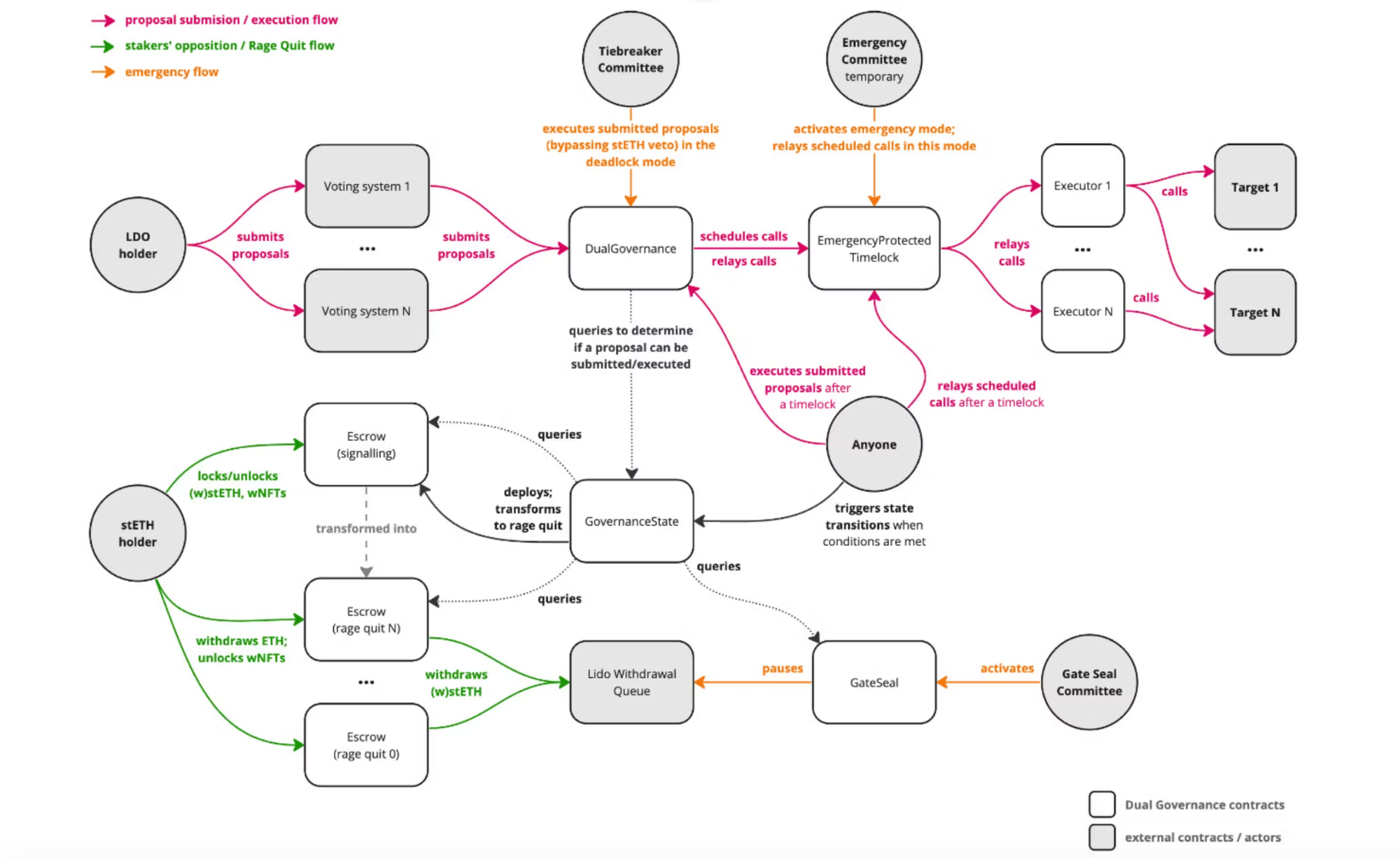
Dual Governance inserts a timelock between Lido-DAO decisions and execution. It is linked to an escrow where stETH holders can signal intent to exit by locking stETH, wstETH, or withdrawal NFTs.


Once deposits cross the first-seal threshold (1 % of Lido-on-Ethereum TVL), the timelock starts to grow. Reaching the second seal (10 % of TVL) triggers rage quit—execution is fully blocked until all locked stake is withdrawn to ETH.


All contracts have undergone multiple independent audits, ensuring the code meets the highest security standards.


The system has undergone third-party design reviews from Certora and Runtime Verification. Audit reports are available from Certora, Statemind, OpenZeppelin, and Runtime Verification.


All proposed parameters were tested by two independent teams: game-theoretic research by 20squares and agent-based modeling by CollectifDAO.


Proposal Lifecycle

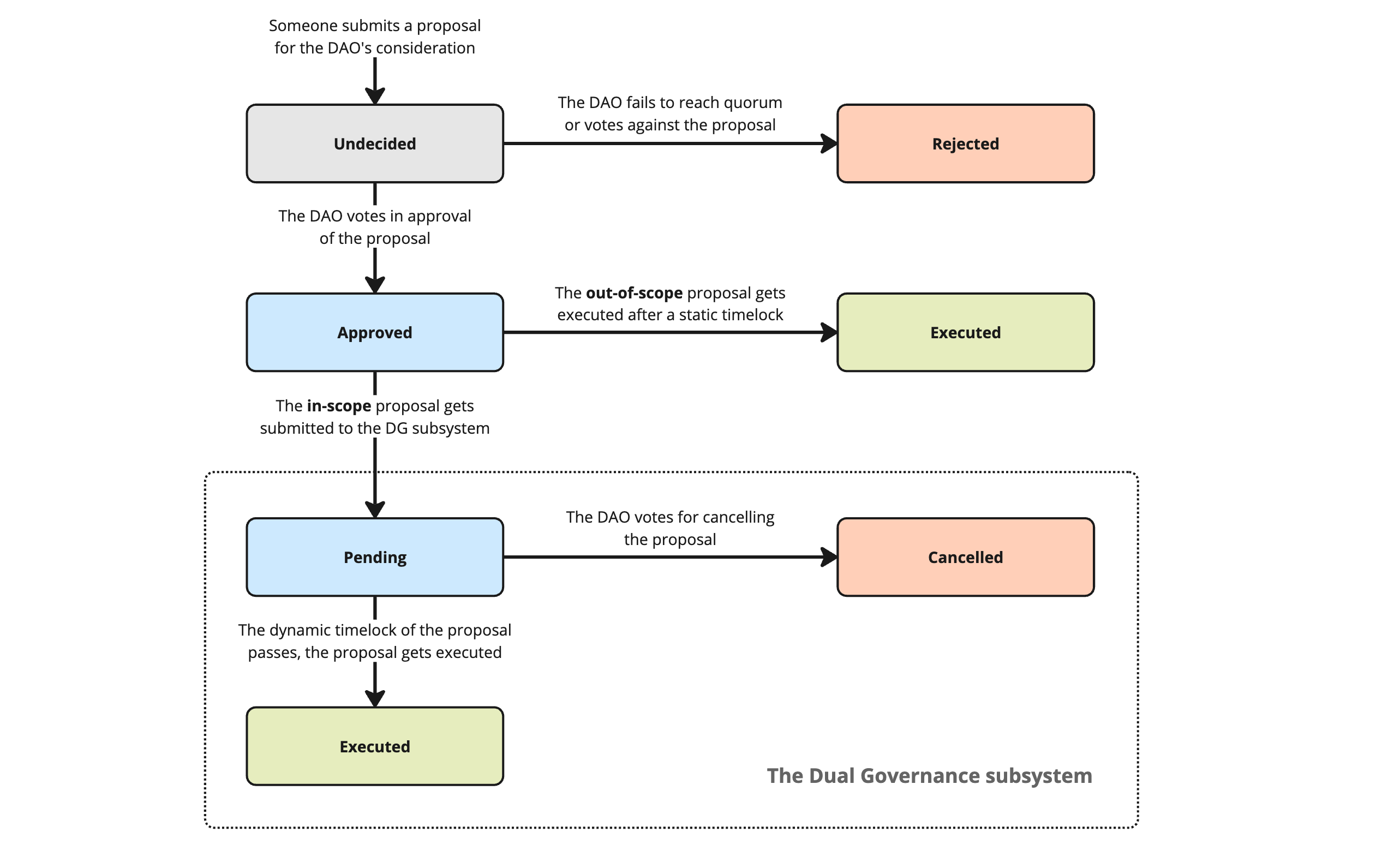
When the DAO (i.e., LDO holders) supports a proposal—such as upgrading a smart contract or adding a node operator—it does not execute immediately. Instead, it enters a four-day waiting period. During this time, stETH holders can trigger Veto Signaling by locking tokens.


If triggered, a dynamic timelock replaces the standard delay, extending the waiting period according to the amount of stETH committed (from five extra days at 1 % to a maximum of 45 days at 10 %). During this period:


  • The DAO can still cancel pending proposals if contention is visible.
  • stETH holders may escalate by locking more stETH, further extending the timelock or eventually triggering a rage quit.


Once the timelock expires, the proposal can be executed, allowing on-chain changes to take effect.


Governance States

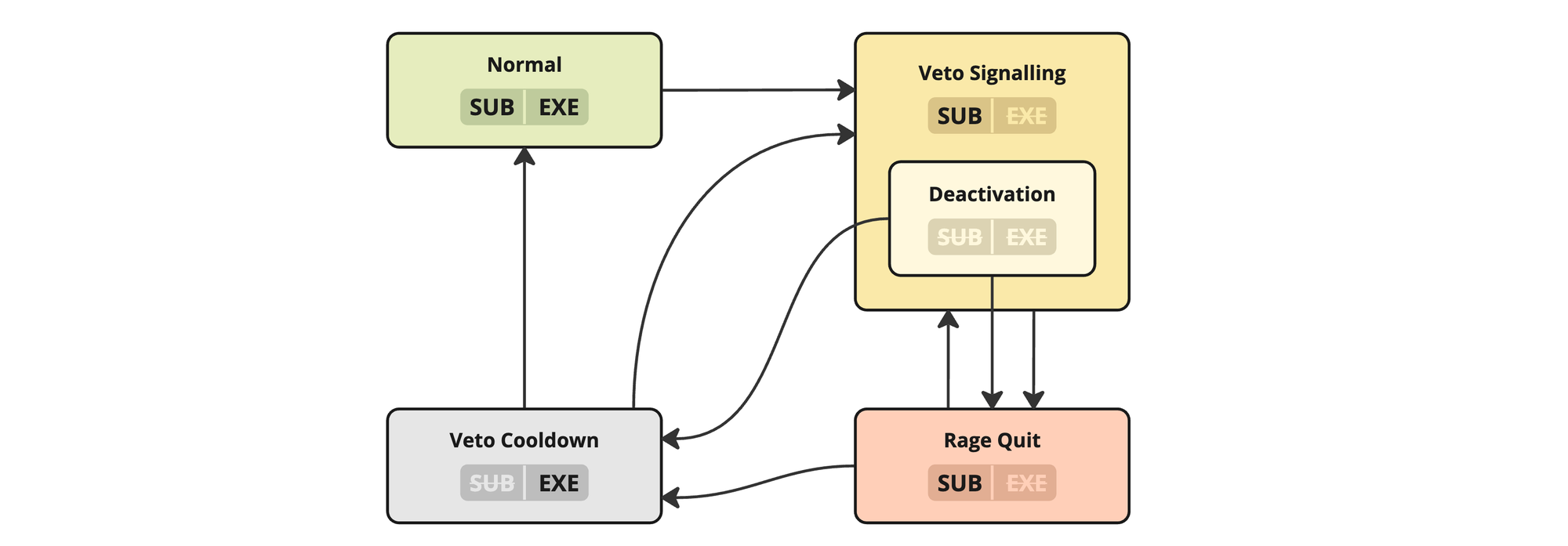
Dual Governance follows a state-machine model, each state imposing specific rules:

  1. Normal: Default state; proposals spend four days pending, then can be executed.
  2. Veto Signaling: Triggered when 1 % of stETH supply is escrowed in opposition. The proposal is paused under a dynamic timelock, which expands from five to 45 days proportional to stETH opposition.
  3. Rage Quit: If 10 % of stETH remains locked until the timelock ends, stakers exit. No new proposals can execute until withdrawals finish, shielding users from the contested motion.
  4. Veto-Signaling Deactivation and Veto Cooldown: Technical sub-states that resolve edge cases; only pending proposals may execute during Veto Cooldown.


The Role of Committees: Fine-Tuning Governance Resilience

Dual Governance introduces three new committees that cover different areas:

1. Reseal Committee

A safety net that extends the withdrawal pause triggered by GateSeal.

  • GateSeal: Pauses withdrawals for 11 days if a critical issue is detected.
  • Reseal: Extends GateSeal’s pause when Veto Signaling is active, giving the DAO more time to act.


2. Tiebreaker Committee

A last-resort measure for unlikely stalemates.

  • Can force execution of stuck proposals or unseal withdrawal contracts.
  • Activates only after long-term governance paralysis.


Structure: A “multisig of multisigs” comprising three subcommittees:

  • Ethereum Ecosystem (3/5 quorum)
  • Builders (3/5 quorum)
  • Node Operators (5/7 quorum)


At least two of the three subcommittees must reach quorum. All members are external to avoid conflicts of interest.


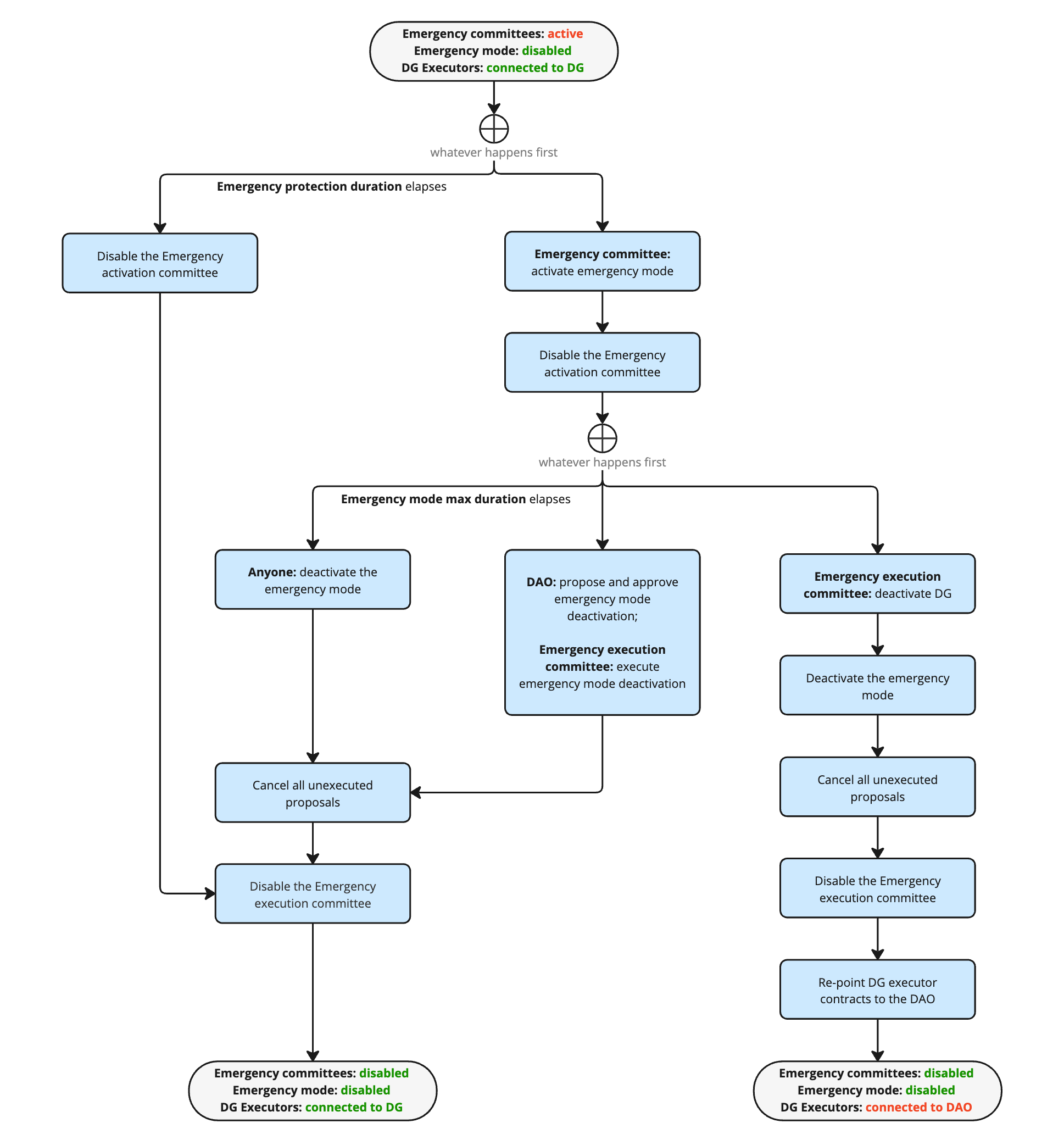
3. Emergency Committee

Purpose: Safety mechanism for the first year after deployment.


  • Can pause Dual Governance, halt permissionless execution, and temporarily restore LDO-token governance.
  • May execute proposals while DG is disabled to restore stability.


Composition

  • Activation multisig (4/7): May trigger emergency mode once, within a limited window.
  • Execution multisig (5/7): Temporarily controls governance logic to fix or revert.


Designed as a one-off failsafe, not a standing power.
 

Conclusion: Solid governance model for Liquid Staking on Ethereum

One of the key properties of DeFi is the user's right to exit, and Dual Governance implements it for Lido on Ethereum. While catering to Ethereum staking mechanics requires an intricate design, the resulting mechanism aims for resilience, mitigating even theoretical edge cases.


The very release of Dual Governance shifts the game theory around the protocol's upgrade levers, mitigating heavy risk vectors without ever being triggered.


While it won't prevent every potential governance risk, it makes large-scale attacks impractical and rebalances power toward those with the most at stake.

Trending Cryptos

Related Reads

Financing Weekly Report | 11 Public Financing Events, Stablecoin Payment Infrastructure Company Trace Finance Completes $32 Million Series A Round Led by CoinFund

Financing Weekly Report | 11 public funding events recorded, with a total scale exceeding $264 million. The stablecoin payment infrastructure sector remains a hot spot. Key Deals: - Trace Finance, a stablecoin payment infrastructure firm, raised $32 million in a Series A round led by CoinFund to expand in Latin America and Asia-Pacific. - Galaxy Ventures co-led a $140 million Series A round for Karta, a US credit card provider for global travelers without requiring an SSN. - Instant payment platform Interchecks completed a $50 million Series C round. - Paradigm led a $9 million Series A for Latin American cross-border payment app El Dorado. - Range, a stablecoin compliance startup, raised $8.3 million in an oversubscribed Series A. - RWA infrastructure project Renaiss raised $1.5 million to expand its on-chain collectibles platform. Sector Breakdown: - Infrastructure & Tools: 6 deals, including the above-mentioned Trace Finance, Range, and Renaiss. - Centralized Finance (CeFi): 3 deals, led by Karta's $140 million round. - DeFi: 1 deal – reinsurance protocol Re secured strategic investment from Coinbase Ventures. - Prediction Markets: 1 deal – K25.ai completed a $10 million Pre-A round from NewGen. Other notable transactions include digital asset depository RDC raising $7 million, ad-tech startup EarnOS securing $6 million, and a $1 million strategic investment in LitVM, a ZK Layer 2 for Litecoin. The report highlights sustained investor interest in stablecoin payment infrastructure, compliant on-chain finance, and real-world asset (RWA) tokenization.

marsbit6m ago

Financing Weekly Report | 11 Public Financing Events, Stablecoin Payment Infrastructure Company Trace Finance Completes $32 Million Series A Round Led by CoinFund

marsbit6m ago

When Transfers Become Truly Frictionless: How Sui Uses 'Zero Gas' to Become the Underlying Infrastructure for Stablecoin Payments

Title: Sui Launches Zero-Gas Stablecoin Transfers to Become the Foundation for Stablecoin Payments Sui has introduced a zero-gas fee feature for peer-to-peer stablecoin transfers, eliminating the need for users or businesses to hold separate SUI tokens to pay transaction costs. This innovation, built on a new underlying account architecture called Address Balances, significantly reduces validator processing costs for eligible transactions. Currently, the feature applies to a whitelist of stablecoins for transfers meeting a minimum amount, effectively preventing spam. This development aims to unlock mainstream payment use cases for stablecoins—such as everyday purchases, remittances, and subscriptions—by removing cost and complexity barriers. It is also positioned to benefit high-frequency micro-payments for AI agents and institutional B2B payments, reducing operational friction. Major custody provider Fireblocks has already announced support. The move follows Sui processing over $1 trillion in stablecoin transfer volume since August 2025. Looking ahead, Sui plans to enhance this infrastructure with protocol-level confidential transactions later in 2026, aiming to provide scalable, free, and privacy-preserving payments. Together, these advancements strengthen Sui's goal of becoming the default settlement layer for stablecoin payments.

marsbit8m ago

When Transfers Become Truly Frictionless: How Sui Uses 'Zero Gas' to Become the Underlying Infrastructure for Stablecoin Payments

marsbit8m ago

Ethereum Is Retracing the Path of the Internet and Linux: No One Yields, and the Neutral Party Ultimately Prevails

This article argues that Ethereum is following the historical path of open, neutral systems like the Internet and Linux, which eventually triumphed over proprietary, centrally-controlled alternatives. Major financial institutions like JPMorgan, Stripe, and Circle are building their own proprietary blockchains or networks (e.g., Tempo, Arc), but will never agree to build on a competitor's controlled infrastructure. This creates the perfect opportunity for Ethereum as the only neutral, credibly neutral settlement layer that no single entity controls. The piece draws parallels to the 1990s, when experts like Bill Gates predicted proprietary networks (from Microsoft, Oracle) would win over the open Internet, and when Sun Microsystems' Unix lost to the open-source "bazaar" development model of Linux. This model, described in Eric Raymond's "The Cathedral and the Bazaar," thrives on permissionless innovation where countless contributors improve the system, outpacing any centralized competitor. Ethereum embodies this through its decentralized development, broad validator distribution, and credible neutrality—rules that are transparent, equally applied, hard to change, and open to all. This has attracted over a million developers and major institutions like Coinbase, BlackRock, and JPMorgan, who choose Ethereum for its security, ecosystem, and sovereignty (the inability of any single party to change the rules). While proprietary chains offer initial speed and control, they inherit the downsides of both centralization and decentralization without the long-term innovation benefits. The article concludes that, just as open systems historically win, Ethereum is poised to become the foundational, neutral settlement layer for global finance.

marsbit18m ago

Ethereum Is Retracing the Path of the Internet and Linux: No One Yields, and the Neutral Party Ultimately Prevails

marsbit18m ago

Kalshi's Biggest Rival is Not Polymarket

Kalshi's CEO Tarek Mansour has identified the company's primary competitors not as the crypto-based prediction market Polymarket, but as established financial and gaming giants: CME Group, Robinhood, and DraftKings. This reflects a shift in the prediction market landscape, where the 2026 FIFA World Cup is expected to bring massive new trading volume. Traditional platforms are increasingly integrating prediction markets as a feature within their existing ecosystems. Robinhood has seen rapid growth with its prediction markets, contributing significantly to its "other transaction revenue." Similarly, Interactive Brokers (IBKR) integrates contracts from Kalshi and CME Group, while DraftKings and FanDuel (via CME) have launched their own prediction products. This allows these firms to leverage their vast user bases and infrastructure at low marginal cost, turning prediction markets from standalone apps into embedded functionalities. In response, prediction market platforms are evolving along two paths. First, they are expanding into new event categories like sports (e.g., the World Cup) and financial data to reduce reliance on election cycles. Second, they are moving towards becoming infrastructure and liquidity providers for distribution platforms. Kalshi's lead over Polymarket in trading volume is partly attributed to this channel strategy, integrating with brokers like Robinhood, Coinbase, and Webull. However, this strategy faces a challenge as distributors like Robinhood begin building their own in-house prediction market capabilities (e.g., Rothera), potentially threatening the value of pure infrastructure providers. The situation parallels historical tech battles, such as Zoom competing with Microsoft Teams and Google Meet, where embedded features in larger platforms reshape market dynamics. The future of standalone prediction market leaders like Kalshi and Polymarket will depend on their ability to navigate this new competitive landscape dominated by integrated financial and gaming titans.

链捕手25m ago

Kalshi's Biggest Rival is Not Polymarket

链捕手25m ago

Trading

Spot
Futures

Hot Articles

How to Buy STETH

Welcome to HTX.com! We've made purchasing Lido Staked ETH (STETH) simple and convenient. Follow our step-by-step guide to embark on your crypto journey.Step 1: Create Your HTX AccountUse your email or phone number to sign up for a free account on HTX. Experience a hassle-free registration journey and unlock all features.Get My AccountStep 2: Go to Buy Crypto and Choose Your Payment MethodCredit/Debit Card: Use your Visa or Mastercard to buy Lido Staked ETH (STETH) instantly.Balance: Use funds from your HTX account balance to trade seamlessly.Third Parties: We've added popular payment methods such as Google Pay and Apple Pay to enhance convenience.P2P: Trade directly with other users on HTX.Over-the-Counter (OTC): We offer tailor-made services and competitive exchange rates for traders.Step 3: Store Your Lido Staked ETH (STETH)After purchasing your Lido Staked ETH (STETH), store it in your HTX account. Alternatively, you can send it elsewhere via blockchain transfer or use it to trade other cryptocurrencies.Step 4: Trade Lido Staked ETH (STETH)Easily trade Lido Staked ETH (STETH) on HTX's spot market. Simply access your account, select your trading pair, execute your trades, and monitor in real-time. We offer a user-friendly experience for both beginners and seasoned traders.

1.4k Total ViewsPublished 2024.03.29Updated 2026.06.02

How to Buy STETH

Discussions

Welcome to the HTX Community. Here, you can stay informed about the latest platform developments and gain access to professional market insights. Users' opinions on the price of STETH (STETH) are presented below.

活动图片