Poland Approves Strict Crypto Law Under EU MiCA Rules

TheCryptoTimesPublished on 2025-09-29Last updated on 2025-09-29

Poland’s lower house of parliament, the Sejm, passed the “Crypto-Asset Market Act” on Friday, establishing a formal regulatory framework for the digital asset industry.

The legislation, approved with a vote of 230 in favor and 196 against, places crypto asset service providers under the authority of the country’s top financial regulator.
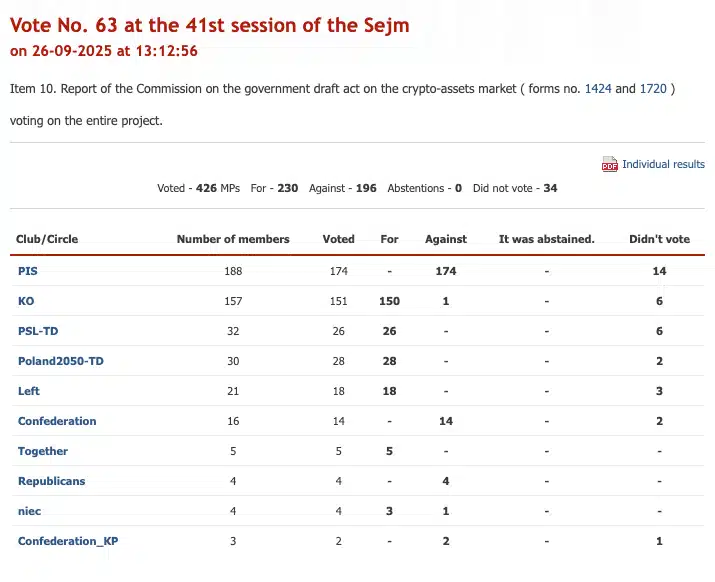
Crypto Asset Market Act Votation

Crypto-Asset Market Act Votation, Source: Poland Parliament

This move aims to implement the European Union’s Markets in Crypto-Assets (MiCA) regulation, standardizing rules across the bloc.

Poland’s Crypto Legislation Overview

The legislation, detailed in Bill 1424, officially designates the Polish Financial Supervision Authority (KNF) as the primary oversight body for the crypto sector. This places digital asset companies under the same supervisory umbrella as institutions like banks and insurers.

According to the official vote process, the bill passed with support from opposition parties, while the governing PiS party voted against it. The legislation will now proceed to the Senate for further consideration.

What the new licensing regime means for crypto providers

Under the new act, Crypto Asset Service Providers (CASPs) operating in Poland will be required to obtain a license from the KNF to operate legally. The framework introduces guidelines and aims to standardize operations within the Polish crypto ecosystem.

The law includes strict penalties for non-compliance. Violations could result in fines of up to 10 million Polish zlotys and potential prison sentences of up to two years.

Broader implications for Poland’s market and EU alignment

This legislation precedes the institutionalization of cryptocurrency. By following the EU’s MiCA states, Poland looks to meet its standards, which could attract institutional investment seeking regulatory clarity.

While the law provides a clear structure, some critics have raised concerns that the strict penalties and regulatory oversight could be perceived as overly restrictive, potentially impacting innovation.

The act represents Poland’s crypto industry interests, which aims to establish more regulation, so It could join a growing trend of national governments integrating digital assets into regular financial systems.

Also read: Société Générale and Bullish Launch First MiCA-Regulated Stablecoin


Mobile Only Image

Trending Cryptos

Related Reads

Report Interpretation: J.P. Morgan Details Micron's Pre-Earnings Sentiment, Current Hardware Sector Dynamics

Morgan Stanley analyst Joshua Meyers' report (June 21, 2026) highlights key trends in the hardware and semiconductor sector ahead of Micron's earnings. The core takeaways are: 1. **Micron & Memory:** Memory remains a high-conviction long theme, driven by strong AI demand and rising ASPs. However, investor focus is shifting to the sustainability of Micron's >80% gross margins and the specifics of potential new long-term supply agreements (SCAs). 2. **Hardware Supply Chain:** AI-related demand for servers, networking, and storage remains robust, but company performance is diverging. Celestica (CLS) shows improved margin confidence, Western Digital and Seagate benefit from pricing, Fabrinet (FN) sees predictable AI optics growth, and Teradyne (TER) anticipates a new Google customer. 3. **AI Capex & WFE Forecasts:** JPMorgan increased its Wafer Fab Equipment (WFE) market growth forecasts to 28% in 2026 and 29% in 2027. AI infrastructure financing is evolving, with higher project-level debt reducing constraints on capex expansion. The report signals that while the AI-driven hardware cycle is strong, the market is entering a phase focused on execution verification (e.g., Micron's SCA details, Fabrinet's ramp with Amazon) and valuation sustainability. Key near-term signals include Micron's guidance, Arista Networks' outlook, and the pace of demand normalization post potential tariff-related pull-ins.

marsbit8h ago

Report Interpretation: J.P. Morgan Details Micron's Pre-Earnings Sentiment, Current Hardware Sector Dynamics

marsbit8h ago

Research Report Analysis: The Fed's New Chair's Debut – New Leader, But Same Script?

Report Analysis: Federal Reserve's New Chair Debut – A New Captain, But the Same Script? Morgan Stanley's chief global economist Seth B. Carpenter analyzes the first FOMC meeting under new Fed Chair Kevin Warsh in a June 21 report. Warsh deliberately avoided providing forward guidance on interest rates, aligning with his philosophy. However, market expectations for a rate hike this year were reinforced. Key signals lie elsewhere: inflation may fall more than expected, and quantitative tightening (QT) could be more aggressive than anticipated. The FOMC's "dot plot" suggests only one rate hike in 2026. Carpenter argues that if inflation undershoots forecasts, the logic for even a single hike weakens, especially as projections indicate potential rate cuts in 2027. On QT, Warsh's stance is clear. Carpenter notes that measures like halving the Treasury's account balance could shrink the Fed's balance sheet by around $500 billion with minimal market impact. Combined with adjustments to reserve interest and liquidity rules, the ultimate QT scale may exceed expectations, though its market effect might be less disruptive unless the Fed actively sells Mortgage-Backed Securities (MBS). While Warsh initiated a review of the Fed's policy framework, the 2% inflation target remains intact for now. The report concludes that the market may be overestimating the significance of reduced forward guidance and the near-term rate hike risk, while potentially underestimating the scope and manageable nature of the coming balance sheet reduction. The key debates will hinge on upcoming core PCE data, the specifics of the QT path, and the framework review's findings.

marsbit8h ago

Research Report Analysis: The Fed's New Chair's Debut – New Leader, But Same Script?

marsbit8h ago

Trading

Spot
Futures

Hot Articles

How to Buy HOUSE

Welcome to HTX.com! We've made purchasing Housecoin (HOUSE) simple and convenient. Follow our step-by-step guide to embark on your crypto journey.Step 1: Create Your HTX AccountUse your email or phone number to sign up for a free account on HTX. Experience a hassle-free registration journey and unlock all features.Get My AccountStep 2: Go to Buy Crypto and Choose Your Payment MethodCredit/Debit Card: Use your Visa or Mastercard to buy Housecoin (HOUSE) instantly.Balance: Use funds from your HTX account balance to trade seamlessly.Third Parties: We've added popular payment methods such as Google Pay and Apple Pay to enhance convenience.P2P: Trade directly with other users on HTX.Over-the-Counter (OTC): We offer tailor-made services and competitive exchange rates for traders.Step 3: Store Your Housecoin (HOUSE)After purchasing your Housecoin (HOUSE), store it in your HTX account. Alternatively, you can send it elsewhere via blockchain transfer or use it to trade other cryptocurrencies.Step 4: Trade Housecoin (HOUSE)Easily trade Housecoin (HOUSE) on HTX's spot market. Simply access your account, select your trading pair, execute your trades, and monitor in real-time. We offer a user-friendly experience for both beginners and seasoned traders.

4.7k Total ViewsPublished 2025.04.27Updated 2026.06.02

How to Buy HOUSE

Discussions

Welcome to the HTX Community. Here, you can stay informed about the latest platform developments and gain access to professional market insights. Users' opinions on the price of HOUSE (HOUSE) are presented below.

活动图片