Violent Attacks On Crypto Holders Escalate Worldwide, Data Shows

bitcoinist發佈於 2026-01-06更新於 2026-01-06

文章摘要

Data shows a significant escalation in violent "wrench attacks" – physical robberies and kidnappings targeting cryptocurrency holders to force asset transfers – both in frequency and severity worldwide. Security researcher Haseeb Qureshi analyzed an incident database maintained by Jameson Lopp, finding 269 categorized attacks, with over half classified as "Serious" and 5% as "Fatal." The data indicates attacks are becoming more violent over time, with 2025 showing the highest incident count. Approximately 45% of the variation in attacks is explained by crypto market capitalization, meaning higher prices correlate with more incidents. However, when normalized per user (using Coinbase active users as a proxy), attack rates spiked in earlier market cycles, fell after 2019, and have recently risen again toward 2021 levels. Geographically, Western Europe and North America have the most incidents, but Latin America and Africa have significantly higher fatality rates. Notably, zero fatal attacks have occurred in North America. Researchers warn these events are transitioning from rare occurrences to a recurring risk for crypto participants.

Violent “wrench attacks” against crypto holders, physical robberies and kidnappings meant to force victims to hand over coins, appear to be rising in absolute terms and trending more severe, according to a new visualization built from a long-running incident database maintained by security researcher Jameson Lopp.

Dragonfly partner Haseeb Qureshi said he analyzed Lopp’s dataset and built an interactive dashboard to stress-test a question many traders and builders have been asking quietly for years: is simply holding crypto becoming physically more dangerous? “You’re not imagining it: the number of attacks has been increasing over time,” Qureshi wrote on X. “Not only that, the attacks are getting more violent.”
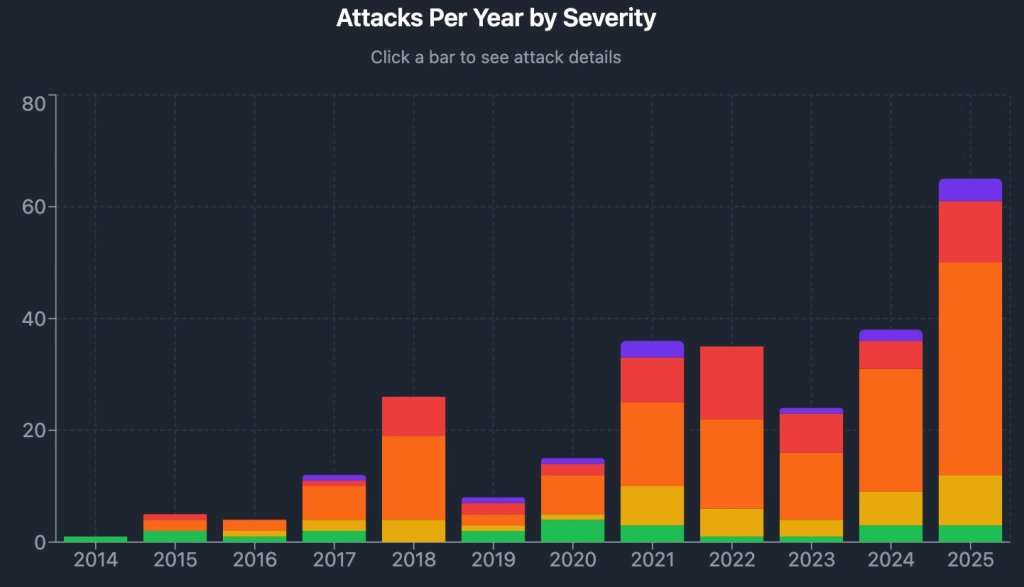
Attacks per year by severity | Source: X @hosseeb

The dashboard breaks reported incidents into five severity bands — Minor, Moderate, Serious, Severe, and Fatal and the distribution skews heavily toward the sharp end of the spectrum. Of 269 categorized incidents shown, 137 (51%) were labeled “Serious,” 57 (21%) “Severe,” and 13 (5%) “Fatal,” with the remainder split between 39 (14%) “Moderate” and 23 (9%) “Minor.”

The year-by-year bars show the later years carrying a larger share of “Severe” and “Fatal” outcomes than the early history of the dataset, with 2025 appearing as the highest-incident year on the chart.
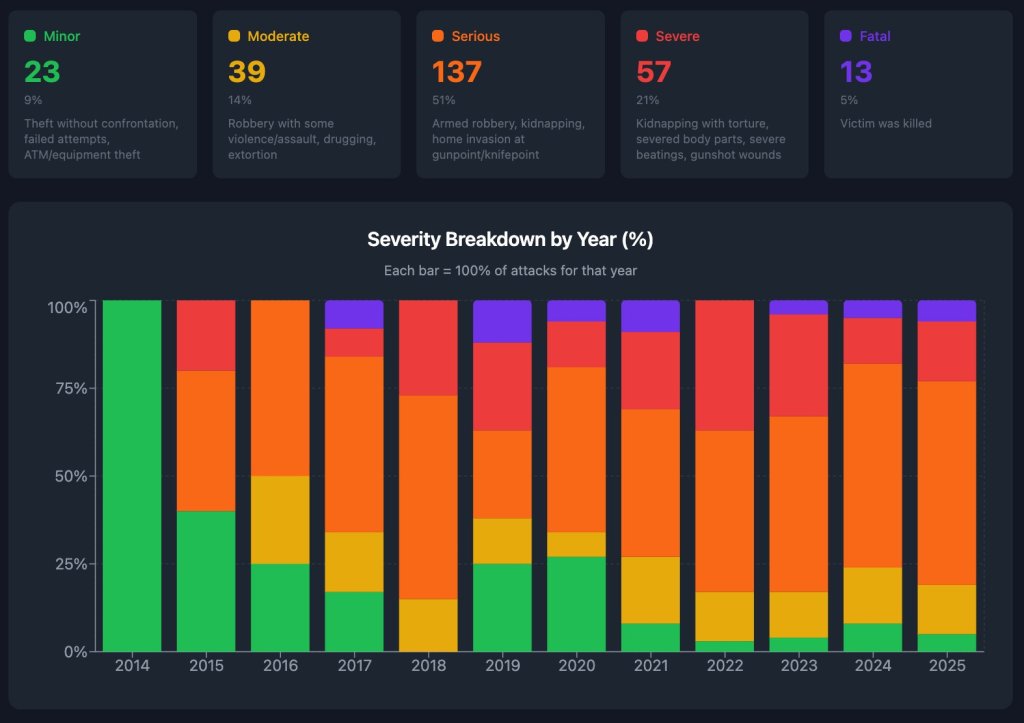
Severity breakdown by year | Source: X @hosseeb

Qureshi’s analysis also puts a number on the most intuitive driver: price. Charting incidents against total crypto market capitalization, he reported a simple regression with an R2 of 0.45 — implying roughly 45% of the variation in reported violence is explained by market cap alone. In plain terms, higher prices coincide with more attacks.

But the more consequential question for everyday holders is not raw counts; it’s risk per person. Because comprehensive “number of crypto users” data is hard to pin down, Qureshi used Coinbase monthly active users as a proxy, and separately normalized incidents by market cap to approximate attacks per dollar of wealth.

The resulting “normalized attack rates” chart tells a less linear story: per-user attack rates spiked in earlier market eras (notably around 2015 and again in 2018), then fell sharply after 2019, before ticking higher in the most recent observations. “So is that it?” Qureshi asked. “Proof crypto is becoming more physically dangerous?”
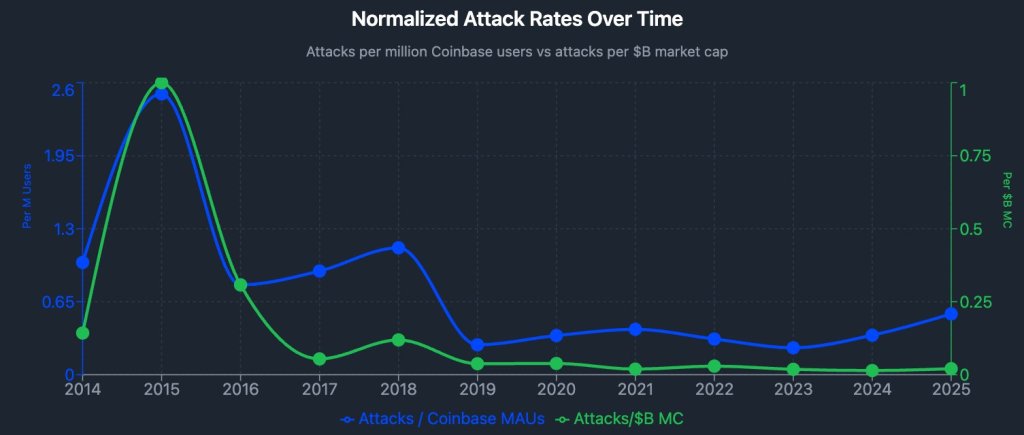
Normalized attack rate over time | Source: X @hosseeb

On his telling, not quite. Coinbase MAUs, he noted, expanded dramatically over the decade, while normalized attack rates did not rise proportionally, suggesting a meaningful “population effect” behind the higher headline totals. Still, the per-user line has moved up from its post-2019 lows, roughly back toward the levels seen during the 2021 cycle, even as the “attacks per $ of market cap” line remains comparatively flat in recent years.

Geography adds another uncomfortable layer. A regional table in the dashboard shows Western Europe (73 attacks) and North America (64) as the two largest buckets by incident count, with Asia-Pacific also substantial (53). But the most lethal outcomes cluster elsewhere: Latin America shows a 21% fatality rate and Africa 17%, versus 0% in North America. Qureshi underscored that point directly: “Notably, there have been 0 fatalities in North America ever,” he wrote, adding that the “lion’s share” of fatalities are in Latin America and Africa.
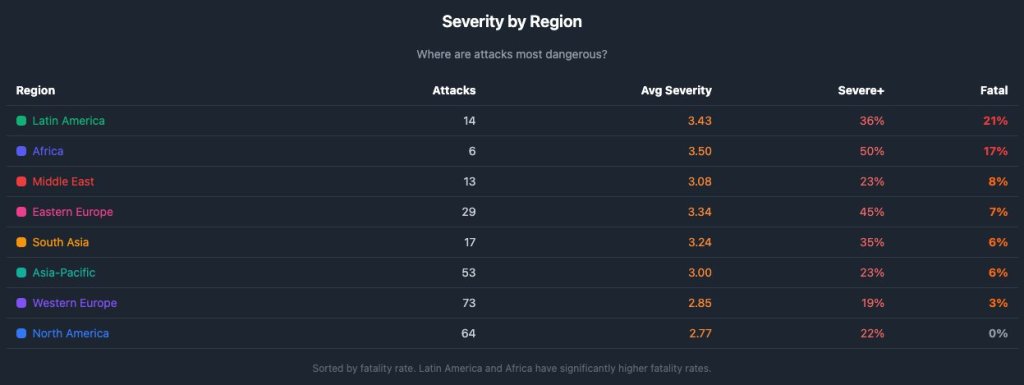
Severity by region | Source: X @hosseeb

Lopp, who has maintained the underlying “Bitcoin Wrench Attack” archive for years, has warned the workload and frequency are becoming harder to treat as isolated incidents. “When an event goes from being rare to happening every few days, it’s no longer newsworthy — it’s just a fact of life,” he wrote in a Dec. 21 post cited in the thread, while inviting others to help maintain the database.

At press time, the total crypto market cap stood at $3.12 trillion.
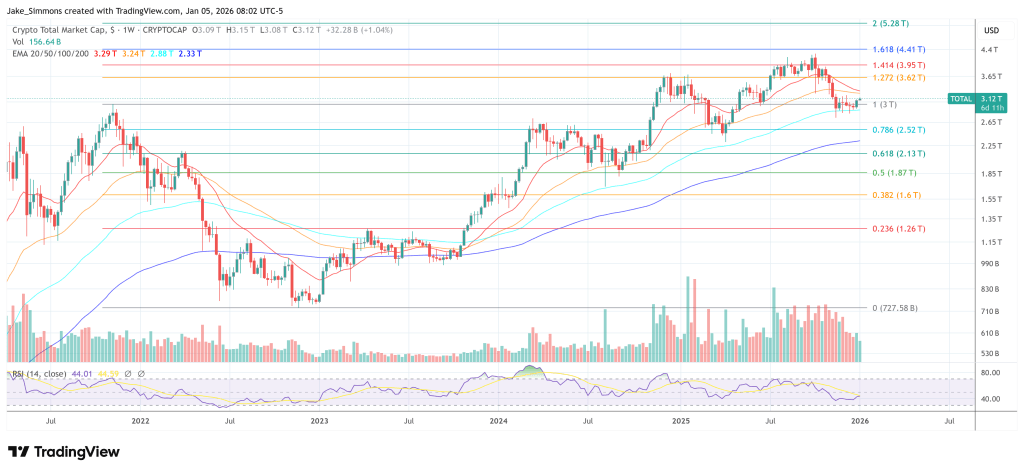
Total crypto market cap recovers above the 2021 high, 1-week chart | Source: TOTAL on TradingView.com

相關問答

QAccording to the analysis, what is the relationship between crypto market capitalization and violent attacks?

AThe analysis shows a correlation between higher crypto prices and increased attacks, with a regression R2 of 0.45 indicating that approximately 45% of the variation in reported violence is explained by market cap alone.

QWhich regions have the highest fatality rates in crypto-related attacks, according to the data?

ALatin America has a 21% fatality rate and Africa has a 17% fatality rate in crypto-related attacks, while North America has recorded 0% fatalities.

QWhat does the normalized attack rate analysis reveal about per-user risk over time?

AThe normalized attack rate shows that risk per user spiked in earlier market eras (2015 and 2018), fell sharply after 2019, but has recently ticked higher toward 2021 levels, though it didn't rise proportionally to the dramatic expansion of crypto users.

QHow are the severity of attacks distributed across the 269 incidents analyzed?

AThe severity distribution is heavily skewed toward serious outcomes: 51% were 'Serious', 21% 'Severe', 5% 'Fatal', 14% 'Moderate', and 9% 'Minor'.

QWhat trend does Jameson Lopp observe regarding the frequency of these attacks?

AJameson Lopp notes that attacks have moved from being rare events to happening every few days, making them 'no longer newsworthy' but rather 'a fact of life' in the crypto space.

你可能也喜歡

SharpLink CEO:如何理解以太坊开发者刚刚突破 100 万?

作者Joseph Chalom从亚洲之行中感受到以太坊生态的活力与建设者的雄心。他指出,Electric Capital数据显示以太坊历史开发者总数已突破100万,其中约23.2万人在过去一年保持活跃,这是加密领域最大的技术人才库。 Chalom认为,加密领域的核心问题并非哪条链最快,而是顶尖建设者选择在哪里长期建设。以太坊的显著优势源于十年积累的制度、文化、经济和生态结构,使其成为可编程金融和互联网原生资本形成的默认操作系统。 这百万建设者正致力于解决行业最难的问题:核心协议的可扩展性、隐私、抗量子能力及智能体系统。例如,2026年预计进行的Glamsterdam升级将在不破坏核心原则下提升性能;同步可组合性技术让众多Rollup能像一条链般运作;以太坊在抗量子准备上也处于明显领先地位。 以太坊的深层护城河在于开发者聚集产生的复利效应,以及由此强化的可组合性、共享标准(如EVM和Solidity)和信任。其可信中立性(由超90万验证者保障)、模块化架构(如Base、Arbitrum等Rollup)以及吸引顶尖研究人员的文化,共同巩固了其作为大型机构首选互联网原生金融协调层的地位。Chalom坚信,以太坊的生态系统优势及其汇聚的人才,将持续推动下一代金融基础设施的变革。

marsbit3 分鐘前

SharpLink CEO:如何理解以太坊开发者刚刚突破 100 万?

marsbit3 分鐘前

SharpLink CEO:如何理解以太坊开发者刚刚突破 100 万?

SharpLink CEO分享了其对以太坊开发者总数突破100万的见解。根据Electric Capital数据,以太坊历史开发者总数已达1,012,824人,其中约23.2万人在过去一年保持活跃,构成了加密领域最庞大的技术人才库。 作者认为,加密领域的核心竞争并非单纯追求速度与低费用,而是顶尖建设者的选择。以太坊凭借十年积累的制度、文化、经济与生态结构,形成了难以复制的综合优势,已成为可编程金融和互联网原生资本的默认操作系统。 这百万开发者正致力于攻克行业最前沿的挑战:通过预计2026年的Glamsterdam升级提升核心协议可扩展性;通过同步可组合性技术让众多Rollup如一条链般协同工作;以及积极布局抗量子能力,以太坊基金会已成立专门团队推进,目标是2029年前完成迁移。 更深层的护城河在于网络效应:以太坊的可组合性让应用像乐高积木一样互操作,EVM和Solidity技能在数百个网络中通用,形成了“更多开发者→更多工具与流动性→更多应用”的飞轮。此外,由超90万验证者保障的可信中立性、模块化扩展架构以及顶尖的研究与文化氛围,共同巩固了其作为大型机构首选信任层的地位。 作者在访问亚洲以太坊社区后强调,以太坊的竞争优势在于汇聚了改变未来金融的建设者,其生态不仅是链上活跃,更在成为互联网原生金融的长期协调层。

链捕手7 分鐘前

SharpLink CEO:如何理解以太坊开发者刚刚突破 100 万?

链捕手7 分鐘前

从身份协议到AI入口,World的野心有多大?

近期,加密市场中的WLD成为焦点,其价格持续上涨,市值突破30亿美元。这一热度源于World项目正式进入“The Simple Plan”第三阶段,其发展逻辑正从早期的代币激励转向实用驱动。World的核心目标是构建全球“人格证明”网络,通过扫描虹膜的World ID解决互联网中验证真实人类身份的关键问题。随着生成式AI爆发,区分真人与AI变得日益紧迫。 World的落地场景正在拓宽,覆盖企业端、个人端及AI Agent端。企业方面,与Zoom等公司合作应对深度伪造;个人层面,瞄准社交与票务等场景的真人验证需求;AI Agent端则推出AgentKit,旨在建立人与AI间的可信授权框架,为未来AI经济奠定信任基础。 市场上涨背后是对“真人身份”稀缺价值的重估。在AI内容成本趋近零的未来,真人身份与行为可能成为稀缺资源。World的运营策略也更聚焦,资源集中于高价值城市以构建网络效应,同时下一代Orb设备将实现自助化以降低扩张成本。 宏观来看,World可能推动加密叙事从金融扩展到身份基础设施,身份或成为可组合资产。它也有望成为AI Agent经济的关键入口,解决Agent归属、可信与验证问题。World ID 4.0引入的费用机制开启了协议的收入来源,使其商业模式更趋清晰。 总之,WLD的上涨反映了市场对World在AI时代定位的认可——其野心是成为验证人类身份的关键入口。随着AI与人的界限模糊,掌握人格证明网络可能意味着掌握下一代互联网的重要枢纽。

marsbit1 小時前

从身份协议到AI入口,World的野心有多大?

marsbit1 小時前

没有腾讯,燧原还剩什么?

燧原科技科创板IPO获通过,成为国产GPU“四小龙”中最后一家上市的公司。其招股书揭示了一个核心问题:公司营收高度依赖单一客户腾讯,2025年销售额的74.9%(按另一口径超80%)来自腾讯。 与其他“四小龙”先融资、讲故事的路径不同,燧原从成立起就锚定大客户交付,营收增长迅猛,2026年第一季度同比暴增1474.85%。这种陡峭增长源于超级大客户的算力订单集中释放。 腾讯大规模采购燧原芯片,背后是自身庞大的AI算力需求(如混元大模型、元宝等)以及构建可控、稳定算力供应链的战略考量。燧原超过80%的加速卡及模组收入来自推理产品,精准匹配了腾讯大模型落地的急需。 腾讯不仅是燧原第一大客户,也是持股20.26%的第一大股东。这种“股东+客户”的深度绑定,在产业逻辑上被视为供应链培育。腾讯通过确定性订单帮助燧原迭代工艺,而自身业务系统与燧原芯片的深度集成也形成了较高的替换成本,构成了燧原的生态护城河。 行业格局逐渐清晰:英伟达为规则制定者,华为昇腾走国家级路线,而燧原、摩尔线程等商业化玩家则依靠市场订单。燧原的定位愈发偏向“腾讯生态的算力底座”,其产品路线图与腾讯需求高度协同。 文章指出,中国AI芯片行业已告别PPT融资驱动,进入残酷的订单交付周期。未来比拼的关键不再是技术参数,而是订单量、交付能力和生态绑定深度。燧原手握腾讯长期且金额翻倍的采购订单,这或许比技术本身更能体现其现阶段价值。国产芯片的长期主义,在于赢得客户的信任、场景和持续订单。

marsbit1 小時前

没有腾讯,燧原还剩什么?

marsbit1 小時前

交易

現貨
合約
活动图片