USD1 Hits $5 Billion Market Cap As Trump Hails ‘Built In America’ Stablecoin

bitcoinist發佈於 2026-01-31更新於 2026-01-31

文章摘要

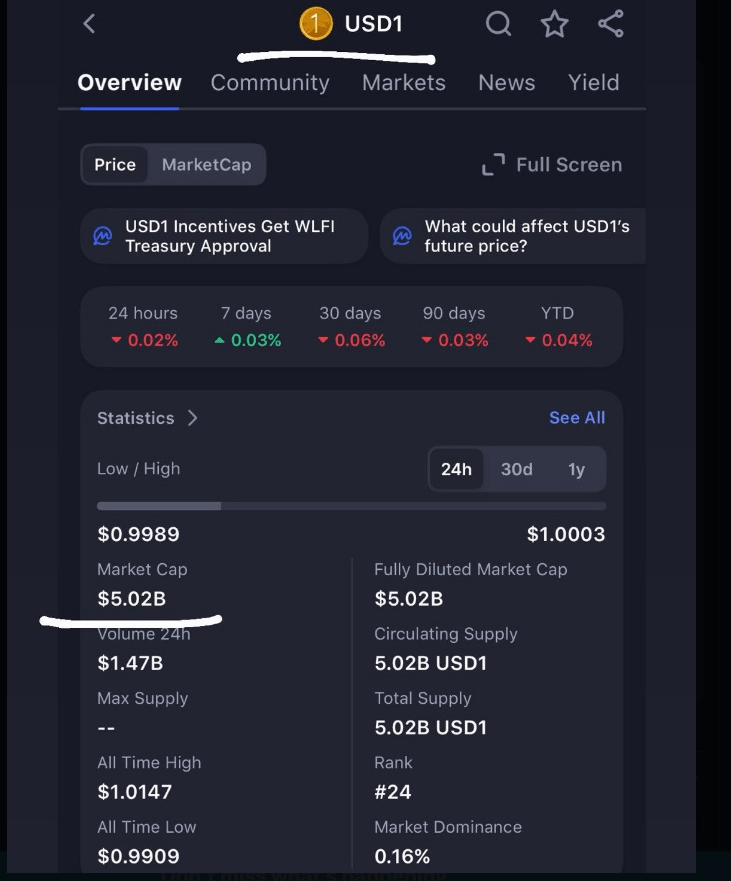
USD1, a stablecoin issued by World Liberty Financial, has surpassed a $5 billion market cap, becoming one of the largest dollar-pegged tokens. It maintained its $1 peg despite increased market interest, aided by new exchange listings and incentives. The milestone was celebrated by the Trump family on social media, boosting mainstream attention. Growth was driven by improved liquidity, institutional adoption, and large fund movements. However, questions remain about reserve transparency and regulatory compliance, with the issuer seeking a U.S. banking charter. Notably, while USD1 thrived, other related speculative tokens fell sharply, highlighting a market shift toward stability over volatility.

USD1 has pushed past a $5 billion market cap, a rapid climb that has attracted wide attention across crypto markets. Reports say the stablecoin, issued by World Liberty Financial, now ranks among the largest dollar-pegged tokens.

Trading has stayed close to the $1 peg even as overall market interest spiked. Some exchanges have added new pairs and incentives, which helped volume swell over recent weeks.

Market Milestone Reached

Reports note that members of the Trump family celebrated the milestone on social feeds, calling USD1 “Built in America.” US President Donald Trump was quoted praising the token as an example of American engineering and finance coming together.

That message boosted mainstream interest and brought a fresh round of headlines. At the same time, other tokens linked to the same circle have fallen sharply, showing mixed fortunes across related projects.

How The Coin Grew

Liquidity and listings matter. Based on exchange disclosures, USD1 gained listings and earning programs that made the stablecoin easier for traders and institutions to hold massive balances.

This lowered technicalities for movement and helped the coin’s market valuation rise quickly. On-chain activity shows large inflows at times, while prices stayed steady around the dollar peg.

Reports say some big holders moved funds between platforms, which pushed reported market cap numbers higher on public trackers.

Trust And Regulation

There remain some queries over transparency in reserves, along with some queries from banking regulators and observers about a clearer audit and a specific banking arrangement for issuance.

Total crypto market cap currently at $2.78 trillion. Chart: TradingView

According to reports, the issuer has applied for charter and is taking steps to be in compliance with US requirements. While this has reassured some of the investors, others claim they still need proof to gain their trust.

The regulatory angle is shaping future plans for expansion and institutional use.

Comparisons And Contrast

USD1’s rise has not lifted every project tied to the same names. One meme token linked to the group dropped more than 90% from its peak.

Investors are splitting between stable, utility-style holdings and speculative bets that have lost steam. Reports say the stablecoin’s steady peg made it attractive to users fleeing volatility elsewhere.

This split highlights a broader shift: some money prefers a token that holds value closely to the dollar, while other funds chase quick gains.

Featured image from Unsplash, chart from TradingView

相關問答

QWhat is the current market cap of the USD1 stablecoin and why has it attracted attention?

AThe USD1 stablecoin has reached a market cap of $5 billion, attracting wide attention due to its rapid growth and its position as one of the largest dollar-pegged tokens.

QWhich company issued the USD1 stablecoin and how did the Trump family react to its milestone?

AThe USD1 stablecoin was issued by World Liberty Financial. Members of the Trump family, including Donald Trump Jr., celebrated the $5 billion market cap milestone on social media, hailing it as 'Built in America'.

QWhat are two key factors that contributed to the rapid growth of USD1's market valuation?

ATwo key factors were increased liquidity through new exchange listings and earning programs, which made it easier for traders and institutions to hold large balances, and large on-chain inflows that pushed the reported market cap higher.

QWhat are some of the regulatory concerns or queries surrounding the USD1 stablecoin?

AThere are queries over the transparency of its reserves and calls from banking regulators and observers for a clearer audit and a specific banking arrangement for its issuance. The issuer has applied for a charter and is taking steps to comply with US requirements.

QHow does the performance of USD1 contrast with other tokens linked to the same group, and what does this highlight?

AWhile USD1 has grown steadily, other tokens like a related meme coin dropped over 90% from its peak. This contrast highlights a broader market shift where some investors prefer stable, utility-style holdings, while others chase speculative, volatile bets.

你可能也喜歡

BTC“数字黄金”的叙事是不是失败了?

这篇文章从三个核心问题探讨了比特币的现状与未来,强调提供的是思考框架而非投资建议。 **如何看待比特币资产?** 作者认为比特币是一种全新的、更优秀的“黄金”资产。其优势在于总量恒定、转移便捷、交易可审计。尽管早期与灰色地带关联,但合规化是趋势。目前全球数字货币渗透率仅3%-4%,类比互联网和电商的早期阶段,意味着比特币仍处于发展初期,潜力巨大但波动性也极高。 **如何理解本轮下跌?** 比特币自2025年10月高点(近12.6万美元)持续下跌,2026年2月一度跌破6.1万美元,单日跌幅达15%,随后又快速反弹。这被解读为遵循四年减半周期的共识性获利了结。特别之处在于,美国比特币ETF的批准引入了机构资金,也促使早期低成本持有者(如矿工和信仰者)进行大规模“换手”,这是资产迈向主流化的必经过程。历史数据显示,比特币历次大跌的幅度在收窄(从93%到当前的约50%),表明资产正在成熟,波动率逐步下降,但高波动仍是其获取超额回报的固有特征。 **长期如何看待发展?** 长期价值可对标黄金。当前比特币市值仅为黄金市值的约7%,若“数字黄金”叙事实现一半,上行空间依然显著。但作者提醒,短期市场脆弱,换手可能未完,底部无法预测。真正的风险并非资产归零(概率较低),而在于错误的仓位管理(如All-in或加杠杆)以及对资产缺乏深刻理解。投资者必须计算并承受潜在的最大回撤(例如从已跌50%的位置再跌50%),才能存活至长期价值兑现。 文章最后以亚马逊在互联网泡沫后暴涨为例,指出关键不在于比特币未来是否上涨,而在于投资者能否通过理性的仓位管理和深度认知,扛过剧烈波动存活到那一天。文末提问引导读者反思:当前黄金涨、比特币跌的局面,究竟意味着“数字黄金”叙事失败,还是资产进化过程中的换手阵痛?这取决于每个人对比特币最底层的信仰。

marsbit52 分鐘前

BTC“数字黄金”的叙事是不是失败了?

marsbit52 分鐘前

BTC“数字黄金”的叙事是不是失败了?

标题:BTC“数字黄金”的叙事是不是失败了? 作者:@wuk_Bitcoin 本文从三个核心问题出发,探讨比特币的现状与未来。 **如何看待比特币?** 作者认为比特币是一种全新的、更优秀的“黄金”类资产。其优势在于:总量恒定(2100万枚);资产可转移性极强,在全球不确定性时代具备溢价;所有交易链上可审计,透明度高。反驳了比特币主要用于灰色地带的过时观点,指出其正走向合规。目前全球数字货币渗透率仅约3%-4%,类比互联网和电商早期,意味着该资产类别仍处早期,潜力与巨大波动并存。 **如何理解本轮下跌?** 比特币自2025年10月高点(近12.6万美元)持续下跌,2026年2月初曾单日暴跌15%,跌破6.1万美元。这被视为遵循其四年减半周期的规律性回调,是长期持有者在周期高点锁定利润的结果。本轮下跌的特殊性在于:美国比特币ETF的批准引入了大量机构新资金,但也促使成本极低的早期持有者(矿工、OG)进行历史性抛售,即从“早期信仰者”向“长期配置机构”的换手过程。历史数据显示,比特币历次大回撤的跌幅在逐步收窄(从93%到目前的约50%),表明资产在成熟,波动率在下降,但高波动仍是获取超额回报的代价。 **长期怎么看?** 若将比特币视为“数字黄金”,其当前总市值(约1.4万亿美元)仅为黄金总市值(约20万亿美元)的7%。即使该叙事仅部分实现,上行空间依然可观。但作者强调短期风险:换手可能未结束,市场脆弱,不排除进一步下跌。真正的风险不在于资产归零(概率极低),而在于错误的仓位管理(如All-in、加杠杆)和对资产缺乏深度理解,这可能导致投资者无法承受巨大波动而提前被迫出局。 **最后对比** 作者以亚马逊在互联网泡沫破裂后股价跌95%又最终上涨42倍为例,指出关键在于“活着等到那一天”。对于比特币,核心同样是能否通过理性仓位管理活到其价值兑现之时。文末提问:当黄金大涨而比特币大跌,这究竟是“数字黄金”叙事的失败,还是资产进化过程中的阵痛?答案取决于每个人对比特币最底层的信仰。

链捕手1 小時前

BTC“数字黄金”的叙事是不是失败了?

链捕手1 小時前

从代码到认知:机器人大脑进化的万字指南

本文概述了机器人大脑从传统代码控制到现代人工智能模型驱动的演进历程。文章首先回顾了前大型语言模型(LLM)时代,机器人依赖手工编码的模块化技术栈(感知、状态估计、规划、控制)和行为树,虽稳定但泛化能力差。随后,深度学习改进了感知,强化学习和模仿学习进入了控制层,但策略仍较为狭窄。 ChatGPT的出现带来了转折。LLM最初被用作自然语言编译器,将指令转化为机器人可执行的原子技能序列(如谷歌的SayCan)。但更重要的突破是视觉-语言-动作模型(VLA),例如谷歌的RT-2和开源的OpenVLA,它能将视觉、语言信息融合,直接输出动作指令,实现了推理与行动的耦合。 目前最先进的系统采用“双脑”架构(如Figure AI的Helix、NVIDIA GR00T):一个慢速、参数多的“系统2”负责高层次推理和规划;一个快速、小巧的“系统1”负责高频动作生成。其下还可能有一个“系统0”反射层处理平衡等底层控制。出于延迟和可靠性考虑,安全关键的控制回路通常在机器人本地(如NVIDIA Jetson模块)运行,而对话界面和集群学习等任务可交由云端。 开源模型(如OpenVLA、GR00T、π0)降低了行业门槛,让初创公司能在其基础上用自有数据微调。然而,当前VLA机器人仍存在任务中途恢复能力弱、样本效率低、缺乏物理常识和长期规划能力等局限。 这催生了下一代方向:世界模型。这类模型(如NVIDIA Cosmos、Meta V-JEPA)能根据当前状态和动作预测未来结果,让机器人在行动前进行模拟和评估,从而改善恢复能力、泛化能力和长期规划。架构上主要分为像素级视频扩散、联合嵌入预测架构(JEPA)和潜在动作世界模型等流派。 文章最后指出,数据采集(特别是远程操作数据)是核心竞争力,仿真训练至关重要,机器人成本正在迅速下降。当前物理AI的发展阶段大约相当于“GPT-2时代”,虽未完全自主,但正通过架构的持续演进(从代码到感知、规划、策略,最终到世界模型),朝着更通用、更强大的方向稳步前进。

marsbit1 小時前

从代码到认知:机器人大脑进化的万字指南

marsbit1 小時前

AI 泡沫正在破裂

近期市场剧烈波动,“AI泡沫论”甚嚣尘上。桥水达利欧认为AI市场存在“相对较高”的泡沫,而英伟达黄仁勋则强调AI算力需求才刚刚开始。两者观点看似矛盾,实则揭示了技术革命初期的典型特征:市场因高估短期影响而产生泡沫,却往往低估其长期颠覆性力量。 回顾2000年互联网泡沫,纳指暴跌78%,超5万亿美元财富蒸发,大量公司破产。然而,泡沫破裂后留下的廉价电信基础设施(如海底光缆),却成为日后流媒体、云计算乃至移动互联网崛起的基石。这符合“阿玛拉定律”:人们高估技术的短期影响,低估其长期影响。泡沫是创新必须缴纳的“智商税”,其破裂能淘汰投机者,沉淀下坚固的基础设施,滋养真正伟大的公司。 当前AI行业同样呈现巨大的“投入-产出”不对称:2026年,五大云服务商的AI基础设施资本开支预计达6900亿美元,而头部纯AI厂商的总收入预计不超过400亿美元。但深层逻辑正在演变:AI推理成本在两年内暴跌超过99.7%,接近零的边际成本解锁了海量长尾需求,驱动企业AI支出翻倍增长。这印证了“杰文斯悖论”——效率提升导致总消耗量指数级上升。如今,各行业关心的已非“是否用AI”,而是如何更有效地整合AI。 市场已进入“幻灭的低谷”前夕,缺乏护城河的套壳公司正批量死亡,这是市场的自我净化。与此同时,价值转移正在发生:1. 从资本开支(CapEx,如硬件)向运营开支(OpEx,如解决垂直行业痛点的应用)转移;2. 高估值正被高速增长的业绩逐步消化。AI已深入制造业(缩短研发周期)、金融(微秒级定价)、法律、医疗等专业领域,成为实质性的生产力工具。 历史总在重演“创造性毁灭”。当下近7000亿美元的基建投资短期内无法全部转化为利润,市场洗牌不可避免。但洗牌之后,廉价的算力与高度优化的算法将赋能千行百业。正如互联网泡沫后我们迎来了数字时代,AI泡沫的喧嚣过后,我们将不可逆转地迈向一个所有行业都由AI深度赋能的智能全盛时代。泡沫终会破裂,但底层先进生产力的势能,没有水分。

链捕手1 小時前

AI 泡沫正在破裂

链捕手1 小時前

交易

現貨
合約
活动图片