US Calls for Restrictions on Sports Prediction Markets

cryptonews.ru發佈於 2026-07-28更新於 2026-07-28

文章摘要

The National Football League (NFL) has urged the U.S. Commodity Futures Trading Commission (CFTC) to tighten rules for prediction markets on sports events. In a July letter, the NFL argued that current proposals fail to adequately protect the integrity of games and market participants. Key demands include banning contracts on events easily manipulated by individuals (e.g., a kicker missing a field goal), clarifying definitions to prevent gambling-like contracts, and explicitly prohibiting trading based on non-public insider information. The league also called for restricted person lists, a ban on margin trading, advertising limits, stronger user protections, and a minimum age of 21. This push coincides with an ongoing jurisdictional dispute between the CFTC and several states. The CFTC claims exclusive federal oversight, classifying event contracts as swaps, while states argue these platforms violate local gambling laws. Recent legal actions in Michigan and Minnesota highlight the conflict, with a federal court temporarily blocking Minnesota from applying a new law to CFTC-registered platforms like Kalshi and Polymarket. Meanwhile, prediction markets are experiencing significant growth. In June, driven by events like the World Cup, Kalshi's trading volume exceeded $31 billion (85% from sports contracts), while Polymarket's global platform hit a monthly record of $10.8 billion. However, platforms face legal challenges, such as lawsuits from Kentucky accusing them of operatin...

The National Football League (NFL) has called on the U.S. Commodity Futures Trading Commission (CFTC) to tighten regulations for prediction markets on sporting events. This was stated in a letter dated July 27.

The NFL noted that maintaining the integrity of the games is its top priority. In the league's opinion, the rules proposed by the regulator do not provide sufficient protection for competitions and market participants.

Manipulation

The NFL proposed restricting contracts on events that could be manipulated by one person or a small group of individuals. Examples cited included bets on a kicker missing a field goal or a quarterback throwing an inaccurate first pass.

Separately, the league asked the CFTC to clarify the definition of contracts that cannot be meaningfully distinguished from gambling.

NFL representatives also criticized the possibility of an exemption for markets on awards and voting. They believe this could allow platforms to circumvent restrictions by adding a formal voting or award-granting element to sports contracts.

As a controversial example, The Block cited a market on the winner of the Offensive Player of the Year award. The outcome of such a contract depends on a voting panel, but the subject itself is related to player performance.

Insider Information

Another set of proposals concerns material non-public information. The NFL urged the CFTC to explicitly state that trading sports contracts based on confidential league, team, or related-party information should be considered a manipulative or deceptive practice.

The letter's authors also proposed introducing mandatory lists of individuals prohibited from trading contracts for specific competitions. The NFL believes platforms should not rely solely on their own controls.

Furthermore, the league reiterated previous demands: a ban on margin trading, advertising restrictions, additional user protection measures, and an age threshold of 21.

The CFTC and States Dispute Continues

Meanwhile, questions remain regarding the regulation of prediction markets at the federal and local levels. CFTC Chairman Michael Selig insists that the agency has "exclusive jurisdiction" over the sector, as event contracts fall under the category of swaps. States object, arguing that platforms violate local gambling laws.

In July, this dispute put Kalshi in a difficult position. The CFTC demanded that the platform settle transactions for Michigan residents normally, even though a state court ordered it to annul the same operations in late June.

At the end of the month, a U.S. Federal Court temporarily prohibited Minnesota from applying a new law to platforms registered with the Commodity Futures Trading Commission. Kalshi and Polymarket US will continue operating in the state until the dispute is resolved. The judge considered that some contracts on event outcomes might fall under the exclusive jurisdiction of the CFTC.

Industry organizations are also dissatisfied. For example, American gambling associations have called on the U.S. Senate to ban prediction markets related to sports and gambling.

Premudrye Kity

Amid the FIFA World Cup, Kalshi and Polymarket surpassed traditional U.S. bookmakers. In June, Kalshi's trading volume exceeded $31 billion — 70% higher than May's figure. According to Dune, sports contracts accounted for 85% of the platform's turnover.

The international platform Polymarket updated its monthly record to $10.8 billion. Its regulated U.S. version collected $3.5 billion.
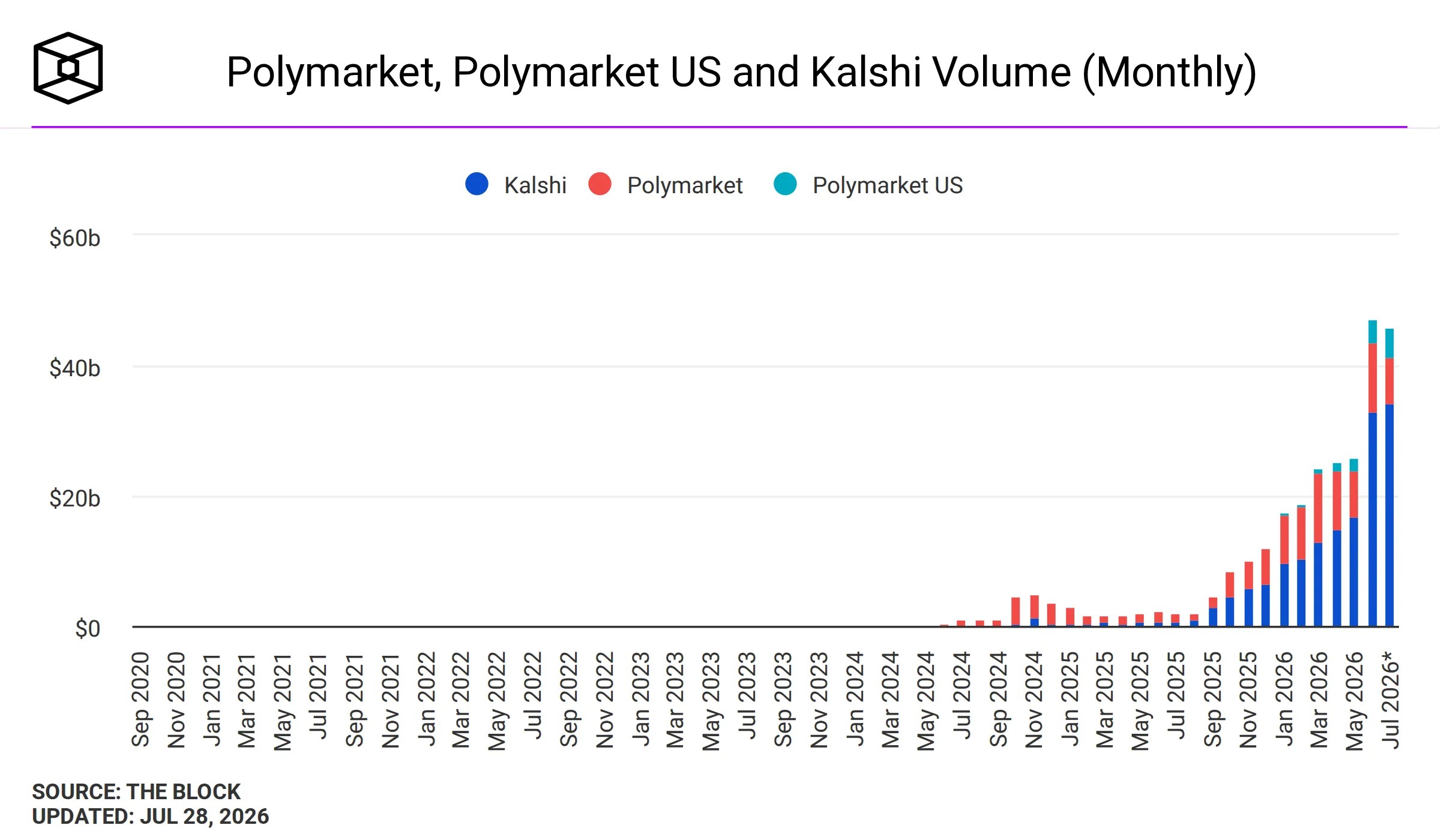
Source: The Block.

Recall that in June, Kentucky authorities filed lawsuits against Kalshi and Polymarket. The state accused the platforms of operating unlicensed sports betting under the guise of prediction markets.


相關問答

QWhich U.S. sports league has called on the CFTC to tighten rules for sports prediction markets, and what is their main stated priority?

AThe National Football League (NFL) has called on the U.S. Commodity Futures Trading Commission (CFTC) to tighten the rules. Their main stated priority is the preservation of game integrity.

QWhat specific examples did the NFL provide of event contracts that could be manipulated by a small group of people?

AThe NFL provided examples such as contracts based on whether a kicker misses a field goal or whether a quarterback's first pass is incomplete.

QAccording to the article, what is the core of the jurisdictional dispute between the CFTC and U.S. states regarding prediction markets?

AThe CFTC chairman insists the agency has 'exclusive jurisdiction' over the sector because event contracts fall under the category of swaps, while states argue that the platforms violate local gambling laws.

QWhat recent legal action caused difficulty for the prediction market platform Kalshi in July?

AIn July, Kalshi was put in a difficult position when the CFTC demanded it settle trades for Michigan residents as usual, while a Michigan state court had ordered it to cancel those same operations in late June.

QWhich two prediction market platforms reportedly surpassed traditional U.S. sportsbooks in trading volume during the World Cup, and what were their approximate June trading volumes?

AKalshi and Polymarket reportedly surpassed traditional sportsbooks. In June, Kalshi's trading volume exceeded $31 billion, and Polymarket's international platform set a monthly record of $10.8 billion, with its regulated U.S. version at $3.5 billion.

你可能也喜歡

《夏季拉锯战》仍在继续:突破67000美元将是比特币上涨的起点

比特币价格在8月1日跌至62,217美元,延续了自6月5日开始的盘整格局。目前比特币被困在58,000至67,000美元的区间内,市场参与者对下一步走向存在分歧。 技术分析显示关键价位在60,000美元和67,000美元。交易员Crypto Candy认为,只要价格低于66,000美元,就可能跌向60,000美元或更低。投资者Jelle则将当前市场比作“夏季拉锯战”,坚持定期买入的平均成本策略。 上行突破的关键在于能否站稳67,000美元以上。交易员Daan Crypto Trades认为,若无法突破此位,市场可能继续盘整。交易员Roman则预测,若伴随足够交易量有效突破67,000美元,价格可能快速上涨至70,000-80,000美元区间。 宏观分析师Gert van Lagen从更长周期观察,认为比特币正在测试一个持续七年之久的“杯柄形态”的颈线位,市场恐惧情绪在盘整中逐渐消退。他强调,长期持有者仍未出现投降迹象,NUPL指标显示他们远未进入抛售区域。 总而言之,市场共识是比特币正处于积累阶段,60,000美元和67,000美元是关键水平,对任一水平的突破都将决定资产的下一个方向。当前围绕67,000美元的博弈,也反映出短期持有者盈亏平衡点附近的心理压力。近期价格在利好新闻后迅速回落,表明市场叙事尚未转化为持续的资本流入,能否构建更稳固的上涨基础仍有待观察。

cryptonews.ru43 分鐘前

《夏季拉锯战》仍在继续:突破67000美元将是比特币上涨的起点

cryptonews.ru43 分鐘前

股票跌得比加密货币还狠,钱去了哪?

7月底,韩国Kospi指数罕见连续两天触发熔断,全球半导体股集体暴跌。SK海力士业绩虽创纪录但不及预期,股价重挫,其两倍做多杠杆ETF市值更蒸发超万亿港元。与此同时,比特币却从低点反弹约15%,呈现“股票跌出币圈样,比特币装死躺赢”的反常局面。 此次暴跌并非全市场恐慌,而是对前期最拥挤交易(如AI半导体)的精准去杠杆。催化剂包括不及预期的财报、中国存储芯片扩产带来的竞争压力,以及日元套息交易平仓带来的流动性压力。分析认为,产业逻辑未死,死的是过高的杠杆。 那么,从股市流出的资金是否流入了比特币?答案是否定的。比特币的相对抗跌,是因为它在5月至6月已提前经历大幅调整,美国现货比特币ETF曾出现历史性资金外流。真正的避险资金流向了黄金。数据显示,比特币与黄金的相关性已降至极低水平,“数字黄金”叙事在此次危机中暂时失效。机构将两者视为不同资产:黄金用于避险,比特币用于博弈高波动回报。 资金未来的流向取决于三个条件:全球流动性压力缓解、美联储在不引发衰退的前提下降息,以及美国CLARITY加密法案的最终落地。当前,比特币与纳斯达克指数的走势正在脱钩,其价格更依赖全球流动性而非单一科技股盈利。这种低相关性可能使其在未来成为机构资产配置中分散风险的选择。尽管当前并非避风港,但比特币已提前出清,为未来资本重新配置占据了有利位置。

marsbit1 小時前

股票跌得比加密货币还狠,钱去了哪?

marsbit1 小時前

交易

現貨
活动图片




