Tether Fails $500B Evaluation Amidst Investor Pushback as HYPER Gains Momentum

bitcoinist發佈於 2026-02-04更新於 2026-02-04

文章摘要

The cryptocurrency market is experiencing a significant shift as Tether (USDT) faces investor resistance and fails to achieve a $500 billion valuation, driven by transparency concerns and a move towards decentralized alternatives. This has led to a rotation of liquidity into Bitcoin Layer 2 solutions, which aim to unlock Bitcoin's dormant capital by enhancing its utility. Bitcoin Hyper ($HYPER) is emerging as a key player, integrating the Solana Virtual Machine (SVM) to offer high-speed execution and smart contract capabilities while maintaining Bitcoin's security. It enables sub-second transactions, decentralized finance (DeFi) applications, and seamless BTC transfers, addressing scalability issues. The project has raised over $31.2 million in its presale, indicating strong institutional confidence. With a current token price of $0.0136751, it offers staking rewards and aims to attract long-term investors amid growing interest in Bitcoin's programmability.

The cryptocurrency market is witnessing a decoupling event play out in real-time.

Tether (USDT), long considered the unshakeable bedrock of stablecoin liquidity, has hit a wall in its pursuit of a $500B-implied market valuation.

Institutional investors have reportedly balked at the metrics, spooked by transparency concerns and a regulatory landscape shifting toward decentralized alternatives. This stalemate at the half-trillion-dollar mark isn’t just a pricing failure; it’s a signal that risk appetite is rotating.

But here’s the kicker: liquidity isn’t leaving the ecosystem. It’s just moving deeper into the Bitcoin infrastructure. The market is bored with simple store-of-value assets; traders want utility layers capable of unlocking Bitcoin’s dormant capital.

That shift explains the sudden surge in Bitcoin Layer 2 solutions, which are quietly absorbing the liquidity Tether failed to capture.

Investors appear to be hedging against stablecoin stagnation by betting on the ‘programmability’ of Bitcoin. The logic holds up: if Bitcoin is the gold standard, the rails allowing it to transact like Solana or Ethereum are the ultimate pick-and-shovel plays.

This environment created a perfect storm for emerging protocols like Bitcoin Hyper ($HYPER), which is seeing its valuation climb while Tether’s dominance faces scrutiny.

You can buy your $HYPER here.

Bitcoin Hyper Bridges the Gap Between Store of Value and High-Speed Execution

The core friction point in the current market isn’t a lack of assets, it’s a lack of velocity.

Bitcoin holds over a trillion dollars in value, yet that capital remains largely inert, trapped by slow block times and the absence of native smart contracts. Bitcoin Hyper ($HYPER) answers this bottleneck not just as a sidechain, but as the first Bitcoin Layer 2 to integrate the Solana Virtual Machine (SVM).

Why does this technical architecture matter? It solves the ‘trilemma’ without sacrificing Bitcoin’s security, which is one of Bitcoin Hyper’s mantras.
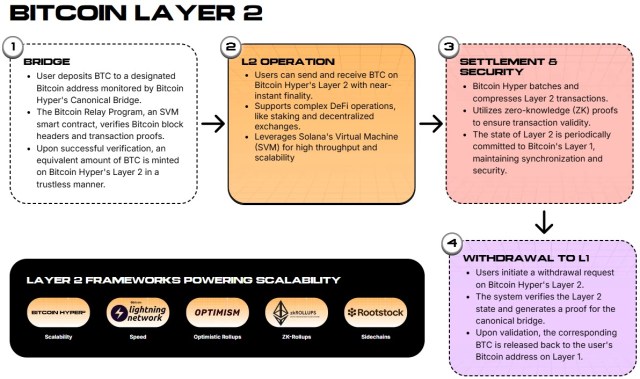
By using the SVM for execution, Bitcoin Hyper achieves the sub-second finality and low-latency performance DeFi developers require, all while anchoring its state to Bitcoin L1.

Finally, developers can write in Rust and deploy high-speed dApps that actually settle on Bitcoin. For the market, that utility is tangible. The protocol offers a Decentralized Canonical Bridge for seamless $BTC transfers and supports SPL-compatible tokens modified for Layer 2 operations.

This opens the door for high-frequency trading, gaming, and complex lending protocols directly on the Bitcoin network, use cases that were previously impossible. Plus, the integration of high-speed payments in wrapped $BTC with negligible fees addresses the precise scalability issues that have historically held the ecosystem back.

Check the $HYPER presale.

Whale Accumulation Signals Confidence With Over $31M Raised

While Tether struggles to justify its valuation, smart money is aggressively positioning itself in the Bitcoin Hyper presale. The sentiment contrast is stark. According to official data, the project has raised over $31.2M. That figure suggests robust institutional confidence, even as the broader market hesitates on stablecoins.

Traders watching this setup will notice this pattern often precedes retail adoption, as whales position themselves before the Token Generation Event.

Frankly, the tokenomics look designed to discourage mercenary capital rotation. With the token currently priced at $0.0136751, early participants are eyeing immediate staking opportunities post-TGE. The protocol offers high APY staking rewards, with a modest 7-day vesting period for presale stakers to prevent immediate dump pressure.

For investors fatigued by the regulatory ambiguity surrounding centralized stablecoins, the programmatic certainty of a Bitcoin L2 offers a compelling alternative, while the presale performance creates the expected FOMO.

Buy your $HYPER today.

Disclaimer: The content of this article is for informational purposes only and does not constitute financial advice. Cryptocurrency investments, including presales and Layer 2 tokens, carry inherent risks. Always perform your own due diligence before investing.


相關問答

QWhy has Tether (USDT) failed to achieve a $500 billion market valuation according to the article?

AInstitutional investors balked at the metrics due to transparency concerns and a regulatory landscape favoring decentralized alternatives, signaling a shift in risk appetite.

QWhat is Bitcoin Hyper ($HYPER) and how does it address the limitations of Bitcoin?

ABitcoin Hyper is a Bitcoin Layer 2 solution that integrates the Solana Virtual Machine (SVM) to enable sub-second finality, low-latency performance, and support for high-speed dApps, gaming, and DeFi on Bitcoin, solving its scalability and smart contract limitations.

QHow much has the Bitcoin Hyper ($HYPER) presale raised and what does this indicate?

AThe Bitcoin Hyper presale has raised over $31.2 million, indicating robust institutional confidence and smart money positioning ahead of retail adoption, contrasting with Tether's struggles.

QWhat technical feature allows Bitcoin Hyper to achieve high-speed execution while maintaining Bitcoin's security?

ABitcoin Hyper uses the Solana Virtual Machine (SVM) for execution, achieving sub-second finality and low-latency performance while anchoring its state to Bitcoin L1, thus maintaining Bitcoin's security.

QWhat are the benefits of Bitcoin Hyper's integration of SPL-compatible tokens and a Decentralized Canonical Bridge?

AThe integration allows seamless $BTC transfers, supports Layer 2 operations for SPL-compatible tokens, and enables high-frequency trading, gaming, and complex lending protocols directly on the Bitcoin network with negligible fees.

你可能也喜歡

Agent 赛马结束,超级工作台上位

过去一个月,腾讯、阿里、字节三家巨头不约而同地开始调整其AI战略:他们并未发布新的Agent(智能体),反而着手缩减和整合现有的众多Agent产品。腾讯将QClaw业务并入其战略级产品WorkBuddy;阿里计划将多款办公智能体整合进“千问办公”,由钉钉统一主导;字节则将其AI编程产品TRAE SOLO更名为TRAE Work,转向工作流协同。这标志着行业对Agent发展的共识正在形成:分散探索阶段结束,资源开始向统一入口集中。 此前,各大厂曾效仿早期互联网,在各个部门和场景广泛布局Agent,导致产品功能重叠、资源分散、成本高昂。随着技术壁垒因开源工具而降低,竞争核心转向算力效率与市场聚焦。当下的调整类似于PC时代的浏览器和移动时代的超级App,预示着AI时代正进入以“超级工作台”统一入口的新阶段。 这一转变背后是市场重心的深刻转移:AI的最大市场并非最初的程序员群体,而是更广阔的数十亿职场人的通用办公场景。超级工作台的目标是成为员工处理邮件、文档、数据、审批等日常工作的首要AI入口,从而掌握企业数据和系统API的调度权。 这并非要取代现有的企业软件(如ERP、CRM),而是通过引入“Skills”(标准化能力接口)让软件能力无缝接入工作台。软件的前端交互界面重要性下降,其价值将转向按能力调用和结果付费。Agent本身也从独立产品,逐渐演变为一种底层能力,最终像电力和网络协议一样,无处不在却又隐于无形。 行业正从Agent作为明星产品的第一阶段,快速迈向其作为统一工作入口的第二阶段,并终将进入其化为无形基础设施的第三阶段。

marsbit14 分鐘前

Agent 赛马结束,超级工作台上位

marsbit14 分鐘前

Michael Saylor:反对 BIP—110 的 110 个理由

Michael Saylor发表长文,系统性地阐述了反对比特币改进提案BIP 110的110个理由。他认为,BIP 110旨在通过修改共识规则来限制区块链上的非支付类数据存储(如铭文等),但其根本动机源于对特定应用的价值判断和“垃圾信息”的担忧,而非修复协议的安全或技术漏洞。Saylor强调,比特币的核心优势在于其中立性、硬共识和开放的无许可创新环境。 他反对BIP 110的主要论点包括:该提案将社会性价值判断提升为协议法律,破坏了规则的中立性;其举证不足,未能量化所谓“紧急威胁”的具体影响;提案捆绑了七项过于宽泛的技术限制,可能误伤未来的合法金融应用与升级路径;临时性的共识规则增加了系统复杂性和协调风险;可能对矿工收入、网络安全和长期创新产生不确定的负面经济影响。 Saylor指出,比特币已具备区块大小和手续费市场等中立的调节机制,节点和矿工也可以自行制定中继和打包策略,这些是比动用共识分叉更优的解决方案。他警告,BIP 110会开创一个危险的先例,即通过协议规则排除不受欢迎的用途,这可能导致未来更多的治理冲突,并扼杀尚未被发现的创新。他呼吁社区应完善测量、采用更精准的资源定价机制,并等待压倒性的共识,而非仓促实施一个可能弊大于利的方案。他最终主张,比特币需要的是“中立性的守护者”,而非“救赎性的守护者”。

marsbit29 分鐘前

Michael Saylor:反对 BIP—110 的 110 个理由

marsbit29 分鐘前

United Stables 市值突破 10 亿美元,Chainlink 数据喂价保障 U 代币抵押资产

United Stables发行的稳定币U市值已突破10亿美元,其关键在于采用了Chainlink数据预言机网络来提供抵押品定价和数据基础设施。 这一里程碑事件突显了在稳定币领域,可靠的数据基础设施已非可选,而是必需品。稳定币的价值依赖于用户对其抵押品、定价和赎回机制的信任,若相关数据薄弱或不透明,将阻碍其在DeFi中的整合与应用。Chainlink通过提供外部数据源,为U稳定币生态系统支持自动化的抵押品审计和定价。 需要明确的是,Chainlink在此扮演的是基础设施角色,它本身并不直接赋予稳定币价值,而是通过提供可靠的数据层,使其他系统能更安全地与稳定币交互。U市值的增长也表明,尽管稳定币市场仍由巨头主导,但新的发行方正在凭借强大的基础设施支持找到发展空间。 对于LINK持有者而言,这一集成案例巩固了Chainlink在稳定币关键基础设施(如抵押品验证)领域的战略地位,增强了其网络效应和机构相关性。然而,单一稳定币的增长并不能直接等同于LINK代币的费用增长或价格驱动,其影响更多是间接和战略层面的。核心在于,稳定币正变得越来越重要、受监管且依赖基础设施,而Chainlink正将自己定位为该环境中的关键服务提供商。

bitcoinist1 小時前

United Stables 市值突破 10 亿美元,Chainlink 数据喂价保障 U 代币抵押资产

bitcoinist1 小時前

交易

現貨
活动图片

