Shielded Labs is urging the Zcash community to move quickly on long-term sustainability changes, arguing that the network has a near-term opening to attract patient capital and should not wait for that window to close. The pitch is not just technical. In Shielded Labs’ telling, protocol-level clarity around future security and emissions could itself become an investment signal for ZEC.
The argument surfaced in a Zcash Community Forum discussion around the proposed Network Sustainability Mechanism, or NSM, where Shielded Labs pushed back on the idea that the work lacks short-term relevance.
“We believe there’s an opportunity right now to attract long-term investors. In conversations we’ve had over the past year, investors respond positively to the fact that we’re thinking about and actively addressing long-term sustainability. Broad consensus from the community and coinholders for implementing the NSM in the next network upgrade would send a clear signal that we have a credible path forward,” the group wrote.
Zcash Could Miss Its Moment Without Fast Action
That framing matters because the current debate is not simply about whether Zcash should strengthen its future security budget, but how. In a separate governance post, Shielded Labs said recent polling showed a split between support for the overall direction of the NSM and resistance to one of its more sensitive design choices, issuance smoothing.
According to the group, “There were two separate questions: one related to the NSM and issuance smoothing, and another focused on burning 60 percent of transaction fees to support network sustainability.” It added that the issuance-smoothing question won “broad support from panels but not from coinholders,” while the fee-burning component drew broad support from both panels and coinholders.
On that basis, Shielded Labs said it sees “clear support” for the elements that remove ZEC from circulation, including ZIP 233 and ZIP 235, and intends to push those parts toward the next network upgrade.
Shielded Labs also acknowledged that resistance from coinholders is not irrational. “For some coinholders, the existing emissions schedule is viewed as a defining part of Zcash’s monetary identity, similar in principle to the 21 million supply cap. That is a rational position,” the post said, adding that the team remains open to alternative designs that preserve the halving schedule while still improving sustainability.
Still, the core message from the newer forum exchange was unmistakably urgent. Shielded Labs argued that upcoming network developments could make the timing more consequential than it appears today.
“Tachyon could increase aggregate fees in the near term by allowing a much higher rate of transactions, which makes the timing especially important. NEAR Intents integrations and additional Maya DEX activity could also increase fee demand. If several of these developments gain traction at the same time, aggregate network usage could rise meaningfully. In that scenario, it would be better to already have the NSM in place rather than trying to introduce it later.”
The broader strategic claim is that Zcash can differentiate itself by confronting a question many proof-of-work networks still treat as a future problem. Shielded Labs explicitly tied the issue to the wider debate over Bitcoin’s long-term security budget, arguing that a mechanism “explicitly defined at the protocol level” could matter for how users and investors evaluate network durability.
Whether that case is enough to win over skeptical coinholders remains unresolved, but the direction of travel is clearer: Shielded Labs wants Zcash to present sustainability not as an abstract research topic, but as part of the asset’s investment thesis now.
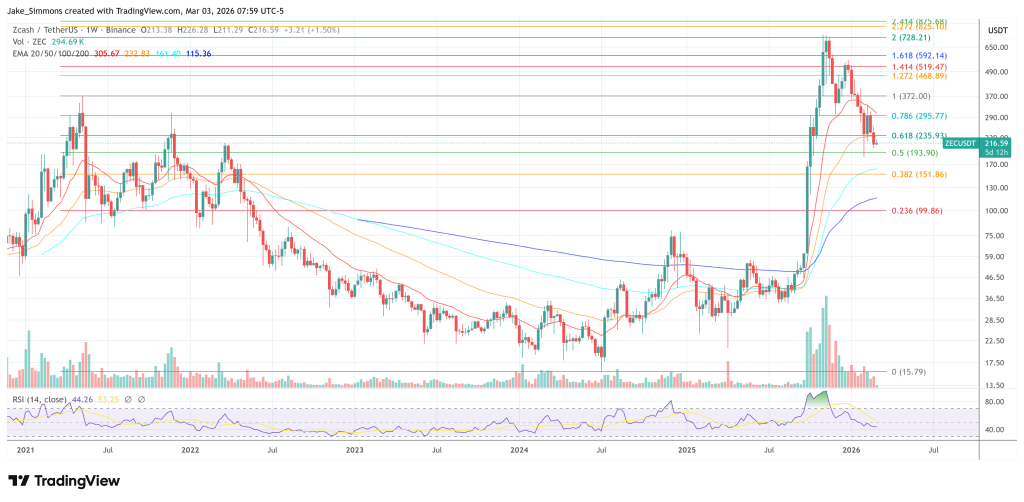
At press time, ZEC traded at $216.59.