Ripple Joins Top 10 Global Private Companies With A $50B Valuation

bitcoinist發佈於 2026-02-10更新於 2026-02-10

文章摘要

Ripple has been ranked among the top 10 most valuable private companies globally, with an estimated valuation of $50 billion, according to a widely shared "unicorn companies" list on X. This positions Ripple alongside major AI and fintech firms like OpenAI, ByteDance, and SpaceX. The valuation marks a significant increase from its $40 billion late-2025 financing, suggesting a sharp upward revaluation. Unlike public companies, Ripple's value is shaped by private transactions, including share buybacks at lower valuations in 2022 and 2024. The ranking reframes Ripple as a large-scale payments infrastructure business rather than a crypto-focused narrative. However, with no imminent IPO plans, its valuation remains subject to periodic private market activity. At the time of reporting, XRP was trading at $1.40.

Ripple has been slotted into the global top 10 of the most valuable private companies at an estimated $50 billion valuation, according to a widely shared “unicorn companies” table circulating on X.

The ranking matters because it reframes Ripple less as a single-token narrative and more as a scaled private-market franchise: a payments infrastructure firm that, at least in secondary valuation terms, is now being discussed in the same breath as the largest AI and fintech “super-unicorns.”

Ripple Ranks #9 Among World’s Largest Private Companies

The image that has been widely reposted on X presents a “List of unicorn companies” with Ripple highlighted at a $50 billion valuation. In that snapshot, Ripple appears alongside a cohort dominated by AI, fintech, and consumer platforms, including OpenAI ($500B), ByteDance ($480B), SpaceX ($400B), Anthropic ($350B), xAI ($230B), Databricks ($100B), Revolut ($75B), Stripe ($70B), and Shein ($66B).
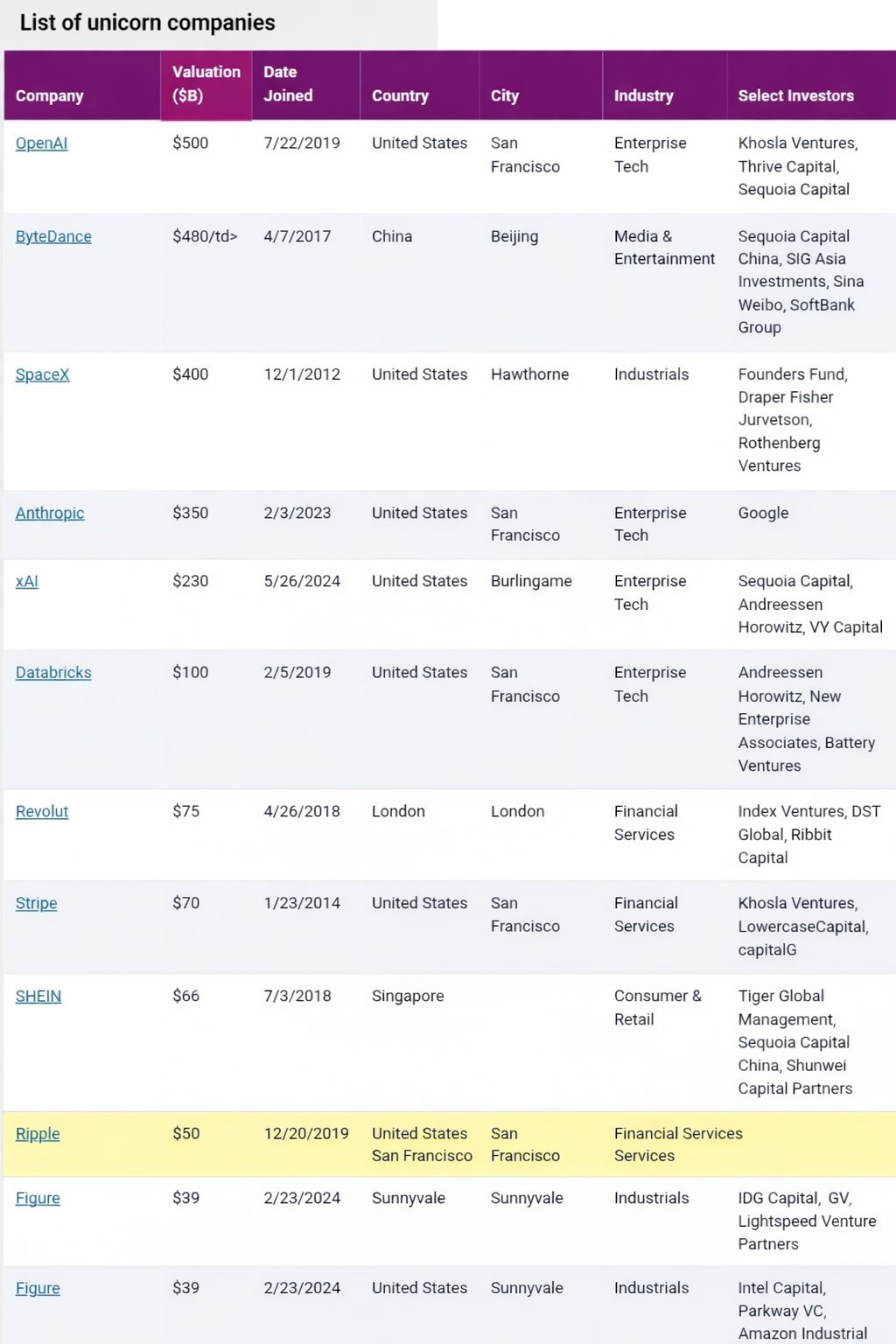
Ripple valuation enters top 10 | Source: X @Xaif_Crypto

A $50 billion tag implies a step-up from a $40 billion post-money valuation associated with a late-2025 equity financing. Taking those two marks at face value, the move to $50 billion represents roughly a 25% increase in implied enterprise value in a short window, an unusually sharp change for a late-stage private company unless secondary markets are repricing aggressively or a new transaction has reset expectations.

Ripple’s private valuation history has also been shaped by company-led liquidity events. The firm has previously conducted share repurchases that effectively created valuation reference points for employees and early investors, including buybacks at an implied $15 billion valuation in 2022 and $11.3 billion in early 2024. Against that backdrop, the late-2025 jump to $40 billion and the current $50 billion figure depict a company whose private-market value has been re-marked upward in distinct steps rather than through the continuous feedback loop of public markets.

That context also matters for how traders and allocators interpret the headline. Private valuations are not the same thing as liquid market prices, and they can reflect transaction structure, preferred terms, or limited float dynamics as much as broad investor consensus. Still, when a company starts appearing on top-10 private-company lists dominated by AI and mega-fintech, it signals that the market increasingly views it as an infrastructure-scale business rather than a niche crypto-adjacent story.

The valuation narrative is also colliding with IPO expectations and Ripple’s consistent stance that a listing is not imminent. With no near-term plan or timeline to go public, Ripple’s price discovery remains anchored to episodic financings and tender offers, meaning the next meaningful datapoint could come from another private round, a new buyback, or secondary transactions that leak into the market.

For crypto markets, the immediate implication isn’t a direct token catalyst so much as a reframing of Ripple’s corporate footprint. If the $50 billion valuation is true, it sets a higher bar for how investors model the company’s optionality: whether that’s future capital raising, M&A capacity, or leverage in institutional partnerships. If it doesn’t, the episode will still have demonstrated how quickly private-market narratives can harden into “consensus” once a single, shareable number hits the timeline.

At press time, XRP traded at $1.40.
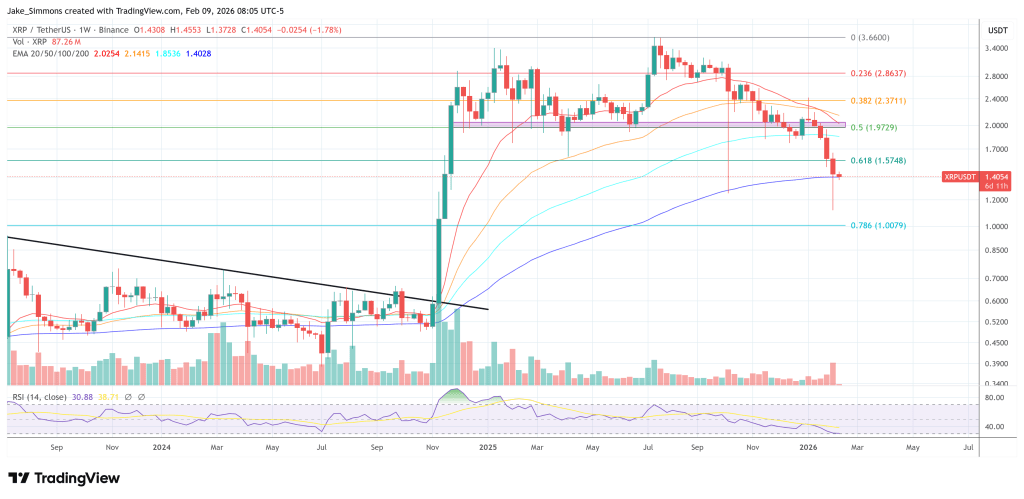
XRP holds above the 200-week EMA, 1-week chart | Source: XRPUSDT on TradingView.com

熱門幣種推薦

相關問答

QWhat is Ripple's estimated valuation according to the widely shared 'unicorn companies' table?

ARipple's estimated valuation is $50 billion.

QHow does the $50 billion valuation rank Ripple among global private companies?

AIt ranks Ripple as the #9 most valuable private company in the world.

QWhat type of companies dominate the top 10 list alongside Ripple?

AThe list is dominated by AI, fintech, and consumer platform companies.

QWhat does the article say about Ripple's plans for an IPO?

ARipple has a consistent stance that an IPO is not imminent, with no near-term plan or timeline to go public.

QWhat was the price of XRP at the time the article was published?

AXRP traded at $1.40 at press time.

你可能也喜歡

Agent 赛马结束,超级工作台上位

过去一个月,腾讯、阿里、字节三家巨头不约而同地开始调整其AI战略:他们并未发布新的Agent(智能体),反而着手缩减和整合现有的众多Agent产品。腾讯将QClaw业务并入其战略级产品WorkBuddy;阿里计划将多款办公智能体整合进“千问办公”,由钉钉统一主导;字节则将其AI编程产品TRAE SOLO更名为TRAE Work,转向工作流协同。这标志着行业对Agent发展的共识正在形成:分散探索阶段结束,资源开始向统一入口集中。 此前,各大厂曾效仿早期互联网,在各个部门和场景广泛布局Agent,导致产品功能重叠、资源分散、成本高昂。随着技术壁垒因开源工具而降低,竞争核心转向算力效率与市场聚焦。当下的调整类似于PC时代的浏览器和移动时代的超级App,预示着AI时代正进入以“超级工作台”统一入口的新阶段。 这一转变背后是市场重心的深刻转移:AI的最大市场并非最初的程序员群体,而是更广阔的数十亿职场人的通用办公场景。超级工作台的目标是成为员工处理邮件、文档、数据、审批等日常工作的首要AI入口,从而掌握企业数据和系统API的调度权。 这并非要取代现有的企业软件(如ERP、CRM),而是通过引入“Skills”(标准化能力接口)让软件能力无缝接入工作台。软件的前端交互界面重要性下降,其价值将转向按能力调用和结果付费。Agent本身也从独立产品,逐渐演变为一种底层能力,最终像电力和网络协议一样,无处不在却又隐于无形。 行业正从Agent作为明星产品的第一阶段,快速迈向其作为统一工作入口的第二阶段,并终将进入其化为无形基础设施的第三阶段。

marsbit8 分鐘前

Agent 赛马结束,超级工作台上位

marsbit8 分鐘前

Michael Saylor:反对 BIP—110 的 110 个理由

Michael Saylor发表长文,系统性地阐述了反对比特币改进提案BIP 110的110个理由。他认为,BIP 110旨在通过修改共识规则来限制区块链上的非支付类数据存储(如铭文等),但其根本动机源于对特定应用的价值判断和“垃圾信息”的担忧,而非修复协议的安全或技术漏洞。Saylor强调,比特币的核心优势在于其中立性、硬共识和开放的无许可创新环境。 他反对BIP 110的主要论点包括:该提案将社会性价值判断提升为协议法律,破坏了规则的中立性;其举证不足,未能量化所谓“紧急威胁”的具体影响;提案捆绑了七项过于宽泛的技术限制,可能误伤未来的合法金融应用与升级路径;临时性的共识规则增加了系统复杂性和协调风险;可能对矿工收入、网络安全和长期创新产生不确定的负面经济影响。 Saylor指出,比特币已具备区块大小和手续费市场等中立的调节机制,节点和矿工也可以自行制定中继和打包策略,这些是比动用共识分叉更优的解决方案。他警告,BIP 110会开创一个危险的先例,即通过协议规则排除不受欢迎的用途,这可能导致未来更多的治理冲突,并扼杀尚未被发现的创新。他呼吁社区应完善测量、采用更精准的资源定价机制,并等待压倒性的共识,而非仓促实施一个可能弊大于利的方案。他最终主张,比特币需要的是“中立性的守护者”,而非“救赎性的守护者”。

marsbit24 分鐘前

Michael Saylor:反对 BIP—110 的 110 个理由

marsbit24 分鐘前

United Stables 市值突破 10 亿美元,Chainlink 数据喂价保障 U 代币抵押资产

United Stables发行的稳定币U市值已突破10亿美元,其关键在于采用了Chainlink数据预言机网络来提供抵押品定价和数据基础设施。 这一里程碑事件突显了在稳定币领域,可靠的数据基础设施已非可选,而是必需品。稳定币的价值依赖于用户对其抵押品、定价和赎回机制的信任,若相关数据薄弱或不透明,将阻碍其在DeFi中的整合与应用。Chainlink通过提供外部数据源,为U稳定币生态系统支持自动化的抵押品审计和定价。 需要明确的是,Chainlink在此扮演的是基础设施角色,它本身并不直接赋予稳定币价值,而是通过提供可靠的数据层,使其他系统能更安全地与稳定币交互。U市值的增长也表明,尽管稳定币市场仍由巨头主导,但新的发行方正在凭借强大的基础设施支持找到发展空间。 对于LINK持有者而言,这一集成案例巩固了Chainlink在稳定币关键基础设施(如抵押品验证)领域的战略地位,增强了其网络效应和机构相关性。然而,单一稳定币的增长并不能直接等同于LINK代币的费用增长或价格驱动,其影响更多是间接和战略层面的。核心在于,稳定币正变得越来越重要、受监管且依赖基础设施,而Chainlink正将自己定位为该环境中的关键服务提供商。

bitcoinist1 小時前

United Stables 市值突破 10 亿美元,Chainlink 数据喂价保障 U 代币抵押资产

bitcoinist1 小時前

交易

現貨

熱門文章

如何購買COMP

歡迎來到HTX.com!在這裡,購買Compound (COMP)變得簡單而便捷。跟隨我們的逐步指南,放心開始您的加密貨幣之旅。第一步:創建您的HTX帳戶使用您的 Email、手機號碼在HTX註冊一個免費帳戶。體驗無憂的註冊過程並解鎖所有平台功能。立即註冊第二步:前往買幣頁面,選擇您的支付方式信用卡/金融卡購買:使用您的Visa或Mastercard即時購買Compound (COMP)。餘額購買:使用您HTX帳戶餘額中的資金進行無縫交易。第三方購買:探索諸如Google Pay或Apple Pay等流行支付方式以增加便利性。C2C購買:在HTX平台上直接與其他用戶交易。HTX 場外交易 (OTC) 購買:為大量交易者提供個性化服務和競爭性匯率。第三步:存儲您的Compound (COMP)購買Compound (COMP)後,將其存儲在您的HTX帳戶中。您也可以透過區塊鏈轉帳將其發送到其他地址或者用於交易其他加密貨幣。第四步:交易Compound (COMP)在HTX的現貨市場輕鬆交易Compound (COMP)。前往您的帳戶,選擇交易對,執行交易,並即時監控。HTX為初學者和經驗豐富的交易者提供了友好的用戶體驗。

574 人學過發佈於 2024.12.13更新於 2026.06.02

如何購買COMP

相關討論

歡迎來到 HTX 社群。在這裡,您可以了解最新的平台發展動態並獲得專業的市場意見。 以下是用戶對 COMP (COMP)幣價的意見。

活动图片










