OpenAI Official Plugin Strongly Integrated into Claude Code

marsbit發佈於 2026-03-31更新於 2026-03-31

文章摘要

OpenAI has officially released the "codex-plugin-cc" on GitHub, enabling developers to integrate OpenAI’s Codex model capabilities directly into Anthropic’s command-line development tool, Claude Code. This cross-platform integration breaks down ecosystem barriers between major AI tools, allowing developers to leverage the strengths of both models without switching environments. With simple configuration, Claude Code becomes a versatile programming assistant combining the advantages of both companies. Key features include: - Standard code review via the `/codex:review` command, providing expert improvement recommendations and double-checking for logic errors. - Adversarial review using `/codex:adversarial-review`, which challenges design decisions to identify potential performance bottlenecks or security risks. - Task delegation through `/codex:rescue`, allowing complex debugging or repair tasks to be handed off to a Codex sub-agent for collaborative problem-solving. This integration enhances code quality and development efficiency through multi-model collaboration.

Recently, the AI developer community welcomed a major update: OpenAI officially released an open-source project named codex-plugin-cc on GitHub. This plugin allows developers to directly utilize the capabilities of OpenAI's Codex model within the command-line development tool Claude Code, introduced by Anthropic.

This "cross-brand" integration breaks down the ecosystem barriers that previously existed between major AI model tools, enabling developers to leverage the technical strengths of both industry giants without switching environments. With simple command configurations, Claude Code instantly transforms into an all-in-one programming assistant that combines the best of both.
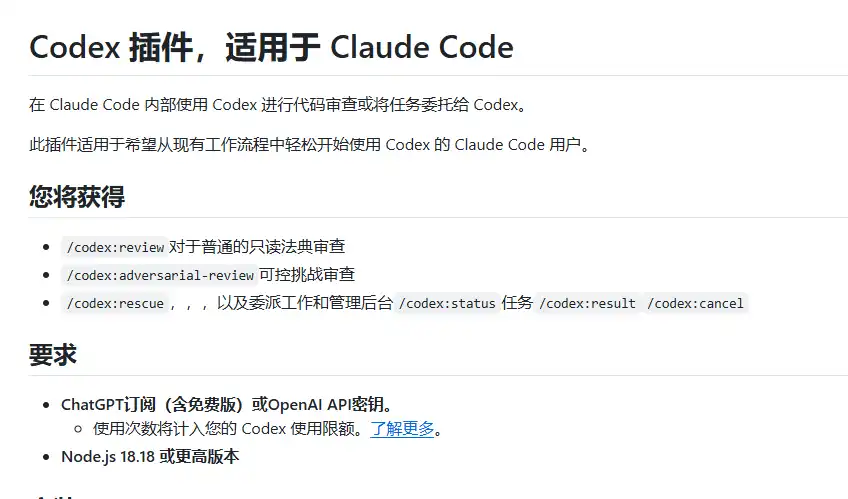
Empowered by this plugin, users can initiate a standard read-only code review using the /codex:review command to receive professional improvement suggestions from Codex. This dual verification mechanism effectively catches logical vulnerabilities that a single model might miss, adding a "double insurance" for code quality.

More uniquely, its "adversarial review" feature allows developers to use /codex:adversarial-review to actively request Codex to challenge existing design decisions. This mode is specifically designed to stress-test the rationality of system architecture, uncovering potential performance bottlenecks or security risks from a "fault-finding" perspective.

Additionally, the plugin introduces a task delegation mechanism, enabling users to transfer complex debugging or repair tasks to a Codex sub-agent via /codex:rescue. This collaborative model achieves automatic task distribution, allowing the primary model and auxiliary models to each focus on their respective areas of expertise.

github:https://github.com/openai/codex-plugin-cc

相關問答

QWhat is the name of the official OpenAI plugin that integrates with Claude Code?

AThe plugin is called codex-plugin-cc.

QWhat is the primary function of the /codex:review command in the new plugin?

AThe /codex:review command is used to initiate a standard read-only code review to get professional improvement suggestions from the Codex model.

QWhat unique feature does the /codex:adversarial-review command provide?

AThe /codex:adversarial-review command enables an 'adversarial review' function, which actively challenges existing design decisions to stress-test the system architecture and uncover potential performance bottlenecks or security risks.

QHow does the /codex:rescue command facilitate task management?

AThe /codex:rescue command allows users to delegate complex debugging or repair tasks to a Codex sub-agent, enabling a collaborative model where the main and auxiliary models work in their respective areas of expertise.

QWhere was the codex-plugin-cc project officially released?

AThe project was officially released by OpenAI on GitHub.

你可能也喜歡

比特币提现仍在继续:Coldcard冷钱包8年存储终成空

硬件钱包Coldcard遭黑客攻击,导致大量资金从易受攻击设备中被持续转出。据Galaxy Research数据,截至2026年8月2日,已有4585个地址被盗,损失总额达1367.05 BTC(约合8860万美元),远超7月30日最初报告的594.5 BTC。大部分被盗资金仍停留在攻击者地址。 问题根源并非固件,而是设备生成的种子短语存在漏洞。2021年3月起,因程序员错误集成libNgU库,设备从使用STM32硬件随机数生成器转为使用软件生成器Yasmarang,该生成器由公开可获取的芯片序列号和计时器状态初始化,导致生成的种子短语可在离线状态下被暴力破解。即使固件后续已更新,只要用户未将资金转移至基于新种子短语生成的新地址,旧钱包就始终处于风险中。 受影响的设备包括特定固件版本的Mk2/Mk3、Mk4/Mk5及Q系列。仅当种子短语是通过至少50次独立掷骰子或强唯一性BIP-39密码短语创建时方可幸免。官方建议受影响用户立即在已修复的固件上生成新种子短语并转移资产。 报道提及一位39岁投资者的案例,他因该漏洞损失了2 BTC(约13万美元)。他多年来通过体力劳动积攒比特币,将其视为在制裁和高通胀国家中的财务保障与提前退休的途径。此次事件使他的长期持有策略和“冷存储”信心遭受重击,他因此决定彻底退出加密货币领域。 从历史数据看,随机数生成器缺陷并非首例,类似问题曾导致巨额损失。此次事件警示,即使离线存储也未必绝对安全,其安全性高度依赖于底层硬件和算法的可靠性。

cryptonews.ru23 分鐘前

比特币提现仍在继续:Coldcard冷钱包8年存储终成空

cryptonews.ru23 分鐘前

帕克·刘易斯解释为何比特币仍是最佳货币

知名比特币分析师帕克·刘易斯在访谈中批评了某些上市公司以“数字信贷”形式销售永续优先股的营销策略,认为这从根本上扭曲了比特币的本质。他指出,比特币在算法层面不具备法币收益性,承诺定期分红主要依赖牛市吸引新投资者来维持,风险极高。 刘易斯引用数据说明此类衍生品的巨大风险:全球信贷市场规模达300万亿美元,而永续优先股市场仅约1万亿美元,这表明机构有意规避这种无还款期限的资产,将风险转嫁给信息不足的散户。 针对“比特币波动性太大”的常见观点,他认为波动性是这一供应量严格受限的新资产被大规模采用过程中的自然数学结果。新人入场需出更高价从早期持有者手中购买,导致价格剧烈波动。他建议投资者直接持有比特币,这比投资MicroStrategy等公司发行的衍生品更安全。 投资者将焦点从直接持有加密货币转向公司衍生品,会忽视法币急速贬值的真正威胁。刘易斯以自创的“肋眼牛排指数”为例,指出其本地超市一款牛排价格从2020年的19.99美元涨至37.99美元,反映年化约12-13%的真实通胀,远超官方平滑后的CPI数据。 在全球通胀环境下,最明智、保守且安全的策略仍是直接持有比特币并完全掌控私钥。追逐加密货币国库股等公司工具的收益只会叠加隐性系统风险,而理解去中心化货币的本质才能有效保护财富免受宏观经济动荡影响。

cryptonews.ru4 小時前

帕克·刘易斯解释为何比特币仍是最佳货币

cryptonews.ru4 小時前

交易

現貨
活动图片





