Thailand’s second-largest lender, Kasikornbank (KBank), is quietly fortifying its digital asset infrastructure.
The banking giant isn’t just tinkering; trademark filings show they are securing IP rights for digital wallets and stablecoin solutions right before the anticipated IPO of their asset management arm. This isn’t just a technical upgrade; it’s a signal that institutional banking is finally getting serious about integrating blockchain rails.
KBank seems to be prepping for a future where crypto is a daily medium of exchange, not just a speculative toy. By locking down these trademarks now, the bank is effectively hedging against the slow death of legacy SWIFT systems to capture digital capital flows across Southeast Asia.
Why does that matter? Simple: institutional validation usually precedes mass utility. When banks build the wallet infrastructure, they’re essentially rolling out the red carpet for the applications built on top of it.
But while banks focus on the ‘rails’, the actual movement of money, the real innovation is happening at the application layer. Specifically, where AI meets decentralized finance. The $85B content creation industry is undergoing a similar overhaul.
Just as KBank wants to bypass legacy payment friction, new ecosystems are cutting out the restrictive fee structures of Web2 platforms. This shift from centralized control to decentralized utility is bridging the gap between institutional adoption and retail use. That’s why investors are looking closely at AI-powered challengers like SUBBD Token ($SUBBD).
AI-Driven Platforms Decentralize The $85B Creator Economy
While giants like KBank modernize the back end, the front-end user experience is shifting toward creator sovereignty. Frankly, the current model looks predatory. Legacy platforms often extract fees ranging from 20% to 70% of a creator’s earnings while retaining the right to de-platform users on a whim. The inefficiency is glaring: intermediaries are extracting massive value without contributing proportional utility.
SUBBD Token ($SUBBD) tackles this by merging the Ethereum blockchain with advanced AI tools. The goal?
Return control to the creators. By using an ERC-20 token for transactions, the ecosystem cuts out high banking fees and payment processor delays—the very friction points KBank’s stablecoin initiatives aim to solve institutionally.
But SUBBD goes beyond payments. It integrates proprietary AI models for content generation (think AI Voice Cloning and AI Influencer Creation), allowing creators to scale their output without exploding their labor costs.
The addition of an AI Personal Assistant for automated interactions signals a major shift in how influencers manage community engagement. Instead of manual replies, AI tools handle the grunt work, optimizing revenue streams through subscriptions, pay-per-view (PPV), and NFT sales. (For creators, this means transforming a passive audience into an active, token-gated economy.)
Governance rights further distinguish this model. Token holders vote on feature rollouts and community events, ensuring the platform evolves based on user needs rather than shareholder mandates.
LEARN MORE ABOUT $SUBBD WITH OUR ‘WHAT IS SUBBD TOKEN?’ GUIDE.
$SUBBD Presale Momentum Highlights Demand For Yield-Bearing Web3 Utilities
The market’s appetite for utility-driven AI projects is obvious in recent capital inflows. Smart money is watching early-stage valuations closely, hunting for assets that offer both technological innovation and incentives for long-term holding. SUBBD has already secured over $1.4M in its ongoing presale, a figure that suggests robust confidence in the roadmap, even with broader market volatility.
Currently priced at $0.05749, the token offers an entry point that contrasts sharply with the saturated valuations of established AI cryptos. The project’s economic model is built for retention.
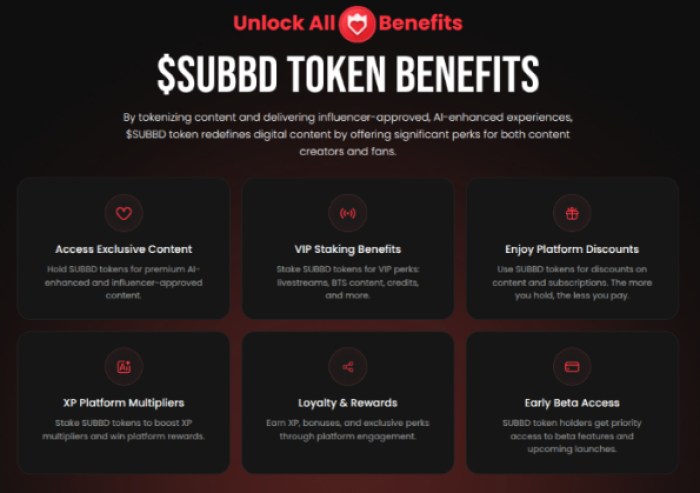
To mitigate the volatility often seen with new utility tokens, SUBBD offers a staking protocol with a fixed 20% APY for the first year. This high-yield structure does double duty: it rewards early adopters for locking liquidity and stabilizes the token’s circulating supply during the critical initial growth phase.
Source: SUBBD Token
But it’s not just about yield. For fans, staking unlocks tiered platform benefits, including access to exclusive livestreams and ‘HoneyHive’ membership. This gamification of finance, where holding a token grants both interest and experiential access, is fast becoming the standard for successful Web3 launches.
As institutional giants like KBank build the stablecoin highways, projects like SUBBD are building the high-speed vehicles that give users a reason to drive on them.
VISIT THE OFFICIAL $SUBBD PRESALE SITE.
This article is not financial advice. Cryptocurrency investments, including presales and AI tokens, carry inherent risks. Always conduct independent research before making investment decisions.