ETH/BTC looks promising – Is Ethereum set to surge?

ambcrypto發佈於 2026-01-12更新於 2026-01-12

文章摘要

The ETH/BTC ratio appears to have bottomed in April 2025, similar to the pattern observed in 2019, suggesting a potential shift in Ethereum's performance relative to Bitcoin. Despite a nearly four-year downtrend, the ratio has stabilized and formed higher lows, indicating a constructive recovery phase. Key factors supporting Ethereum’s strength include a significant increase in stablecoin activity on the network. Stablecoin supply on Ethereum surged by over 65% in 2025, reaching roughly double its previous 2021 peak, with a market value of $160–170 billion—the highest on record. This growth suggests strong institutional and user confidence, as stablecoins often represent idle capital poised for future activity. Additionally, Ethereum continues to serve as the leading settlement layer for dollar-denominated transactions. Stablecoin transfer volume on the network reached a new all-time high of $8 trillion in Q4 2025, underscoring its foundational role in crypto liquidity and usage. With development activity remaining robust and on-chain metrics strengthening, Ethereum may be poised for a bullish breakout relative to Bitcoin.

The ETH/BTC ratio appeared to have bottomed in April, similar to what played out in 2019. Development activity on Ethereum is still strong, and more value is flowing into tokenized assets on the network.

While the market’s attention is elsewhere for now, ETH could just walk up into success soon.

ETH/BTC cycle set to shift?

The ETH/BTC pair has trended lower for nearly four years, leading many to write off Ethereum’s [ETH] relative performance.

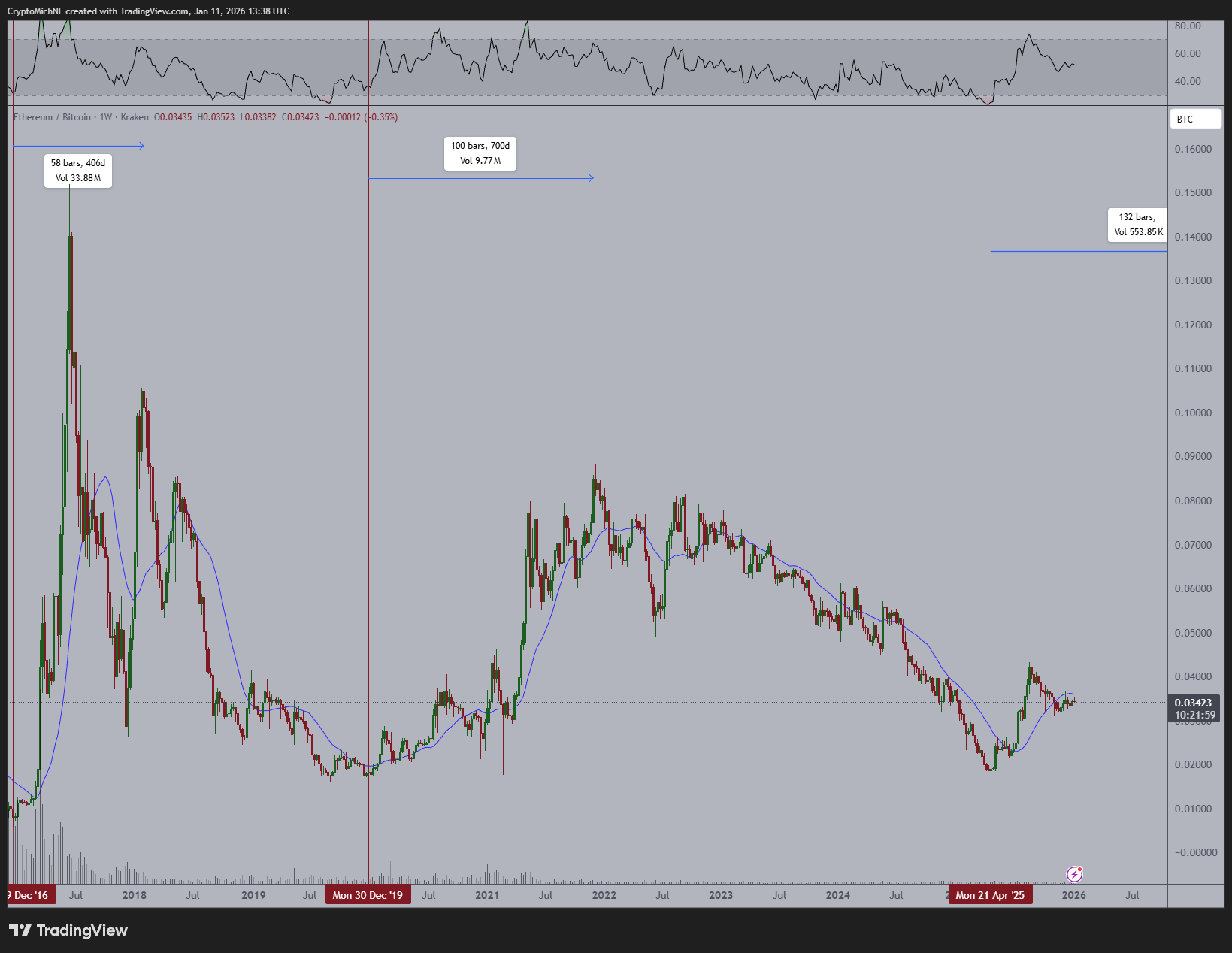
That downtrend appears to have stalled in April 2025, when the ratio found a base and began to stabilize.

Source: X

Market analyst Michael van de Poppe has drawn comparisons to the 2019 cycle, when ETH/BTC also bottomed after an extended slide before entering a recovery phase.

Since April, price has remained constructive, with higher lows forming on the chart. While the move has been gradual, Ethereum may be coming out of its weakest phase relative to Bitcoin [BTC].

Stablecoins on Ethereum

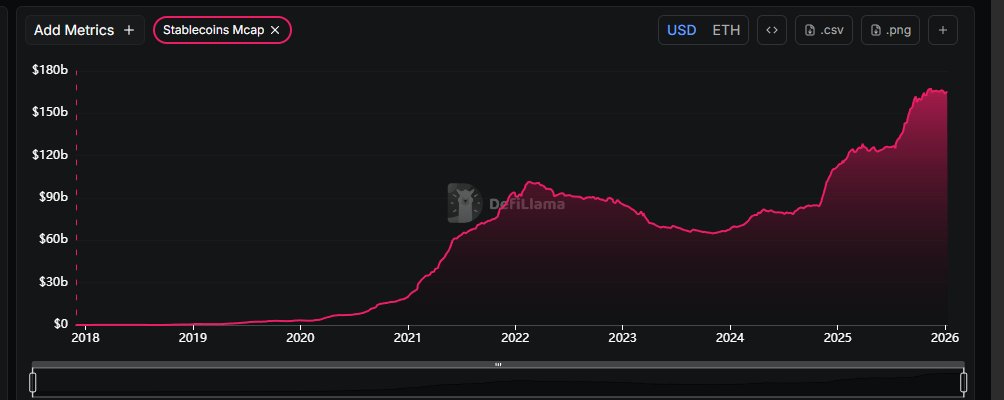
While ETH’s price has struggled, stablecoin balances on the network have surged. Supply on Ethereum rose by more than 65% over 2025 and is now roughly double its previous peak from 2021.

Source: DeFiLlama

This matters because stablecoins often act as idle capital. Rising balance means users and institutions are still placing value on Ethereum.

Van de Poppe sees this as constructive, with growing stablecoin liquidity usually coming before greater activity numbers.

The backbone is intact

Stablecoins on Ethereum now account for roughly $160-170 billion in market value, per DeFiLlama. This is the highest level on record and well above previous cycle peaks.

This expansion has continued even with ETH’s price being range-bound.

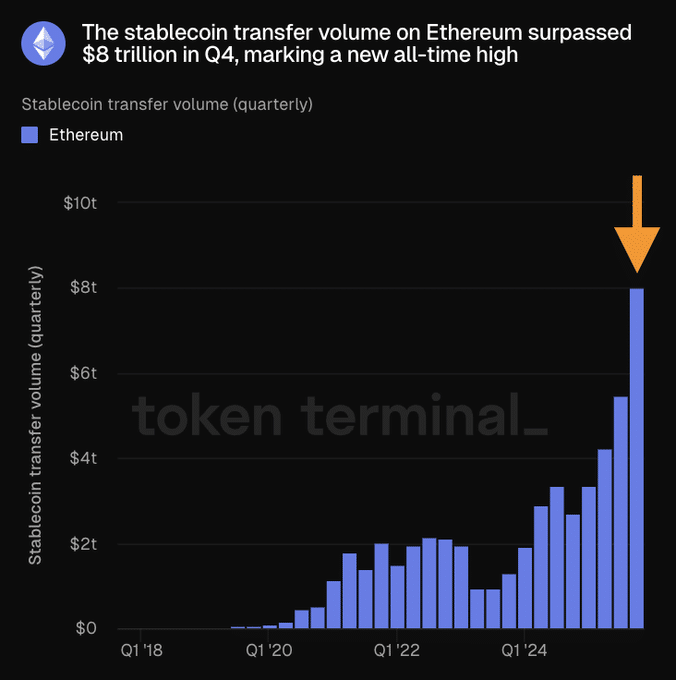
Usage has followed the same pace. According to Token Terminal, stablecoin transfer volume on Ethereum crossed $8 trillion in Q4 2025, a new ATH.

Source: Token Terminal

Ethereum is still functioning as the settlement layer of choice for dollar-denominated activity.


Final Thoughts

  • ETH/BTC may have bottomed in April; Ethereum looks like it’s recovering.
  • The network’s settlement role remains firmly intact.
Next: Ethereum: 2 factors strengthening ETH’s potential bullish breakout
Share
  • Share
  • Tweet

相關問答

QWhat key indicator suggests that the ETH/BTC ratio may have bottomed in April 2025?

AThe ETH/BTC ratio found a base and began to stabilize in April 2025, with higher lows forming on the chart, similar to the pattern observed in 2019.

QHow much did the stablecoin supply on Ethereum increase by in 2025, and why is this significant?

AThe stablecoin supply on Ethereum rose by more than 65% in 2025, reaching roughly double its previous peak from 2021. This is significant because stablecoins represent idle capital, and rising balances indicate that users and institutions continue to place value on the Ethereum network.

QWhat was the approximate market value of stablecoins on Ethereum as per DeFiLlama?

AStablecoins on Ethereum accounted for roughly $160-170 billion in market value, which is the highest level on record and well above previous cycle peaks.

QHow much stablecoin transfer volume was recorded on Ethereum in Q4 2025, and what does this indicate?

AStablecoin transfer volume on Ethereum crossed $8 trillion in Q4 2025, setting a new all-time high. This indicates that Ethereum remains the preferred settlement layer for dollar-denominated activity.

QAccording to the article, what two factors strengthen Ethereum's potential for a bullish breakout?

AThe two factors are: 1) The ETH/BTC ratio may have bottomed, showing signs of recovery, and 2) The network's settlement role remains firmly intact, supported by growing stablecoin liquidity and transfer volume.

你可能也喜歡

如何让自己变得让人工智能永远也无法取代

面对人工智能的冲击,许多人担心工作被取代。然而,真正的威胁在于个人对他人和系统的依赖,以及由此产生的“薪资奴役”——即为生存而从事无意义、枯燥的工作。摆脱这种困境的关键,不是抵制技术,而是成为拥有高自主性的“不可受雇”个体。 文章提出了成功抵御AI替代的五个核心要素:自主性(主动行动的能力)、品味(判断事物价值的经验)、说服力(让他人关注你工作的能力)、毅力(坚持并从错误中学习)和迭代(根据反馈持续改进)。这些能力无法仅通过理论学习获得,必须通过实践来培养。 要启动转变,首先要彻底改变环境,重塑身份认同。其次,应选择一个能获得真实、快速反馈的实践领域,例如创业。在众多技能中,内容创作(媒体)比编写代码更具优势,因为其价值是主观的,需要独特的审美和判断力,这正是AI目前难以完全复制的。 具体行动上,可以从三个步骤开始: 1. **挖掘原始素材**:反思自己长期痴迷的知识领域、轻松解决的难题或童年被压抑的兴趣,找到独特的个人经验。 2. **确立反向思考主轴**:找出你坚信但主流观点错误的地方,或行业内普遍忽视的“皇帝新衣”,形成独特的批判性视角。 3. **立即发布**:将前两步的思考融合,撰写并发布第一个核心内容(如帖子、视频),勇敢接受真实世界的反馈,并在此基础上持续学习和迭代。 最终,抵御AI的关键在于构建一份与自身身份深度契合的毕生事业,通过持续的内容创作和真实互动,建立无法被自动化取代的独特价值和影响力。行动,从今天发布第一个想法开始。

marsbit4 小時前

如何让自己变得让人工智能永远也无法取代

marsbit4 小時前

通过掷骰子离线保管比特币密钥:并非人人愿意为之

文章探讨了通过投掷骰子生成比特币钱包种子短语的安全方法及其现实挑战。核心观点如下: **1. 骰子提供物理熵源** 骰子结果由众多微小变量决定,理论上虽可预测,但实践中无法被攻击者复制或计算,从而提供高质量的随机性。每个六面骰子投掷约产生2.585比特熵,50次投掷即可满足典型12词助记词(128比特熵)的安全需求。 **2. Coldcard漏洞事件凸显手工熵源的价值** 近期Coldcard硬件钱包因固件漏洞导致其内部随机数生成器存在缺陷,致使约1128枚比特币被盗。但那些**完全**通过足量骰子投掷生成种子短语的用户未受此漏洞影响,因为他们的主密钥未使用有缺陷的生成器。 **3. 重要警示:手工种子并非万能保护** 安全研究员指出,即使用户使用骰子生成了安全的种子,若他们使用了Coldcard的其他功能(如生成纸钱包、克隆密钥、共享签名密钥、密码等),这些**衍生密钥**仍可能调用有漏洞的随机数生成器,从而存在风险。安全种子不保证设备生成的所有秘密都安全。 **4. 手工生成熵源的现实局限性** 尽管数学上可靠,但该方法对大多数用户并不友好: * **过程繁琐易错**:需投掷50-99次,精确记录,任何输入错误都会导致钱包完全不同。 * **引入新风险**:用户可能在记录、转换过程中泄露信息,或使用有偏的骰子/投掷方式。 * **用户体验差**:难以想象大规模推广需要用户手动投掷近百次骰子。安全措施需适应现实生活场景和普通用户的知识水平。 **5. 给用户的建议** 受影响的Coldcard用户应: * 更新固件至最新版。 * 检查是否使用过有漏洞的功能生成了次级密钥或密码,如有则需立即更换。 * 考虑采用多签方案,使用不同厂商的设备分散风险。 **结论**:手工投掷骰子生成熵源是技术娴熟用户的一个有效安全选项,但其过程复杂、容易出错,不适合作为主流用户的默认方法。长远目标是依赖安全、透明且无需专业知识的硬件/软件随机数生成方案。

cryptonews.ru8 小時前

通过掷骰子离线保管比特币密钥:并非人人愿意为之

cryptonews.ru8 小時前

交易

現貨
活动图片