Crypto May No Longer Be Treated Like Penny Stocks Under SEC Plan

bitcoinist發佈於 2026-03-17更新於 2026-03-17

文章摘要

The US Securities and Exchange Commission (SEC) has proposed amending Exchange Act Rule 15c2-11 to apply only to equity securities, a move that could significantly impact crypto market structure. The rule, historically used to prevent fraud in over-the-counter equity markets, would no longer broadly apply to other asset classes like cryptocurrencies. This change is seen as a meaningful shift away from forcing crypto into existing securities frameworks. By excluding crypto from these rules—originally designed for penny stocks—the SEC signals a more tailored regulatory approach. The proposal is open for public comment, reflecting the agency's growing willingness to treat crypto differently from traditional equities.

The US Securities and Exchange Commission has proposed narrowing Exchange Act Rule 15c2-11 so that it applies only to equity securities, a technical change that could carry outsized significance for crypto market structure. For digital assets, the proposal signals a more tailored regulatory approach after years of trying to force crypto into frameworks built for traditional securities.

In a press release issued March 16, the SEC said Rule 15c2-11 has historically focused on preventing manipulative and fraudulent schemes in over-the-counter equity markets. The proposed amendment would revise the rule so it refers only to equity securities, rather than leaving room for broader application to other asset classes.

Quiet But Meaningful Win For Crypto

That matters because Rule 15c2-11 governs certain information gathering and review requirements for broker-dealers that publish quotations for, or maintain a continuous quoted market in, securities in the OTC market. By explicitly tying the rule to equities, the SEC appears to be drawing a cleaner line around where those obligations begin and end.

SEC Chairman Paul S. Atkins framed the move as a matter of regulatory fit rather than ideology. “Regulations should be appropriately tailored to fit the asset class to which they apply,” Atkins said. “This proposal would clarify regulatory obligations when publishing quotations and affirm what was always understood: Rule 15c2-11 applies to equity securities.”

For crypto market participants, the proposal reads as more than a drafting cleanup. Marty Bent, writing on X (@TFTC), argued that the shift quietly reverses the posture that defined much of the prior SEC era. “The SEC just proposed excluding crypto assets from OTC market rules that govern broker-dealer quotations. These are regulations originally designed for penny stocks and thinly traded equities.”

He went further, casting the amendment as a subtle but meaningful break from the agency’s past playbook. “This is a quiet but meaningful shift. Instead of forcing Bitcoin and crypto into existing securities frameworks, the SEC is explicitly carving it out. The rules being amended (Rule 15c2-11) dictate how broker-dealers can publish quotes for securities. By clarifying that crypto doesn’t fall under these requirements, the SEC is signaling it doesn’t view these assets through the same lens as traditional equities.”

That interpretation is likely to resonate because Rule 15c2-11 was never designed with digital assets in mind. Its original function was tied to OTC equities, particularly the kind of thinly traded names that have historically been vulnerable to quote manipulation and fraud. In that context, the SEC’s proposal does not create a bespoke crypto regime, but it does something nearly as important: it narrows the set of legacy securities rules that might otherwise be stretched to cover crypto by default.

Bent also contrasted the proposal with the enforcement-heavy approach associated with former Chair Gary Gensler. “Under Gensler, the approach was the opposite, force everything into existing rules, then sue when companies couldn’t comply. This is the regulatory posture flipping from ‘prove you’re not a security’ to ‘these rules weren’t built for you.’”

The proposal is now headed to the standard public process. The SEC said the release will be published on SEC.gov and later in the Federal Register, with a 60-day comment period beginning after Federal Register publication. That leaves room for revisions, but the message is already clear enough: the agency is increasingly willing to distinguish crypto from the infrastructure and assumptions of legacy equity markets.

At press time, the total crypto market cap stood at $2.51 trillion.
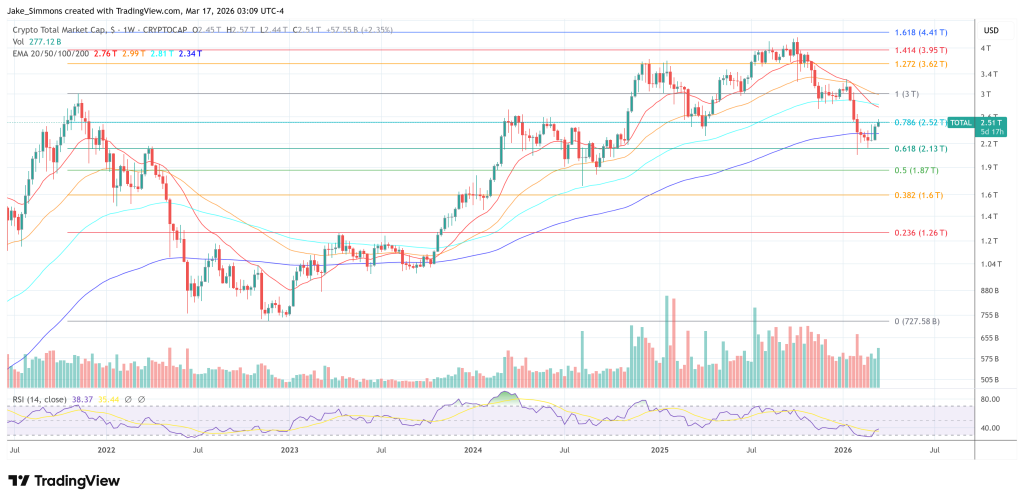
Total crypto market cap must reclaim the 0.786 Fib, 1-week chart | Source: TOTAL on TradingView.com

相關問答

QWhat is the main change proposed by the SEC regarding Rule 15c2-11?

AThe SEC has proposed narrowing Exchange Act Rule 15c2-11 so that it applies only to equity securities, rather than having broader application to other asset classes like crypto.

QWhy is this proposal considered a significant shift for the crypto market?

AIt signals a more tailored regulatory approach, distinguishing crypto from traditional securities frameworks and reversing the previous posture of forcing crypto into existing rules designed for equities like penny stocks.

QHow did SEC Chairman Paul S. Atkins justify the proposed amendment?

AHe framed it as a matter of regulatory fit, stating that regulations should be appropriately tailored to the asset class they apply to, and that the proposal clarifies Rule 15c2-11 was always understood to apply to equity securities.

QWhat does Marty Bent suggest about the SEC's change in approach compared to the Gary Gensler era?

ABent argues this shifts from an enforcement-heavy approach that forced crypto into existing rules and then sued for non-compliance, to a posture that acknowledges these rules weren't built for crypto assets.

QWhat is the next step for this SEC proposal after its announcement?

AThe proposal will go through a standard public process with a 60-day comment period after being published in the Federal Register, leaving room for potential revisions.

你可能也喜歡

全球股市的风暴点:韩国股市的去杠杆已基本完成

近期韩国股市出现剧烈波动,KOSPI指数自6月高点最大回撤达32%,成为全球AI行情调整的“风暴中心”。文章指出,市场下跌的深层原因并非基本面恶化,而是由高度集中的杠杆资金结构所驱动。 具体来看,核心风险来源于两方面: 1. **杠杆ETF大规模去化**:前期规模一度接近500亿美元的杠杆ETF,其“每日再平衡”机制在下跌中引发了“股价下跌→强制平仓”的负向循环。目前其规模已从高点收缩约240亿美元,去化进度已达约75%,剩余压力显著收敛。监管层也已出台新规,从8月起严格限制此类产品,从源头降低风险。 2. **对冲基金快速降杠杆**:通过互换交易放大敞口的对冲基金,其多空持仓比率已从峰值显著回落,净多头水平显示杠杆已下降超过50%,最剧烈的被动去杠杆阶段基本完成。 相比之下,韩国居民融资余额占股市市值比重很小(约0.5%),且不具备强制平仓机制,难以成为系统性风险的核心来源。 综合而言,最容易引发“连锁抛售”的高杠杆结构已大部分出清,市场正从“流动性驱动的下跌”过渡到“基本面驱动的定价”。只要AI产业趋势未发生根本逆转,本轮调整更接近一次拥挤交易的集中出清,而非行情的终结。 文章最后强调,AI代表的硅基革命趋势不可逆,波动是参与趋势的成本而非风险。每一次调整都是在进行筹码结构的优化,并为认清趋势的投资者提供新的参与机会。

链捕手1 小時前

全球股市的风暴点:韩国股市的去杠杆已基本完成

链捕手1 小時前

自2024年以来推出的加密货币代币中,92.9%跌破发行价:CryptoRank

加密货币数据平台CryptoRank的最新研究显示,自2024年以来发行的加密货币代币中,有高达92.9%目前正低于其代币生成事件(TGE)时的初始价格。 该分析聚焦于市值超过1亿美元的项目,在2024年至2026年间发行的113个项目中,仅有8个仍保持在发行价之上,其余105个均已跌破。这意味着只有约7.1%的项目为投资者带来了正回报,而整体样本的中位数回报率低至-95.7%。 表现最突出的项目是Hyperliquid (HYPE),自TGE以来上涨了1,519%。其次是Ondo Finance (ONDO)、EverValue Coin (EVA)和Midnight Network (NIGHT),涨幅分别为101.4%、20.32%和16.50%。 数据表明,与过去市场周期中新股常持续上涨不同,当前投资者变得更加挑剔。资本正越来越集中于少数已证明其产品采用度、生态增长或强劲市场需求的项目。许多新代币难以维持初始估值。 这一趋势反映了市场关注点的转变:投资者愈发看重代币经济学、流通供应量、解锁时间表和长期实用性,而非仅关注上市初期的价格动能。 研究结果可能影响未来项目的发行策略。项目因过高的完全稀释估值(FDV)、上市初期流通量不足以及大量未来代币解锁计划而备受审视,这些因素都可能在新供应进入市场时对价格构成下行压力。因此,开发者和投资者未来或将更重视可持续的代币分发模式和长期的生态增长,而非激进的初始估值。

ambcrypto1 小時前

自2024年以来推出的加密货币代币中,92.9%跌破发行价:CryptoRank

ambcrypto1 小時前

交易

現貨
活动图片