All about Dogecoin’s ‘muted’ price action and the distribution pressure on it

ambcrypto發佈於 2026-03-21更新於 2026-03-21

文章摘要

Dogecoin's on-chain activity surged with 1.037 billion DOGE transferred, yet the price remained stagnant around $0.094. This divergence suggests the high volume stems from redistribution, exchange movements, or internal transfers rather than genuine buying pressure. Whale activity, including $90 million+ flows into exchanges like Bitget, indicates distribution, increasing sell-side pressure. Although exchange balances dropped 30% since late 2025, intermittent large inflows continue to introduce overhead resistance. With top holders controlling 66% of supply and not accumulating, DOGE remains range-bound, balancing between distribution and absorption forces.

Dogecoin’s [DOGE] on-chain activity has expanded sharply lately. And yet, the price action stayed muted, establishing a clear imbalance between flow and valuation. Transfer volume climbed to 1.037 billion DOGE, roughly $97.8 million, while the price held near $0.094 with gains of only 0.3%.

As this divergence developed, the transaction count increased to 26,627 alongside 32,915 active addresses, reflecting rising network engagement. However, the price failed to respond in tandem, shifting attention towards the composition of these flows.

The high volume is more likely a sign of redistribution, exchange routing, or internal wallet movements than accumulation. As activity intensifies without directional follow-through, the gap between volume and price will only widen.

This pattern also suggested that raw on-chain expansion, when unadjusted for internal transfers, does not quite confirm genuine demand or sustained buying pressure.

Whale flows signal distribution behind Dogecoin’s volume spike

As transaction volume cools down, whale flows can help clarify why the price has been unresponsive. Transfers above $90 million moved into Bitget-linked wallets within 24 hours, signaling distribution into available liquidity.

As these flows hit exchanges, they increased immediate sell pressure, which absorbed incoming demand rather than pushing the price higher.

Meanwhile, top-100 holders still control over 66% of supply, translating to approximately 101.99 billion DOGE, without expanding balances, reinforcing the absence of accumulation. This behavior implied a late-cycle rotation, where large players offload into retail-driven activity. As supply met demand at these levels, the price stabilized near $0.094 instead of breaking out.

However, since holdings have been concentrated, the downside stayed controlled, leaving DOGE range-bound until either accumulation resumes or sell pressure intensifies.

Exchange flows keep Dogecoin range-bound

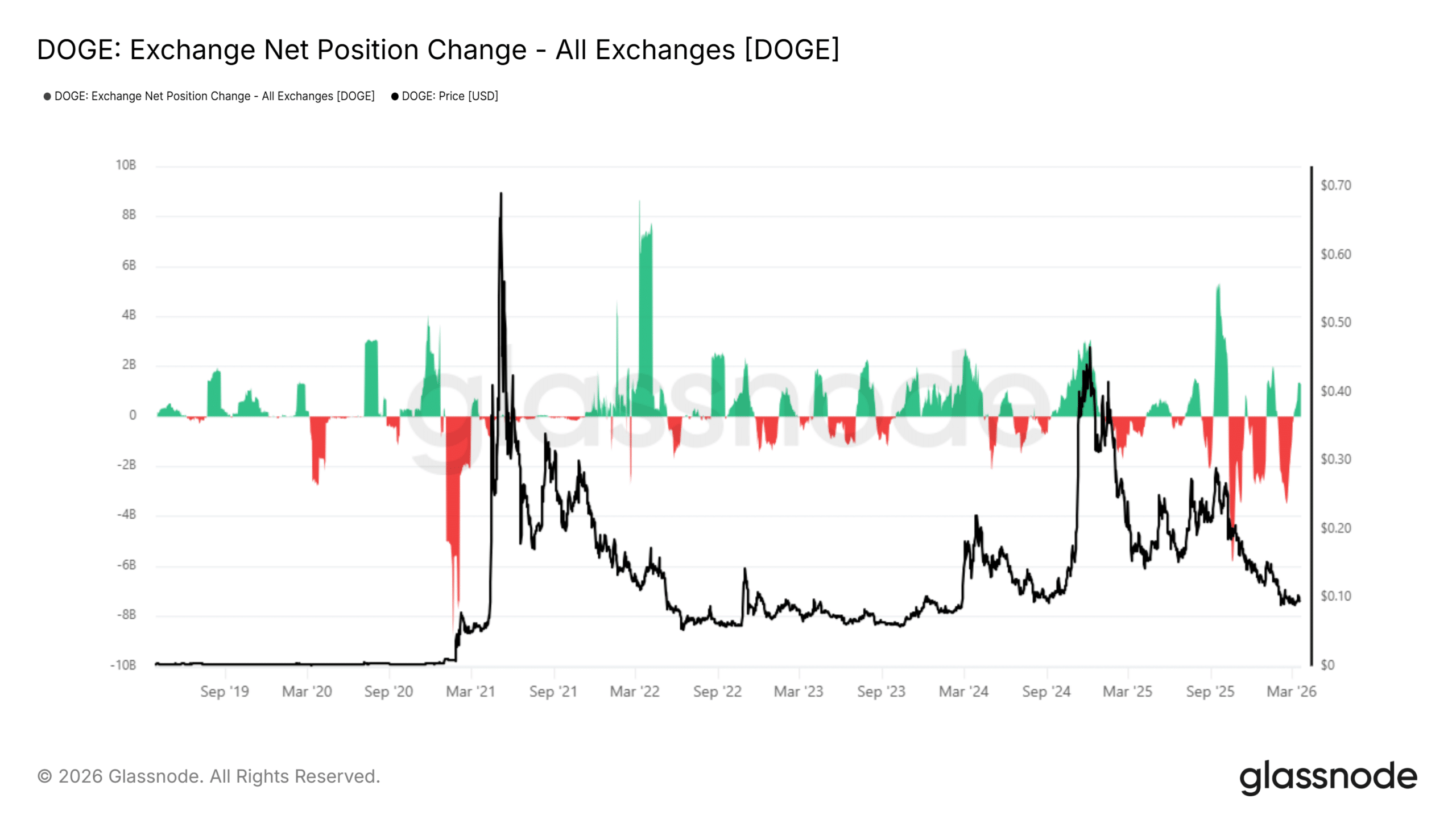
Exchange flows add context to the redistribution narrative. For example – The Net Position change showed repeated spikes above 4 billion DOGE, reflecting strong inflows into exchanges during key periods.
Source: Glassnode

As these inflows rise, the price often stalls or declines, reinforcing sell-side pressure. More recently, persistent negative flows hinted at intermittent outflows – Indicative of periods of absorption or accumulation.

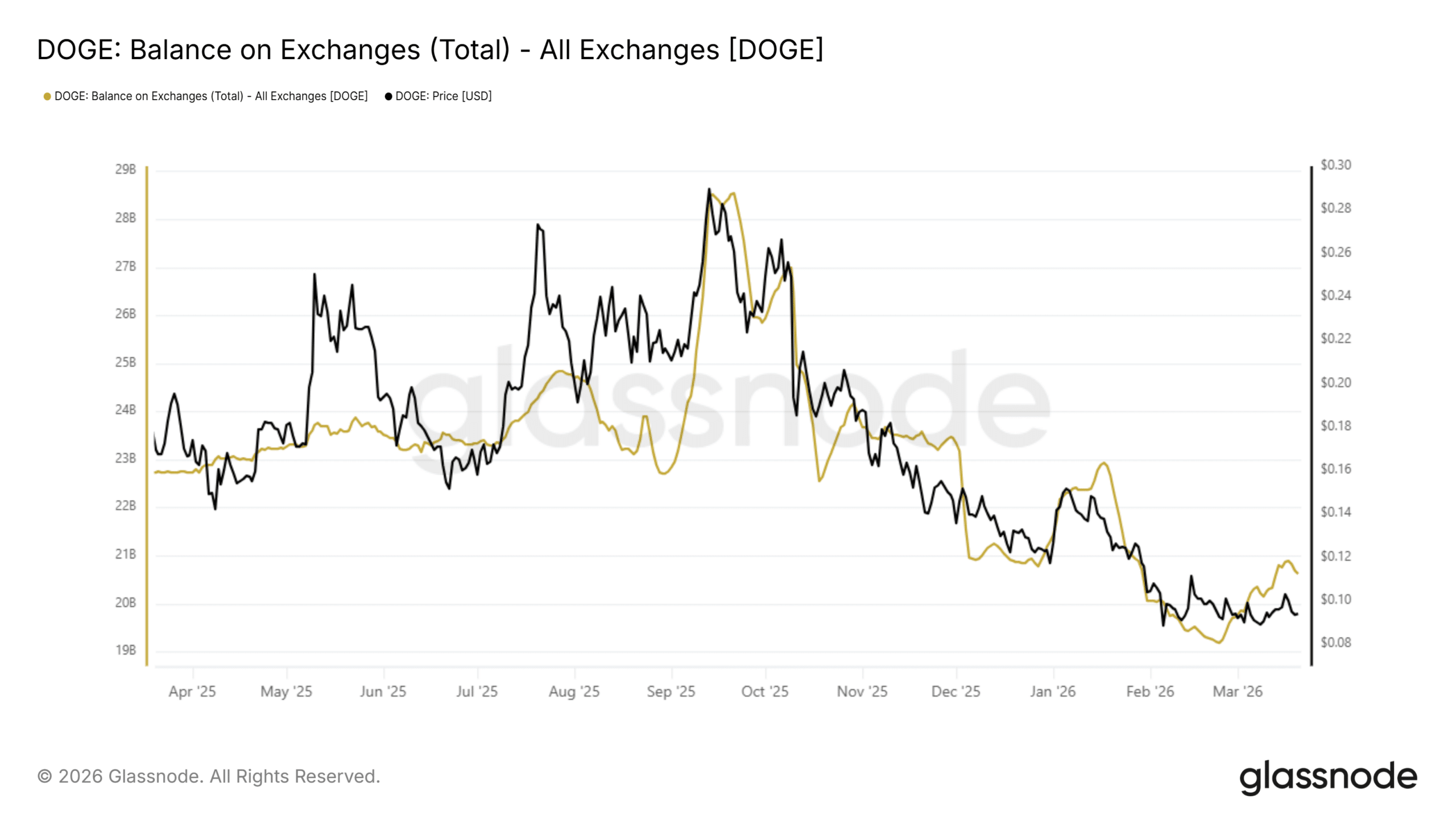
At the same time, total Exchange Balances declined from nearly 29 billion DOGE in late 2025 to around 20 billion DOGE at press time – Marking a roughly 30% drop. This reduction could allude to supply moving off exchanges, which can support price over time.
Source: Glassnode

However, intermittent inflow spikes have still introduced some overhead pressure. This is likely to keep DOGE range-bound as opposing forces balance market direction.


Final Summary

  • Dogecoin’s [DOGE] on-chain volume of 1.037 billion DOGE with the price near $0.094 reflected whale-led redistribution into exchanges.
  • Exchange inflows above 4 billion DOGE, alongside a 30% drop in balances, revealed ongoing absorption, despite intermittent sell pressure keeping price compressed.


相關問答

QWhat was the key divergence observed in Dogecoin's on-chain activity and price action?

ADogecoin's on-chain transfer volume climbed sharply to 1.037 billion DOGE, yet the price remained muted, holding near $0.094 with minimal gains of only 0.3%, establishing a clear imbalance between network flow and valuation.

QAccording to the article, what does the high transaction volume more likely signify rather than accumulation?

AThe high volume is more likely a sign of redistribution, exchange routing, or internal wallet movements, rather than genuine demand or sustained buying pressure from accumulation.

QHow did whale flows contribute to the unresponsive price of Dogecoin?

AWhale transfers above $90 million moved into Bitget-linked wallets, signaling distribution into available liquidity. This increased immediate sell pressure on exchanges, which absorbed incoming demand instead of pushing the price higher.

QWhat does the 30% drop in total exchange balances from late 2025 to the time of the article suggest?

AThe decline from nearly 29 billion DOGE to around 20 billion DOGE suggests that supply is moving off exchanges, which can be a supportive factor for the price over time, indicating periods of absorption.

QWhat are the two opposing forces that the article suggests are keeping DOGE's price range-bound?

AThe two opposing forces are intermittent inflow spikes that introduce overhead sell pressure and the reduction of supply on exchanges from absorption, which balance market direction and keep the price compressed.

你可能也喜歡

越涨越危险?SpaceX估值狂飙背后的系统性风险

本文就SpaceX市值在盘后交易中突破3万亿美元、超越亚马逊和微软的现象,提出一个核心关切:当前资本市场机制可能已从“价格发现”异化为“制造价格”的自我强化投机机器,并埋下系统性风险。 文章指出,推动SpaceX估值狂飙的主要力量并非其基本面(公司仍处亏损),而是市场结构因素:包括有限的流通盘、即将开始的期权交易(可能引发类似特斯拉过去的“gamma squeeze”逼空循环)、做市商对冲行为、动量资金追逐以及被动资金配置。这种机制使得价格上涨本身成为看涨理由,估值与经济现实脱钩。 作者担忧,若这种趋势持续,SpaceX市值膨胀到5万亿甚至10万亿美元,它将因其巨大规模被强制纳入各类主要指数和被动投资组合(如ETF、养老金)。届时,其估值波动将直接影响整个市场表现,使单一公司的投机性泡沫转化为广泛的系统性风险——当所有人都无法避开它时,即便一次温和回调也可能冲击无数普通投资者的长期资产。 因此,本文的讨论超越了SpaceX是否值这个价钱,而是警示现代金融市场存在的结构性悖论:当叙事、杠杆和流动性能够压倒基本面时,市场是否已丧失其资本配置与价格发现的根本功能?SpaceX只是一个极端案例,但它折射的问题可能更为普遍和危险。

marsbit5 分鐘前

越涨越危险?SpaceX估值狂飙背后的系统性风险

marsbit5 分鐘前

你交给Claude的订阅费,光模块公司能拿到多少?

一张将Claude Pro约20美元月费拆解给模型公司、云算力、GPU折旧、电力及供应链的估算图,引发了投资者对AI应用估值逻辑的重新审视。 核心问题在于:用户为AI应用支付的订阅费,有多少能像传统SaaS(软件即服务)那样沉淀为高软件毛利?传统SaaS新增用户成本极低,毛利率可达70%-80%。而AI应用不同,用户每一次调用模型(推理)都会消耗GPU算力、电力和云资源,导致边际成本显著。固定月费背后是随使用量波动的成本链,重度用户的成本可能急剧上升。 因此,AI应用公司要获得高估值,不仅需证明用户付费意愿,更需证明在考虑使用量后,其毛利率能持续改善并接近传统软件公司。当前阶段,AI使用量的增长更直接地转化为对底层基础设施(如英伟达GPU、台积电芯片、HBM内存、电力及数据中心)的需求,这使得基础设施供应商的业绩和估值更早、更确定地得到验证。 支持AI应用高毛利前景的观点认为,当前推理成本高是早期现象。通过模型优化、缓存技术、使用小模型、自研芯片以及提高集群利用率,单位成本有望快速下降。行业已有案例显示,部分模型的单位成本大幅降低。 然而,挑战在于,AI应用正从简单问答转向更复杂、耗能更高的任务(如代码生成、长文档处理)。关键在于,推理成本下降的速度能否超越用户使用量和任务复杂度的增长速度。 总之,该分析图的价值在于提醒市场:在AI应用公司缺乏透明毛利率数据的情况下,不应简单将其收入等同于高毛利SaaS收入。投资者需要关注其成本结构、用户使用行为分层以及效率提升的实际证据。模型公司最终需要证明,即使在重度使用下,订阅收入也能转化为可观的利润。

marsbit15 分鐘前

你交给Claude的订阅费,光模块公司能拿到多少?

marsbit15 分鐘前

OpenAI的Hyperliquid盘前定价生意,为何只撑了半年?

文章讨论了在Hyperliquid平台上两家从事“盘前定价”业务的团队:Trade.xyz和Ventuals的不同命运。 Trade.xyz团队匿名,却成为平台上最大的盘前合约市场,成功抓住了SpaceX上市前的交易机会。其策略聪明之处在于,选择像SpaceX这样上市日期和发行价都已确定的标的,最终价格能与现实市场“锚定”,风险相对可控。 而获得顶级风投Paradigm支持的Ventuals,手握OpenAI和Anthropic这类更稀缺但无明确上市计划的标的,反而在运营九个月后关停。其失败关键在于定价机制存在缺陷:合约价格一半依赖外部非公开的老股报价,另一半则参考其自身价格的均线,形成了一个自我强化的循环。这导致价格长期虚高,缺乏真实市场流动性的支撑和纠错,最终失去市场认可。 Ventuals关停时,其定出的OpenAI(1341.80美元)和Anthropic(1618.90美元)的最终价,甚至被部分内部人士作为估值参考,凸显了未上市公司对流动定价的强烈需求,也暴露了这类定价的脆弱性。 文章指出,为未上市明星公司提供实时交易价格正成为一门热门生意,Coinbase等大机构也已入场。但Ventuals的案例表明,这门生意的核心挑战在于,缺乏一个公开、有效、能持续纠错的市场机制来形成真正公允的价格。在标的公司真正上市前,任何定价都可能面临“悬空”的风险。

marsbit31 分鐘前

OpenAI的Hyperliquid盘前定价生意,为何只撑了半年?

marsbit31 分鐘前

日活冲到行业第二的3-4倍,腾讯WorkBuddy撕开了办公Agent的哪条裂缝?

2026年上半年,腾讯推出的办公智能体(Agent)产品WorkBuddy日活跃用户已达行业第二名产品的3到4倍,其高速增长的核心在于成功吸引了大量非技术岗位用户(如HR、运营、行政)。这与OpenAI同期披露的Codex趋势相似(非开发者增速是开发者的3倍以上),但二者路径截然不同。 WorkBuddy并非预设产品,其前身是代码助手CodeBuddy。转折点在于腾讯内部非技术员工自发用它处理研究、报告等非编码任务。团队洞察到“产物才是目的”,于2026年1月快速推出极简版WorkBuddy,公测前已有超2000名内部非技术员工每日使用。 其成功源于三个关键设计决策: 1. **用自然语言替代技术概念**:用户无需理解Agent、prompt等术语,直接以日常语言下达任务。 2. **预封装场景模板**:内置超20种Skills技能包(如数据处理、竞品调研),开箱即用,无需自建流程。 3. **深度原生集成生态**:深度“住进”腾讯文档、微信等国内高频办公软件,成为现有工作流的一部分,而非独立工具。 这些设计拆除了认知、场景和环境三重门槛。相比之下,Codex和Claude Code从命令行/IDE出发,面向开发者,非技术用户需跨越安装、配置和理解交互逻辑的障碍。尽管OpenAI和Anthropic已开始推出角色插件或简化界面(如Claude Cowork)向非技术用户转向,但交互范式和生态集成的重构需要时间,这为WorkBuddy创造了约半年的领先窗口。 数据显示,WorkBuddy在2026年3月公测后增速迅猛(环比达831%),PC端月访问量领先第二名2.6倍。其定价(个人版起价39元/月)也低于海外同类产品(20美元/月起),在国内市场触及面更广。 WorkBuddy代表“场景封装”路线,追求用户使用路径最短;海外产品则侧重“底层能力”,追求功能最强。当前,WorkBuddy已发布企业版以巩固优势,但面对海外巨头在底层模型能力和快速追赶,其先发优势将面临长期考验。核心差异在于:用户无需懂技术,只需知道自己要什么。

marsbit40 分鐘前

日活冲到行业第二的3-4倍,腾讯WorkBuddy撕开了办公Agent的哪条裂缝?

marsbit40 分鐘前

交易

現貨
合約
活动图片




