Ethereum is about to complete the Merge soon. How much do you know about the Merge? Welcome to read this article and participate in the Q&A to share the 1000U reward.
1
Participate directly in the quiz
1
The Status Quo and Historical of the Ethereum Merge
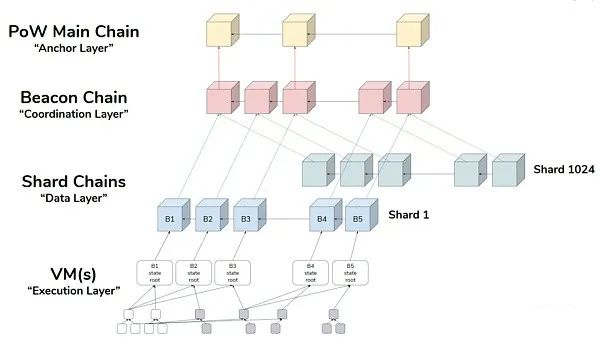
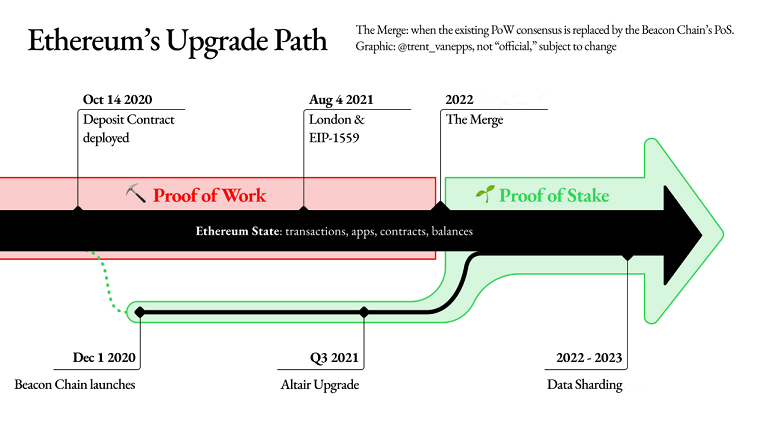
The PoS Beacon Chain, previously widely known as Phase0 of Ethereum 2.0 , went live in December 2020 to manage coordinated scaling of sharding and PoS network staking, and Ethereum users can stake their ETH in smart contracts to help protect Ethereum. By August 2022, the total number of ETH staked on the beacon chain exceeds 13 million, and the number of validators exceeds 400,000.
The Ethereum Foundation also announced in January 2022 that it would rename “ETH 2” as the “Consensus Layer.” After the Merge, the beacon chain will serve as the consensus layer network for Ethereum, and the merge of the beacon chain [consensus layer] and the main network [execution layer] will complete the transition of the consensus mechanism from PoW to PoS.
Previously, the merge of public testnet Kiln was launched in March 2022, and the successful transited to the PoS consensus mechanism. After its success, the Ethereum testnet Ropsten and Sepolia successfully merged, and the latest merge was testnet Goerli and completed on August 11.
Why adapt PoS?
PoS will greatly reduce the energy consumption and carbon emissions of Ethereum, and is expected to reduce the energy consumption of Ethereum by more than 95%. At the same time, PoS will also provide higher security for the network. As Vitalik Buterin explained in his article:
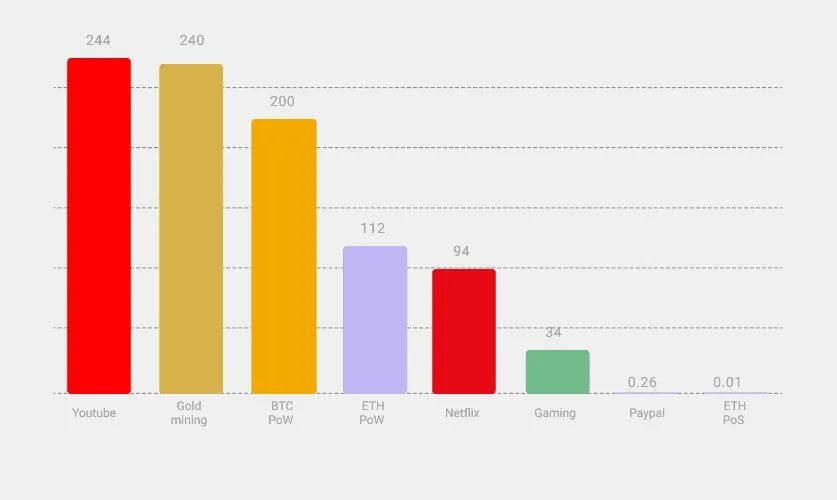
Estimated annual energy consumption (TWh/yr)
The cost of attacking the network in PoW is simply the cost of renting enough computing power to overtake existing miners, and it only takes a small amount of cost and time to attack. In Proof of Stake, however, it is almost entirely the cost of capital, the cost of running a node. As the staking rate increases, the attack cost is expected to be extremely high.
In a PoW network, if a 51% attack occurs, the only response is to "wait until the attacker actively withdraws the attack". Things are much better with PoS, and for certain types of 51% attacks (especially rolling back finalized blocks), there is a built-in penalty mechanism in Proof-of-Stake, by which most of the attacker's stake (and excluding others) will be automatically destroyed.
This merger and upgrade is also in preparation for the subsequent launch of the shard chain. The verifiers of the shard chain will be randomly assigned by the beacon chain. It is difficult for the verifiers on a shard chain to conspire to do evil. According to the Ethereum team, the possibility of doing evil is less than one in a trillion, and the security of the shard chain can be improved. Assure.
What is the Ethereum Merge?
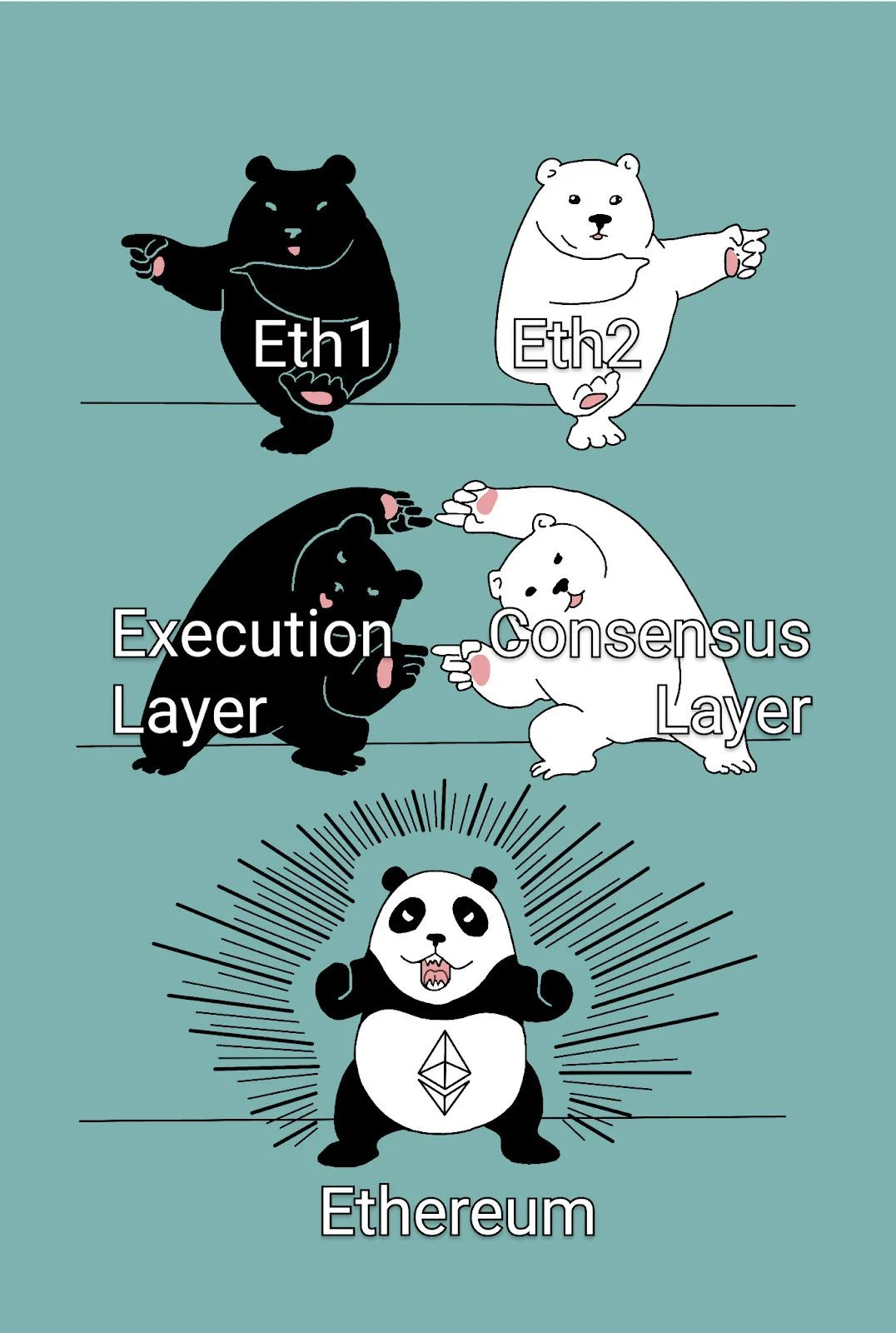
Before the merger, Ethereum actually had "two chains": the current Ethereum mainnet (Eth1) and the beacon chain (Eth2). The two chains currently operate independently and separately from each other. The current Ethereum mainnet (Eth1) continues to be protected by the PoW consensus mechanism, the beacon chain (Eth2) uses the PoS consensus mechanism to run in parallel, and merging The Merge is the ultimate fusion of these two systems. When ready, the Ethereum mainnet will be "merged" with the beacon chain, and the mainnet will bring the ability to run smart contracts along with the full history and current state into the PoS system.
1
Participate directly in the quiz
1
Merged Ethereum = Execution Layer (Eth1) + Consensus Layer (Eth2)
Eth1 → Execution layer: responsible for processing transactions and data [current PoW Ethereum main network]
Eth2 → consensus layer: responsible for handling PoS consensus [current PoS beacon chain]
The impact of Ethereum mergers on ETH supply
Before the merger, daily additional issuance ~ 13,000 ETH / day
After the merger, it will be issued every day ~ 1,600 ETH / day
Supply reduced by 90% (4.62% → 0.5%)
Before and after the merger, the principle of daily burning ETH based on EIP1559 remains unchanged, depending on the level of activity on the chain
Common Misconceptions about Ethereum Mergers
Myth 1: Once the merger is complete, the ETH staked in the beacon chain can be retrieved.
Actual situation: The merger will not initiate mortgage withdrawals, and withdrawals will be initiated in the Shanghai upgrade after the merger.
Myth 2: Validators will not receive any "liquid" ETH rewards until withdrawals are enabled in the Shanghai upgrade.
Actual situation: The combined MEV withdrawal/transaction fee income can be directly credited to the mainnet account provided by the validator and is immediately available.
Myth 3: After enabling withdrawals, stakers can withdraw immediately.
Reality: By design for security reasons, the rate at which validators exit will be limited (linear exits that need to be queued).
Myth 4: After the merger, the APY of staking is expected to increase by 3x (12%).
Actual situation: In addition to staking rewards, there will be transaction fee rewards after the merger. Based on estimates of recent network activity levels, the combined APR is estimated to be around 7%.
Misunderstanding 5: Combining wells will reduce the gas fee.
Actual situation: The merger is actually a change in the consensus mechanism, and will not expand the network capacity, nor will it significantly reduce the gas fee.
Myth 6: Trading will speed up significantly after combining wells.
Actual situation: The fast delivery time has become more stable, but the change table is small, which is basically not much different from the current transaction speed.
Myth 7: Running a node requires at least 32 ETH to be staked.
Actual situation: Anyone can run a node, and nodes that do not pledge 32ETH can also participate in network synchronization, but they cannot withdraw block rewards.
Myth 8: Ethereum will go down during the merge process.
Actual situation: Hejing upgrade is to complete the transition of POS without downtime.
1
Participate directly in the quiz
1
Ethereum Merger Could Create Hard Fork
At present, the Ethereum ecosystem has formed a certain scale, and its fork will involve thousands of Dapps and protocols, as well as tens of billions of dollars in basic assets on the chain, so this fork will be the choice of the entire ecosystem, and its complexity will be far More than any previous fork.
For example, after the upgrade of Ethereum, a blockchain ETH-PoW with a PoW mechanism is forked, then the Dapps and protocols in the Ethereum ecosystem need to make choices, and different Dapps and protocols are interrelated and nested. At the same time, DeFi has become the infrastructure of the entire Web3 world. Most on-chain activities will ultimately rely on DeFi protocols such as transactions and lending. Therefore, the choice of DeFi protocols will also have a significant impact on applications in other fields.
Judging from the development history of the Ethereum Classic network, after losing the spiritual leader of Vitalik and the support of the Ethereum core developer community, its ecology has been stagnant. If miners fork the ETH-PoW chain after the Ethereum upgrade, it will be a question how far the ETH-PoW chain can go without the support of Vitalik and other core Ethereum developers.
For example, if you want to receive the forked coins generated by the merger of Ethereum, you need to deposit ETH in an exchange or wallet that supports fork in advance, such as Huobi.
What about the PoW miners?
After the merger, all PoW miners’ equipment and infrastructure will be idled, and in anticipation of the merger, the resale price of GPUs has dropped by half compared to the beginning of the year. If these machines want to continue functioning within the crypto ecosystem, a possible candidate is Ethereum Classic. But Ethereum Classic’s daily fees are orders of magnitude smaller than Ethereum’s. Furthermore, if miners use GPU power heavily, especially if prices do not rise, the profitability of mining these networks will inevitably decline. Therefore, it is possible for miners to try to keep the PoW fork after the merger. Some miners have already gained support for the ETHPoW fork.
Three Key Steps to Ethereum Merger
Step 1: Beacon Chain [Consensus Layer] Bellatrix Upgrade
[Time] September 6, 11:34 UTC (Epoch 144896)
[Upgrade content] The final preparation for the consensus layer to be merged is to issue an order to the consensus layer client:
①Please do not store the transaction data of the [execution layer] before reaching the TTD;
②After you arrive at TTD, the block structure starts to include transaction data of [Execution Layer];
This upgrade has no direct impact on the current PoW mainnet.
Step 2: Ethereum reaches the scheduled TTD
[Time] According to the current computing power, it is expected to be September 15.
[What is TTD] The total difficulty is the sum of the Ethash mining difficulties of all blocks before a certain point in the blockchain; the total difficulty value at the end point is a specific value used as a time stamp.
Currently set TTD = 58750000000000000000000 (19 zeros)
[Why use TTD as the upgrade time] can effectively avoid fork interference and malicious interference.
After reaching the TTD, the third step will be triggered.
Step 3: PoW main network [execution layer] Paris upgrade
[Time] is the time to arrive at the scheduled TTD, around September 15th.
[Upgrade content] EIP-3675 and EIP-4399.
EIP-3675 removes the dependency on PoW mining alorithm ethash and moves to the new standard chain [consensus layer].
EIP-4399 changes how on-chain randomness is generated.
Simply put, when the Paris upgrade is completed, Ethereum will officially transition to the PoS era.
Ethereum's follow-up development roadmap
The merger is only the beginning of a comprehensive upgrade of Ethereum. Vitalik also introduced the future development roadmap of Ethereum when he attended the Ethereum Community Conference (ETHCC).
The Merge: Implementation will make ETH a deflationary asset and reduce energy consumption by 99%.
The Surge: It is expected to launch in 2023 after the merger is fully realized, introducing sharding on Ethereum, which will significantly improve the scalability of the network.
The Verge: Introducing Verkle trees to optimize storage on Ethereum and help reduce node size, which in turn helps ETH improve scalability.
The Purge: Reduces the hard drive space required for validators. Eliminate historical data and bad debts. Reduce network congestion through storage simplification.
The Splurge: Make sure the network runs smoothly after the first 4 stages.
Vitalik also said that the five Merge, Surge, Verge, Purge and Splurge were not in stages, but occurred and progressed simultaneously. When this roadmap is fully realized, Ethereum will be a more scalable system capable of processing 100,000 transactions per second.
1