Why Chainlink’s $32.6M whale move could shape LINK’s push toward $9

ambcrypto發佈於 2026-07-20更新於 2026-07-20

文章摘要

A transfer of 3.89 million Chainlink (LINK) tokens worth $32.58 million from a Coinbase Institutional wallet to an unknown address drew significant attention, sparking speculation about strategic accumulation by large holders. This coincided with Chainlink's spot exchange netflows turning positive after a prolonged period of outflows, indicating a slight increase in tokens moving to exchanges. However, the overall selling pressure remained limited. Despite improving spot market activity and a price recovery to around $8.35, derivatives data revealed persistent bearish sentiment among futures traders, creating uncertainty. Technically, LINK faces resistance near $8.35. A successful break above this level could target $9, while a rejection might lead to a retest of support near $8.18. The article concludes that while institutional activity and spot buying are supportive, cautious futures positioning continues to challenge the recovery.

A transfer involving 3.89 million Chainlink [LINK] worth $32.58 million drew fresh attention to Chainlink after Whale Alert flagged the transaction. The tokens moved from a Coinbase Institutional wallet to an unknown wallet, encouraging speculation about strategic positioning among large holders rather than immediate exchange selling.

Such transfers often reflect changes in custody or portfolio management rather than outright distribution. However, the movement still highlighted growing institutional participation around LINK.

Large transactions frequently influence market sentiment because traders monitor them for signs of accumulation or distribution. As a result, the transfer placed Chainlink back on investors’ watchlists while the market assessed whether whale activity would support the ongoing recovery.

Exchange inflows returned after months of out flows

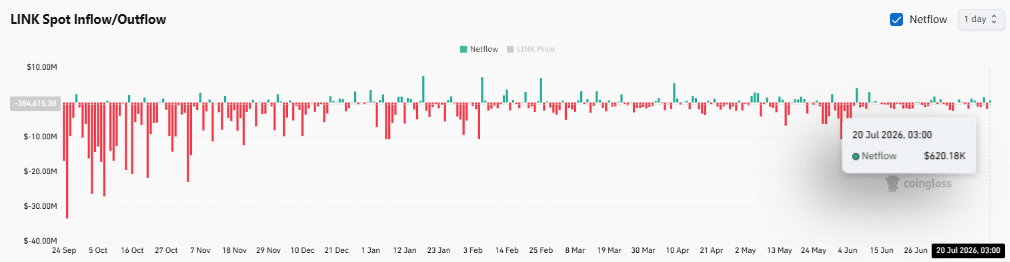
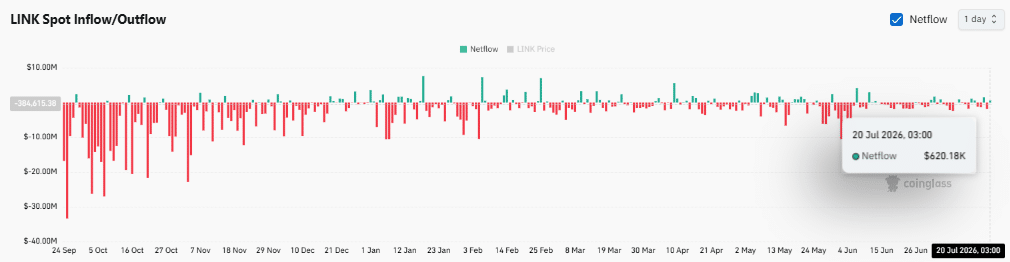
Chainlink’s spot netflows shifted into positive territory after recording an inflow of approximately $620.18K.

The change marked a notable departure from the prolonged period of exchange outflows that had previously reduced available selling supply. Positive netflows indicate that more tokens reached exchanges than left them during the latest session.

However, the relatively modest inflow suggested that exchange-bound supply remained limited instead of overwhelming the market. Even so, the latest reading reflected a change in short-term market behavior, making exchange activity an important metric for assessing LINK’s next directional move.
Source: CoinGlass

Can bearish futures sentiment derail LINK’s recovery?

Derivatives traders maintained a cautious stance despite improving activity in the spot market.

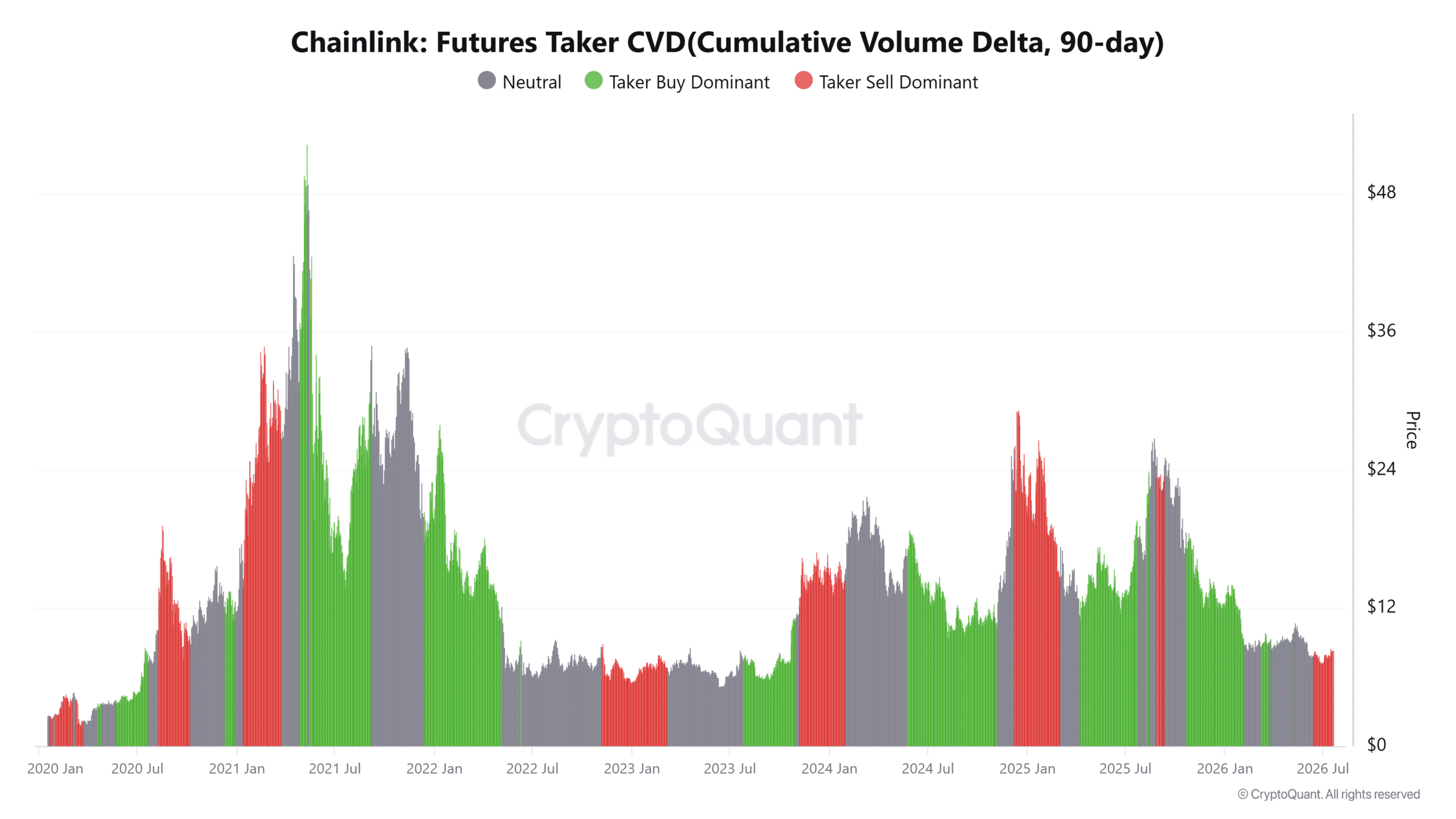
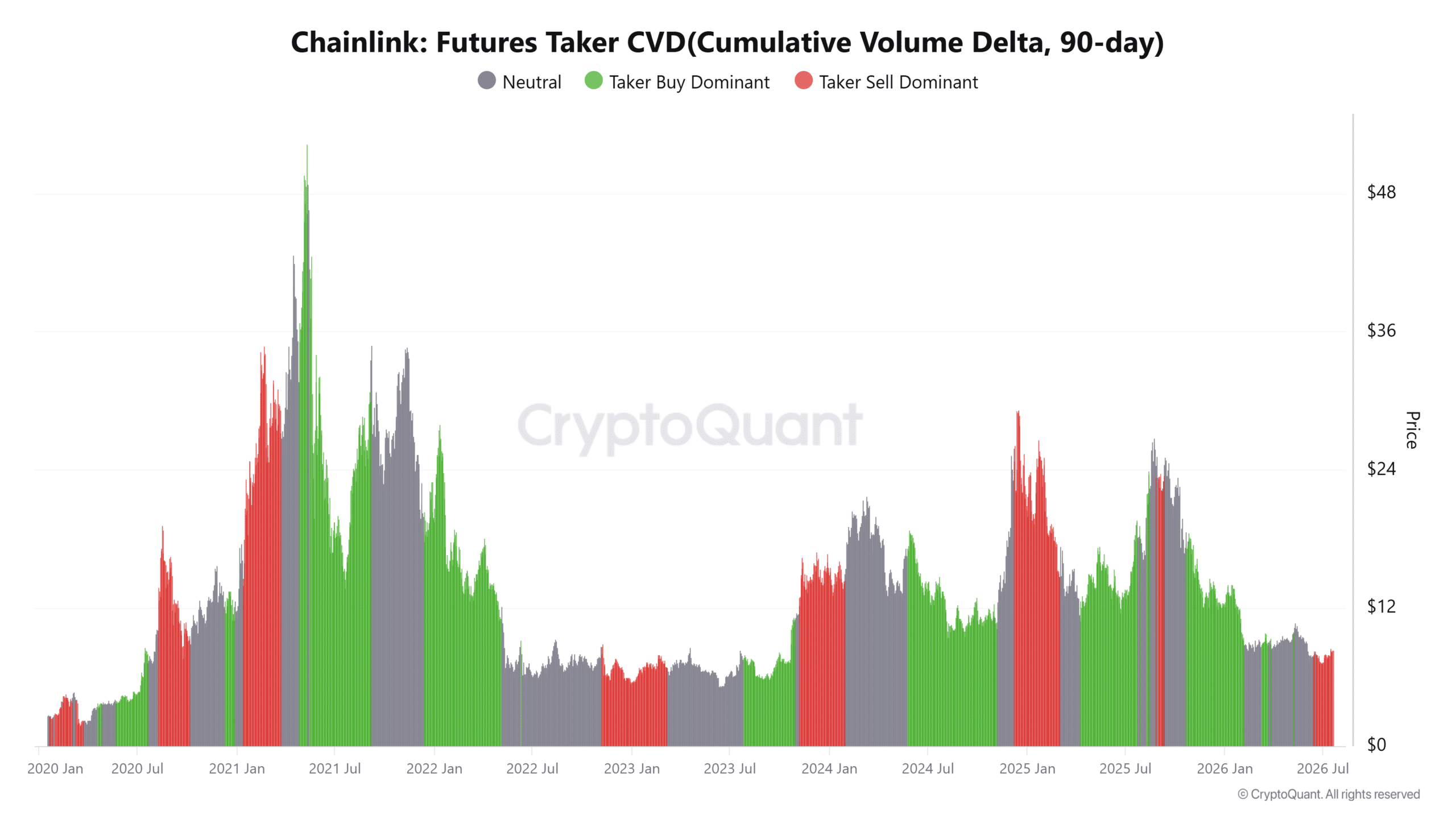
At press time, the 90-day Futures Taker CVD remained seller-dominant, indicating that aggressive market participants continued executing more sell orders than buy orders.

This imbalance suggested bearish conviction persisted among leveraged traders even as institutional wallet activity attracted attention. However, the divergence between spot positioning and futures activity created uncertainty around LINK’s short-term outlook.

Spot participants appeared willing to absorb supply, while futures traders continued favoring downside exposure. Such contrasting behavior often preceded stronger volatility because either buyers eventually overwhelmed sellers or derivatives sentiment pulled prices lower.
Source: CryptoQuant

Chainlink tests resistance as RSI continues improving

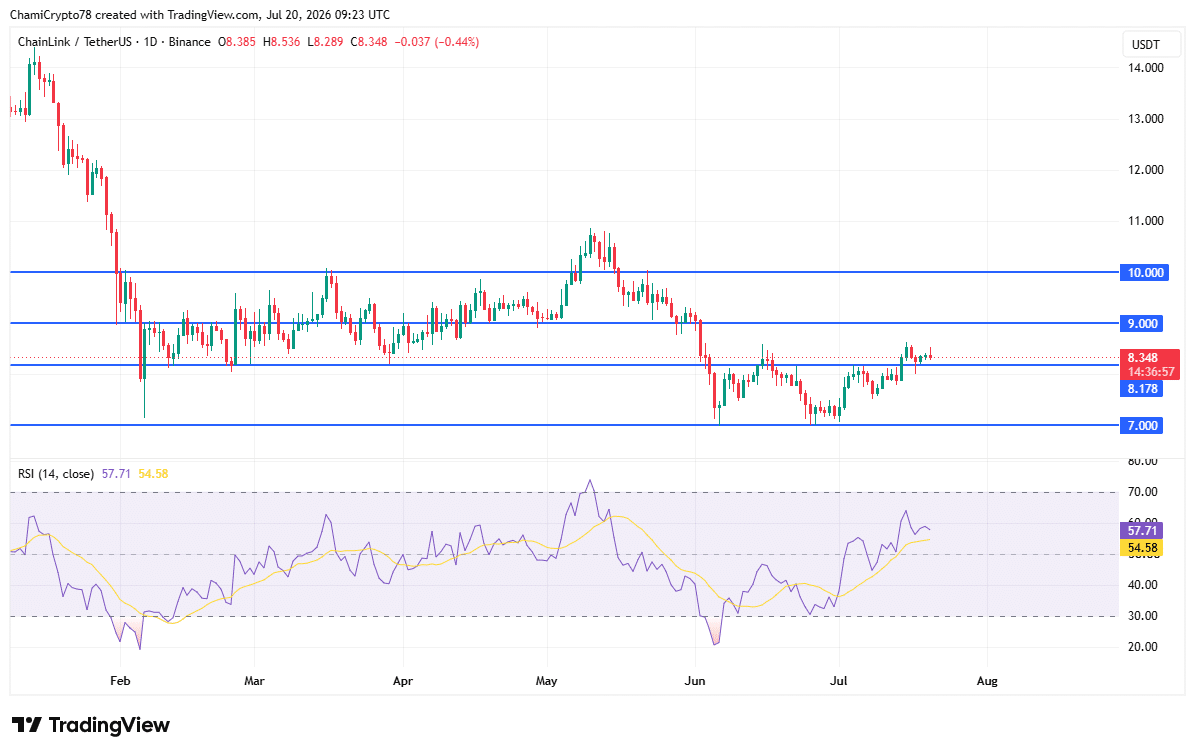
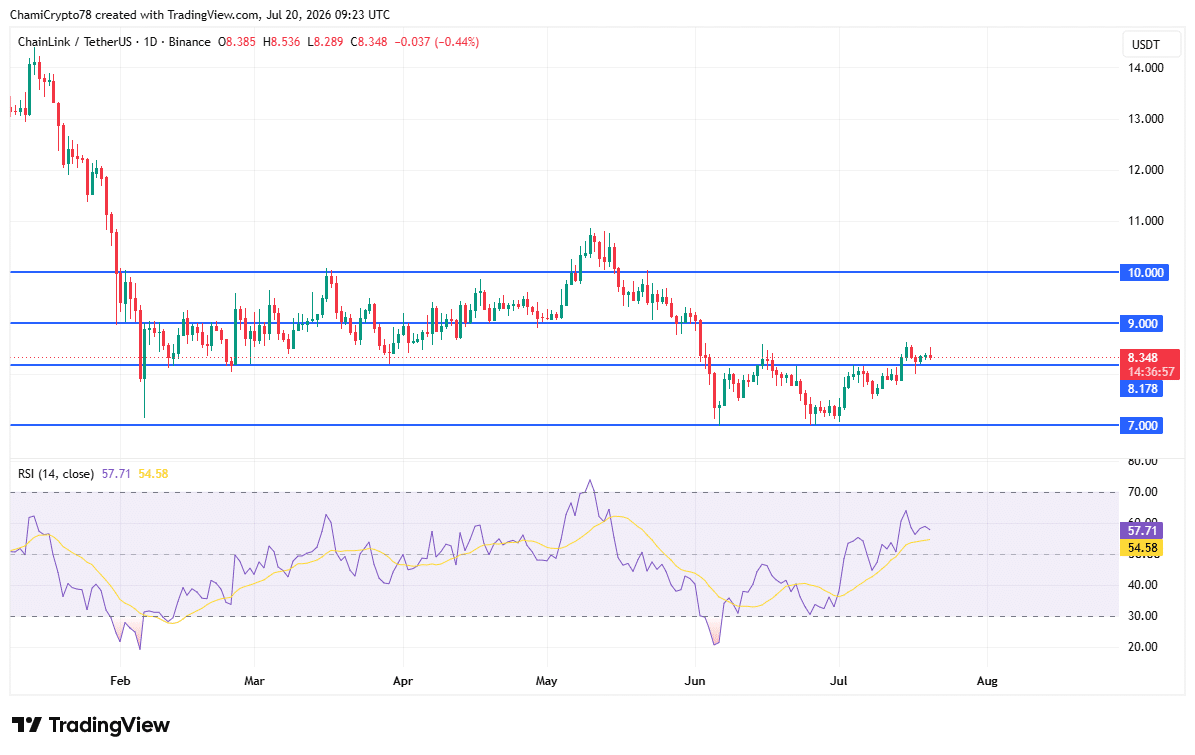
At the time of press, Chainlink [LINK] traded around $8.35 after extending its recovery from the $7.00 support region.

Buyers reclaimed the $8.18 level and pushed the price toward immediate resistance near $8.35, although that area continued limiting further advances.

A successful break above this zone would likely expose $9.00, while sustained buying could later bring $10.00 into focus. However, rejection at current levels could encourage another retest of $8.18 before buyers attempted another advance.

Meanwhile, the Relative Strength Index (RSI) climbed to 57.71 as of writing, remaining above its Moving Average near 54.58. The indicator reflected strengthening buying pressure without entering overbought territory.

As a result, the technical structure favored continued recovery, provided buyers reclaim nearby resistance with stronger participation.
Source: TradingView

To conclude, institutional wallet activity increased attention around Chainlink, while spot netflows shifted back into positive territory. However, seller-dominant futures positioning continued to signal caution.

If buyers clear the $8.35 resistance, LINK would likely challenge $9.00 next. Otherwise, another pullback toward $8.18 would remain the more likely short-term outcome.


Final Summary

  • Institutional wallet activity increased, while positive netflows reflected more LINK returning to exchanges.
  • LINK approached a key resistance, but bearish futures traders continued limiting the recovery.

熱門幣種推薦

相關問答

QWhat was the significance of the $32.58 million Chainlink (LINK) transfer flagged by Whale Alert?

AThe transfer of 3.89 million LINK from a Coinbase Institutional wallet to an unknown wallet drew attention to growing institutional participation. It encouraged speculation about strategic positioning by large holders rather than immediate selling pressure, influencing market sentiment.

QHow did Chainlink's spot netflows change according to the article, and what does it indicate?

AChainlink's spot netflows shifted into positive territory with an inflow of approximately $620.18K. This marked a departure from a prolonged period of outflows. While positive netflows indicate more tokens reached exchanges than left them, the modest size suggests the supply increase was limited and not overwhelming the market.

QWhat does the seller-dominant 90-day Futures Taker CVD indicate about market sentiment?

AThe seller-dominant 90-day Futures Taker CVD indicates that aggressive leveraged traders executed more sell orders than buy orders. This shows bearish conviction persisted among futures traders, creating uncertainty and contrasting with more positive spot market activity.

QWhat key price levels are discussed for Chainlink (LINK) in the technical analysis?

ALINK was trading around $8.35, having reclaimed the $8.18 support. Immediate resistance was near $8.35. A break above this zone could expose $9.00 and later $10.00. A rejection could lead to a retest of $8.18.

QWhat was the state of the Relative Strength Index (RSI) for LINK, and what does it suggest?

AThe RSI climbed to 57.71, remaining above its Moving Average at 54.58. This indicates strengthening buying pressure without the asset entering overbought territory, which favored a continued recovery provided buyers can overcome nearby resistance with stronger participation.

你可能也喜歡

Gate 研究院:加密金融产品掀起“华尔街化”浪潮,是竞争还是融合?

2009年比特币的创世区块暗含对传统金融体系的批判,其理想是建立去中心化、去中介、去银行的点对点金融系统。然而十七年后,比特币现货ETF获批、贝莱德等巨头发行相关产品、CME推出受监管衍生品、RWA(真实世界资产)和代币化国债市场快速增长等现象,显示传统金融正系统性地介入加密资产的发行、定价、托管和分销环节,引发了加密市场是否“华尔街化”的讨论。 文章认为,这并非单方面的吞并,而是加密体系与传统金融的双向融合与互补。加密领域提供无许可开放性、24小时交易和可编程结算,但缺乏合规通道、机构级托管和主流分销网络;传统金融则拥有牌照、信任、资金和渠道,但受限于交易时间、跨境门槛和结算效率。双方正朝彼此的核心优势靠拢。 这种融合体现为两条路径:一是以Gate为代表的加密交易所,逐步从提供代币化美股、CFD差价合约,发展到接入真实股票、港股、韩股交易,成为连接加密账户与传统券商基础设施的前端入口;二是以Robinhood为代表的传统券商,通过收购加密交易所、推出股票代币和建设自有Layer 2,将加密资产和链上代币化产品整合进其平台。两者的共同目标是争夺下一代综合金融账户的入口,让用户在一个界面内交易多种资产。 同时,RWA和链上国债作为资产层的融合正在加速。尽管规模尚小,但代币化国债等产品为链上提供了低波动收益资产,并吸引JP摩根、贝莱德等传统机构参与,测试未来资本市场的底层结算方式。 最终,加密与华尔街并非谁征服谁,而是在共同塑造一个更高效、全球化的统一资本市场。用户未来或将在同一个账户中自由交易比特币、股票、ETF、链上国债等多种资产,体验无缝的跨资产配置。去中心化的理想仍在底层协议中延续,而在应用层,一个融合了双方优势的新金融形态正在形成。

marsbit17 分鐘前

Gate 研究院:加密金融产品掀起“华尔街化”浪潮,是竞争还是融合?

marsbit17 分鐘前

给AI喂“噪声”也能涨分,这项工作让噪声实现正迁移

这篇发表于ICML 2026的研究提出了一种名为“半监督噪声自适应(SSNA)”的新方法,其核心思想是:迁移学习中,用于辅助训练的“源数据”可以不是真实的图像或文本,而是**完全没有语义的随机噪声**。 传统迁移学习需要大量有标签的源数据,但在隐私、版权等限制下,真实数据往往难以获得。SSNA框架(NAF)打破了这一限制。研究者为每个目标类别(例如CIFAR-10的10个类)生成一组对应的高斯分布噪声样本,并为每个噪声类预先指定一个目标类别编号(但编号本身无意义)。 NAF通过三个步骤实现“正迁移”: 1. **利用少量真实标签**:使用目标域中极少的标注样本进行基础监督学习,建立噪声与真实类别间的初步联系。 2. **在噪声域构建判别结构**:训练模型将同类噪声聚集、异类噪声分离,形成清晰的类别结构。 3. **跨域对齐**:将噪声域中学习到的类别结构(分布)与目标域的对齐,从而将判别性知识迁移到真实数据上。 实验表明,在每类仅有4个标注样本的极端少样本设定下,NAF相比仅使用标注数据的基线方法(ERM)在多个数据集上取得显著提升(如CIFAR-10提升12.35%)。研究还发现,关键因素在于噪声域中是否形成了**可分离的类别结构**,而非噪声数量多少。当把所有噪声压缩为一点(无结构)时,性能会大幅下降。 这项工作的意义在于,它揭示了迁移学习中可迁移的知识可能不限于数据的“语义内容”,**表征空间的“组织结构”本身也是一种有效的知识**。这为无法获取真实源数据的场景提供了一种低成本、保护隐私的替代方案。

marsbit23 分鐘前

给AI喂“噪声”也能涨分,这项工作让噪声实现正迁移

marsbit23 分鐘前

交易

現貨

熱門文章

如何購買MOVE

歡迎來到HTX.com!在這裡,購買Movement (MOVE)變得簡單而便捷。跟隨我們的逐步指南,放心開始您的加密貨幣之旅。第一步:創建您的HTX帳戶使用您的 Email、手機號碼在HTX註冊一個免費帳戶。體驗無憂的註冊過程並解鎖所有平台功能。立即註冊第二步:前往買幣頁面,選擇您的支付方式信用卡/金融卡購買:使用您的Visa或Mastercard即時購買Movement (MOVE)。餘額購買:使用您HTX帳戶餘額中的資金進行無縫交易。第三方購買:探索諸如Google Pay或Apple Pay等流行支付方式以增加便利性。C2C購買:在HTX平台上直接與其他用戶交易。HTX 場外交易 (OTC) 購買:為大量交易者提供個性化服務和競爭性匯率。第三步:存儲您的Movement (MOVE)購買Movement (MOVE)後,將其存儲在您的HTX帳戶中。您也可以透過區塊鏈轉帳將其發送到其他地址或者用於交易其他加密貨幣。第四步:交易Movement (MOVE)在HTX的現貨市場輕鬆交易Movement (MOVE)。前往您的帳戶,選擇交易對,執行交易,並即時監控。HTX為初學者和經驗豐富的交易者提供了友好的用戶體驗。

750 人學過發佈於 2024.12.13更新於 2026.06.02

如何購買MOVE

相關討論

歡迎來到 HTX 社群。在這裡,您可以了解最新的平台發展動態並獲得專業的市場意見。 以下是用戶對 MOVE (MOVE)幣價的意見。

活动图片